Genomic BLUP and Relationship Matrices: A Comprehensive Guide for Biomedical Researchers
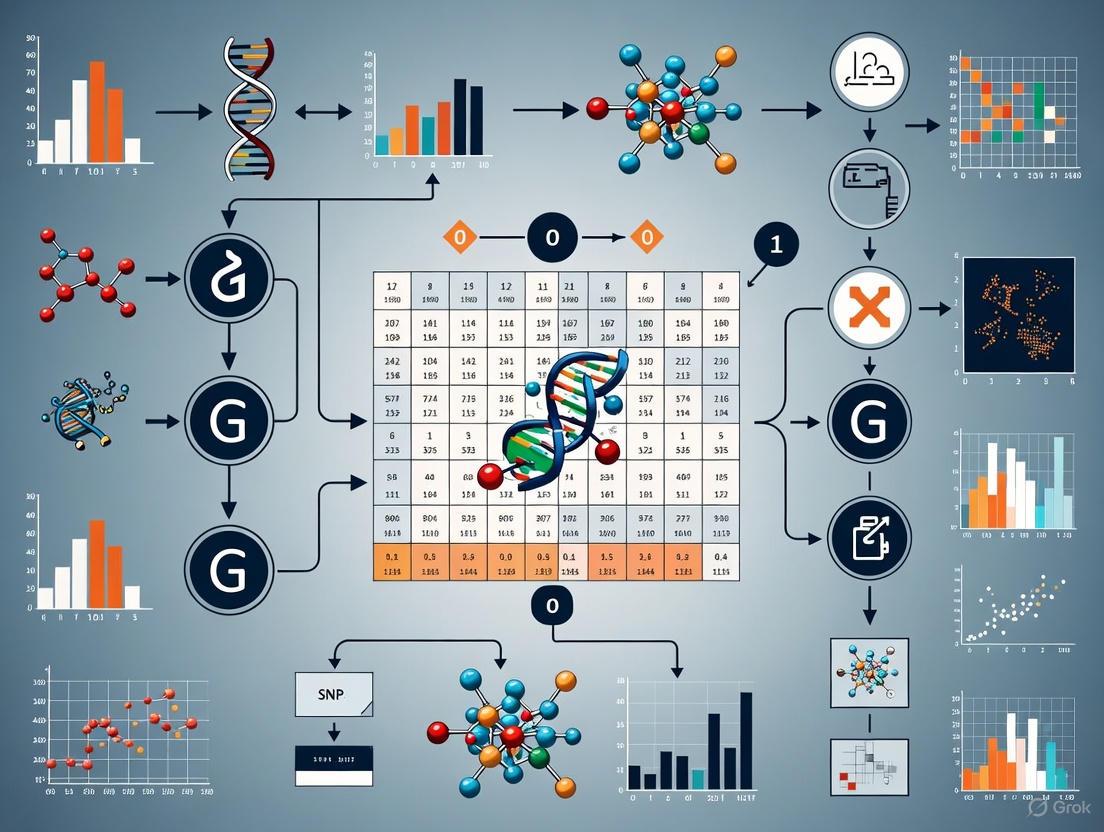
This article provides a comprehensive overview of the implementation of Genomic Best Linear Unbiased Prediction (GBLUP) and genomic relationship matrices (G-matrices) for researchers and drug development professionals.
Genomic BLUP and Relationship Matrices: A Comprehensive Guide for Biomedical Researchers
Abstract
This article provides a comprehensive overview of the implementation of Genomic Best Linear Unbiased Prediction (GBLUP) and genomic relationship matrices (G-matrices) for researchers and drug development professionals. It covers foundational concepts, from the limitations of pedigree-based models to the advantages of marker-based genomic relationships. The guide details practical methodological considerations for G-matrix construction and implementation, including single-step approaches for integrating genotyped and non-genotyped individuals. It further explores advanced optimization strategies, such as weighted matrices and feature selection, to enhance prediction accuracy for complex traits. Finally, the article presents a comparative analysis of GBLUP performance against alternative methods like machine learning, validating its application across diverse species and genetic architectures to inform its potential in human biomedical research and clinical applications.
From Pedigree to Genomics: The Foundational Shift in Genetic Prediction
Limitations of Pedigree-Based Relationship Matrices (A-Matrix) and Shallow Pedigrees
In genetic evaluation and selective breeding, accurately quantifying the genetic relationships between individuals is fundamental for estimating heritability, predicting breeding values, and managing genetic diversity. For decades, the pedigree-based relationship matrix (A-matrix), which calculates the expected proportion of the genome shared between individuals based on known ancestry, has been the cornerstone of these analyses [1]. However, the A-matrix relies on critical assumptions: pedigrees are complete and accurate over many generations, and genes are transmitted from parents to offspring following Mendelian sampling without selection. In practice, these conditions are often violated, especially in species with shallow pedigrees or where tracking parentage is biologically or logistically challenging, such as in forest trees and some livestock populations [2] [1].
These limitations necessitate a shift towards marker-based genomic relationship matrices (G-matrices), which use genome-wide molecular markers to measure the actual proportion of alleles shared between individuals, thereby capturing realized genetic similarities [3] [1]. This application note details the specific drawbacks of the A-matrix, provides experimental evidence of its inadequacies, and outlines protocols for implementing more robust genomic evaluation methods, contextualized within broader research on Genomic Best Linear Unbiased Prediction (G-BLUP).
Key Limitations of the A-Matrix and Shallow Pedigrees
The use of the A-matrix in populations with shallow or incomplete pedigrees introduces significant biases and inaccuracies in genetic parameter estimates. The table below summarizes the core limitations and their consequences.
Table 1: Core Limitations of Pedigree-Based Relationship Matrices (A-Matrix) in Shallow Pedigrees
| Limitation | Description | Impact on Genetic Estimates |
|---|---|---|
| Hidden Relatedness [2] [1] | Undetected familial relationships (e.g., full-sibs, selfing) due to incomplete pedigree tracking (e.g., in open-pollinated designs). | Overestimation of additive genetic variance; breeding values are shrunk toward the population mean, reducing accuracy and leading to inaccurate selection [2]. |
| Ignored Mendelian Sampling [1] | The A-matrix treats all family members (e.g., half-sibs) as having identical relatedness, ignoring variation from the random segregation of alleles. | Inflated breeding values; fails to capture true genetic differences between siblings, lowering prediction accuracy [1]. |
| Incompatibility with Genomic Data [4] | The scale and level of the A-matrix often do not align with the G-matrix, as pedigrees cannot account for changes in allele frequency due to selection or drift. | Biased genomic predictions in single-step evaluations; requires statistical rescaling to harmonize matrices, adding complexity [2] [4]. |
| Inability to Capture Inbreeding [5] | Pedigree-based inbreeding coefficients ((F_{PED})) underestimate actual autozygosity, especially with limited ancestral depth. | Underestimation of realized inbreeding and its detrimental effects (inbreeding depression), risking the long-term health of managed populations [5]. |
| No Resolution of Non-Additive Effects [1] | The A-matrix is typically used to estimate only additive genetic variance, confounding it with non-additive effects (dominance, epistasis). | Overestimation of narrow-sense heritability; inability to decompose genetic variance, limiting understanding of trait architecture [1]. |
Quantitative Evidence: A-Matrix vs. G-Matrix
Empirical studies across multiple species directly demonstrate the consequences of these limitations. The following table compiles key findings from the literature.
Table 2: Empirical Comparisons of Pedigree-Based (A-Matrix) and Genomic (G-Matrix) Evaluations
| Species (Trait) | Pedigree-Based Estimate (A-Matrix) | Genomic Estimate (G-Matrix) | Outcome and Improvement with G-Matrix |
|---|---|---|---|
| White Spruce (Wood Density) [1] | Additive variance confounded with non-additive variances. | Realistic additive variance; dominance and epistatic variances estimated. | Heritability estimates more realistic; non-additive variances quantified for the first time in an open-pollinated test. |
| Eucalyptus nitens (Stem Diameter) [2] | Accumulated unrecognized relatedness shrunk breeding values. | Sib-ship reconstruction resolved hidden relatedness. | Increased prediction accuracy; profound impact on traits with inbreeding depression. |
| Slovenian Lipizzan Horse (Inbreeding) [5] | Pedigree-based inbreeding ((F_{PED})) underestimated autozygosity. | Genomic estimators ((F{ROH}), (F{HBD})) revealed higher inbreeding, often from distant ancestors. | Genomic tools provided a fuller picture of inbreeding, enabling better conservation management. |
| Commercial Pigs & Bulls (Production Traits) [3] | Lower theoretical accuracy of breeding values. | GBLUP with optimized G-matrix (e.g., GD for pigs). | Superior prediction accuracy for various traits; method efficacy is species- and trait-dependent. |
Experimental Protocols
Protocol 1: Assessing Hidden Relatedness and Inbreeding Depression in a Eucalyptus OP Population
This protocol is adapted from Klápště et al. (2018) [2].
Objective: To evaluate the impact of hidden relatedness on genetic parameters and breeding values in an advanced-generation open-pollinated (OP) breeding population, and to implement a single-step genetic evaluation using a sib-ship reconstructed relationship matrix.
Materials and Reagents:
- Plant Material: 3,593 individuals from a third-generation Eucalyptus nitens population, structured into 116 documented half-sib families.
- Phenotypic Data: Measurements for diameter at breast height (DBH), straightness (STR), and malformation (MAL).
- Genotyping: EUChip60K SNP chip. Filter SNPs for GenTrain score > 0.5, GenCall > 0.15, minor allele frequency (MAF) > 0.05, and SNP call rate > 0.6, resulting in 13,844 high-quality SNPs for analysis.
Software: Statistical software capable of mixed linear models and genomic evaluation (e.g., ASReml-R).
Methodology:
- Sib-ship Reconstruction: Use the high-quality SNP set and a likelihood-based approach to infer the true familial relationships (full-sibs, half-sibs, selfs) among the 691 genotyped individuals, correcting the documented pedigree.
- Relationship Matrix Construction:
- Scenario A (Documented Pedigree): Construct the traditional pedigree-based relationship matrix (A).
- Scenario B (Sib-ship Reconstruction): Construct a more accurate relationship matrix based on the sib-ship reconstruction.
- Single-Step Genetic Evaluation:
- Implement a single-step model that integrates both pedigree and genomic information into a combined relationship matrix (H).
- Use the relationship matrix from Step 2 to rescale the marker-based relationship matrix (G).
- Fit the following linear mixed model for each trait:
y = Xβ + Za + Zr + Zr(s) + ewhereyis the vector of phenotypes,βis the vector of fixed effects (e.g., seed orchard),ais the vector of random animal effects ~ (N(0, H\sigma^2_a)),ris the replication effect,r(s)is the set effect, andeis the residual.
- Analysis: Compare the two scenarios for model fit, theoretical accuracy of breeding values, and estimated heritability, particularly for DBH, a trait known to be affected by inbreeding depression.
Protocol 2: Genetic Variance Decomposition in White Spruce OP Families
This protocol is based on the study by Beaulieu et al. (2016) [1].
Objective: To decompose the total genetic variance into additive and non-additive components using a genomic model, overcoming the limitations of the A-matrix in an OP family test.
Materials and Reagents:
- Plant Material: 1,694 individuals from 214 white spruce OP families grown in a randomized complete block design with six blocks.
- Phenotypic Data: 30-year wood density measurements from increment cores.
- Genotyping: Illumina Infinium HD iSelect bead chip (PgAS1) with 7,338 SNP loci. Apply standard quality control (MAF, call rate).
- Software: Software capable of REML estimation using a genomic relationship matrix (e.g., GCTA, ASReml).
Methodology:
- Relationship Matrix Construction:
- Pedigree-based A-matrix: Constructed assuming all OP families are independent half-sib families.
- Genomic G-matrix: Construct the additive genomic relationship matrix ( G{add} ) using the VanRaden (2008) Method 1 [1]: ( G{add} = \frac{ZZ'}{2\sum pi(1-pi)} ) where ( Z ) is the matrix of genotypes coded as 0, 1, 2 adjusted by allele frequencies ( p_i ).
- Statistical Modeling:
- Fit separate models using the A-matrix and the G-matrix.
- The basic model is:
y = Xβ + Za + e - For the pedigree model,
a~ (N(0, A\sigma^2_a)). - For the genomic model,
a~ (N(0, G{add}\sigma^2a)). The genomic model implicitly accounts for Mendelian sampling and hidden relatedness.
- Variance Component Estimation: Use Restricted Maximum Likelihood (REML) to estimate the additive genetic variance ((\sigma^2a)) and residual variance ((\sigma^2e)) for both models.
- Comparison: Calculate narrow-sense heritability as (h^2 = \sigma^2a / (\sigma^2a + \sigma^2e)) for both models. Compare the estimates. The model using ( G{add} ) is expected to provide a less inflated and more realistic estimate of heritability by accounting for hidden non-additive genetic structures.
- Relationship Matrix Construction:
Workflow Visualization: From Pedigree to Genomic Evaluation
The following diagram illustrates the conceptual and practical shift from traditional pedigree-based evaluation to a more accurate genomic framework, highlighting key steps and outcomes.
The Scientist's Toolkit: Essential Reagents and Software
Table 3: Key Research Reagents and Tools for Implementing Genomic Evaluations
| Item | Function/Application | Example/Note |
|---|---|---|
| High-Density SNP Array | Genome-wide genotyping to determine individual genetic makeup for constructing the G-matrix. | Illumina Infinium SNP chips (e.g., PorcineSNP60, Equine 70K, PgAS1 for white spruce) [3] [1] [5]. |
| Genomic Relationship Matrix (G) Methods | Formulas to calculate the realized genetic similarity between individuals from marker data. | VanRaden Method 1 [1], various scaling methods (G05, GOF, GN, GD) - choice is species-dependent [3]. |
| Sib-ship Reconstruction Software | To infer correct familial relationships from genotype data and correct pedigree errors. | Used in Eucalyptus study to resolve hidden relatedness [2]. |
| Single-Step Evaluation Software | Software that can integrate A and G matrices into a single H matrix for unified genetic evaluation. | Essential for combining historical pedigree data with new genomic information [2] [6] [4]. |
| PLINK / R (AGHmatrix, BGLR) | Open-source software for extensive genomic data quality control, analysis, and relationship matrix computation. | PLINK used for ROH analysis [5]; R packages for statistical genetics and genomic prediction [3] [5]. |
| Ethyl 3-Methyl-2-butenoate-d6 | Ethyl 3-Methyl-2-butenoate-d6, CAS:53439-15-9, MF:C7H12O2, MW:134.21 g/mol | Chemical Reagent |
| Diethyl propylmalonate | Diethyl Propylmalonate|2163-48-6|CAS 2163-48-6 | Diethyl propylmalonate (CAS 2163-48-6), a high-purity malonic acid derivative for organic synthesis. For Research Use Only. Not for human or veterinary use. |
The limitations of the pedigree-based A-matrix in the presence of shallow pedigrees are severe and well-documented, leading to biased estimates that can compromise the effectiveness of breeding programs and conservation efforts. The empirical evidence and protocols outlined herein demonstrate that transitioning to marker-based genomic relationship matrices (G-matrices) is not merely an incremental improvement but a fundamental necessity for accurate genetic evaluation. The implementation of single-step methods and genomic models allows researchers to overcome the issues of hidden relatedness, Mendelian sampling, and inflated variance estimates, paving the way for more precise and accelerated genetic gain. Future research should focus on optimizing G-matrix construction methods for specific population structures and further integrating these approaches into routine genetic evaluation workflows.
The Genomic Relationship Matrix (G-matrix) is a foundational component in modern genomic selection, enabling the estimation of breeding values using genome-wide molecular markers. By quantifying the genetic similarity between individuals based on their single nucleotide polymorphism (SNP) profiles, the G-matrix has revolutionized the field of genetic evaluation. This cornerstone technology allows breeders and researchers to make more accurate selections early in an organism's life, significantly accelerating genetic progress in plant and animal breeding programs. The implementation of the G-matrix within Genomic Best Linear Unbiased Prediction (G-BLUP) models has become a standard approach in genomic prediction, offering substantial advantages over traditional pedigree-based methods by more precisely capturing the genetic relationships and Mendelian sampling variation among individuals [3].
Principles of the G-Matrix
Fundamental Mathematical Construction
The G-matrix is constructed from molecular marker data, typically SNPs, which are coded numerically to represent individual genotypes. The basic formulation begins with a genotype matrix M, of dimensions n × m (where n is the number of individuals and m is the number of markers), containing values of 0, 1, or 2 representing the count of alternative alleles for each SNP. An initial, unscaled relationship matrix can be simply derived as MM′, which counts the number of alleles shared between individuals [3].
To make this matrix comparable to the traditional numerator relationship matrix (A) from pedigree records, the M matrix is typically centered and scaled. The centered genotype matrix is calculated as Z = M - P, where P is a matrix containing 2páµ¢ for each column i, and páµ¢ is the frequency of the second allele at locus i. The final scaled G-matrix is then computed as [3]:
G = ZZ′ / {2∑[pᵢ(1-pᵢ)]}
This scaling ensures that the elements of G are approximately on the same scale as the elements of the pedigree-based relationship matrix A, with average diagonal elements close to 1 [3].
Allele Frequency Considerations
The choice of allele frequencies used in centering the genotype matrix significantly impacts the properties of the resulting G-matrix. In an ideal scenario, allele frequencies from the unselected base population would be used, but these are rarely available in practice. Researchers have proposed several alternative approaches [3]:
- G05: Uses 0.5 for all markers, equivalent to assuming equal allele frequencies across all loci
- GOF: Uses the observed allele frequencies from the genotyped individuals
- GMF: Uses the average minor allele frequency across all markers
- GN: Applies normalization to ensure the average diagonal element is 1
- GD: Weights markers by the reciprocals of their expected variance, giving more weight to rare alleles
These different approaches accommodate various breeding scenarios and population structures, with the optimal choice depending on the specific application and available data.
Figure 1: Workflow for constructing a genomic relationship matrix, showing key steps from raw genotype data to the final G-matrix ready for analysis. The process involves quality control, genotype coding, matrix centering and scaling, and selection of an appropriate construction method based on the breeding context and population structure.
Key Advantages of the G-Matrix
Enhanced Accuracy of Genetic Values
The G-matrix provides a more precise estimate of genetic relationships between individuals compared to pedigree-based relationships. While the pedigree-based A matrix estimates expected genetic similarity based on ancestry, the G matrix captures the actual proportion of the genome shared between individuals, accounting for Mendelian sampling variation. This leads to more accurate estimates of breeding values, particularly for traits with complex inheritance patterns [3].
In commercial pig breeding programs, the single-step GBLUP (ssGBLUP) approach, which integrates both genomic and pedigree data, has demonstrated superior predictive performance compared to traditional GBLUP and various Bayesian models. For carcass and body measurement traits, ssGBLUP achieved prediction accuracies ranging from 0.371 to 0.502, outperforming other methods across all traits studied [7].
Species-Specific Optimization
The G-matrix framework allows for species-specific optimization to maximize prediction accuracy. Research has shown that different G-matrix construction methods perform variably across species, with population structure being a key determining factor. For instance, the GD matrix, which weights markers by the reciprocals of their expected variance, demonstrated significant improvements in prediction accuracy for pig traits, while most scaled G-matrices showed minimal effects on mice, wheat, and bull data [3].
This species-specific performance highlights the importance of selecting the appropriate G-matrix construction method based on the breeding population. In bull populations with large reference sizes and high-density genetic markers, the choice of G-matrix construction method had minimal impact on prediction accuracy, suggesting that the influence of G-matrix construction diminishes in large-scale, high-density genomic datasets [3].
Accommodation of Complex Genetic Architectures
Advanced G-matrix formulations can account for varying genetic architectures across different traits. The standard GBLUP model assumes all markers contribute equally to genetic variation, which may not be biologically realistic for traits influenced by major genes. The GD matrix addresses this limitation by weighting markers differently based on their expected contribution to genetic variance [3].
Further innovations include the GWABLUP approach, which uses genome-wide association study (GWAS) results to differentially weight all SNPs in a weighted GBLUP analysis. This method has demonstrated reliability improvements of up to 10% for milk yield traits compared to standard GBLUP, effectively bridging the gap between GWAS and genomic prediction [8].
Table 1: Comparison of Genomic Relationship Matrix Construction Methods
| Method | Allele Frequency Source | Key Features | Optimal Use Cases | Reported Performance |
|---|---|---|---|---|
| G05 | Fixed at 0.5 for all markers | Simple, no need for frequency estimation | When base population is unknown; some allele frequencies unknown | Minimal effect in mice, wheat, bulls; species-dependent [3] |
| GOF | Observed frequencies in genotyped individuals | Most widely used method | General purpose applications | Widely applied but performance varies by population [3] |
| GMF | Average minor allele frequency | Gives more weight to rare alleles | When rare alleles are important | Similar to G05 but more emphasis on rare variants [3] |
| GN | Various, with normalization | Average diagonal elements close to 1 | When compatibility with pedigree matrix A is needed | Recommended for single-step BLUP for A-matrix compatibility [3] |
| GD | Various, with variance weighting | Weights markers by reciprocal of expected variance | Traits with major genes; human genetic diseases | Significant improvement for pig traits [3] |
| GWABLUP | GWAS-informed weighting | Uses posterior probabilities from GWAS as weights | Traits with known QTL regions; complex architectures | 10% more reliable than GBLUP for milk yield [8] |
G-Matrix Implementation Protocols
Basic GBLUP Implementation
The standard GBLUP model is implemented using the following mixed model equation:
y = Xb + Zg + e
Where:
- y is the vector of phenotypic observations
- X is the design matrix for fixed effects
- b is the vector of fixed effects
- Z is the design matrix for random animal effects
- g is the vector of random additive genetic effects ~N(0, Gσ²g)
- e is the vector of random residuals ~N(0, Iσ²e)
- G is the genomic relationship matrix
- σ²g is the genomic variance
- σ²e is the residual variance [7]
The mixed model equations are then solved to obtain estimates of the fixed effects and predicted genomic breeding values. Variance components (σ²g and σ²e) are typically estimated using restricted maximum likelihood (REML) methods [7].
Single-Step GBLUP (ssGBLUP) Protocol
The single-step approach seamlessly integrates genomic and pedigree information by combining the genomic relationship matrix for genotyped animals with the pedigree-based relationship matrix for non-genotyped animals. The key steps include:
Construct the H Matrix Inverse: The inverse of the combined relationship matrix Hâ»Â¹ is constructed as follows:
Hâ»Â¹ = Aâ»Â¹ + [ \begin{bmatrix} 0 & 0 \ 0 & Gâ»Â¹ - Aâ‚‚â‚‚â»Â¹ \end{bmatrix} ]
Where Aâ»Â¹ is the inverse of the pedigree relationship matrix, Gâ»Â¹ is the inverse of the genomic relationship matrix, and Aâ‚‚â‚‚â»Â¹ is the inverse of the pedigree relationship matrix for genotyped animals [9].
Blending and Tuning: To ensure numerical stability and compatibility between G and Aâ‚‚â‚‚, blending and tuning are often applied:
- Blending: Gb = wG + (1-w)Aâ‚‚â‚‚, where w is typically 0.80-0.95
- Tuning: Adjusts G to have the same average diagonal and off-diagonal elements as Aâ‚‚â‚‚ [9]
Parameter Optimization: Optimal blending (β = 0.30-0.40), tuning (τ), and scaling (ω = 0.60-1.00) parameters should be determined through validation to maximize prediction accuracy for specific populations and traits [9].
Multi-Breed Genomic Evaluation
For numerically small breeds, multi-breed genomic evaluation using a shared G-matrix can significantly improve prediction accuracy. The protocol involves:
Assess Genetic Similarity: Perform Principal Component Analysis (PCA) and evaluate Linkage Disequilibrium (LD) decay patterns to identify genetically similar breeds that can be combined in a multi-breed reference population [10].
Construct Multi-Breed G-Matrix:
- Shared GRM Approach: Use a single genomic relationship matrix for all animals across breeds, assuming SNPs have identical effects
- Non-Shared GRM Approach: Model breed-specific SNP effects, accounting for breed-wise allele frequencies
- Metafounder Approach: Use pseudo-individuals to establish genetic relationships between base populations [10]
Validate Prediction Accuracy: Compare GEBV accuracies between single-breed and multi-breed approaches using validation populations [10].
Table 2: Impact of Multi-Breed Reference Populations on Genomic Prediction Accuracy in Cattle
| Breed Combination | Single-Breed Accuracy | Shared GRM Approach | Non-Shared GRM Approach | Metafounder Approach |
|---|---|---|---|---|
| Gir (Single) | 0.65 | - | - | - |
| Sahiwal (Single) | 0.60 | - | - | - |
| Kankrej (Single) | 0.49 | - | - | - |
| Gir-Kankrej Multi-breed | - | 0.605 (+23.6%) | 0.611 (+24.6%) | 0.573 (+16.9%) |
| Gir-Sahiwal-Kankrej Multi-breed | - | 0.592 (+20.8%) | 0.598 (+22.0%) | 0.565 (+15.3%) |
Note: Percentage improvements for Kankrej breed shown in parentheses relative to single-breed accuracy of 0.49 [10]
Advanced Applications and Integration
Multi-Omics Integration
The G-matrix concept can be extended to incorporate multiple layers of biological information beyond genomics. Multi-omics integration combines genomic, transcriptomic, metabolomic, and other molecular data to provide a more comprehensive view of the biological pathways underlying complex traits. Model-based integration techniques that capture non-additive, nonlinear, and hierarchical interactions across omics layers have shown consistent improvements in predictive accuracy over genomic-only models, particularly for complex traits [11].
Covariance-Adjusted Models
For populations with specific structures, such as backcross populations, covariance-adjusted models can improve prediction accuracy by accounting for marker correlations resulting from linkage disequilibrium. The Covariance-Adjusted Genomic BLUP (CAG-BLUP) incorporates a covariance matrix R developed for full sibs to capture marker correlations:
GCAG = ZRZ′ · (1/s), where s = 1′R1
Where R is the covariance matrix with elements rᵢⱼ = exp(-2dᵢⱼ) calculated using Haldane's mapping function, and dᵢⱼ is the genetic distance between markers in morgans [12].
Figure 2: Decision framework for selecting appropriate genomic prediction approaches based on population structure, data availability, and trait complexity. Advanced applications include weighted GBLUP using GWAS information, covariance-adjusted models for structured populations, and multi-omics integration for complex traits.
Table 3: Essential Computational Tools and Resources for G-Matrix Construction and Analysis
| Tool/Resource | Primary Function | Key Features | Application Context |
|---|---|---|---|
| BLUPF90 Suite | Mixed model analysis | Implements various BLUP models including GBLUP and ssGBLUP | Routine genetic evaluations; supports single-step approaches [9] |
| GCTA | Genome-wide Complex Trait Analysis | Estimates variance components; constructs GRM; REML analysis | Heritability estimation; genetic parameter estimation [7] |
| PLINK | Genome Data Management | Quality control; data management; basic association analysis | SNP dataset filtering; MAF and HWE calculations [9] [7] |
| BGLR | Bayesian Regression | Bayesian generalized linear regression | Genomic prediction with various prior distributions [3] |
| PREGSF90 | Genomic relationship matrix construction | Computes G matrices following Method 1 of VanRaden | Preparation of genomic relationship matrices [9] |
| SWIM | Genotype Imputation | Haplotype-based imputation to whole genome sequence level | Increasing marker density from chip to sequence data [7] |
| FImpute | Genotype Imputation | Accurate genotype imputation using family and population information | Preparing high-density genotypes from various platforms [8] |
Genomic Best Linear Unbiased Prediction (G-BLUP) has become a cornerstone method in modern genetic evaluation for both plant and animal breeding, as well as in human genetics research. A critical component of the G-BLUP framework is the genomic relationship matrix (G-matrix), which quantifies the genetic similarities between individuals based on genome-wide marker data. The G-matrix fundamentally shifts the paradigm from pedigree-based inferred relatedness to marker-based realized relatedness, thereby capturing the true genetic relationships and inbreeding coefficients that arise from Mendelian sampling and historical recombination events. This document explores the theoretical foundations, construction methodologies, and practical implementations of G-matrices, with particular emphasis on how they overcome the limiting assumptions of traditional pedigree-based approaches. Framed within broader G-BLUP implementation research, this review serves as a comprehensive guide for researchers and drug development professionals seeking to leverage genomic data for accurate genetic value prediction.
Theoretical Foundations of Genomic Relationship Matrices
From Pedigree to Genomic Relationships
Traditional pedigree-based relationship matrices (A-matrices) estimate relatedness using expected probabilities of identity by descent based on lineage information. These matrices operate under several simplifying assumptions, including random mating and the absence of selection, which are frequently violated in real populations. This can lead to inaccurate relatedness estimates, particularly for inbreeding coefficients, as pedigree methods cannot account for the random nature of allele transmission during meiosis [3].
The genomic relationship matrix (G-matrix) replaces these expected values with realized relatedness measured directly from molecular marker data. The basic form of the G-matrix is derived from a centered genotype matrix. Let M be an n × m matrix of genotype scores (coded as 0, 1, or 2 copies of a reference allele) for n individuals and m markers. The matrix is centered by subtracting P, a matrix containing twice the allele frequency (2pᵢ) for each locus i [3]. The unscaled G-matrix is then calculated as [3]:
To make this matrix comparable to the numerator relationship matrix A (which has an average diagonal of approximately 1 + F, where F is the inbreeding coefficient), a scaling factor is typically applied. A common scaling method divides by the sum of the expected variances across all loci [3] [13]:
This scaling ensures that the elements of G are approximately equivalent to the coancestry coefficients found in the A-matrix, thereby facilitating direct comparison and combination of genomic and pedigree information.
Capturing True Relatedness and Inbreeding
The G-matrix provides several advantages over pedigree-based approaches for quantifying relatedness and inbreeding:
Realized Relatedness: The G-matrix measures the actual proportion of the genome shared between individuals, which can differ significantly from the expected pedigree-based values due to recombination and random segregation during gamete formation [3]. This is particularly valuable for estimating the genetic relationships between individuals with incomplete or unknown pedigree records.
Detection of Inbreeding Depression: Diagonal elements of the G-matrix (Gᵢᵢ) reflect individual autozygosity—the proportion of the genome that is homozygous due to identity by descent. This provides a direct, genome-wide measure of inbreeding that is more accurate than pedigree-based estimates, especially in populations with complex kinship structures or selection history [3]. This accurate estimation is crucial for detecting and mitigating inbreeding depression in breeding programs.
Accounting for Population Structure: The construction of G inherently accounts for the population allele frequencies, making it more robust for analyzing structured populations where relatedness estimates might otherwise be confounded by stratification [3].
Methodological Approaches for G-Matrix Construction
Common G-Matrix Parameterizations
Several methodological variations exist for constructing G-matrices, primarily differing in how allele frequencies are estimated and how scaling factors are applied. The choice of method can significantly impact the accuracy of genomic predictions, particularly in populations with specific characteristics.
Table 1: Comparison of Genomic Relationship Matrix Construction Methods
| Method | Allele Frequency | Scaling Approach | Key Features | Optimal Use Cases |
|---|---|---|---|---|
| G05 [3] | Fixed at 0.5 for all markers | Variance-weighted | Does not require known allele frequencies; simple computation | Base population frequencies unknown; some genotypes missing |
| GOF [3] | Observed frequencies in the genotyped population | Variance-weighted | Currently the most widely used method; uses actual sample frequencies | Large, randomly sampled genotyped populations |
| GMF [3] | Average minor allele frequency | Variance-weighted | Compromise between G05 and GOF; uses population-level frequency | Base population unavailable; unbalanced data |
| GN [3] | Observed frequencies | Normalized by trace of numerator matrix | Ensures average diagonal close to 1; better corresponds to A-matrix | Integration with pedigree information; low inbreeding populations |
| GD [3] | Observed frequencies | Weighting by reciprocals of expected variances | Higher weight on rare alleles; accounts for unequal marker effects | Traits influenced by major genes; human genetic diseases |
Addressing Computational and Statistical Challenges
Singularity and Blending
When the number of genotyped animals (N_g) exceeds the number of markers (m), the G-matrix becomes singular (non-invertible), preventing its use in mixed model equations [14]. A common solution involves "blending" G with another positive definite matrix to ensure invertibility. The blended matrix G* is calculated as [15]:
Where K is typically either the pedigree-based relationship matrix for genotyped animals (A₂₂) or an identity matrix (I), and α and β are blending parameters (e.g., 0.95 and 0.05, or 0.99 and 0.01) [15]. Research on US Holstein populations has shown that blending G with 0.001I performs similarly to blending with 0.30A₂₂ but with significantly reduced computational requirements [15].
Single-Step GBLUP (ssGBLUP)
The single-step approach allows for the simultaneous analysis of genotyped and non-genotyped individuals by combining the pedigree-based relationship matrix A with the genomic relationship matrix G into a single matrix H [16] [13]. The inverse of H, which is needed for mixed model equations, can be efficiently computed as [16] [13]:
This approach eliminates the need for a multi-step evaluation process and allows genomic information to be implicitly imputed from genotyped to non-genotyped animals based on pedigree relationships [16] [13].
Algorithm for Proven and Young (APY)
For large genotyped populations, constructing and inverting G becomes computationally prohibitive. The APY algorithm partitions genotyped animals into core (c) and non-core (n) groups and enables the direct construction of Gâ»Â¹ without explicitly inverting the entire G matrix [13]. This results in a sparse matrix that significantly reduces computational demands while maintaining accuracy (correlations >0.99 with regular ssGBLUP) [13].
Experimental Protocols and Validation
Comparative Evaluation Across Species
A comprehensive study evaluated the impact of different G-matrix construction methods on prediction accuracy across four species: pigs, bulls, wheat, and mice [3]. The experimental framework utilized the GBLUP model:
where y is the phenotype vector, X and Z are design matrices, b represents fixed effects, g is the random additive genetic effect ~N(0, Gσ²g), and e is the residual error ~N(0, Iσ²e) [3].
Table 2: Dataset Characteristics for Multi-Species G-Matrix Evaluation
| Species | Population Size | Marker Count | Traits Analyzed | Key Findings |
|---|---|---|---|---|
| Pigs [3] | 820 | 44,580 SNPs | Backfat thickness, loin muscle area | GD matrix showed significant improvement |
| Bulls [3] | 5,024 | 42,551 SNPs | Milk fat %, milk yield, somatic cell score | Minimal G-matrix effect with large reference population |
| Wheat [3] | 599 | 1,279 DArT markers | Grain yield in four environments | Minimal differences between methods |
| Mice [3] | 1,814 | 10,346 polymorphic markers | Body mass index, body weight, body length | Minimal G-matrix effect |
The results demonstrated that the optimal G-matrix construction method is species-dependent. The GD matrix, which weights markers by the reciprocals of their expected variances, showed significant improvements for pig traits [3]. In contrast, most scaled G-matrices had minimal effects on prediction accuracy in mice, wheat, and bull populations [3]. For bull data, which had a large reference population size and high marker density, the choice of G-matrix had minimal impact on prediction accuracy, suggesting that the influence of G-matrix construction diminishes with sufficiently large and dense genomic datasets [3].
Protocol: Implementing GBLUP with BLUPF90 Suite
For researchers implementing GBLUP in practice, the following protocol provides a step-by-step guide using the widely-adopted BLUPF90 software suite [17]:
Data Preparation:
- Create a data file with columns for: animal ID, fixed effect(s), phenotype, and optional weight.
- Prepare a marker file containing all genotyped animals with their SNP genotypes.
- For standard GBLUP (all animals genotyped), create a dummy pedigree file where all animals have unknown parents. This results in Aâ»Â¹ = Aâ‚‚â‚‚â»Â¹ = I, which cancels out in the single-step equations, effectively yielding Hâ»Â¹ = Gâ»Â¹ [17].
Parameter File Specification:
- Use RENUMF90 to create an instruction file specifying the analysis parameters [17]:
Matrix Construction and Analysis:
- Run BLUPF90 with the parameter file generated by RENUMF90.
- The software will automatically construct the G-matrix using the specified method (default is similar to GOF).
- Solutions for breeding values and fixed effects are obtained by solving the mixed model equations.
Output Interpretation:
- Breeding values are provided for all genotyped animals in the solutions file.
- The accuracy of predictions can be calculated using approximation methods based on the diagonal elements of the mixed model equations [13].
Advanced Integration: DeepGBLUP
A novel algorithm called deepGBLUP has been developed to integrate deep learning networks with the GBLUP framework [18]. This approach uses locally-connected layers to capture marker effects while considering their distinct loci, then combines these with GBLUP-estimated additive, dominance, and epistatic genomic values [18]. In evaluations on Korean native cattle, deepGBLUP outperformed conventional GBLUP and Bayesian methods across diverse traits, marker densities, and training population sizes [18].
The Scientist's Toolkit: Essential Research Reagents and Materials
Table 3: Essential Research Reagents and Computational Tools for G-Matrix Research
| Item | Function | Example Tools/Platforms |
|---|---|---|
| Genotyping Platforms | Generate genome-wide marker data | Illumina PorcineSNP60 BeadChip, Illumina BovineSNP50 BeadChip [3], DArT technology [3] |
| Quality Control Software | Filter and clean raw genotype data | PLINK1.9 [18] |
| Imputation Algorithms | Predict missing genotypes | Eagle v2.4 [18] |
| Genomic Prediction Software | Implement GBLUP/ssGBLUP models | BLUPF90 suite [17], BGLR R package [3] |
| Variance Component Estimation | Estimate genetic parameters | REML through BLUPF90 [17] |
| Relationship Matrix Tools | Construct and manipulate relationship matrices | PreGSf90 (part of BLUPF90 suite) |
| Indantadol hydrochloride | Indantadol hydrochloride, CAS:202914-18-9, MF:C11H15ClN2O, MW:226.70 g/mol | Chemical Reagent |
| gypsogenin 3-O-glucuronide | gypsogenin 3-O-glucuronide, CAS:105762-16-1, MF:C36H54O10, MW:646.8 g/mol | Chemical Reagent |
Workflow and Conceptual Diagrams
G-Matrix Implementation Workflow
Single-Step GBLUP Conceptual Framework
The genomic relationship matrix represents a fundamental advancement in statistical genetics, effectively overcoming key assumption violations inherent in pedigree-based methods. By capturing realized rather than expected relatedness, the G-matrix provides more accurate estimates of both relatedness and inbreeding, leading to improved accuracy in genomic predictions. The optimal implementation of G-matrices requires careful consideration of construction methods, with the GD matrix showing particular promise for traits influenced by major genes, while traditional methods like GOF perform adequately in large, randomly mating populations. As genomic technologies continue to evolve, methodologies such as single-step GBLUP and advanced computational approaches like APY inversion and deepGBLUP integration will further enhance our ability to leverage genomic information for accurate genetic prediction across diverse species and breeding contexts.
Genomic Best Linear Unbiased Prediction (GBLUP) has become a cornerstone of genetic evaluation in animal and plant breeding, as well as in human genetics. The central component of the GBLUP framework is the Genomic Relationship Matrix (G-matrix), which quantifies the genetic similarity between individuals based on genome-wide marker data rather than pedigree information. Among the various methods proposed for constructing this matrix, VanRaden's Method 1 has emerged as a standard approach due to its computational efficiency and theoretical properties. This formulation allows the G-matrix to be directly compatible with the classical numerator relationship matrix (A-matrix) used in traditional BLUP, facilitating its integration into established genetic evaluation systems. The accurate implementation of this matrix is critical for genomic prediction, inbreeding management, and the estimation of genetic parameters in breeding programs and genetic studies [3] [19] [20].
Mathematical Foundations
Core Formulation of VanRaden's Method 1
The standard genomic relationship matrix (G) according to VanRaden's Method 1 is calculated as follows:
G = (M - P)(M - P)' / 2∑(pj(1-pj))
Where:
- M is an
n × mmatrix of genotype scores, wherenis the number of individuals andmis the number of markers. Genotypes are typically coded as 0 (homozygous for allele A), 1 (heterozygous), and 2 (homozygous for allele B). - P is an
n × mmatrix where each columnjcontains the value2p<sub>j</sub>, wherep<sub>j</sub>is the frequency of the second allele (usually the alternative or minor allele) at locusjin the base population. - The denominator
2∑(p<sub>j</(1-p<sub>j</sub>)scales the matrix so that the relationships are comparable to the pedigree-based numerator relationship matrix [21] [19].
This formulation centers the genotype scores by subtracting twice the allele frequency, which effectively measures the deviation of an individual's genotype from the population mean. The scaling factor ensures that the expected variance of genetic relationships is consistent with the additive genetic variance under Hardy-Weinberg equilibrium.
Key Theoretical Properties
VanRaden's Method 1 possesses several important theoretical properties:
- It provides an unbiased estimate of the numerator relationship matrix when using base population allele frequencies
- The matrix is positive semi-definite, ensuring its mathematical validity in mixed model equations
- The average diagonal elements are approximately 1 + F, where F is the inbreeding coefficient, making it directly comparable to the pedigree-based relationship matrix
- It assumes equal variance contributions from all markers, which is consistent with the infinitesimal model of quantitative genetics [19] [20]
Table 1: Comparison of Genomic Relationship Matrix Construction Methods
| Method | Key Formula | Allele Frequency Usage | Weighting of Markers | Primary Application |
|---|---|---|---|---|
| VanRaden Method 1 (VR1) | G = (M-P)(M-P)' / 2∑pj(1-pj) | Base population frequencies | Equal variance contribution | Standard GBLUP |
| VanRaden Method 2 (VR2) | G = (M-P)(M-P)' / m, with locus-specific denominator | Base population frequencies | Inverse of expected heterozygosity | Emphasis on rare alleles |
| G05 | G = (M-P)(M-P)' / 2∑0.5(1-0.5) | Fixed at 0. for all markers | Equal variance, simple implementation | Unknown base population |
| GOF | G = (M-P)(M-P)' / 2∑pj(1-pj) with observed frequencies | Current population frequencies | Adjusted for current diversity | Compatibility with current kinship |
| GN | G = (M-P)(M-P)' / trace[(M-P)(M-P)']/n | Any frequency source | Average diagonal of 1 | Direct scaling to A-matrix |
Comparative Performance Analysis
Statistical Properties Across Methods
The choice of G-matrix construction method significantly impacts the statistical properties of the resulting matrix and its behavior in genomic prediction. VanRaden's Method 1 typically produces relationship estimates where both diagonal and off-diagonal elements are, on average, greater than pedigree-based coefficients when using fixed or base population allele frequencies. This method tends to be more efficient than pedigree-based relationships for managing inbreeding while maximizing genetic gain, particularly in small populations under optimum contribution selection (OCS) schemes [21] [19].
Research has demonstrated that genomic relationships were more efficient than pedigree-based relationships at managing inbreeding, with VR1 being slightly more efficient than VR2, though the difference was not always statistically significant. When comparing reference allele frequency sources, those computed from base animals were more efficient compared to frequencies computed from recent animals [21].
Prediction Accuracy Across Species
The performance of VanRaden's Method 1 varies across species and genetic architectures:
Table 2: Performance of VanRaden's Method 1 Across Species and Traits
| Species | Trait Category | Performance of VR1 | Key Findings |
|---|---|---|---|
| Dairy Cattle | Production traits (milk yield, fat) | High accuracy | Minimal impact of G-matrix choice with large reference populations |
| Swine | Litter size | Moderate to high accuracy | Correlation of 0.79 between EBV and GEBV |
| Plants (Wheat) | Grain yield | Variable accuracy | Species-specific optimization beneficial |
| Mouse | Body composition | High accuracy | Effective in controlled breeding designs |
| Korean Native Cattle | Carcass traits | State-of-the-art | Strong performance in GBLUP frameworks |
In cattle populations, one study found that the choice of G-matrix had minimal impact on prediction accuracy when the reference population size and genetic marker density reached a sufficient threshold. However, for populations with limited reference sizes or specific genetic architectures, the method of G-matrix construction remained important [3].
Experimental Protocols
Standard Implementation Protocol
Protocol 1: Construction of VanRaden's Method 1 G-Matrix
Genotype Data Preparation
- Obtain genotype data in the form of an
n × mmatrix M, wherenis the number of individuals andmis the number of markers - Code genotypes as 0, 1, or 2 representing the number of alternative alleles
- Perform quality control: exclude markers with minor allele frequency < 0.05, significant deviation from Hardy-Weinberg equilibrium, and high missing genotype rates
- Impute missing genotypes using appropriate algorithms (e.g., Eagle v2.4)
- Obtain genotype data in the form of an
Allele Frequency Calculation
- Estimate allele frequencies (pj) for each marker j
- For base population frequencies, use historical genotypes if available
- Alternatively, use the current population frequencies, though this may reduce compatibility with pedigree relationships
Matrix Construction
- Compute matrix P where each column j contains the value 2pj
- Calculate the difference matrix: Z = M - P
- Compute the scaling factor: s = 2Σj=1mpj(1-pj)
- Construct G-matrix: G = ZZ' / s
Quality Assessment
Application in Optimum Contribution Selection
Protocol 2: Implementation in Breeding Program with OCS
This protocol is adapted from studies on Icelandic Cattle populations [21]:
Population Structure Analysis
- Define the breeding population and selection candidates
- Genotype all selection candidates using appropriate SNP arrays
- Calculate the G-matrix using VanRaden's Method 1 with base population allele frequencies
Genetic Parameter Estimation
- Estimate variance components using REML with the G-matrix
- Calculate breeding values using GBLUP
- Define selection constraints based on inbreeding targets
OCS Implementation
- Apply optimization algorithms to maximize genetic gain while constraining the rate of inbreeding
- Use the G-matrix to calculate average kinship between potential matings
- Select parent combinations that maximize genetic gain while maintaining kinship below the desired threshold
Validation and Monitoring
- Monitor actual versus predicted genetic gain
- Track the rate of inbreeding accumulation
- Adjust selection constraints as needed based on population parameters
Computational Implementation
Workflow for G-Matrix Construction and Application
The following diagram illustrates the complete workflow for constructing and applying VanRaden's Method 1 G-matrix in genomic prediction:
Integration in Single-Step Genomic Evaluation
For populations where not all individuals are genotyped, VanRaden's Method 1 can be integrated into a single-step evaluation approach:
The Scientist's Toolkit
Essential Research Reagents and Computational Tools
Table 3: Essential Resources for G-Matrix Implementation
| Resource Category | Specific Tools/Software | Key Function | Implementation Notes |
|---|---|---|---|
| Genotyping Platforms | Illumina BovineSNP50 BeadChip, PorcineSNP60 BeadChip | Generate raw genotype data | Standardized SNP arrays ensure consistent coding |
| Quality Control Tools | PLINK 1.9, R/genetics packages | Filter markers by MAF, HWE, missingness | Critical for removing problematic variants |
| Imputation Software | Eagle v2.4, BEAGLE | Fill in missing genotypes | Improves marker completeness and matrix stability |
| Matrix Computation | R, Python NumPy, MATLAB | Perform matrix operations | Efficient handling of large matrices required |
| Variance Component Estimation | DMU, AIREML, BLUPF90 | Estimate genetic parameters | REML provides unbiased variance estimates |
| Specialized Packages | MoBPS, GMATRIX, EVA | Simulate breeding programs, optimize contributions | Specialized for advanced breeding applications |
| 2-Amino-3-Hydroxypyridine | 2-Amino-3-Hydroxypyridine, CAS:16867-03-1, MF:C5H6N2O, MW:110.11 g/mol | Chemical Reagent | Bench Chemicals |
| 5-Methoxytryptamine hydrochloride | 5-Methoxytryptamine Hydrochloride|CAS 66-83-1 | 5-Methoxytryptamine hydrochloride is a potent, non-selective serotonin receptor agonist for neuroscience and psychopharmacology research. For Research Use Only. Not for human consumption. | Bench Chemicals |
Advanced Applications and Considerations
Inbreeding Estimation
VanRaden's Method 1 can be used to estimate genomic inbreeding coefficients through the diagonal elements of the G-matrix. The inbreeding coefficient F for an individual i is calculated as:
FVR1 = Gii - 1
However, it is important to note that this measure differs from other genomic inbreeding coefficients. Compared to the Nejati-Javaremi allelic relationship matrix (FNEJ), which simply measures homozygosity, FVR1 gives greater weight to rare alleles, as rare homozygous genotypes contribute more to the inbreeding measure than common homozygous genotypes [20].
Weighted G-Matrices
Advanced implementations of VanRaden's Method 1 may incorporate marker weights to account for unequal variance contributions:
Gw = ZDZ'
Where D is a diagonal matrix containing weights for each marker. This approach can be useful when integrating prior information about marker effects or when dealing with traits influenced by major genes [22].
Compatibility with Pedigree Relationships
For optimal performance in single-step evaluations, the G-matrix should be compatible with the pedigree-based relationship matrix (A). This can be achieved by:
- Using base population allele frequencies when available
- Scaling G to have average diagonal elements equal to 1
- Blending G with A22 to avoid singularity: Gadj = wG + (1-w)A22, where w is typically 0.95 [19]
VanRaden's Method 1 represents a robust, theoretically sound approach for constructing genomic relationship matrices in GBLUP applications. Its mathematical formulation provides compatibility with traditional pedigree-based models while leveraging the rich information contained in genome-wide marker data. The method has demonstrated consistent performance across species and breeding contexts, particularly when implemented with appropriate allele frequency estimates and quality control procedures. As genomic selection continues to evolve, VanRaden's Method 1 remains a fundamental tool in the quantitative geneticist's toolkit, forming the foundation for more advanced methodologies including single-step evaluations, optimized breeding strategies, and comprehensive genetic analyses.
In modern genetics and breeding programs, accurately estimating the components of genetic variance—additive, dominance, and epistatic effects—is crucial for understanding complex trait architecture and predicting phenotypic outcomes. Traditional methods struggled to disentangle these components, but genomic approaches, particularly those utilizing Genomic Best Linear Unbiased Prediction (G-BLUP) with various genomic relationship matrices (G-matrices), now enable more precise estimation. These advancements allow researchers to partition the total genetic variance into its constituent parts, providing insights that inform selection strategies in animal and plant breeding, as well as human genetics. This protocol details the implementation of genomic models for variance component estimation, framed within broader research on G-BLUP and genomic relationship matrices.
Theoretical Foundation: Genetic Variance Components in Genomic Models
Genomic prediction models have revolutionized quantitative genetics by enabling the separation of genetic variance components using genome-wide marker information. In the context of hybrid crops, for example, a dedicated GCA-model (General Combining Ability model) allows the separation of general combining ability (GCA) into within-line additive effects and within-line additive-by-additive epistatic deviations, while the specific combining ability (SCA) can be split into dominance and across-groups epistatic deviations [23].
The additive genetic variance represents the sum of individual allele effects and forms the basis for estimating breeding values. Dominance variance arises from interactions between alleles at the same locus, while epistatic variance results from interactions between alleles at different loci. In standard genomic models, the covariance between hybrids can be analytically derived to account for additive substitution effects, dominance deviations, and epistatic deviations [23].
The genomic best linear unbiased prediction (G-BLUP) method serves as a cornerstone for this analysis, relying on the construction of a genomic relationship matrix (G-matrix) that quantifies the genetic similarity between individuals based on marker data [3] [24]. Different constructions of this matrix can significantly impact the accuracy of variance component estimation, particularly for traits with contrasting genetic architectures.
Computational Approaches and Model Specifications
G-BLUP Framework and G-Matrix Construction
The foundational G-BLUP model follows the specification:
y = Xb + Zg + e
Where y is the phenotypic vector, X is the design matrix for fixed effects (b), Z is the design matrix for random genetic effects (g), and e is the residual vector [3] [24]. The random genetic effects are assumed to follow a normal distribution: g ~ N(0, Gσ²g), where G is the genomic relationship matrix and σ²g is the genomic variance.
Multiple methods exist for constructing the G-matrix, each with distinct properties and applications. The choice of method depends on the population structure, genetic architecture of the trait, and available genomic data. The performance of these different G-matrices varies across species, with population structure being a key determining factor [3] [24].
Table 1: Methods for Genomic Relationship Matrix (G-matrix) Construction
| Method | Formula | Key Features | Optimal Use Cases |
|---|---|---|---|
| Unscaled (MM') | G = MM' | Simple computation; counts shared alleles | Preliminary analysis; large, diverse populations |
| G05 | G = (M-P)(M-P)' / 2∑pᵢ(1-pᵢ) with pᵢ=0.5 | Assumes equal allele frequencies; standardized diagonal | When base population frequencies unknown |
| GOF | G = (M-P)(M-P)' / 2∑pᵢ(1-pᵢ) with pᵢ=observed | Uses observed allele frequencies; most widely used | General purpose; diverse populations |
| GMF | G = (M-P)(M-P)' / 2∑pᵢ(1-pᵢ) with pᵢ=mean MAF | Uses average minor allele frequency | Balanced approach for unknown base population |
| GN | G = (M-P)(M-P)' / k with k=trace of numerator | Normalized matrix; average diagonal close to 1 | Compatibility with pedigree matrices; low inbreeding |
| GD | G = (M-P)D(M-P)' with D=diagonal of expected variance weights | Weights markers by reciprocal of expected variance | Traits influenced by major genes; uneven marker effects |
Advanced Models for Variance Component Estimation
For hybrid breeding contexts, more sophisticated models have been developed that explicitly account for different variance components:
Model 1 (M1) - GCA Model: yᵢⱼ = μ + Eⱼ + gP1ᵢ + gP2ᵢ + eᵢⱼ
This model includes general combining ability effects from both parents but does not account for specific combining ability [25].
Model 2 (M2) - GCA + SCA Model: yᵢⱼ = μ + Eⱼ + gP1ᵢ + gP2ᵢ + gP1×P2ᵢ + eᵢⱼ
This extended model incorporates both general and specific combining ability, where gP1×P2 represents the interaction effect between parent 1 and parent 2 [25].
Model 3 (M3) - GCA + SCA + Environment Interaction Model: yᵢⱼ = μ + Eⱼ + gP1ᵢ + gP2ᵢ + gP1×P2ᵢ + gEP1ᵢⱼ + gEP2ᵢⱼ + gEP1×P2ᵢⱼ + eᵢⱼ
This comprehensive model accounts for all genetic effects and their interactions with environments, providing the most complete partitioning of variance components [25].
Experimental Protocol for Variance Component Estimation
Sample Preparation and Genotypic Data Processing
Materials and Reagents:
- Tissue samples for DNA extraction (leaf, blood, or saliva depending on species)
- DNA extraction kits
- SNP genotyping platforms (e.g., Illumina BeadChip, DArT technology)
- Quality control tools for genomic data
Protocol Steps:
Sample Collection and DNA Extraction:
- Collect tissue samples from all individuals in the breeding population or study cohort
- Extract DNA using standardized protocols appropriate for the species
- Quantify DNA concentration and quality using spectrophotometry
Genotyping and Quality Control:
- Genotype all samples using an appropriate SNP array or sequencing technology
- Perform quality control filtering: remove markers with call rate <95%, minor allele frequency (MAF) <0.05, and significant deviation from Hardy-Weinberg equilibrium
- Impute missing genotypes using appropriate algorithms (e.g., Beagle, FImpute)
- Format the genotype matrix M, where rows represent individuals and columns represent markers, coded as 0, 1, 2 for the number of minor alleles
Phenotypic Data Collection and Processing
Materials:
- Standardized measurement tools for target traits
- Environmental monitoring equipment
- Data recording systems
Protocol Steps:
Trait Measurement:
- Measure target traits of interest in replicated trials or environments
- Record environmental covariates that may influence trait expression
- For hybrid crops, ensure balanced representation of crosses between heterotic groups
Data Adjustment:
- Adjust raw phenotypic data for fixed effects (e.g., trial, location, block) using mixed models
- Calculate best linear unbiased estimators (BLUEs) for genotypes if needed
- For multi-environment trials, account for genotype-by-environment interaction
Model Implementation and Variance Component Estimation
Computational Tools:
- Statistical software with mixed model capabilities (R, ASReml, SAS)
- Specialized packages for genomic prediction (BGLR, sommer, rrBLUP)
- High-performance computing resources for large datasets
Protocol Steps:
G-matrix Construction:
- Choose appropriate G-matrix construction method based on population structure and trait architecture (refer to Table 1)
- Compute the genomic relationship matrix using the selected method
- Validate that the G-matrix properties are reasonable (diagonal elements ≈1, off-diagonal elements reflect relatedness)
Model Fitting:
- Implement the basic G-BLUP model for initial variance component estimation
- For hybrid crops, implement the GCA-model (M1) to separate within-line additive effects from epistatic deviations
- Fit extended models (M2, M3) to estimate dominance and epistatic variances
- Use restricted maximum likelihood (REML) for variance component estimation
Model Comparison and Validation:
- Compare models using information criteria (AIC, BIC) or cross-validation
- Perform cross-validation by partitioning data into training and validation sets
- Calculate predictive accuracy as the correlation between predicted and observed values in the validation set
The following workflow diagram illustrates the complete experimental protocol for disentangling genetic variance components:
Specialized Approaches for Specific Breeding Contexts
For Hybrid Crops (e.g., Maize):
- Ensure balanced representation of crosses between heterotic groups (e.g., Dent × Flint)
- Implement the GCA-model to appropriately separate additive from non-additive effects
- Use the specific combining ability (SCA) component to capture dominance and epistasis
For Backcross Populations:
- Consider specialized models like CAG-BLUP that account for correlated markers due to linkage disequilibrium
- Implement genomic-architecture-specific BLUP (GAS-BLUP) for traits with major genes
For Structured Populations with Admixture:
- Account for group-specific allele effects using multi-group GWAS approaches
- Include admixed individuals to disentangle local genomic differences from epistatic interactions
Data Analysis and Interpretation
Variance Component Estimation
After model fitting, the estimated variance components can be interpreted as follows:
- Additive Genetic Variance (σ²a): Represents the heritable portion of genetic variation attributable to average allele effects
- Dominance Variance (σ²d): Captures non-additive interactions between alleles at the same locus
- Epistatic Variance (σ²i): Represents non-additive interactions between alleles at different loci
- Residual Variance (σ²e): Includes environmental variance and measurement error
Table 2: Example Variance Component Estimates from a Maize Hybrid Study Using the GCA-Model
| Variance Component | Estimate | Percentage of Total Genetic Variance | Biological Interpretation |
|---|---|---|---|
| Additive (GCA) | 45.2 | 68.5% | Primary genetic effects determining breeding values |
| Dominance | 12.1 | 18.3% | Intra-locus allelic interactions |
| Epistatic | 8.7 | 13.2% | Inter-locus interactions |
| Total Genetic | 66.0 | 100% | Sum of all genetic effects |
| Residual | 34.5 | - | Environmental and error variance |
Advanced Analytical Approaches
For temporal analysis of genetic variance, the framework proposed by Sorensen et al. (2001) can be extended to marker-based models, allowing partitioning of genetic variance into genic variance and linkage disequilibrium components across different stages of a breeding program [26]. This approach involves:
- Fitting a marker-based model to the data
- Sampling realizations of marker effects from the fitted model
- Calculating the variance of sampled genetic values by time and genome partitions
This analysis can reveal how different population processes (selection, drift) change the genome over time and affect the sustainability of breeding programs.
Table 3: Key Research Reagent Solutions for Genomic Variance Component Analysis
| Resource Category | Specific Examples | Function in Research |
|---|---|---|
| Genotyping Platforms | Illumina SNP BeadChips (PorcineSNP60, BovineSNP50), DArT technology | Genome-wide marker genotyping for relationship matrix construction |
| Statistical Software | R/BGLR package, ASReml, SAS, sommer package | Implementation of mixed models for variance component estimation |
| Quality Control Tools | PLINK, VCFtools, TASSEL | Filtering and processing of genomic data |
| Reference Datasets | Publicly available maize (CIMMYT), cattle (VIT), mouse datasets | Benchmarking and method validation |
| Computational Resources | High-performance computing clusters, cloud computing platforms | Handling large-scale genomic data and computationally intensive models |
Troubleshooting and Technical Considerations
Common Challenges and Solutions:
- Inflated Additive Variance Estimates: This may occur when using standard models instead of the GCA-model in hybrid crops. Solution: Implement the GCA-model which appropriately separates additive from non-additive components [23].
- Low Precision of Epistatic Variance Estimates: Often due to limited sample size or genetic diversity. Solution: Increase population size and ensure balanced representation of crosses.
- Computational Limitations: Large datasets with high marker density can be computationally demanding. Solution: Use dimensionality reduction approaches like singular value decomposition (SVD) of marker genotypes [26].
- Model Convergence Issues: Can occur with complex models including multiple variance components. Solution: Use Bayesian approaches with appropriate priors or simplify the model structure.
Disentangling genetic variance into additive, dominance, and epistatic components is essential for understanding the genetic architecture of complex traits and optimizing breeding strategies. The genomic prediction frameworks outlined in this protocol, particularly those utilizing various G-matrix constructions and specialized models like GCA-model for hybrid crops, provide powerful tools for this purpose. The choice of appropriate models based on the breeding context and population structure is crucial for accurate variance component estimation. As genomic technologies continue to advance, these approaches will become increasingly refined, enabling more precise dissection of genetic variance components across diverse species and breeding programs.
Building and Implementing Genomic Relationship Matrices in Practice
Genomic Best Linear Unbiased Prediction (GBLUP) is a cornerstone method in modern genomic prediction, widely used in animal and plant breeding as well as human genetics [3]. Unlike traditional BLUP, which relies on pedigree information, GBLUP utilizes genome-wide genetic markers to construct a genomic relationship matrix (G-matrix). This matrix directly reflects the genetic similarity between individuals based on their DNA profiles, leading to more accurate estimates of breeding values by better capturing Mendelian sampling deviations [3] [24]. The accuracy of predicting breeding values using genomic data has been shown to be significantly higher than that achieved using genealogical records alone [3]. The general GBLUP model is represented as:
y = Xb + Zg + e
where y is the phenotypic vector, X is the design matrix for fixed effects (b), Z is the design matrix for random additive genetic effects (g), and e is the random residual vector [3] [24]. The random effect g is assumed to follow a normal distribution ( N(0, G\sigmag^2) ), where ( \sigmag^2 ) is the genomic additive variance and G is the genomic relationship matrix [3] [24]. The construction of the G-matrix is therefore a critical step that significantly influences the accuracy of genomic predictions [3] [19].
Core Mathematical Framework for G-Matrix Construction
Foundation and Common Formula
The construction of genomic relationship matrices begins with a genotype matrix M, where entries correspond to the number of minor alleles (0, 1, or 2) for each individual and each genetic marker [3] [24]. The most fundamental approach involves a simple cross-product, resulting in the matrix MM′, which counts alleles shared between individuals [3].
A more refined general formula, which forms the basis for several major methods, centralizes the genotype matrix using allele frequencies and scales it to be comparable to the pedigree-based relationship matrix (A-matrix) [3] [24] [19]. This formula is expressed as:
[ G = \frac{(M - P)(M - P)'}{2\sum{i=1}^{m} pi(1-p_i)} ]
Here, M is the ( n \times m ) genotype matrix (( n ) individuals, ( m ) markers), P is a matrix where each column ( i ) contains the value ( 2pi ) (( pi ) is the frequency of the second allele at locus ( i )), and the denominator scales the matrix [3] [24] [19]. The term ( (M - P) ) centers the allele effects around zero [3]. The primary differences between methods revolve around the choice of allele frequency ( p_i ) and the scaling approach [3].
Methodologies and Algorithmic Variations
Table 1: Summary of Major G-Matrix Construction Methods
| Method | Allele Frequency (páµ¢) | Key Feature | Primary Application Context |
|---|---|---|---|
| G05 | Fixed at 0.5 for all markers [3] [19] | Does not require known allele frequencies; simple computation [3] | Base population when allele frequencies are unknown [3] |
| GOF | Observed allele frequency from the genotyped population [3] [19] | Most widely used method; average off-diagonal elements close to 0 [3] [19] | Standard applications with representative population data [3] |
| GMF | Average minor allele frequency across all markers [3] | Uses a single frequency value for all markers [3] | Base population when some allele frequencies are unknown [3] |
| GN | Varies (often observed frequency) | Scaled to have an average diagonal of 1 [3] [19] | Better compatibility with A-matrix; low inbreeding [3] [19] |
| GD | Varies (often observed frequency) | Weights markers by reciprocals of expected variance [3] | Traits influenced by major genes or human genetic diseases [3] |
G05 (Allele Frequency Fixed at 0.5): This method assumes all allele frequencies are 0.5, effectively treating every locus as equally informative [3] [19]. It does not require prior knowledge of allele frequencies, making it suitable for situations where the base population is unavailable or genotypes are missing [3]. A potential limitation is that it may overestimate relationships when the actual allele frequencies deviate substantially from 0.5 [19].
GOF (Observed Allele Frequency): This approach uses the actual observed allele frequencies from the genotyped population [3] [19]. It is currently the most widely used method in practice [3]. A key characteristic is that the average of its off-diagonal elements is approximately zero, reflecting the assumption that the average genetic relationship between unrelated individuals in a population is zero [19].
GMF (Average Minor Allele Frequency): Similar to G05, this method employs a single frequency value for all markers but uses the average minor allele frequency instead of 0.5 [3]. This provides a slightly more population-specific adjustment than G05 while maintaining computational simplicity [3].
GN (Normalized Matrix): This method applies a normalization step to ensure the average of the diagonal elements is approximately 1, making it more directly comparable to the pedigree-based relationship matrix (A) [3] [19]. The general formula is:
[ G_N = \frac{(M - P)(M - P)'}{\text{trace}[(M - P)(M - P)'] / n} ]
where ( n ) is the number of genotyped individuals [3] [19]. This scaling helps control estimates of additive variance, particularly with smaller datasets [3].
GD (Variance-Weighted Matrix): This method addresses a key limitation of the previous approaches—the assumption that all markers contribute equally to genetic variation [3]. Instead, it weights markers by the reciprocals of their expected variance, allowing markers with larger effects to contribute more strongly to the relationship estimates [3]. This is particularly beneficial for traits influenced by genes of major effect [3].
Comparative Performance Across Species
A comprehensive 2025 study systematically evaluated these G-matrix methods across four species (pigs, bulls, wheat, and mice), revealing that optimal method choice is highly species-dependent [3] [27] [24].
Table 2: Performance of G-Matrix Methods Across Different Species
| Species | Sample Size | Markers | Optimal Method(s) | Key Findings |
|---|---|---|---|---|
| Pig | 820 | 44,580 | GD [3] | GD showed significant prediction accuracy improvements for traits like backfat and loin muscle area [3] |
| Bull | 5,024 | 42,551 | All methods similar [3] | G-matrix choice had minimal impact with large reference population and high marker density [3] |
| Wheat | 599 | 1,279 | Minimal differences [3] | Most scaled G-matrices showed minimal effects compared to unscaled baseline [3] |
| Mice | 1,814 | 10,346 | Minimal differences [3] | Scaled G-matrices showed minimal effects on prediction accuracy [3] |
The study found that population structure and dataset scale significantly influence method performance [3]. For bull data, which had the largest population size and high marker density, the choice of G-matrix construction method had minimal impact on prediction accuracy, suggesting that the influence of G-matrix construction diminishes when reference population size and genetic marker density reach a sufficient threshold [3]. Conversely, in pigs, the GD matrix demonstrated significant advantages, likely because the studied traits were influenced by genes with major effects [3]. For mice and wheat with smaller datasets, most scaled G-matrices showed minimal effects compared to the original unscaled matrix [3].
Experimental Protocols for G-Matrix Implementation
Data Preprocessing and Quality Control
Materials:
- Genotype Data: Raw intensity files or pre-called genotypes from platforms such as Illumina PorcineSNP60 BeadChip or Illumina BovineSNP50 BeadChip [3] [19].
- Quality Control Software: PLINK, R/Bioconductor packages, or custom scripts for genotype filtering [19].
- Computing Resources: Workstation or high-performance computing cluster with sufficient memory for large matrix operations [3].
Procedure:
- Genotype Calling: Convert raw intensity data to genotype calls (0, 1, 2) using platform-specific algorithms [3].
- Marker Filtering: Remove markers with:
- Individual Filtering: Remove individuals with:
- High missing genotype rate (> 10%)
- Unusual heterozygosity rates indicating potential sample contamination
- Data Formatting: Convert filtered genotypes to a standardized numeric matrix format (M-matrix) for G-matrix computation [3].
G-Matrix Construction Workflow
G-Matrix Construction Workflow
Procedure:
- Method Selection: Choose the appropriate G-matrix construction method based on population characteristics and research objectives (refer to Table 1 for guidance) [3].
- Frequency Calculation:
- Matrix Centralization: Compute ( M - P ), where P contains columns of ( 2p_i ) [3] [24]
- Cross-Product Calculation: Compute ( (M - P)(M - P)' ) [3]
- Scaling Application:
- Compatibility Adjustment: For single-step applications, blend G with the pedigree relationship matrix ( A{22} ) using: ( G = wGr + (1 - w)A_{22} ), where w is typically 0.95-0.98 [19]
Validation and Evaluation Protocol
Procedure:
- Comparison with Pedigree Relationships: Calculate summary statistics (mean, variance) for diagonal and off-diagonal elements of G and compare with the pedigree-based relationship matrix (A) [19]. Well-scaled matrices should have similar means [19].
- Genomic Prediction Accuracy: Implement GBLUP using the different G-matrices and evaluate prediction accuracy through:
- Variance Component Estimation: Use REML procedures to estimate variance components with different G-matrices and compare estimates [19].
Table 3: Essential Research Reagents and Computational Tools
| Category | Item | Specification/Function | Application Context |
|---|---|---|---|
| Genotyping Arrays | Illumina PorcineSNP60 BeadChip [3] [19] | ~60,000 SNP markers for pigs | Porcine genomic studies |
| Illumina BovineSNP50 BeadChip [3] | ~54,000 SNP markers for cattle | Bovine genomic studies | |
| Software Tools | R Statistical Environment with BGLR package [3] | Implementation of GBLUP and Bayesian methods | Genomic prediction analysis |
| PLINK [19] | Genome association analysis toolset | Genotype quality control and basic analysis | |
| Computational Methods | Single-step GBLUP [19] | Integrates genomic and pedigree relationships | Combined analysis of genotyped and non-genotyped individuals |
| REML algorithms [19] | Estimation of variance components | Heritability and genetic parameter estimation |
The selection of an appropriate G-matrix construction method should be guided by population characteristics, trait architecture, and dataset scale. The following decision framework is recommended:
G-Matrix Selection Decision Framework
Key Recommendations:
- For large-scale genomic datasets (e.g., >5,000 individuals with high-density markers), method choice has minimal impact on accuracy; GOF provides a robust standard approach [3].
- For traits with suspected major gene effects (e.g., milk fat percentage in cattle, meat quality in pigs), GD is preferred as it accounts for heterogeneous marker variances [3].
- When integrating with pedigree relationships in single-step approaches, GN provides better compatibility with the A-matrix scale [3] [19].
- For populations with unknown ancestry or missing base population information, G05 or GMF offer practical alternatives [3].
- Always conduct species-specific and trait-specific validation studies, as performance varies across biological contexts [3].
This guide provides researchers with both theoretical foundations and practical protocols for implementing major G-matrix construction methods in genomic prediction studies. The comparative performance data across species and the decision framework support informed method selection tailored to specific research contexts and experimental resources.
Single-Step Genomic Best Linear Unbiased Prediction (ssGBLUP) is a significant methodological advancement in the field of genetic evaluation, enabling the simultaneous integration of genotyped and non-genotyped individuals within a unified statistical framework. Originally developed to address limitations in multi-step genomic selection approaches, this method allows breeders and geneticists to leverage all available phenotypic, pedigree, and genomic information in a single analysis without requiring post-processing steps [28]. The fundamental innovation of ssGBLUP lies in its replacement of the pedigree-based relationship matrix (A) in traditional BLUP with a combined relationship matrix (H) that incorporates both pedigree and genomic relationships [16]. This approach effectively propagates genomic information from genotyped to non-genotyped animals through their pedigree connections, overcoming the historical constraint that limited genomic predictions only to genotyped individuals [28] [16]. Since its introduction, ssGBLUP has been successfully implemented across numerous livestock species including cattle, pigs, sheep, goats, and poultry, demonstrating enhanced prediction accuracy, reduced selection bias, and simplified evaluation procedures compared to traditional multi-step methods [28].
Core Methodology and Computational Framework
Theoretical Foundation and Relationship Matrices
The ssGBLUP method is built upon a sophisticated matrix-based framework that seamlessly blends different sources of genetic information:
Fundamental Matrix Operations in ssGBLUP
The core innovation of ssGBLUP centers on the H matrix, which combines the genomic relationship matrix (G) for genotyped animals with the pedigree-based relationship matrix (A) for all animals in the population. The inverse of the H matrix, which is required for solving mixed model equations, has a remarkably simple structure despite the complexity of the forward matrix [28] [16]:
Hâ»Â¹ = Aâ»Â¹ + [ \begin{bmatrix} 0 & 0 \ 0 & G^{-1} - A_{22}^{-1} \end{bmatrix} ]
Where Aâ»Â¹ is the inverse of the pedigree relationship matrix, Gâ»Â¹ is the inverse of the genomic relationship matrix, and Aâ‚‚â‚‚â»Â¹ is the inverse of the pedigree relationship matrix for genotyped animals only [16]. This elegant mathematical formulation effectively adjusts the pedigree relationships for genotyped animals using genomic information while maintaining pedigree-based relationships for non-genotyped animals, with the subtraction of Aâ‚‚â‚‚â»Â¹ preventing double-counting of pedigree information for genotyped individuals [16].
The genomic relationship matrix G is typically constructed from genome-wide single nucleotide polymorphism (SNP) markers. Several methods exist for constructing this matrix, with VanRaden's methods being among the most popular [28]:
G = ZZ′ / 2∑pᵢ(1-pᵢ)
Where Z is a matrix of centered SNP genotypes (M-P), M contains SNP genotypes coded as 0, 1, or 2, and P contains the allele frequencies used for centering [29]. The denominator serves as a scaling factor to make G comparable to the A matrix.
Model Formulations and Computational Approaches
The general mixed model for ssGBLUP can be represented as [29]:
y = Xb + Wu + e
Where y is the vector of observations, X is the design matrix for fixed effects (b), W is the design matrix for random animal effects (u), and e is the vector of residuals. The random effects are assumed to follow a multivariate normal distribution:
u ~ MVN(0, Hσ²ᵤ)
Where σ²ᵤ is the additive genetic variance. Several computational implementations of ssGBLUP have been developed:
ssGTBLUP utilizes the Woodbury matrix identity to efficiently compute products involving Gâ»Â¹, which is crucial for iterative solving of mixed model equations with large genotyped populations [29]. This approach expresses G as G = ZZ′ + C, where C is an easily invertible regularization matrix, significantly reducing computational complexity [29].
ssSNPBLUP is an equivalent formulation that works directly with SNP effects rather than genomic relationships [29]. This marker-based model offers computational advantages for certain scenarios and provides direct estimates of SNP effects for genome-wide association studies.
Experimental Protocols and Validation Studies
Protocol 1: Implementation in Dairy Cattle Populations
Objective: To evaluate the accuracy of ssGBLUP for production traits in a relatively small dairy cattle population and assess the benefit of genotyping cows [30].
Materials and Reagents:
- Population: Israeli Holstein cattle with ~30,000 milk-recorded cows annually
- Genotypes: 3,336 animals (1,216 bulls and 2,120 cows) using various SNP arrays
- Phenotypes: 305-day lactation yields for milk, fat, and protein
- Software: BLUPF90 software suite for ssSNPBLUP implementation [30]
Methodology:
- Data Preparation: Organize pedigree, phenotype, and genotype data into compatible formats
- Quality Control: Filter SNPs based on call rate (>95%) and minor allele frequency (>0.05)
- Relationship Matrices: Construct A, Aâ‚‚â‚‚, and G matrices using allele frequencies of 0.5
- Matrix Integration: Create Hâ»Â¹ according to the standard formula
- Model Fitting: Implement single-step evaluation using a multi-trait animal model
- Validation: Use truncated datasets to compare predicted and current genomic EBVs
Key Findings:
- Correlations between predicted and current genomic EBVs were 0.64, 0.57, and 0.56 for milk, fat, and protein yields, respectively
- Genotyping 1.8-5 cows provided approximately equivalent statistical power to genotyping one additional bull
- For small populations, approximately 13,000 genotyped cows are needed for sufficiently reliable genomic EBVs [30]
Protocol 2: Application in Alpaca Fiber Traits
Objective: To compare the prediction accuracy of ssGBLUP versus traditional BLUP for fiber traits in Huacaya alpacas [31].
Materials and Reagents:
- Population: 12,431 alpacas from the Pacomarca Genetic Center
- Genotypes: 431 animals with 60,624 SNPs after quality control
- Phenotypes: 24,169 records for fiber diameter (FD) and standard deviation of fiber diameter (SD), 8,386 records for percentage of medullation (PM)
- Software: Appropriate statistical software capable of ssGBLUP implementation
Methodology:
- Data Partitioning: Randomly select 100 genotyped animals as validation set, using the remainder as training set
- Model Comparison: Fit both traditional BLUP and ssGBLUP models to the training data
- Trait Analysis: Analyze FD, SD, and PM separately using univariate models
- Validation: Compute correlations between predicted breeding values and deregressed phenotypes in validation set
- Replication: Repeat process 50 times with different random partitions
Key Findings:
- ssGBLUP improved prediction accuracy compared to BLUP by 2.62% for FD, 6.44% for SD, and 1.47% for PM
- The highest improvement was observed for the most complex trait (SD)
- Genomic information provided meaningful gains even with a limited number of genotyped animals [31]
Table 1: Summary of Key Experimental Studies Implementing ssGBLUP
| Species | Population Size | Genotyped Animals | Traits Analyzed | Accuracy Improvement | Citation |
|---|---|---|---|---|---|
| Dairy Cattle | ~30,000 records/year | 3,336 | Milk, fat, protein yield | Correlations: 0.56-0.64 with truncated data | [30] |
| Alpaca | 12,431 | 431 | Fiber diameter, medullation | 1.47-6.44% increase over BLUP | [31] |
| Nordic Dairy Cattle | 6.05 million | 207,475 | Milk, protein, fat yield | Slight reliability increase with metafounders | [32] |
Practical Implementation Considerations
Addressing Computational Challenges
As the number of genotyped animals increases, computational efficiency becomes crucial. Several strategies have been developed to address these challenges:
The ssGTBLUP Approach utilizes the Woodbury matrix identity to efficiently compute products involving Gâ»Â¹, reducing computational complexity from O(n²) to O(mn), where n is the number of genotyped animals and m is the number of SNPs [29]. This approach enables the analysis of datasets with millions of genotyped animals.
Compatibility Adjustment through metafounders (MF) helps resolve differences between G and A₂₂ matrices, which is essential for reducing bias in genomic predictions [32]. Metafounders are related pseudo-individuals representing unknown parents, with relationships described by a Γ matrix. Studies in Nordic dairy cattle have demonstrated that ssGBLUP with metafounders and 10% residual polygenic effect shows less overprediction compared to models with unknown parent groups [32] [33].
Genotyping Strategies and Optimization
The proportion and selection criteria for genotyping candidates significantly impact the sustained benefits of ssGBLUP over multiple generations [34]. Simulation studies comparing three genotyping strategies revealed:
- TOP Strategy: Genotyping candidates with the best selection criteria maximizes genetic gain
- RANDOM Strategy: Genotyping random candidates provides higher reliability of genomic EBVs but lower genetic gain
- EXTREME Strategy: Genotyping both the best and worst candidates behaves similarly to RANDOM at low genotyping proportions and similar to TOP at high proportions [34]
Table 2: Comparison of Genomic Relationship Matrix Construction Methods Across Species
| Method | Description | Cattle | Pigs | Mice | Wheat |
|---|---|---|---|---|---|
| G05 | Allele frequencies fixed at 0.5 | Minimal impact with large reference | Moderate improvement | Minimal impact | Minimal impact |
| GOF | Uses observed allele frequencies | Standard approach | Variable performance | Minimal impact | Minimal impact |
| GN | Normalized matrix | Compatible with pedigree | Moderate improvement | Minimal impact | Minimal impact |
| GD | Weighted by expected variance | Moderate improvement | Strong improvement | Minimal impact | Minimal impact |
For large-scale evaluations, indirect prediction approaches allow efficient computation of genomic EBVs for newly genotyped selection candidates without solving the full ssGBLUP system [29]. These approaches use information from the latest full evaluation and achieve correlations greater than 0.99 with full ssGBLUP evaluations while being computationally more efficient.
The Researcher's Toolkit
BLUPF90 Software Suite: A comprehensive collection of programs for genetic evaluation that includes full support for ssGBLUP [28]. The suite includes:
- blupf90: Basic BLUP analysis
- remlf90 and airemlf90: Variance component estimation
- pregsf90: Quality control and preprocessing of genomic data
- renumf90: Data preparation and pedigree reorganization
Alternative Software Packages:
- ASREML: Commercial statistical software with ssGBLUP capability
- Wombat: Mixed model analysis with genomic options
- DMU: Multivariate analysis package
- MTG2: Efficient genomic prediction software
- GCTA: Genome-wide complex trait analysis [28]
Methodological Components and Parameters
Genomic Relationship Matrix Options:
- VanRaden Method 1: Standard approach using observed allele frequencies
- VanRaden Method 2: Alternative weighting scheme
- Various Scaling Methods: Including G05, GOF, GN, and GD for different genetic architectures [3]
Polygenic Weight Adjustment: The proportion of genetic variance not explained by markers (typically 0.05-0.20) can be optimized for specific populations [30] [33]. Studies suggest that 10% residual polygenic effect often provides good balance between bias and accuracy [33].
Compatibility Methods:
- Unknown Parent Groups (UPG): Traditional approach for accounting for missing pedigree
- Metafounders (MF): Advanced approach modeling relationships between base populations [32]
The single-step Genomic Best Linear Unbiased Prediction (ssGBLUP) has become a standard method for genomic evaluation in animal breeding and genetics research. It seamlessly integrates genomic and pedigree information into a unified model. A primary computational bottleneck in ssGBLUP is the inversion of the genomic relationship matrix (G), which has a cubic computational cost relative to the number of genotyped animals. This limitation becomes prohibitive as the number of genotyped individuals grows into the hundreds of thousands. The Algorithm for Proven and Young (APY) has been proposed as an efficient solution to this challenge. This protocol outlines the application of APY for the computationally efficient inversion of G within ssGBLUP, detailing its theoretical basis, implementation, and optimization.
Theoretical Foundation
The ssGBLUP Framework and the Computational Bottleneck
In ssGBLUP, the mixed model equations incorporate the inverse of a combined relationship matrix, H, which is built using the pedigree-based relationship matrix (A) and the genomic relationship matrix (G). The matrix Hâ»Â¹ is structured as follows:
Hâ»Â¹ = Aâ»Â¹ + 0 0 0 Gâ»Â¹ - Aâ‚‚â‚‚â»Â¹
where A₂₂ is the block of the pedigree relationship matrix for genotyped animals. The inversion of the dense G matrix for a large number of genotyped animals (n) is an O(n³) operation, creating a fundamental scalability constraint [35] [36].
APY Algorithm for Sparse Matrix Inversion
The APY algorithm circumvents the direct inversion of the full G matrix by partitioning genotyped animals into two groups: core and noncore. The underlying assumption is that the breeding values of noncore animals can be conditioned on the breeding values of core animals. This allows for a computationally efficient, recursive calculation of its inverse [36].
The central formula for the APY-based inverse of G is:
- GAPYâ»Â¹ = [ Gccâ»Â¹ 0 0 0 ] + [ -Gccâ»Â¹ Gcn I ] Mnnâ»Â¹ [ -Gnc Gccâ»Â¹ I ]
Where:
- Gcc is the genomic relationship matrix for core animals.
- Gcn (Gnc) is the genomic relationship matrix between core and noncore animals.
- Mnn is a diagonal matrix with elements Mnn,ii = gii - gic Gccâ»Â¹ gic′ for noncore animal i.
- I is an identity matrix.
This formulation's computational cost is O(n₳) for the core inversion and linear O(nₙ) for the noncore animals, making it highly scalable [35] [36]. The following workflow diagram illustrates the logical process of the APY algorithm.
Application Notes and Protocols
Protocol 1: Defining the Core Group
The definition and size of the core group are critical for balancing computational efficiency with predictive accuracy.
Objective: To select a core group of animals that effectively represents the genetic diversity and independent chromosome segments of the entire genotyped population.
Materials:
- Genotype data for all animals.
- Pedigree information (optional, for certain methods).
- Computational software (e.g., R, Python) for eigenvalue decomposition and/or core selection algorithms.
Methodology:
- Determine Core Size: The optimal core size is intrinsically linked to the effective number of chromosome segments (Me) or the dimensionality of the G matrix.
- Select Core Animals: Several strategies exist for selecting which animals form the core group. The choice is critical for small core sizes but becomes less impactful as the core size approaches the optimal value [36].
- Most Popular Animals (MPA): Animals with the highest contributions to the genetic pool (e.g., proven sires with many offspring).
- Random (Rnd): A simple random sample of genotyped animals.
- Pedigree-based (Ped): Animals selected to be evenly distributed across all genealogical paths.
- Unrelated (Unrel): Genetically unrelated individuals based on pedigree or genomic relationships.
- Within-Family (Fam): One or a few animals selected from each family.
Recommendation: For populations with strong family structures (e.g., pigs, sheep), MPA or Ped core definitions are robust, especially with smaller core sizes. For large, well-connected populations (e.g., dairy cattle), a random core often suffices if the core size is large enough [36].
Protocol 2: Implementing APY in ssGREML for Variance Component Estimation
This protocol describes the integration of APY into a single-step Genomic REML (ssGREML) analysis for estimating variance components.
Objective: To estimate genetic variance components using ssGREML with APY, potentially incorporating pedigree truncation to further enhance computational efficiency.
Materials:
- Phenotypic data.
- Pedigree data for all animals.
- Genotype data for a subset of animals.
- Software capable of ssGREML with APY (e.g., modified BLUPF90 suite).
Methodology:
- Data Truncation (Optional): To increase the sparsity of the Hâ»Â¹ matrix, consider truncating the pedigree and phenotype data to a limited number of recent generations. Studies show that removing each prior generation of data can reduce computing time for symbolic factorization by approximately 7% [35].
- Construct GAPYâ»Â¹: Follow Protocol 1 to define the core group and compute the sparse inverse of the genomic relationship matrix using the APY algorithm.
- Run ssGREML Analysis:
- Construct the Hâ»Â¹ matrix by replacing the dense Gâ»Â¹ with GAPYâ»Â¹.
- Use Average Information REML (AI-REML) to iterate towards estimates of variance components.
- Monitor convergence to ensure stability of the estimates.
Validation: The estimated variance components from ssGREML with APY should be compared with those from the full model (if computationally feasible). Reliable estimates are achieved when the core size corresponds to the number of eigenvalues explaining ~98% of the variation in G [35]. The following diagram outlines the complete ssGBLUP workflow with integrated APY.
Performance and Validation
Impact of Core Definition and Size on Prediction Accuracy
Empirical studies on large datasets (e.g., over 100,000 genotyped pigs) have quantified the performance of APY. The table below summarizes the impact of core definition and size on the prediction accuracy of ssGBLUP.
Table 1: Impact of Core Definition and Size on ssGBLUP Prediction Accuracy [36]
| Core Size (Eigenvalue %) | Core Definition | Average Prediction Accuracy | Correlation with full ssGBLUP GEBV |
|---|---|---|---|
| ~50% (n=160) | Most Popular Animals (MPA) | 0.41 - 0.53 | Moderate |
| ~50% (n=160) | Random (Rnd) | Lower than MPA | Moderate |
| ~99% (n=7320) | Most Popular Animals (MPA) | ~0.55 | >0.99 |
| ~99% (n=7320) | Random (Rnd) | ~0.55 | >0.99 |
| ~99% (n=7320) | Any other definition | ~0.55 | >0.99 |
| Acetyl-L-homoserine lactone | Acetyl-L-homoserine lactone, MF:C6H9NO3, MW:143.14 g/mol | Chemical Reagent | Bench Chemicals |
| 2,2,5,5-Tetramethylcyclohexane-1,4-dione | 2,2,5,5-Tetramethylcyclohexane-1,4-dione, CAS:86838-54-2, MF:C10H16O2, MW:168.23 g/mol | Chemical Reagent | Bench Chemicals |
Key Findings:
- Core Size is Paramount: For small core sizes (e.g., explaining 50% of variation), the definition of the core (MPA, Random, etc.) has a significant impact on accuracy. However, when the core size is increased to a threshold that captures ~99% of the genetic variation, the prediction accuracy becomes nearly identical across all core definitions and correlates almost perfectly with the results from the full G inversion [36].
- Computational Gain: The most time-consuming operation in ssGREML is the inversion of G. Using APY shifts the computational bottleneck from O(n³) to O(n₳), leading to substantial time savings when nâ‚ << n. Additionally, truncating pedigree data can further reduce computing time for the symbolic factorization step [35].
Comparison of Genomic Relationship Matrices in GBLUP
The construction of the G matrix itself can influence genomic predictions. The following table compares different G-matrix methods used in standard GBLUP, which also form the building blocks for the Gcc and Gcn blocks in APY.
Table 2: Comparison of Genomic Relationship Matrix (G) Construction Methods [24] [1]
| Method | Formula | Key Characteristics | Recommended Use |
|---|---|---|---|
| Unscaled (MM') | G = MM' | Simple count of shared alleles. Not directly comparable to the A-matrix. | Baseline method. |
| G05 | G = ZZ' / 2∑(0.5)(1-0.5) | Assumes all allele frequencies are 0.5. Simple but may be inaccurate. | When base population allele frequencies are truly unknown. |
| GOF | G = ZZ' / 2∑pi(1-pi) | Uses observed allele frequencies. Most widely used method. | Standard for many populations with no major genes. |
| GN | G = ZZ' / tr(ZZ')/n | Normalized so the average diagonal is 1. Better compatibility with A-matrix. | When integrating with pedigree in single-step. |
| GD | G = ZDZ' | Weights markers by reciprocals of expected variance (D). Captures major genes. | Traits influenced by major genes or in human genetics. |
Where M is the genotype matrix (0,1,2), Z = M - P, and P is a matrix of 2pi (twice the allele frequency).
The Scientist's Toolkit: Essential Materials and Reagents
Table 3: Key Research Reagent Solutions for APY-ssGBLUP Implementation
| Item | Function/Description | Example/Tool |
|---|---|---|
| High-Density SNP Array | Provides genome-wide marker data for constructing the genomic relationship matrix. | Illumina PorcineSNP60 BeadChip (Pigs) [36], Illumina BovineSNP50 (Cattle) [24]. |
| Genomic Relationship Matrix Software | Computes various forms of the G-matrix from genotype data. | R packages (rrBLUP, synbreed), PLINK, custom scripts in Python/R. |
| Eigenvalue Decomposition Tool | Determines the effective rank of the G-matrix to guide core size selection. | Built-in functions in R (eigen, prcomp), Python (numpy.linalg.eig), ARPACK. |
| ssGBLUP Solver with APY Support | Software that implements the mixed model equations for ssGBLUP and supports the APY algorithm for sparse inversion. | BLUPF90 family of programs (e.g., AI-REMLF90, BLUPF90+) [35] [36]. |
| High-Performance Computing (HPC) Cluster | Provides the computational power necessary for large-scale genomic analyses, including parallel processing for matrix operations and solver iterations. | Clusters with multiple CPU/GPU nodes, large RAM capacity. |
| 2,3,5-Triiodobenzoic acid | 2,3,5-Triiodobenzoic Acid (TIBA) | |
| Dibenzothiophene-4-boronic acid | Dibenzothiophene-4-boronic Acid|CAS 108847-20-7 |
In genomic prediction, the accuracy of models like Genomic Best Linear Unbiased Prediction (GBLUP) is fundamentally dependent on the quality of input genetic data. Single nucleotide polymorphism (SNP) datasets generated from genotyping arrays or sequencing technologies invariably contain errors and artifacts that can severely skew relationship matrices and introduce biases in breeding value estimates. Data preprocessing and quality control (QC) therefore constitute a critical first step in any genomic analysis pipeline, serving to filter out unreliable markers and ensure the genetic parameters estimated downstream are robust and biologically meaningful [22].
This Application Note details a standardized protocol for SNP filtering focusing on three cornerstone QC metrics: Minor Allele Frequency (MAF), genotype missingness, and Hardy-Weinberg Equilibrium (HWE). We frame these procedures within the context of implementing a GBLUP model, where the genomic relationship matrix (G-matrix) is highly sensitive to the inclusion of poor-quality variants. A carefully curated SNP set ensures that the G-matrix accurately reflects the true genetic similarities between individuals, leading to more reliable genomic predictions [3] [37].
Core Quality Control Metrics
The following metrics form the foundation of SNP quality control. Filtering thresholds should be chosen based on the specific study goals, sample size, and species characteristics.
Table 1: Core SNP Quality Control Metrics and Standard Thresholds
| QC Metric | Description | Common Thresholds | Impact on GBLUP |
|---|---|---|---|
| Minor Allele Frequency (MAF) | Proportion of the second most common allele in the population. | MAF < 0.01 - 0.05 [3] [22] | Rare variants add noise to the G-matrix, inflating relationships and reducing prediction accuracy. |
| Genotype Missingness | Proportion of individuals with missing genotype calls at a given SNP. | Missingness > 0.05 - 0.10 [38] | High missingness can indicate poor genotyping quality and introduces bias in relationship estimates. |
| Hardy-Weinberg Equilibrium (HWE) p-value | Statistical measure of conformity to expected genotype proportions under random mating. | HWE p-value < 10â»â¶ - 10â»Â¹â° [39] [40] | Significant deviation can indicate genotyping errors, population structure, or selection, distorting the G-matrix. |
Experimental Protocols
This section provides a detailed, step-by-step workflow for performing SNP quality control, from data preparation to the generation of a cleaned dataset ready for GBLUP analysis.
Pre-Filtering and Data Preparation
Before applying the core filters, initial data cleaning is essential.
- Data Format Conversion: Ensure data is in a compatible format, such as PLINK's binary format (
.bed,.bim,.fam) or VCF. Tools like PLINK2 or VCF2PCACluster can handle this conversion [41] [38]. - Remove Non-SNP Variants: Exclude indels and other non-SNP variants to maintain a homogenous dataset.
- Discard Monomorphic SNPs: Remove SNPs that are fixed (i.e., have no variation) in the sample population, as they provide no information for the relationship matrix.
Application of Core QC Filters
The following steps should be performed sequentially. The provided PLINK 2.0 commands serve as a practical guide.
Table 2: Standard Workflow for Applying Core QC Filters
| Step | Filter | PLINK 2.0 Command Example | Rationale |
|---|---|---|---|
| 1 | Minor Allele Frequency | --maf 0.05 |
Removes SNPs with a MAF below 5% [41]. |
| 2 | Genotype Missingness | --geno 0.05 |
Excludes SNPs with more than 5% missing genotypes [41]. |
| 3 | Hardy-Weinberg Equilibrium | --hwe 1e-6 |
Removes SNPs that significantly deviate from HWE [41]. Specific thresholds may vary; for conservation genetics, a threshold of 1e-10 has been used [40]. |
Post-Filtering Procedures
After applying the primary filters, additional steps are necessary to finalize the dataset.
- Sample-Level QC: Remove individuals with excessively high missing genotype rates (e.g.,
--mind 0.1in PLINK). - Sex Chromosome and PAR: If analyzing sex chromosomes, carefully filter out markers in the pseudoautosomal regions (PAR) to avoid confounding effects, as was done in the development of the wolf SNP panel [40].
- Data Imputation: Use high-quality imputation algorithms (e.g., Eagle, SHAPEIT2) to fill in missing genotypes in the filtered dataset, thereby maximizing the number of usable markers for the GBLUP model [22].
The entire workflow, from raw data to a GBLUP-ready dataset, is summarized below.
The Scientist's Toolkit
Successful implementation of the SNP filtering protocol relies on a suite of robust software tools and reagents.
Table 3: Essential Research Reagents and Tools for SNP QC
| Category | Item / Software | Function / Application |
|---|---|---|
| Genotyping Platform | Illumina BovineSNP50 BeadChip [22] | Species-specific high-density SNP array for generating raw genotype data. |
| Primary QC Software | PLINK / PLINK2 [41] [22] | Industry-standard tool for processing genetic data and performing core QC filters (MAF, missingness, HWE). |
| Alternative PCA & QC Tool | VCF2PCACluster [38] | A memory-efficient tool for PCA and kinship estimation that also performs SNP filtering (MAF, missingness, HWE) directly from VCF files. |
| Imputation Software | Eagle v2.4 [22], SHAPEIT2 [39] | Algorithms used to infer missing genotypes after initial QC, increasing marker density for analysis. |
| Reference Dataset | 1000 Genomes Project [42] [38] | Publicly available reference panel often used for imputation and population structure comparison. |
| (2S)-5-Methoxyflavan-7-ol | (2S)-5-Methoxyflavan-7-ol, CAS:691410-93-2, MF:C19H34N2O2S4, MW:450.8 g/mol | Chemical Reagent |
| 6-Bromonicotinic acid | 6-Bromonicotinic acid, CAS:6311-35-9, MF:C6H4BrNO2, MW:202.01 g/mol | Chemical Reagent |
Rigorous preprocessing of SNP data is a non-negotiable prerequisite for the successful implementation of GBLUP and other genomic prediction models. By systematically applying filters for MAF, missingness, and HWE deviation, researchers can construct a high-quality genomic relationship matrix that forms a solid foundation for accurate and reliable predictions. The standardized protocols and tools outlined in this document provide a clear roadmap for researchers to enhance the integrity of their genomic analyses, ultimately supporting more confident selection decisions in breeding programs and more robust findings in genetic research.
Genomic Best Linear Unbiased Prediction (GBLUP) has become a cornerstone method in modern genetic evaluation, enabling the prediction of breeding values using genome-wide molecular markers. This approach hinges on the construction of a genomic relationship matrix (G-matrix), which quantifies the genetic similarity between individuals based on their single nucleotide polymorphism (SNP) profiles. Unlike traditional pedigree-based methods, GBLUP can capture Mendelian sampling variation, often leading to higher accuracy in predicting breeding values, especially for complex traits controlled by many genes of small effect [3]. The implementation of GBLUP presents specific challenges, particularly regarding the optimal construction of the G-matrix, which can significantly influence prediction accuracy. This case study provides a detailed protocol for implementing GBLUP, from raw genotype processing to final breeding value prediction, contextualized within a broader research framework on genomic relationship matrices.
Materials and Reagents
Research Reagent Solutions
Table 1: Essential reagents, software, and data requirements for GBLUP implementation.
| Item Name | Specification/Version | Primary Function |
|---|---|---|
| Genotype Data | Illumina SNP BeadChip (e.g., PorcineSNP60, BovineSNP50) | Provides raw SNP genotypes (0, 1, 2) for constructing the genomic relationship matrix [3] |
| Phenotype Data | Trait measurements or Estimated Breeding Values (EBVs) | Serves as the response variable in the GBLUP model for training and validation [3] |
| R Statistical Software | Base R environment | Core platform for statistical analysis and data manipulation |
| BGLR R Package | Version as per CRAN | Fits Bayesian regression models, including GBLUP, and provides example datasets [3] |
| Quality Control Tools | PLINK, GCTA, or custom scripts | Filters SNPs based on Minor Allele Frequency (MAF), call rate, and Hardy-Weinberg equilibrium [3] |
Methodological Protocols
Genotypic Data Acquisition and Quality Control
Protocol 1: Data Preparation and QC
- Step 1: Genotype Calling. Obtain raw intensity files from the genotyping platform and perform genotype calling using platform-specific software (e.g., GenomeStudio) to generate a initial SNP matrix.
- Step 2: Data Formatting. Convert the called genotypes into a numerical matrix (M), where rows represent individuals and columns represent SNPs. Genotypes should be coded as 0 (homozygous for allele A), 1 (heterozygous), and 2 (homozygous for allele B) [3].
- Step 3: Quality Control Filtering.
- Minor Allele Frequency (MAF): Remove SNPs with an MAF below 0.05 to eliminate uninformative markers and reduce noise [3].
- Call Rate: Filter out SNPs and individuals with a genotyping success rate below a specific threshold (e.g., 95%).
- Hardy-Weinberg Equilibrium (HWE): Exclude SNPs that significantly deviate from HWE, which may indicate genotyping errors.
Construction of the Genomic Relationship Matrix (G-matrix)
The G-matrix is the core component of the GBLUP model. Different methods for its construction can significantly impact prediction accuracy, and the optimal choice is often species- and trait-dependent [3].
Protocol 2: Calculating the G-Matrix The general formula for a scaled G-matrix is: [ G = \frac{(M - P)(M - P)'}{2\sum pi(1-pi)} ] where M is the (n \times m) genotype matrix, P is a matrix where each column (i) contains the value (2pi), and (pi) is the observed frequency of the second allele at locus (i) [3].
Table 2: Comparison of genomic relationship matrix (G-matrix) construction methods.
| Method | Allele Frequency (páµ¢) Source | Key Feature | Recommended Use Case |
|---|---|---|---|
| GOF | Observed allele frequency in the genotyped population [3] | Most widely used method; mean of off-diagonals is ~0 [3] | General purpose; standard applications |
| G05 | Fixed at 0.5 for all markers [3] | Does not require allele frequency; simple computation [3] | Base population is unknown or ungenotyped |
| GMF | Average minor allele frequency (MAF) [3] | Similar to G05 but uses mean MAF [3] | When some allele frequencies are unknown |
| GN | Observed allele frequency [3] | Normalized so average diagonal element is close to 1 [3] | Best compatibility with pedigree relationship matrix (A-matrix) [3] |
| GD | Observed allele frequency [3] | Weights markers by reciprocals of their expected variance [3] | Traits influenced by major genes or human genetic diseases [3] |
| Unscaled (MM') | Not applicable | Simple count of shared alleles [3] | Foundational method; not directly comparable to A-matrix |
The GBLUP Statistical Model and Validation
Protocol 3: Fitting the GBLUP Model The GBLUP model is specified as: [ \mathbf{y} = \mathbf{Xb} + \mathbf{Zg} + \mathbf{e} ] where:
- (\mathbf{y}) is the vector of phenotypic observations.
- (\mathbf{X}) is the design matrix for fixed effects (e.g., overall mean, contemporary groups).
- (\mathbf{b}) is the vector of fixed effects.
- (\mathbf{Z}) is the design matrix allocating records to random animal effects.
- (\mathbf{g}) is the vector of random additive genetic effects, assumed to follow a multivariate normal distribution (\mathbf{g} \sim N(0, \mathbf{G}\sigma^2g)), where (\mathbf{G}) is the genomic relationship matrix and (\sigma^2g) is the genomic variance.
- (\mathbf{e}) is the vector of random residuals, assumed to be (\mathbf{e} \sim N(0, \mathbf{I}\sigma^2e)), where (\mathbf{I}) is the identity matrix and (\sigma^2e) is the residual variance [3].
This model can be solved using mixed model equations to obtain predictions for the random genetic effects ((\mathbf{\hat{g}})), which are the genomic estimated breeding values (GEBVs).
Protocol 4: Model Validation via Cross-Validation
- Step 1: Data Partitioning. Randomly split the genotyped and phenotyped population into a training set (typically 80-90% of individuals) and a validation set (the remaining 10-20%).
- Step 2: Model Training. Fit the GBLUP model using the training set. The G-matrix is constructed using all individuals, but phenotypes in the validation set are masked (set as missing).
- Step 3: Prediction and Accuracy Calculation. Use the trained model to predict GEBVs for the validation set. The predictive accuracy is calculated as the correlation coefficient between the predicted GEBVs and the observed phenotypes in the validation set [3] [43].
Results and Data Interpretation
Comparative Performance of G-Matrix Methods
A systematic evaluation of the six G-matrix methods across four species (pigs, bulls, wheat, and mice) revealed that the optimal method is species-specific [3].
Table 3: Impact of G-matrix method on genomic prediction accuracy across species.
| Species (Trait) | Highest Accuracy Method | Key Finding |
|---|---|---|
| Pig (Backfat, Loin Muscle Area) | GD | Showed significant prediction accuracy improvements for pig traits [3]. |
| Bull (Milk Yield, Fat Percentage) | All Scaled Methods (GOF, G05, etc.) | Choice of G-matrix had minimal impact when reference population size and marker density were large [3]. |
| Wheat (Grain Yield) | All Scaled Methods | Most scaled G-matrices showed minimal effects on prediction accuracy [3]. |
| Mice (Body Mass Index) | All Scaled Methods | Minimal effects were observed, similar to wheat and bulls [3]. |
Advanced Considerations and Future Directions
For traits with more complex genetic architectures, several advanced considerations are emerging. Multi-trait GBLUP (MT-GBLUP) leverages genetic correlations between traits to improve prediction accuracy, particularly for low-heritability traits which can "borrow" information from correlated, higher-heritability traits [43]. Furthermore, the integration of machine learning and deep learning with GBLUP shows promise in capturing potential nonlinear genetic relationships between traits, a possibility not accounted for by traditional linear models [44]. Finally, the chosen genotyping strategy is critical. Random genotyping of individuals has been shown to create a more diverse and effective reference population, thereby yielding higher GEBV accuracy, compared to strategies that genotype only the top-performing animals based on EBV or phenotype [45].
Workflow and Data Visualization
The following diagram illustrates the complete workflow for implementing GBLUP, from raw data to the final breeding value prediction and validation.
Advanced Strategies for Optimizing GBLUP Accuracy and Efficiency
Genomic Best Linear Unbiased Prediction (G-BLUP) has become a cornerstone method for genomic prediction in animal and plant breeding, as well as in human genetics. The genomic relationship matrix (G-matrix) is the critical component that determines the accuracy of G-BLUP, as it replaces the pedigree-based relationship matrix to model the genetic covariance between individuals based on marker data [3] [16]. However, researchers face a significant challenge: multiple methods exist for constructing the G-matrix, and the optimal choice varies considerably depending on the species, trait architecture, and population structure under investigation [3] [19].
This guide provides a structured framework for selecting the appropriate G-matrix by synthesizing recent comparative studies and experimental protocols. We present quantitative comparisons across species, detailed methodologies for matrix construction, and specific recommendations to enable researchers to maximize genomic prediction accuracy in their specific contexts.
Comparative Performance of G-Matrix Methods Across Species
Different methods for constructing the G-matrix primarily vary in how they handle allele frequency scaling and weighting, which affects how genetic relationships are estimated and how markers contribute to the predicted genetic variance [3] [19].
Table 1: Key G-Matrix Construction Methods and Their Characteristics
| Method | Description | Allele Frequency Source | Key Assumptions | Best Application Context |
|---|---|---|---|---|
| G05 | Uniform allele frequency (0.5) for all markers [3] | Assumed (0.5 for all markers) | All markers contribute equally to genetic variance | Base population frequencies unknown; suitable for multi-breed populations [3] |
| GOF | Uses observed allele frequencies in the genotyped population [3] [19] | Observed in current population | Current population frequencies approximate base population | Standard applications with large, representative genotyped populations [3] |
| GMF | Uses average minor allele frequency across all markers [3] | Mean minor allele frequency | Compromise between G05 and GOF | When some allele frequencies in base population are unknown [3] |
| GN | Normalized matrix with average diagonal elements equal to 1 [3] [19] | Varies (often GOF) | Average inbreeding is low or number of generations is small | Better correspondence with pedigree matrix (A-matrix) [3] [19] |
| GD | Weighted by reciprocals of each locus's expected variance [3] | Varies (often GOF) | Unequal marker contributions; traits influenced by major genes | Traits with major genes; human genetic diseases [3] |
Species-Specific Performance Analysis
Recent research systematically evaluating six G-matrix construction methods across four species (pigs, bulls, wheat, and mice) revealed significant species-dependent performance patterns [3].
Table 2: G-Matrix Performance Across Species and Traits
| Species | Optimal G-Matrix | Accuracy Improvement | Trait-Specific Performance | Population Structure Factors |
|---|---|---|---|---|
| Pigs | GD (weighted by expected variance) | Significant improvement | Particularly effective for backfat and loin muscle area [3] | Commercial lines with potential major genes [3] |
| Bulls | All methods similar at large scales | Minimal differences | Minimal impact for fat %, milk yield, somatic cell score [3] | Large reference population (>5,000) with high-density markers [3] |
| Wheat | Scaled methods showed minimal effects | Minimal differences | Consistent for grain yield across environments [3] | Historical breeding lines with DArT markers [3] |
| Mice | Scaled methods showed minimal effects | Minimal differences | Consistent for body mass index, weight, and length [3] | Highly controlled experimental population [3] |
The performance variation across species highlights the importance of population structure. In bull populations with large reference sizes (5,024 animals) and high-density markers (42,551 SNPs), the choice of G-matrix had minimal impact on prediction accuracy, suggesting that with sufficient data, the method becomes less critical [3]. Conversely, in pig populations (820 animals), the GD matrix demonstrated significant improvements, particularly for traits potentially influenced by major genes [3].
Experimental Protocols for G-Matrix Implementation
Standard G-Matrix Construction Workflow
The following diagram illustrates the standard workflow for constructing and evaluating different G-matrices in genomic prediction studies:
Protocol 1: Basic G-Matrix Construction for GBLUP
Principle: The G-matrix is constructed from a centered genotype matrix to reflect the number of alleles shared by relatives, making it comparable to the traditional numerator relationship matrix (A-matrix) [3] [19].
Procedure:
Genotype Matrix Preparation:
- Code genotypes as 0, 1, 2 for homozygous (first allele), heterozygous, and homozygous (second allele) [19].
- Create matrix M of dimension (n \times m) (n individuals, m markers).
- Apply quality control: exclude markers with minor allele frequency (MAF) < 0.05, remove markers with high missing rates, and exclude those deviating from Hardy-Weinberg equilibrium [19].
Allele Frequency Calculation:
Matrix Construction:
Alternative Scaling Methods:
- For G05: Use (p_i = 0.5) for all markers [3] [19].
- For GN (Normalized): Scale to have average diagonal coefficients equal to 1: [ G_N = \frac{(M - P)(M - P)'}{\text{trace}[(M - P)(M - P)']/n} ] [3] [19]
- For GD (Variance-Weighted): Weight markers by reciprocals of their expected variance instead of uniform scaling [3].
Protocol 2: Single-Step GBLUP Implementation
Principle: Single-step GBLUP (ssGBLUP) enables the combined analysis of genotyped and non-genotyped individuals by integrating genomic and pedigree-based relationships into a single matrix H [16] [13].
Procedure:
Data Preparation:
H Matrix Construction:
- Partition the pedigree relationship matrix A: [ A = \begin{bmatrix} A{11} & A{12} \ A{21} & A{22} \end{bmatrix} ] where subscripts 1 and 2 refer to non-genotyped and genotyped animals, respectively [16] [13].
- Construct the combined relationship matrix H: [ H = \begin{bmatrix} A{11} + A{12}A{22}^{-1}(G - A{22})A{22}^{-1}A{21} & A{12}A{22}^{-1}G \ GA{22}^{-1}A{21} & G \end{bmatrix} ] [16] [13]
- For computational efficiency, use the inverse directly: [ H^{-1} = A^{-1} + \begin{bmatrix} 0 & 0 \ 0 & G^{-1} - A_{22}^{-1} \end{bmatrix} ] [16] [13]
Mixed Model Equations:
Protocol 3: Handling Singular G-Matrices in Large Populations
Principle: When the number of genotyped animals ((N_g)) exceeds the number of markers ((k)), the G-matrix becomes singular and non-invertible [14]. This requires specialized approaches for large-scale applications.
Procedure:
Blending Method:
APY Algorithm for Large Datasets:
- For very large genotyped populations ((N_g) > 100,000), use the Algorithm for Proven and Young (APY) [13].
- Partition animals into core (c) and non-core (n): [ G{APY}^{-1} = \begin{bmatrix} G{cc}^{-1} & 0 \ 0 & 0 \end{bmatrix} + \begin{bmatrix} -G{cc}^{-1}G{cn} \ I \end{bmatrix} M{nn}^{-1} \begin{bmatrix} -G{nc}G_{cc}^{-1} & I \end{bmatrix} ] [13]
Table 3: Essential Resources for G-Matrix Research and Implementation
| Resource Category | Specific Tool/Reagent | Function/Purpose | Implementation Example |
|---|---|---|---|
| Genotyping Platforms | Illumina PorcineSNP60 BeadChip [3] [19] | Generate high-density SNP genotypes for matrix construction | 44,580 SNPs after QC in pig studies [3] [19] |
| Genotyping Platforms | Illumina BovineSNP50 BeadChip [3] | Standardized genotyping for cattle populations | 42,551 SNPs after QC in bull studies [3] |
| Genotyping Platforms | DArT (Diversity Arrays Technology) [3] | Marker discovery and genotyping for plant species | 1,279 markers in wheat studies [3] |
| Software Tools | BLUPF90 suite [17] | Standard software for GBLUP and ssGBLUP implementation | Uses dummy pedigree files for GBLUP-only analyses [17] |
| Software Tools | BGLR R package [3] | Bayesian methods for genomic prediction | Reference datasets for mice and wheat [3] |
| Software Tools | PLINK [18] | Quality control and basic analysis of genotype data | Filtering SNPs by MAF, call rate, and HWE [18] |
| Computational Methods | APY (Algorithm for Proven and Young) [13] | Enables inversion of G for large populations (>100,000 animals) | Partitioning into core and non-core animals [13] |
| Quality Control Metrics | MAF threshold (0.05) [3] [19] | Filter out uninformative rare variants | Standard protocol across species [3] [19] |
| Validation Approaches | Correlation between EBV and genomic EBV [19] | Measure prediction accuracy in validation studies | Target: ~0.79 for swine litter size [19] |
Advanced Considerations and Future Directions
Scaling and Compatibility with Pedigree Relationships
A critical issue in G-matrix implementation is ensuring compatibility between genomic and pedigree-based relationship matrices. When G-matrix diagonals average significantly different from 1 (common in GOF and GOF*), estimates of additive genetic variance may be biased upward [19]. The normalized matrix (GN) typically provides better compatibility with the A-matrix, particularly when inbreeding coefficients are low [3] [19].
For swines, Vitezica et al. (2011) found that while different G-matrices produced similar accuracies (correlations of 0.78-0.79 between EBV and genomic EBV), the GN matrix avoided inflation of accuracy estimates [19].
Specialized Matrices for Unique Population Structures
Backcross populations present unique challenges due to their specific genetic architecture. Novel approaches like covariance-adjusted GBLUP (CAG-BLUP) and genomic-architecture-specific BLUP (GAS-BLUP) have shown promise in these contexts, improving GEBV prediction accuracy by up to 12% in scenarios with independent quantitative trait loci [12].
Emerging Integration with Deep Learning
Recent advances integrate deep learning with GBLUP frameworks. The deepGBLUP algorithm combines locally-connected neural networks with traditional GBLUP, leveraging both marker effects and genomic relationships [18]. This approach has demonstrated superior performance in Korean native cattle across diverse traits and marker densities, potentially addressing limitations of conventional GBLUP in capturing non-additive effects [18].
The selection of an appropriate genomic relationship matrix is not a one-size-fits-all decision but requires careful consideration of species characteristics, trait architecture, and population structure. The GD matrix offers advantages for traits with potential major gene influences, while scaled methods like GN provide better compatibility with pedigree relationships. In large, well-characterized populations with high-density markers, the choice of G-matrix becomes less critical, but for smaller populations or those with specific genetic architectures, the optimal matrix construction method can significantly impact prediction accuracy.
As genomic prediction continues to evolve, integration of novel approaches like APY for large datasets and deepGBLUP for capturing complex genetic architectures will further enhance the precision and applicability of genomic selection across diverse species and breeding contexts.
Genomic Best Linear Unbiased Prediction (GBLUP) has become one of the most widely used methods in genomic selection due to its computational efficiency and robustness [46] [47]. The standard GBLUP approach assumes that all genetic markers contribute equally to the genetic variance of a trait [48] [22]. However, this assumption is biologically unrealistic, as traits are often influenced by a combination of markers with varying effect sizes, including major quantitative trait loci (QTL) with substantial effects and many markers with minimal effects [48] [49].
Weighted GBLUP (wGBLUP) addresses this limitation by incorporating prior information about marker effects to assign differential weights to single nucleotide polymorphisms (SNPs) when constructing the genomic relationship matrix (G). This integration allows wGBLUP to more accurately reflect the underlying genetic architecture of complex traits [50]. The primary sources of prior information for weighting SNPs are genome-wide association studies (GWAS) and Bayesian genomic prediction methods, which can identify markers with substantial effects on traits of interest [51] [49].
The fundamental advantage of wGBLUP lies in its ability to leverage the statistical power of GWAS and Bayesian methods while maintaining the computational efficiency of the GBLUP framework. This approach has demonstrated improved prediction accuracies for various traits in livestock, plants, and human medicine [48] [46] [51].
Theoretical Foundation
From GBLUP to Weighted GBLUP
In standard GBLUP, the genomic relationship matrix G is constructed assuming equal variance for all markers. The matrix elements are calculated as:
[ G{ij} = \frac{1}{k} \sum{m=1}^{k} \frac{(x{im} - 2pm)(x{jm} - 2pm)}{2pm(1-pm)} ]
where (x{im}) and (x{jm}) are the genotypes of individuals (i) and (j) at marker (m), (p_m) is the allele frequency of marker (m), and (k) is the total number of markers [47].
In wGBLUP, this formulation is modified to incorporate marker weights:
[ G{ij} = \frac{1}{k} \sum{m=1}^{k} \frac{(x{im} - 2pm)(x{jm} - 2pm)}{2pm(1-pm)} \cdot w_m ]
where (w_m) represents the weight assigned to marker (m) [50]. These weights are derived from prior information about marker effects, typically obtained from GWAS or Bayesian methods.
Genetic Principles Underlying Weighting Strategies
The genetic rationale for weighting SNPs stems from the concept of linkage disequilibrium (LD) between markers and causal variants. Markers in strong LD with causal variants are expected to have larger effects and thus should receive higher weights in the relationship matrix [49] [22]. This approach effectively allows the genomic relationship matrix to reflect not only pedigree relationships but also the genetic architecture of specific traits.
The weighting process acknowledges that complex traits are influenced by a mixture of causal variants with different effect sizes. As stated in [49], "Bayesian hierarchical and variable selection methods provide a unified and powerful framework for genomic prediction, GWA, integration of prior information, and integration of information from other -omics platforms to identify causal mutations for complex quantitative traits."
Genome-Wide Association Studies (GWAS)
GWAS identifies markers associated with traits by testing each marker individually for statistical association with phenotype. The results provide P-values or other statistics that reflect the strength of association for each marker [49] [52]. Several approaches can transform GWAS results into weights for wGBLUP:
- P-value transformations: The negative logarithm of P-values (-\log_{10}(P)) can be used directly as weights [51].
- Effect size squares: Squared SNP effects ((\hat{b}^2)) from GWAS serve as effective weights [51].
- Smoothed likelihood ratios: GWABLUP, a specific wGBLUP implementation, uses smoothed likelihood ratios from GWAS combined with prior probabilities to calculate posterior probabilities for weighting [48].
A recent study on Suhuai pigs demonstrated that integrating significant SNPs from GWAS as fixed effects in GBLUP models improved prediction accuracy for the number of ribs and carcass length traits [53].
Bayesian Methods
Bayesian methods estimate marker effects using various prior distributions that allow for different genetic architectures. These methods naturally provide effect size estimates that can be transformed into weights [46] [49]. Key Bayesian approaches include:
- BayesA: Assumes each marker has its own variance, with effects following a t-distribution [49].
- BayesB: Assumes a proportion of markers have zero effects, while the rest have non-zero effects with their own variances [49].
- BayesC/CÏ€: Assumes a proportion of markers have zero effects, while the rest share a common variance [46] [49].
- BayesR: Assumes marker effects follow a mixture of normal distributions with different variances [49].
The posterior variances or squared effects from these methods can be directly used as weights in wGBLUP [51] [50].
Table 1: Comparison of Information Sources for wGBLUP Weighting
| Information Source | Key Outputs for Weighting | Advantages | Limitations |
|---|---|---|---|
| GWAS | P-values, effect sizes, likelihood ratios | Computationally efficient, widely understood | Multiple testing issues, winner's curse effect |
| Bayesian Methods | Posterior variances, squared effects, inclusion probabilities | Flexible prior distributions, accounts for uncertainty | Computationally intensive, requires expertise |
Implementation Protocols
GWABLUP Protocol
GWABLUP provides a structured approach to integrate GWAS results into genomic prediction [48]. The protocol consists of five key steps:
Step 1: Perform GWAS on Training Data
- Use the training population with both genotypes and phenotypes
- Conduct association analysis using appropriate methods (linear mixed models for continuous traits)
- Calculate likelihood ratios for each SNP
Step 2: Smooth Likelihood Ratios
- Apply smoothing algorithms to account for linkage disequilibrium
- Reduce sampling variance in likelihood ratios
Step 3: Calculate Posterior Probabilities
- Combine smoothed likelihood ratios with prior probabilities of SNPs having non-zero effects
- Use Bayesian principles to derive posterior probabilities
Step 4: Construct Weighted Genomic Relationship Matrix
- Use posterior probabilities as weights for each SNP
- Calculate the weighted genomic relationship matrix G_w
Step 5: Perform Genomic Prediction
- Use G_w in the GBLUP framework
- Estimate genomic breeding values for selection candidates
GWABLUP Workflow: This diagram illustrates the five-step protocol for implementing GWABLUP, from initial GWAS to final genomic prediction.
Iterative Weighting Protocol
For both GWAS and Bayesian-based weighting, iterative approaches often improve performance [50]. The general iterative wGBLUP protocol includes:
Initialization
- Set initial weights (w_m^{(0)} = 1) for all markers (m)
- Construct initial genomic relationship matrix (G^{(0)})
Iteration Loop (repeat until convergence)
- Perform GBLUP using current weighted matrix (G^{(t)})
- Estimate SNP effects through back-solving or explicit estimation
- Calculate new weights (w_m^{(t+1)}) based on estimated SNP effects
- Construct updated genomic relationship matrix (G^{(t+1)})
- Check convergence criteria
Different weighting functions can be used in step 3:
- Direct squared effects: (wm^{(t+1)} = (\hat{u}m^{(t)})^2)
- Squared effects with constant: (wm^{(t+1)} = (\hat{u}m^{(t)})^2 + c)
- Window-based weighting: Group adjacent SNPs and use summary statistics
Window-Based Weighting Strategies
Instead of weighting individual SNPs, window-based approaches group adjacent markers and assign common weights [51] [50]. This strategy accounts for LD between neighboring SNPs and can improve the stability of weight estimates.
Table 2: Window-Based Weighting Strategies
| Strategy | Description | Application Context |
|---|---|---|
| Maximum Effect | Use the largest effect within each window | Traits with sharp QTL peaks |
| Mean Effect | Use the average of effects within each window | Polygenic traits with distributed effects |
| Summation | Use the sum of effects within each window | Capturing overall region contribution |
| Variance Summation | Use the sum of variances within each window | Bayesian posterior variances |
Research on Nordic Holstein cattle demonstrated that group-marker weighting with approximately 30 SNPs per window performed better than single-marker weighting, increasing reliability by 1.7 percentage points on average while reducing bias [51].
Performance Comparison and Applications
Empirical Performance Across Species
wGBLUP has been successfully applied across multiple species, demonstrating improved prediction accuracy compared to standard GBLUP:
Dairy Cattle
- GWABLUP showed 10%, 6%, 7%, and 1% more reliable predictions than GBLUP for milk, fat, and protein yield, and somatic cell count, respectively [48].
- In Nordic Holstein, wGBLUP with posterior variance weighting achieved 1.7 percentage points higher reliability than standard GBLUP [51].
Chinese Holstein Cattle
- WGBLUP with BayesBÏ€-derived weights outperformed GBLUP across all traits, averaging 1.1% gain in accuracy, with up to 4.9% for fat percentage [46].
- WGBLUP with GWAS weights improved accuracy by 1.3% but showed a 9.1% loss in unbiasedness [46].
Pigs
- Integration of significant GWAS SNPs as fixed effects in GBLUP improved prediction accuracy for the number of ribs from 0.314 to 0.528 in Suhuai pigs [53].
- For carcass length, adding significant SNPs as a second random effect achieved the highest prediction accuracy (0.305) [53].
Poultry
- In Wenchang chicken, weighted single-step GWAS identified major genomic regions explaining up to 19.05% of genetic variance for body weight [52].
Table 3: Performance Comparison of Genomic Prediction Methods
| Method | Average Accuracy | Computational Efficiency | Implementation Complexity |
|---|---|---|---|
| GBLUP | Baseline | High | Low |
| wGBLUP (GWAS weights) | Moderate improvement | Medium | Medium |
| wGBLUP (Bayesian weights) | Good improvement | Medium | Medium |
| Bayesian Methods | Highest accuracy | Low | High |
| Machine Learning | Variable | Low | High |
Factors Influencing Performance
The effectiveness of wGBLUP depends on several factors:
Trait Genetic Architecture
- wGBLUP shows greater improvements for traits influenced by major QTL
- For highly polygenic traits, the advantage over standard GBLUP may be modest
Reference Population Size
- Larger training populations provide more accurate estimates of SNP effects for weighting
- Small populations may benefit from multi-breed or historical data
Marker Density
- Higher density panels improve the resolution of association signals
- Sequence data may provide better weighting information than SNP chips
Time Lag in Weight Updates
- Weights derived from datasets up to 3 years old maintain prediction reliability [51]
- Periodic updates (e.g., every 3 years) are sufficient in breeding programs
Advanced Integration Protocols
Multi-Trait wGBLUP
Multi-trait wGBLUP incorporates information from genetically correlated traits to improve prediction accuracy [48]. The implementation involves:
Protocol:
- Perform multi-trait GWAS or Bayesian analysis on all available traits
- Extract SNP effects or associations for each trait
- Combine information across traits using appropriate weighting schemes
- Construct multi-trait informed weighted genomic relationship matrix
- Perform multi-trait genomic prediction
In Norwegian Red cattle, multi-trait GWABLUP yielded up to 13% more reliable predictions than standard GBLUP for some traits, though unrelated traits (like somatic cell count) showed reduced reliability when including yield trait GWAS results [48].
Single-Step wGBLUP
Single-step wGBLUP (wssGBLUP) extends the weighting approach to populations where only a subset is genotyped [50]. The protocol integrates pedigree and genomic information:
Protocol:
- Construct the combined relationship matrix H that incorporates both pedigree and genomic relationships
- Apply weighting schemes to the genomic component of H
- Use iterative approaches to update weights based on SNP effects
- Compute genomic estimated breeding values for all animals in the pedigree
Simulation studies with 5, 100, and 500 QTL scenarios showed that wssGBLUP procedures achieved higher accuracies than BayesB and BayesC, particularly for scenarios with smaller numbers of QTL [50].
The Scientist's Toolkit
Essential Software and Tools
Table 4: Research Reagent Solutions for wGBLUP Implementation
| Tool/Software | Function | Implementation Features |
|---|---|---|
| R Statistical Software | Data processing, analysis, and visualization | Comprehensive statistical capabilities with specialized packages |
| BLUPF90 Family | GBLUP and wGBLUP implementation | Efficient handling of large datasets, various weighting options |
| BGLR R Package | Bayesian regression models | Multiple prior distributions for SNP effect estimation |
| PLINK | Genotype data management and QC | Data filtering, basic association analysis |
| GCTA | Genomic relationship matrix construction | Various GRM calculation methods, including weighted approaches |
| JWAS | Bayesian genomic prediction | Advanced modeling capabilities for complex traits |
Computational Considerations
Implementing wGBLUP requires attention to computational requirements:
Memory and Processing
- Weighting algorithms increase computational load compared to standard GBLUP
- Iterative approaches require multiple runs of genomic prediction
- Parallel computing can significantly reduce computation time
Data Management
- Efficient storage of large genotype datasets is essential
- Weight matrices require additional storage capacity
- Data compression techniques may be necessary for large-scale applications
Weighted GBLUP represents a powerful extension of the standard GBLUP framework that incorporates prior biological knowledge through differential weighting of genetic markers. By leveraging information from GWAS and Bayesian methods, wGBLUP bridges the gap between computational efficiency and biological realism in genomic prediction.
The protocols outlined in this document provide researchers with practical guidance for implementing wGBLUP in various contexts, from single-trait analyses to complex multi-trait evaluations. As genomic data continue to grow in size and complexity, wGBLUP and its extensions offer promising avenues for enhancing the accuracy of genetic merit prediction in breeding programs and understanding the genetic architecture of complex traits.
Future developments in wGBLUP will likely focus on better integration of functional annotation data, more sophisticated weighting algorithms, and improved computational efficiency for large-scale applications. These advances will further solidify the role of wGBLUP as a cornerstone method in genomic prediction.
The integration of causal variant information into genomic prediction frameworks represents a paradigm shift in genetic research and breeding programs. For complex traits influenced by major genes, moving beyond the assumption that all single nucleotide polymorphisms (SNPs) contribute equally to genetic variance can significantly enhance prediction accuracy. This application note synthesizes current methodologies for identifying causal variants and incorporating them into Genomic Best Linear Unbiased Prediction (G-BLUP) models. We provide detailed protocols for fine-mapping, gene prioritization, and implementation of weighted genomic relationship matrices, along with empirical evidence of performance improvements across various species and trait architectures.
Genomic selection has revolutionized animal and plant breeding by enabling early selection of superior individuals using genome-wide markers. The standard G-BLUP model assumes all markers contribute equally to genetic variance, which is computationally efficient but biologically unrealistic, particularly for traits influenced by major genes with substantial effects [46]. This limitation has driven research into methods that prioritize causal variants, with studies demonstrating that targeted approaches can improve prediction accuracy by 1.1% to 4.9% for certain traits compared to standard G-BLUP [46].
The integration of causal variants follows a two-stage process: first, identifying putative causal variants through fine-mapping and functional annotation; second, incorporating this information into prediction models through weighted matrices or specialized algorithms. Open Targets Genetics exemplifies this approach, providing an open resource that systematically fine-maps and prioritizes genes across 133,441 published human GWAS loci by integrating genetics with transcriptomic, proteomic, and epigenomic data [54].
Computational Workflows for Causal Variant Identification
Systematic Fine-Mapping and Gene Prioritization
Protocol: Integrated Fine-Mapping and Colocalization Analysis
- Objective: Identify high-confidence causal variants and their target genes from GWAS loci.
- Input Data: GWAS summary statistics (from sources like NHGRI-EBI GWAS Catalog or UK Biobank), molecular QTL datasets (e.g., GTEx, eQTLGen), and functional genomics data (e.g., chromatin interaction, epigenomic marks) [54].
- Software Requirements: Open Targets Genetics pipeline tools, GCTA-COJO for conditional analysis, Approximate Bayes Factor or PICS for fine-mapping, colocalization analysis software.
- Procedure:
- Harmonization and Processing: Harmonize GWAS data from multiple studies, restricting to specific ancestries if reference genotypes are limited [54].
- Fine-Mapping:
- For studies with full summary statistics: Identify independent signals using GCTA-COJO. Perform per-signal conditional analysis adjusting for other independent signals in a ±2 Mb region. Apply the Approximate Bayes Factor approach to compute posterior probabilities for each variant being causal [54].
- For studies without summary statistics: Use the PICS method with an LD reference from the most closely matched 1000 Genomes superpopulation to estimate causal probability [54].
- Credible Set Definition: Define 95% credible sets containing the minimal set of variants that explain 95% of the posterior probability. Variants fine-mapped to a single variant with posterior probability >0.95 are considered high-confidence [54].
- Colocalization Analysis: Conduct systematic disease-molecular trait colocalization tests across multiple tissues and cell types (e.g., using eQTL, pQTL data) to identify shared genetic signals between trait association and molecular phenotypes [54].
- Gene Prioritization: Apply a machine learning model trained on gold-standard curated GWAS loci. Integrate fine-mapping results, colocalization evidence, functional genomics data, and gene distance to prioritize likely causal genes [54].
- Output: Prioritized genes at trait-associated loci, annotated with functional evidence and potential as therapeutic targets.
Table 1: Fine-Mapping Methods and Their Applications
| Method | Data Requirements | Key Features | Output | Use Case |
|---|---|---|---|---|
| Approximate Bayes Factor [54] | Full GWAS summary statistics | Accounts for linkage disequilibrium (LD), computes posterior probabilities | Credible sets of potential causal variants | High-resolution fine-mapping with complete data |
| PICS (Probabilistic Identification of Causal SNPs) [54] | LD reference population, lead variants | Uses LD information without full summary statistics | Probability each variant is causal | Studies with limited summary statistics |
| Colocalization Analysis [54] | GWAS and QTL (eQTL/pQTL) summary statistics | Tests shared genetic architecture between traits | Posterior probability of shared causal variant | Linking GWAS hits to target genes and mechanisms |
SNP and Structural Variant Calling in Non-Benchmarked Organisms
Protocol: SNP-SVant Workflow for Comprehensive Variant Detection
- Objective: Predict high-confidence SNPs and structural variations (SVs) in organisms without pre-existing benchmarked variant datasets [55].
- Input Data: Contiguous reference genome, short-read paired-end sequencing data (FASTQ format) [55].
- Software Requirements: SNP-SVant workflow (Snakemake-based), GATK (v4.4.0.0), GRIDSS (v2.12.0), Bowtie2, Samtools, Picard, VEP [55].
- Procedure:
- Quality Control and Alignment: Verify raw data quality with FastQC. Map reads to the indexed reference genome using Bowtie2. Sort aligned reads by genomic loci using Samtools and mark duplicate reads using Picard MarkDuplicates [55].
- Initial Variant Calling: Perform first-round SNP and small INDEL calling using HaplotypeCaller in GATK. Filter out low-quality variants based on mapping quality, strand biases, and variant confidence scores [55].
- Base Quality Score Recalibration (BQSR): Recalibrate base quality scores of aligned reads using the filtered high-quality variants to account for context-specific errors. Repeat this step twice [55].
- High-Confidence Variant Calling: Perform a second round of variant calling using HaplotypeCaller on the recalibrated reads. Apply the same filtering criteria to retain final high-confidence SNPs and INDELs [55].
- Structural Variation Calling: Use GRIDSS to identify SVs from patterns of read pair distances and orientations. GRIDSS retains reads with unusual mapping characteristics, constructs a positional de Bruijn graph, and identifies break-end contigs to precisely identify breakpoints [55].
- Variant Annotation: Predict effects on protein-coding regions using Variant Effect Predictor (VEP). Annotate SVs using a custom R script that classifies them into categories (deletions, duplications, insertions, inversions) based on paired break-ends [55].
- Output: VCF files with high-confidence SNPs/INDELs and SVs, BED file with annotated SVs, quality score reports for variant filtration [55].
Figure 1: Workflow for comprehensive variant calling and annotation in non-benchmarked organisms using the SNP-SVant pipeline. Parallel paths for SNP/INDEL and SV calling converge at the annotation step [55].
Strategies for Incorporating Causal Variants into Genomic Prediction
Weighted G-BLUP (WGBLUP) Framework
The standard G-BLUP model assumes all markers contribute equally to genetic variance. The WGBLUP framework modifies the genomic relationship matrix (G) to assign different weights to markers based on prior evidence of their functional importance [46].
The standard genomic relationship matrix is calculated as:
G = ZZ′ / 2∑p~i~(1-p~i~)
where Z is the rescaled genotype matrix (coded as 0, 1, 2) after centering by allele frequencies, and p~i~ is the allele frequency of the i^th^ SNP [1].
In WGBLUP, a diagonal matrix of weights (W) is incorporated:
G~weighted~ = ZWZ′ / 2∑p~i~(1-p~i~)
where W contains weights derived from prior knowledge about SNP functional importance [46].
Protocol: Implementing Weighted G-BLUP with Causal Variant Priors
- Objective: Improve genomic prediction accuracy by incorporating known QTL or putative causal variants into the relationship matrix.
- Input Data: Genotype data, phenotypic records/EBVs, precomputed SNP weights (e.g., from GWAS, Bayesian methods) [46].
- Software Requirements: GBLUP software with custom relationship matrix capability (e.g., bwgs, BLUPF90), GWAS or Bayesian analysis software for weight calculation.
- Procedure:
- SNP Weight Calculation:
- Weight Matrix Construction: Create a diagonal weight matrix W where diagonal elements w~ii~ are the calculated weights for each SNP. Normalize weights if necessary to prevent matrix instability.
- Weighted Genomic Relationship Matrix: Compute G~weighted~ using the centered genotype matrix and the weight matrix.
- Model Fitting: Implement the GBLUP model using the weighted relationship matrix: y = Xβ + Zg + e, where g ~ N(0, G~weighted~σ²~g~) [46].
- Validation: Evaluate prediction accuracy in a validation population using cross-validation. Compare accuracy with standard G-BLUP to assess improvement.
- Output: Genomic estimated breeding values (GEBVs) with potentially improved accuracy, particularly for traits with major genes.
Two-Step GBLUP with Pre-Selected Markers
Simulation studies in livestock populations demonstrate that separating pre-selected markers prevents dilution of genetic signals and improves prediction accuracy [56]. This approach is particularly effective when the included QTL explain a substantial proportion of genetic variance.
Protocol: Two-Step Genomic Prediction with QTL Information
- Objective: Leverage known QTL information by treating them as a separate genetic effect in the prediction model.
- Input Data: Genotype data for SNP markers and known QTL, phenotypic records, QTL effect estimates (if available).
- Software Requirements: Software capable of multiple random effects models (e.g., GCTA, mixed model software).
- Procedure:
- QTL Selection: Identify a set of known QTL for the target trait from previous studies or databases. The proportion of genetic variance explained by the included QTL influences the accuracy gain [56].
- Model Specification: Implement a two-component genomic model: y = Xβ + Z~1~g~1~ + Z~2~g~2~ + e where g~1~ represents the effect of pre-selected QTL (distributed as N(0, G~QTL~σ²~QTL~)), and g~2~ represents the polygenic background captured by all other SNPs (distributed as N(0, G~SNP~σ²~SNP~)) [56].
- Relationship Matrices: Construct G~QTL~ using only the genotypes of the selected QTL, and G~SNP~ using the remaining SNP markers.
- Model Fitting: Estimate variance components and predict breeding values using the two-component model.
- Output: Partitioned breeding values and potentially higher prediction accuracy, especially when major QTL are included.
Table 2: Performance Comparison of Genomic Prediction Models Incorporating Causal Variants
| Model | Key Features | Reported Accuracy Improvement | Computational Demand | Best Use Case |
|---|---|---|---|---|
| Standard GBLUP [46] | All SNPs contribute equally to genetic variance | Baseline | Low | General use, polygenic traits |
| Weighted GBLUP (WGBLUP) [46] | Incorporates SNP weights from prior information | +1.1% to +4.9% for specific traits [46] | Moderate | Traits with known major QTL |
| Two-Step GBLUP [56] | Separates pre-selected QTL from background SNPs | Increases with QTL explaining up to 80% of genetic variance [56] | Moderate to High | When validated QTL panels are available |
| Bayesian Methods (e.g., BayesR) [46] | Flexible assumptions about marker effect distributions | Highest accuracy in some studies (e.g., 0.625 vs 0.622 for BayesCÏ€) [46] | High | Complex traits, large datasets |
| Support Vector Regression (SVR) [56] | Kernel-based machine learning, non-linear effects | Slightly increased with QTL information [56] | High | Non-additive genetic architectures |
| Random Forest (RF) [56] | Ensemble tree-based method | Lowest accuracy, no improvement with QTL [56] | High | Not recommended for standard GP |
Experimental Validation and Performance Metrics
Quantitative Assessment in Livestock Populations
Simulation studies provide controlled environments to evaluate the benefit of incorporating causal variants. In a simulated livestock population under selection, the accuracy of different genomic prediction models was assessed as the proportion of genetic variance explained by the included QTL varied [56].
Table 3: Effect of QTL Information on Prediction Accuracy in a Simulated Population
| Proportion of Genetic Variance Explained by Included QTL | GBLUP | wGBLUP | Support Vector Regression | Random Forest |
|---|---|---|---|---|
| 0% (No QTL) | Baseline | Baseline | Lower than GBLUP | Lowest |
| 20% | Slight Increase | Increased | Slight Increase | No Improvement |
| 50% | Moderate Increase | Further Increased | Moderate Increase | No Improvement |
| 80% | Good Increase | Maximum Accuracy | Good Increase | No Improvement |
| >80% | - | Accuracy Drops | - | - |
Key findings from this simulation include:
- Weighted GBLUP achieved the highest accuracy, which increased as included QTL explained up to 80% of genetic variance, beyond which accuracy dropped [56].
- Standard GBLUP accuracy consistently exceeded SVR, with both showing slight improvements with more QTL information [56].
- Random Forest showed the lowest prediction accuracy and did not benefit from added QTL information, possibly due to data structure incompatibility [56].
Real-World Application in Holstein Cattle
In a comprehensive evaluation of 16,122 Chinese Holstein cattle, incorporating SNP weights from GWAS and Bayesian methods into WGBLUP and neural networks demonstrated trait-dependent improvements [46].
Notably, the Dynamic Prior Attention Neural Network (DPAnet) significantly improved average accuracy for fat percentage (FP), protein percentage (PP), and feet & legs (FL) by 3.0%, 1.1%, and 1.1%, respectively, over standard GBLUP [46]. WGBLUP with weights from BayesBÏ€ outperformed GBLUP across all traits, averaging a 1.1% gain in accuracy, and reaching 4.9% for fat percentage [46].
However, Bayesian models (particularly BayesR) achieved the highest overall predictive performance, though GBLUP maintained the best balance between accuracy and computational efficiency, requiring less than one-sixth the computational time of advanced methods [46].
Figure 2: Integrated framework for incorporating causal variants into genomic prediction. The process flows from variant identification through multiple integration strategies to validation and application [54] [56] [46].
The Scientist's Toolkit: Research Reagent Solutions
Table 4: Essential Computational Tools and Resources for Causal Variant Integration
| Tool/Resource | Type | Primary Function | Application Context |
|---|---|---|---|
| Open Targets Genetics [54] | Web Portal/Platform | Systematic fine-mapping and gene prioritization across GWAS loci | Prioritizing causal genes and variants for complex human diseases |
| GATK (Genome Analysis Toolkit) [55] | Software Package | Variant discovery in high-throughput sequencing data | SNP and INDEL calling from sequencing data |
| GRIDSS [55] | Software Tool | Breakpoint detection and structural variant calling | Comprehensive SV detection from sequencing data |
| SNP-SVant [55] | Computational Workflow | Integrated prediction of SNPs and SVs in non-benchmarked organisms | Variant calling in organisms without gold-standard variants |
| PLINK [46] | Software Tool | Whole-genome association analysis | GWAS, quality control, and basic genomic analyses |
| bwgs [46] | Software Package | Genomic selection implementation | GBLUP and related genomic prediction models |
| Variant Effect Predictor (VEP) [54] | Annotation Tool | Functional annotation of genomic variants | Predicting consequences of variants on genes and proteins |
| PICS [54] | Algorithm | Probabilistic fine-mapping without full summary statistics | Causal variant identification with limited GWAS data |
| Beagle [46] | Software Tool | Genotype imputation and phasing | Increasing marker density and filling missing genotypes |
Genomic Best Linear Unbiased Prediction (G-BLUP) is a cornerstone method in modern genetic evaluation, widely used in plant and animal breeding. Its implementation relies heavily on the genomic relationship matrix (G-matrix), which quantifies the genetic similarity between individuals based on genome-wide molecular markers. A significant computational bottleneck in G-BLUP is the inversion of the G-matrix, an operation with a theoretical complexity of O(n³) for a naïve approach, where n is the number of genotyped individuals. As the scale of genomic datasets continues to grow, managing this computational complexity becomes paramount for research and industrial application. This application note details the sources of this complexity, presents scalable solutions, and provides practical protocols for their implementation, framed within the context of advancing genomic prediction research.
The Computational Bottleneck of G-Matrix Inversion
Complexity Analysis and Algorithmic Challenges
The inversion of an n × n G-matrix is a computationally intensive task. While standard algorithms like Gaussian elimination have a computational complexity of O(n³), this only tells part of the story. When working with exact solutions for matrices containing rational numbers (e.g., in genetic evaluations requiring high precision), the intermediate values computed during the inversion process can become extremely large. This growth in value size means that each individual arithmetic operation (multiplication, addition) takes longer, preventing a straightforward O(n³) time estimation for real-world applications [57].
For exact matrix inversion in a high-precision context, more sophisticated algorithms like Bareiss's algorithm are used, which can have a complexity of approximately O(nâµ(log n)²) when considering the bit-level complexity of handling large numbers [57]. This polynomial complexity becomes a severe constraint as datasets scale, necessitating the exploration of alternative algorithms and hardware solutions.
Impact of Dataset Scale on Computational Demand
The scale of genomic datasets varies significantly across species and studies, directly impacting the computational resources required for G-matrix operations. The table below summarizes the dimensions of typical genomic datasets, illustrating the scope of the problem.
Table 1: Scale of Genomic Datasets in Different Species
| Species | Number of Individuals | Number of Markers | Data Source |
|---|---|---|---|
| Bull | 5,024 | 42,551 | [3] |
| Pig | 820 | 44,578 | [3] |
| Mice | 1,814 | 10,346 | [3] |
| Wheat | 599 | 1,279 | [3] |
| Barley | 1,751 | 176,064 | [58] |
| Common Bean | 444 | 16,708 | [58] |
Scalable Solutions and Innovative Algorithms
Algorithmic and Software Solutions
To address the computational challenge of G-matrix inversion, several algorithmic strategies have been developed.
The
AGHmatrixR Package: This software provides a comprehensive solution for constructing pedigree (A), genomic (G), and hybrid (H) matrices. For genomic matrices, it implements multiple methods, including those from VanRaden (2008) and Yang et al. (2010) for additive relationships, and Su et al. (2012) and Vitezica et al. (2013) for dominance relationships. The package supports both diploid and polyploid species, offering a vital tool for efficient matrix construction prior to inversion [59].Single-Step Genomic BLUP (ssGTBLUP): This method avoids the explicit inversion of the G-matrix and the pedigree-based relationship matrix for genotyped animals (Aâ‚‚â‚‚) by expressing Gâ»Â¹ through a product of two rectangular matrices. Furthermore, (Aâ‚‚â‚‚)â»Â¹ is accessed via sparse matrix blocks from the inverse of the full relationship matrix Aâ»Â¹. This approach leverages the inherent sparsity of the pedigree, significantly reducing the computational burden [60].
Preconditioned Conjugate Gradient (PCG) with Iteration on Data: For solving the large systems of linear equations that arise in mixed models, the PCG method is highly effective. When combined with "iteration on data" techniques—where the relevant matrices (like G or A₂₂) are never fully stored in memory but are computed on the fly—it enables the analysis of very large datasets that would otherwise be impossible to handle due to memory limitations. This combination is crucial for achieving convergence in models with genetic groups [60] [61].
The Algorithm for Proven and Young (APY): The APY algorithm allows for a computationally efficient implementation of ssGBLUP by partitioning the genomic relationship matrix based on genotyped animals into "proven" (core) and "young" (non-core) groups. This partitioning leads to a sparse inverse structure, reducing the computational complexity from cubic to linear relative to the number of non-core animals. In practice, applying APY has been shown to result in a 10-fold increase in computational speed compared to a full ssGBLUP analysis [61].
Hardware and Specialized Computing Architectures
Beyond pure algorithms, leveraging specialized hardware can yield dramatic performance improvements.
Analogue Matrix Computing (AMC) with Resistive Memory (RRAM): A groundbreaking approach uses resistive random-access memory (RRAM) chips to perform analogue matrix inversion. In this architecture, a resistive memory array physically represents the matrix, where the conductance of each device is a matrix element. By setting up closed-loop feedback with operational amplifiers, the circuit can solve matrix inversions in a single step, with complexity theoretically independent of the matrix size [62].
Precision and Scalability in AMC: A key challenge in analogue computing is precision. A hybrid approach combines low-precision analogue inversion (LP-INV) with high-precision analogue matrix-vector multiplication (HP-MVM) in an iterative refinement scheme. This method, implemented using 3-bit RRAM chips fabricated in a 40-nm CMOS process, has experimentally solved the inversion of 16×16 matrices with 24-bit fixed-point precision. Benchmarking suggests this approach could offer a 1,000x higher throughput and 100x better energy efficiency than state-of-the-art digital processors for the same precision [62].
High-Performance Computing (HPC) Paradigms: For large-scale genomic analysis, distributed computing frameworks are essential.
- Message Passing Interface (MPI): This is the industry standard for distributed memory systems, enabling tools like the
pBWAaligner andRayassembler to scale across hundreds of thousands of cores in a cluster [63]. - Partitioned Global Address Space (PGAS): Languages like Unified Parallel C (UPC) and UPC++ combine the programming ease of shared-memory models with the performance of message passing. For instance, the
Meta-HipMermetagenome assembler, built on UPC, assembled a 2.6 TB dataset in just 3.5 hours using 512 nodes [63].
- Message Passing Interface (MPI): This is the industry standard for distributed memory systems, enabling tools like the
Table 2: Comparison of Scalability Solutions for G-Matrix Operations
| Solution | Key Feature | Reported Benefit/Performance | Best Suited For |
|---|---|---|---|
| APY Algorithm | Partitions G-matrix to create sparse inverse | 10-fold speed increase over full ssGBLUP [61] | Large-scale national livestock evaluations |
| PCG + Iteration on Data | Avoids explicit matrix storage; uses sparse solvers | Enables solving for millions of animals [60] [61] | Mixed models with large pedigrees and genotypes |
| Analogue RRAM Solver | In-memory, analogue computation in one step | 1000x throughput, 100x energy efficiency [62] | Medium-scale matrices requiring high-speed, low-power solution |
| MPI/PGAS HPC | Distributed memory parallelization across many nodes | Assembly of 2.6 TB metagenome data in 3.5 hours [63] | Population-scale genomics with massive datasets |
Experimental Protocols and Workflows
Protocol I: G-BLUP Implementation with Scalable G-Matrix Inversion
Objective: To perform a genomic prediction for a complex trait in a population of 5,000 genotyped individuals using a computationally efficient G-matrix inversion strategy.
Diagram 1: GBLUP Inversion Workflow
Materials and Input Data:
- Genotype Matrix (M): A matrix of SNP genotypes for all individuals (coded 0, 1, 2).
- Phenotype Vector (y): Recorded trait values for a subset of individuals.
Procedure:
- Data Preparation and Quality Control:
G-Matrix Construction (in R):
- Use the
AGHmatrixpackage to compute the genomic relationship matrix.
- Use the
Inversion Strategy Selection:
Model Fitting and Evaluation:
- Integrate Gâ»Â¹ into the G-BLUP mixed model equations.
- Solve the system to obtain Genomic Estimated Breeding Values (GEBVs).
- Validate the model by calculating the prediction accuracy (correlation between GEBVs and observed phenotypes in a validation population).
Protocol II: Benchmarking Genomic Prediction Methods with EasyGeSe
Objective: To fairly compare the performance of a novel genomic prediction algorithm against established methods across diverse species and traits.
Materials:
- EasyGeSe Resource: A curated collection of datasets from multiple species (e.g., Barley, Maize, Pig, Rice) [58].
- Computational Resources: A server with sufficient RAM and multiple CPU cores.
Procedure:
- Data Selection:
- Access the EasyGeSe resource and select a minimum of three datasets that represent different genetic architectures (e.g., species with varying ploidy levels, genome sizes, and reproduction systems).
Model Training and Testing:
- For each dataset, partition the data into training (e.g., 80%) and testing (20%) sets.
- Apply the novel method and established benchmarks (e.g., GBLUP, Bayesian methods, Random Forest).
- For GBLUP, follow Protocol I for model implementation.
Performance Metrics:
- Calculate Pearson's correlation coefficient (r) between predicted and observed values in the test set as the primary accuracy metric.
- Record computational metrics: model fitting time and RAM usage.
Analysis and Reporting:
- Perform a statistical analysis (e.g., ANOVA) to determine if differences in accuracy between methods are significant.
- Report the comparative performance, highlighting the trade-offs between predictive accuracy and computational efficiency [58].
Table 3: Key Software and Hardware Resources for Scalable Genomic Prediction
| Resource Name | Type | Primary Function | Application Note |
|---|---|---|---|
| AGHmatrix | R Package | Constructs A, G, and H matrices for any ploidy. | Essential for accurate, method-specific G-matrix construction prior to inversion [59]. |
| EasyGeSe | Data Resource | A curated benchmark collection of genomic datasets from 10+ species. | Enables fair, reproducible comparison of new prediction methods against established benchmarks [58]. |
| RRAM Chip | Hardware | Performs analogue matrix inversion and matrix-vector multiplication. | Offers orders-of-magnitude improvements in speed and energy efficiency for medium-scale problems [62]. |
| PCG Solver | Algorithm | Iteratively solves large linear systems without explicit matrix inversion. | Crucial for handling very large-scale single-step evaluations where direct inversion is impossible [60] [61]. |
| MPI/UPC++ | Programming Model | Enables distributed parallel computing on HPC clusters. | Necessary for scaling genomics analysis (e.g., assembly, selection) to population-level datasets [63]. |
Genomic Best Linear Unbiased Prediction (G-BLUP) is a cornerstone of genomic selection, leveraging genomic relationship matrices (GRMs) to estimate breeding values in plant and animal breeding and to predict disease risk in humans. However, the accuracy of these predictions can be significantly compromised by various forms of bias and inflation, leading to spurious associations, overestimated significance, and reduced generalizability of models. These biases often stem from population structure, relatedness, unequal phenotypic variances across subgroups, and unaccounted-for technical confounders. Within the broader context of G-BLUP implementation research, understanding the sources of these biases and implementing robust correction protocols is paramount for developing reliable genomic prediction models. This Application Note provides a detailed examination of bias sources and offers standardized protocols for diagnosis and correction to enhance the accuracy and equity of genomic predictions.
Quantifying the Impact of G-Matrix Construction and Model Choice
The construction of the Genomic Relationship Matrix (G-matrix) and the choice of prediction model are primary factors influencing bias and accuracy. Research across multiple species reveals that the optimal method is often context-dependent.
Table 1: Impact of G-Matrix Construction Methods on Prediction Accuracy Across Species
| G-Matrix Method | Key Feature | Impact on Accuracy / Recommended Use |
|---|---|---|
| G05 | Allele frequency fixed at 0.5 for all markers | Suitable when total population genotype is unknown [3]. |
| GOF | Uses observed allele frequency | Most widely used; off-diagonal elements mean ~0 [3]. |
| GN | Normalized matrix (average diagonal close to 1) | Best corresponds to pedigree matrix with low inbreeding [3]. |
| GD | Weighting by reciprocals of expected variance per locus | Superior for traits influenced by major genes (e.g., in pigs) [3]. |
| GMF | Uses average minor allele frequency | Suitable when some base population allele frequencies are unknown [3]. |
| CAG-BLUP | Accounts for correlated markers via a covariance matrix | Enhances performance in scenarios with dependent QTLs and lower heritabilities [12]. |
| GAS-BLUP | Employs genome-segment-specific shrinkage parameters | Improves GEBV accuracy and reduces genetic variance underestimation for independent QTLs [12]. |
Table 2: Performance Comparison of GBLUP versus Deep Learning (DL) Models
| Model Type | Key Feature | Performance / Application Context |
|---|---|---|
| GBLUP | Linear mixed model; uses GRM; assumes additive effects | Reliable for traits with additive architecture and large reference populations [64]. |
| Deep Learning (MLP) | Captures non-linear and epistatic interactions | Often superior in smaller datasets and for complex traits with non-linear genetic architectures [64]. |
| deepGBLUP | Hybrid model integrating DL networks and GBLUP | Consistently superior across diverse traits, marker densities, and heritabilities; captures local SNP effects and genetic relationships [22]. |
Experimental Protocols for Diagnosing and Correcting Bias
Protocol 1: Diagnosing Test Statistic Inflation and Bias in Association Studies
1. Purpose: To identify and quantify inflation and bias in test statistics from genome-wide association studies (GWAS), epigenome-wide association studies (EWAS), or transcriptome-wide association studies (TWAS), which are critical for controlling false positives [65].
2. Materials:
- Software: R/Bioconductor with the
BACONpackage [65]. - Input Data: A vector of test statistics (e.g., t- or z-scores) or p-values from your omics-wide association analysis.
3. Procedure:
1. Data Preparation: Load the vector of test statistics from your association analysis into R.
2. Initial Visualization: Create a quantile-quantile (Q-Q) plot of observed versus expected -log10(p-values) to visually assess overall deviation from the null hypothesis.
3. Compute Genomic Inflation Factor (λgc): Calculate the median of the observed chi-squared test statistics and divide it by the median of the expected chi-squared distribution (0.455). Note: λgc can overestimate true inflation in polygenic architectures [66] [65].
4. Assess Test Statistic Bias: Plot a histogram of the test statistics. A deviation of the mode of the observed statistics from zero (the mode of the standard normal distribution) indicates bias [65].
5. Estimate Empirical Null with BACON:
- Run the bacon function on your vector of test statistics to estimate the empirical null distribution.
- The method fits a three-component normal mixture model to disentangle the null distribution (mean = bias, standard deviation = inflation) from the true associations [65].
6. Inference: Use the corrected test statistics and p-values from the BACON output for downstream analysis and interpretation.
Protocol 2: Correcting for Population and Variance Stratification
1. Purpose: To control for false positives and loss of power caused by population structure and differences in phenotypic variance ("variance stratification") across subgroups in pooled analyses [67].
2. Materials:
- Software: GENESIS software package [67].
- Input Data: Phenotypic data, genotype data (e.g., SNP array or WGS), and study/ancestry group labels.
3. Procedure:
1. Stratified Variance Model:
- Fit a linear mixed model for genetic association that allows for different residual variances for each study or ancestry group (e.g., "analysis group") [67].
- This is equivalent to a weighted least squares approach where weights are estimated per group.
- In GENESIS, this can be specified by defining the analysis group as a stratum for the residual variance.
2. Accounting for Population Structure:
- Incorporate a Genomic Relationship Matrix (GRM) or principal components (PCs) as random or fixed effects in the model to account for relatedness and ancestry-based mean differences [68] [67].
- For multi-environment trials with structured populations, consider factor analytic models (e.g., Pfa, Wfa) that explicitly model genotype-by-environment interactions and population structure [68].
3. Diagnosis with Variant-Specific Inflation Factors (λvs):
- Post-analysis, compute λvs for key variants using allele frequencies and phenotypic variances from each subgroup [67].
- The formula for λvs is: λvs = (∑_{k} n_k * MAF_k * (1-MAF_k) * σ²_k) / (∑_{k} n_k * MAF_k * (1-MAF_k)) / ( (∑_{k} n_k * σ²_k) / (∑_{k} n_k) ), where for each subgroup k, n is sample size, MAF is minor allele frequency, and σ² is phenotypic variance.
- Values of λvs > 1.01 indicate potential inflation; λvs < 0.99 indicate potential deflation (loss of power) for that variant under a homogeneous variance model.
Protocol 3: Implementing Equitable Machine Learning to Counter Ancestral Bias
1. Purpose: To correct for ancestral bias in training data and build genomic prediction models that generalize effectively across diverse populations, even those underrepresented in the training set [69].
2. Materials:
- Software: PhyloFrame framework.
- Input Data: Transcriptomic or genomic training data, and population genomics data (e.g., from the 1000 Genomes Project) for calculating Enhanced Allele Frequency (EAF).
3. Procedure: 1. Identify Ancestry-Enriched Variants: - Calculate the Enhanced Allele Frequency (EAF) for genetic variants using healthy tissue genomic data from diverse global populations. EAF identifies variants that are significantly enriched in a specific population compared to all others [69]. 2. Integrate Functional Interaction Networks: - Project the initial disease signature (e.g., from an elastic net model) onto a functional interaction network (e.g., HumanBase). - Identify network nodes adjacent to signature genes that are also enriched for high-EAF variants. These nodes represent potential ancestry-specific dysregulation pathways [69]. 3. Train the Equitable Model: - Use the PhyloFrame framework, which integrates the functional network information and EAF statistics with the transcriptomic training data. - This process adjusts the model to learn ancestry-agnostic signatures of disease, improving predictive performance across all ancestries [69].
Visualizing Bias Diagnosis and Correction Workflows
Workflow for Diagnosing and Correcting Test Statistic Inflation
Strategy Selection for Addressing Population and Variance Structure
The Scientist's Toolkit: Key Research Reagents and Software
Table 3: Essential Computational Tools for Bias Correction in Genomic Prediction
| Tool / Reagent | Type | Primary Function |
|---|---|---|
| BACON | R/Bioconductor Package | Controls bias and inflation in EWAS/TWAS by estimating an empirical null distribution via a Bayesian mixture model [65]. |
| GENESIS | Software Package | Performs association testing in pooled samples with accounting for relatedness and, critically, allows for stratified residual variances by analysis group [67]. |
| PhyloFrame | Machine Learning Framework | An equitable AI method that uses population genomics data and functional networks to correct for ancestral bias in transcriptomic training data [69]. |
| G-BLUP / GABLUP | Statistical Model | Standard genomic prediction model using a genomic relationship matrix. Serves as a baseline; requires modification to account for structure [3] [68]. |
| deepGBLUP | Hybrid Prediction Algorithm | Integrates deep learning (for local SNP effects) with GBLUP (for genetic relationships) to improve accuracy for complex traits [22]. |
| Admixture / PCA | Population Genetics Tool | Used to characterize population structure, which can then be included as fixed or random effects in prediction models [68]. |
| Variant-Specific Inflation (λvs) | Diagnostic Metric | A calculated factor to diagnose variance stratification for individual genetic variants [67]. |
Validating Performance: GBLUP vs. Alternative Genomic Prediction Models
Genomic selection has revolutionized animal and plant breeding by enabling the prediction of breeding values using genome-wide molecular markers. The Genomic Best Linear Unbiased Prediction (GBLUP) method has become a cornerstone in this field due to its computational efficiency and robust statistical framework [70] [3]. However, as researchers tackle traits with increasingly complex genetic architectures involving non-linear interactions, traditional linear models face significant limitations [70] [71].
The emergence of machine learning (ML) methods offers promising alternatives for capturing these complex relationships. Deep Learning (DL), Random Forest (RF), and Support Vector Regression (SVR) can model epistatic interactions and non-linear patterns without strict assumptions about marker effect distributions [70] [71]. This application note provides a structured comparison of these methodologies, offering experimental protocols and performance benchmarks to guide researchers in selecting optimal genomic prediction strategies for diverse breeding contexts.
Performance Benchmarking: Quantitative Comparisons
Table 1: Comparative performance of GBLUP and machine learning methods across various studies
| Study Context | Species | Traits | Best Performing Method(s) | Performance Advantage | Key Findings |
|---|---|---|---|---|---|
| Plant Breeding [70] | Diverse crops (14 datasets) | Grain yield, disease resistance, plant height | Deep Learning | Frequently superior, especially in smaller datasets | DL effectively captured complex, non-linear genetic patterns; performance depended on careful parameter optimization |
| Holstein Cattle [71] | Dairy cattle | Milk yield, fat percentage, type traits | BayesR > WGBLUP/BayesBÏ€ > DPAnet (DL) > GBLUP | BayesR: 0.625 average accuracy; DPAnet: +3.0% for fat percentage over GBLUP | Bayesian models achieved highest accuracy; GBLUP maintained best accuracy-computation balance |
| Broiler Breeding [72] | Yellow-feathered broilers | Laying traits, growth and carcass traits | ML methods for half-eviscerated weight (HEW) and eviscerated weight (EW) | Average improvement of 54.4% for HEW over GBLUP/Bayesian; MLP: +19.0% for EW | ML methods outperformed for specific carcass traits; hyperparameter tuning crucial (up to 46.3% improvement) |
| Working Dogs [73] | Guide dogs | Health and behavior traits | All models (GBLUP, RF, SVM, XGB, MLP) showed similar performance | No single model consistently superior | GBLUP most computationally efficient; low-density SNPs sufficient for accurate predictions |
Scenario-Specific Performance Patterns
Table 2: Method performance across different data scenarios and genetic architectures
| Scenario | Best Performing Method | Performance Characteristics | Practical Considerations |
|---|---|---|---|
| Small datasets (<100 samples) [74] | Logistic Regression or SVR | Superior to Random Forest | Random Forest risks overfitting; interpretability advantage |
| Moderately small datasets (few hundred samples) [74] | SVR | Best mix of flexibility and performance | Kernel methods effective for non-linear relationships |
| Larger small datasets (500+ samples) [74] | Random Forest | Strong predictive power, finds complex patterns | Becomes more viable as dataset size increases |
| Complex genetic architectures [70] | Deep Learning | Captures non-linear and epistatic interactions | Requires careful hyperparameter tuning |
| Additive genetic architectures [70] [3] | GBLUP | Reliable, computationally efficient | Particularly effective with large reference populations |
| Multitrait selection with nonlinear relationships [44] | DL-GBLUP hybrid | Greater genetic progress over 7 generations | Effectively models nonlinear genetic correlations |
Experimental Protocols
Standardized Benchmarking Workflow
Diagram 1: Benchmarking workflow - This flowchart illustrates the standardized experimental procedure for comparing GBLUP and machine learning methods in genomic prediction studies.
GBLUP Implementation Protocol
Genomic Relationship Matrix Construction
The foundational step in GBLUP implementation involves constructing the genomic relationship matrix (G-matrix). Multiple methods exist for G-matrix construction, each with distinct properties and performance characteristics [3]:
- Unscaled Method: Basic relationship matrix computed as ( G = MM' ), where ( M ) is the genotype matrix coded as 0, 1, 2 for alternate alleles
- Scaled Methods: Utilize allele frequency centralization for improved comparability with pedigree-based relationship matrices:
- G05: Assumes all allele frequencies fixed at 0.5
- GOF: Uses observed allele frequencies in the population (most widely used)
- GMF: Utilizes average minor allele frequencies
- GN: Centralized method with weighting by the trace of the numerator matrix
- GD: Weighting by reciprocals of each locus's expected variance (particularly effective for traits influenced by major genes) [3]
Statistical Model and Computational Implementation
The standard GBLUP model is specified as: [ y = Xb + Zg + e ] where ( y ) is the phenotypic vector, ( b ) is the fixed effect vector, ( X ) is the design matrix for fixed effects, ( g ) is the random additive genetic effect vector following ( N(0,G\sigmag^2) ), ( Z ) is the design matrix for random effects, and ( e ) is the residual error following ( N(0,I\sigmae^2) ) [3] [71].
Implementation code framework (R environment):
Machine Learning Implementation Protocols
Deep Learning for Genomic Prediction
Deep learning architectures, particularly multilayer perceptrons (MLPs), have demonstrated strong performance in capturing non-linear genetic patterns [70]. The MLP model with ( L ) hidden layers is mathematically represented as: [ Yi = w{00} + W{10}xi^L + \epsiloni ] where ( xi^l = gl(w{0l} + W{1l}xi^{l-1}) ) for ( l=1,\ldots,L ), with ( xi^0 = xi ) (genomic markers), ( w{0l} ) and ( W{1l} ) represent bias vectors and weight matrices for hidden layers, and ( g_l ) denotes activation functions (typically ReLU) [70].
Implementation protocol:
- Data preprocessing: Standardize genotype data, handle missing values
- Architecture selection: Start with 1-3 hidden layers, adjust based on dataset size
- Hyperparameter tuning: Optimize learning rate, batch size, dropout rates
- Regularization: Apply L2 regularization, early stopping to prevent overfitting
- Validation: Use k-fold cross-validation with independent test sets
Random Forest Implementation
Random Forest operates by constructing multiple decision trees during training and outputting the average prediction of individual trees [75] [72].
Key implementation parameters:
- Number of trees: 100-500 for genomic prediction
- Maximum depth: Limit to prevent overfitting, especially with small datasets
- Minimum samples per leaf: Adjust based on dataset size
- Feature subset size: Typically square root of total markers
Support Vector Regression Implementation
SVR seeks to find a function that deviates from observed training values by a value no greater than ( \epsilon ) for each training point [75] [72].
Critical hyperparameters:
- Kernel type: Linear, polynomial, or radial basis function (RBF)
- Regularization parameter (C): Controls trade-off between model complexity and training error
- Kernel-specific parameters: ( \gamma ) for RBF kernel, degree for polynomial kernel
Table 3: Essential research reagents and computational tools for genomic prediction studies
| Category | Item/Software | Specification/Version | Function/Purpose |
|---|---|---|---|
| Genotyping Platforms | Illumina BovineSNP50 BeadChip [71] | 54,609 SNPs | Standardized genotyping for cattle |
| Illumina PorcineSNP60 BeadChip [3] | 44,580 SNPs after QC | Commercial swine genotyping | |
| DArT (Diversity Arrays Technology) [3] | 1,279 markers after editing | Cost-effective genotyping for plants | |
| Data Processing | PLINK [71] | v1.9 or higher | Quality control, filtering (MAF, HWE, call rate) |
| Beagle [71] | v5.0 or higher | Genotype imputation, haplotype phase | |
| Genomic Prediction Software | BGLR R Package [3] | Latest version | Bayesian and GBLUP implementations |
| TensorFlow/PyTorch [70] | TF 2.x+, PyTorch 1.10+ | Deep learning model development | |
| scikit-learn [72] | 1.0+ | Random Forest, SVR implementations | |
| Computational Infrastructure | High-performance computing cluster [71] | 20+ CPU threads, 64+ GB RAM | Handling large genomic datasets |
| GPU acceleration (for DL) [70] | NVIDIA CUDA-enabled GPUs | Accelerated deep learning training |
Method Selection Guidelines and Decision Framework
Diagram 2: Method selection guide - This decision flowchart provides a structured approach for selecting the most appropriate genomic prediction method based on dataset characteristics and research constraints.
The benchmarking analysis presented in this application note demonstrates that both GBLUP and machine learning methods have distinct advantages in genomic prediction, with optimal method selection being highly context-dependent. GBLUP remains the preferred choice for traits with predominantly additive genetic architectures, offering computational efficiency and reliability, particularly with large reference populations [70] [3]. In contrast, machine learning methods, especially deep learning, show superior performance for traits with complex genetic architectures involving epistasis and non-linear interactions [70] [44].
The emerging trend of hybrid models that combine GBLUP with deep learning represents a promising direction for future research, leveraging the strengths of both approaches [44]. As genomic datasets continue to grow in size and complexity, the strategic selection and implementation of these prediction methods will be increasingly critical for accelerating genetic gains in breeding programs across animal and plant species.
Genomic Best Linear Unbiased Prediction (GBLUP) and pedigree-based BLUP (PBLUP) represent two foundational methodologies in the genetic evaluation of animals and plants. While PBLUP relies on pedigree information to estimate breeding values, GBLUP utilizes genome-wide marker data to construct a genomic relationship matrix (G-matrix), theoretically offering a more precise capture of the genetic similarities between individuals [3]. The accurate prediction of genetic merit is crucial for accelerating genetic gain in breeding programs and for understanding complex traits. This application note synthesizes recent evidence comparing the predictive accuracy of GBLUP and PBLUP across a diverse array of species and traits, providing structured data summaries, detailed experimental protocols, and practical guidance for researchers navigating model selection in genomic prediction.
Accuracy Comparison Across Species and Traits
Table 1 summarizes quantitative findings from recent studies that directly compare the prediction accuracy of GBLUP and PBLUP methods. Accuracy is typically reported as the correlation between predicted breeding values and observed phenotypes or reliable estimated breeding values in cross-validation experiments.
Table 1: Comparison of Predictive Accuracy between GBLUP and PBLUP
| Species | Trait Category | PBLUP Accuracy | GBLUP/ssGBLUP Accuracy | Performance Notes | Citation |
|---|---|---|---|---|---|
| Beijing Oil Chicken | Immune Traits (SRBC, H/L, etc.) | Slightly Higher | Slightly Lower | BLUP was more efficient with a small genotyped reference population (n=519). | [76] |
| Hanwoo Cattle | Carcass Traits (BFT, CW, EMA, MS) | 0.34 (Average) | 0.52 (Average, ssGBLUP) | ssGBLUP significantly outperformed pedigree BLUP. | [77] [78] |
| Hanwoo Cattle (Full-sibs) | Carcass Traits | Lower (Exact value not specified) | 0.18-0.20 higher than PBLUP | GEBVs account for Mendelian sampling, yielding different values for full-sibs. | [79] |
| NCHU-G101 Chicken | Egg Production Traits | 0.536 | 0.555 (ssGBLUP) | ssGBLUP demonstrated superior accuracy in a small population. | [80] |
| Pura Raza Española Horse | Morphological Traits | R²: 6.93%-22.70% (Genotyped animals) | R²: 1.56%-13.30% higher | Significant increase in reliability (R²) for ssGREML. | [81] |
The data indicates that the superior method is context-dependent. GBLUP (particularly its single-step variant, ssGBLUP) generally provides higher accuracy, especially for individuals within the same family [79] and in multi-trait models that incorporate genetically correlated traits [77] [78]. However, in specific scenarios, such as very small genotyped reference populations, PBLUP can retain a slight advantage [76]. The choice of G-matrix construction method also influences GBLUP's performance, with its impact varying by species and population structure [3].
Detailed Experimental Protocols
To ensure reproducible and high-quality genomic predictions, follow these consolidated experimental protocols derived from the reviewed literature.
Protocol 1: Standard GBLUP Analysis for a Single Trait
This protocol outlines the core steps for implementing a GBLUP model, as applied in cattle [77] and chicken [76] studies.
- Phenotypic Data Collection: Collect and quality-control phenotypic records for the target trait. Correct for significant fixed effects (e.g., herd, year, season, management group) as appropriate for the experimental population.
- Genotypic Data Processing:
- Genotyping: Perform genome-wide SNP genotyping using an appropriate platform (e.g., Illumina 50K SNP chip for cattle, 60K for chickens).
- Quality Control (QC): Use software like PLINK to filter SNPs based on:
- Individual and SNP call rate > 90% or 95%.
- Minor Allele Frequency (MAF) > 0.01 to 0.05.
- Hardy-Weinberg Equilibrium (p > 10â»â¶).
- Imputation: Impute missing genotypes using tools like FImpute or Minimac3 to obtain a unified set of markers across all individuals.
- Construction of the Genomic Relationship Matrix (G): Calculate the G-matrix using the second method described by VanRaden (2008) [3] [81]:
G = (M - P)(M - P)' / 2∑pᵢ(1-pᵢ)WhereMis the allele count matrix (0, 1, 2),Pis a matrix of twice the observed allele frequencies (pᵢ), and the denominator scales the matrix to be analogous to the pedigree-based relationship matrix. - Model Fitting and Evaluation:
- Statistical Model: Fit the following GBLUP model using REML software such as BLUPF90, HIBLUP, or GAPIT:
y = Xb + Zg + ewhereyis the vector of phenotypes,bis the vector of fixed effects,gis the vector of random additive genetic effects ~N(0, Gσ²g), andeis the vector of residuals ~N(0, Iσ²e). - Cross-Validation: Employ a k-fold cross-validation scheme (e.g., 5-fold cross-validation repeated 50 times) to assess prediction accuracy. The accuracy is reported as the correlation between the genomic estimated breeding values (GEBVs) and the corrected phenotypes in the validation population.
- Statistical Model: Fit the following GBLUP model using REML software such as BLUPF90, HIBLUP, or GAPIT:
Protocol 2: Multi-Trait Single-Step GBLUP (MT-ssGBLUP) for Correlated Traits
This advanced protocol, used in Hanwoo cattle research [77] [78], integrates multiple data sources to enhance prediction for difficult-to-measure traits.
- Data Collection on Correlated Traits: In addition to the primary trait (e.g., carcass marbling score), collect earlier-in-life, genetically correlated indicator traits (e.g., yearling weight, ultrasound-based intramuscular fat).
- Genotype and Pedigree Integration: Construct the combined relationship matrix
H, which incorporates both the pedigree-based relationship matrix (A) for all animals and the genomic relationship matrix (G) for genotyped animals [79]:Hâ»Â¹ = Aâ»Â¹ + [ [0, 0], [0, Gâ»Â¹ - Aâ‚‚â‚‚â»Â¹] ]whereAâ‚‚â‚‚is the block of theAmatrix for the genotyped individuals. - Multi-Trait Model Implementation: Fit a multi-trait model that simultaneously analyzes the primary and correlated traits. The model for
ttraits can be represented as:[yâ‚, yâ‚‚, ..., yâ‚œ] = [Xâ‚bâ‚, Xâ‚‚bâ‚‚, ..., Xâ‚œbâ‚œ] + [Zâ‚gâ‚, Zâ‚‚gâ‚‚, ..., Zâ‚œgâ‚œ] + [eâ‚, eâ‚‚, ..., eâ‚œ]where the covariance structure of the random genetic effects(g)isVar(g) = H ⊗ Σg, withΣgbeing thet x tgenetic variance-covariance matrix. - Accuracy Assessment: Compare the prediction accuracy for the primary trait from the MT-ssGBLUP model against a single-trait ssGBLUP or PBLUP model, using the cross-validation approach described in Protocol 1.
Methodological Workflow and Decision Pathway
The following diagram illustrates the key decision points and methodological relationships when choosing and implementing BLUP models for genomic prediction.
The Scientist's Toolkit: Essential Reagents and Software
Table 2 lists key reagents, software tools, and their specific functions in genomic prediction analyses, as cited in the reviewed literature.
Table 2: Key Research Reagent Solutions for Genomic Prediction
| Category | Item / Software | Specification / Version | Primary Function in Analysis |
|---|---|---|---|
| Genotyping Array | Illumina BovineSNP50 / PorcineSNP60 / Chicken 60K | 50,000-60,000 SNPs | Genome-wide SNP genotyping for G-matrix construction. |
| Genotyping Array | Illumina Equine MD Microarray | ~71,000 SNPs | High-density equine genotyping. |
| QC & Imputation | PLINK | v1.07 / v1.9 | Quality control of genotype data (filtering by call rate, MAF). |
| QC & Imputation | FImpute | v3.0 | Accurate and fast genotype imputation. |
| Statistical Analysis | BLUPF90 | Suite of programs | Industry-standard for estimating variance components and breeding values (REML, BLUP). |
| Statistical Analysis | HIBLUP | v1.3.1 | Efficient genomic evaluation software supporting ssGBLUP. |
| Statistical Analysis | GAPIT | R Package | Genome association and prediction integrated tool, includes multiple BLUP models. |
| Relationship Matrix | VanRaden Method 2 | G = (M-P)(M-P)' / 2∑pᵢ(1-pᵢ) | Standard algorithm for constructing the Genomic Relationship Matrix (G). |
The collective evidence demonstrates that while GBLUP, particularly in its single-step and multi-trait forms, generally offers a significant advantage in predictive accuracy over PBLUP, it is not universally superior. The performance is contingent on factors such as population size [76], the heritability of the target trait [82], the genetic architecture [3] [12], and the availability of genetically correlated traits [77] [78]. For researchers, the decision pathway should begin with an assessment of available data. The single-step approach is highly recommended when dealing with a mixture of genotyped and non-genotyped individuals, as it prevents information loss. For expensive or difficult-to-measure traits, investing in the collection of genetically correlated, earlier-in-life indicator traits can be highly beneficial when used in a multi-trait model.
Future methodologies are expanding the "BLUP alphabet" with models like SUPER BLUP (sBLUP) for traits influenced by a few major genes and compressed BLUP (cBLUP) for low-heritability traits [82]. Furthermore, research into alternative G-matrix constructions, such as covariance-adjusted GBLUP (CAG-BLUP) for populations with strong linkage disequilibrium, shows promise for further refining prediction accuracy [12]. In conclusion, genomic prediction is a powerful tool, and its effective application requires careful model selection tailored to the specific biological and data constraints of the research program.
Impact of Population Structure, Size, and Marker Density on Prediction Reliability
Genomic best linear unbiased prediction (G-BLUP) has become a cornerstone method in genomic selection (GS) for plant and animal breeding, as well as in biomedical research. Its implementation relies on the genomic relationship matrix (GRM) to capture genetic similarities between individuals and predict complex traits. However, the real-world application of G-BLUP is profoundly influenced by several interconnected factors: population structure, population size, and marker density. Understanding these factors is critical for researchers and drug development professionals to design robust genomic studies and accurately interpret prediction results.
Population structure—systematic genetic differences due to ancestry, geography, or familial relatedness—can significantly bias genomic predictions if not properly accounted for. Similarly, the size of the training population and the density of genetic markers used to construct the GRM directly impact the accuracy and reliability of genomic estimated breeding values (GEBVs). This application note synthesizes current research on these critical factors and provides detailed protocols for optimizing G-BLUP implementation across diverse research contexts.
Quantitative Impact of Key Factors on Prediction Accuracy
Population Structure
Population structure introduces systematic genetic differences that can substantially inflate prediction accuracies in cross-validation studies when not properly accounted for. This inflation occurs because predictions capitalize on genetic differences between subpopulations rather than accurately predicting within-subpopulation genetic merit.
Table 1: Effects of Accounting for Population Structure in Different Species
| Species | Trait | Model Without Structure | Model With Structure | Key Finding | Citation |
|---|---|---|---|---|---|
| Strawberry | Soluble Solids Content | Standard GBLUP | Pfa and Wfa models | Prediction accuracy improved to r=0.8 | [68] |
| Norway Spruce | Growth & Wood Properties | Model-A (unadjusted) | Model-B (structure adjusted) | Additive genetic variance reduced by 36-63%; prediction accuracy improved | [83] |
| Brassica napus | Agronomic Traits | Among-family prediction | Within-family prediction | Revealed inflation from family structure | [84] |
| Black Cottonwood | Adaptive Traits | Among-population prediction | Within-population prediction | Among-population: r>0.9; Within-population: r<0.2 | [85] |
The biochemical implication of unaccounted population structure is the confounding of true marker-trait associations with historical ancestry patterns. In drug development contexts, this can lead to spurious associations between genetic markers and drug response phenotypes, potentially derailing biomarker discovery and personalized medicine approaches.
Population Size and Marker Density
The relationship between training population size, marker density, and prediction accuracy follows asymptotic patterns where initial improvements plateau after certain thresholds are reached.
Table 2: Interaction of Population Size and Marker Density Across Species
| Species | Trait | Population Size | Marker Density | Optimal Threshold | Citation |
|---|---|---|---|---|---|
| Meat Rabbits | Growth & Slaughter Traits | 1,515 | 20M SNPs → 50K SNPs | 50K markers sufficient for prediction plateau | [86] |
| Tetraploid Potato | Dry Matter Content | 762 | 29K-32K functional SNPs | Trait-dependent density requirements | [87] |
| Cattle (Bulls) | Milk Production Traits | 5,024 | 42,551 SNPs | Minimal G-matrix impact with large N & high density | [3] |
| Pigs | Production Traits | 820 | 44,580 SNPs | GD matrix significantly improved accuracy | [3] |
The molecular rationale for these thresholds lies in linkage disequilibrium (LD) patterns. Sufficient marker density ensures that quantitative trait loci (QTLs) are in LD with at least one marker, while adequate population size provides the statistical power to accurately estimate marker effects without overfitting.
Experimental Protocols and Methodologies
Standard Protocol for Population Structure Assessment in G-BLUP
Principle: Identify and quantify subpopulation stratification to prevent spurious predictions and improve model accuracy.
Reagents and Materials:
- Genotype data (SNP array or sequencing)
- High-performance computing resources
- Population genetics software (ADMIXTURE, PLINK, GCTA)
Procedure:
Data Quality Control
- Filter markers based on call rate (>95%) and minor allele frequency (MAF > 0.01-0.05)
- Remove individuals with excessive missing data (>10-20%)
- Impute missing genotypes using software such as FImpute v3 or Beagle [68]
Population Structure Analysis
- Perform Principal Component Analysis (PCA) using the genomic relationship matrix
- Run ADMIXTURE analysis for K=2 to K=10 ancestral populations
- Classify individuals as "non-admixed" (≥90% ancestry) or "admixed" (<90% ancestry) [68]
Model Implementation
Validation
- Compare model performance with and without structure correction
- Use cross-validation schemes that separate families or subpopulations [84]
Troubleshooting:
- If model convergence issues occur, check for multicollinearity between PCs
- If prediction accuracy decreases after structure correction, verify that subpopulation definitions are biologically meaningful
Protocol for Optimizing Training Set Size and Marker Density
Principle: Determine cost-effective thresholds for population size and marker density to maximize prediction accuracy within budget constraints.
Reagents and Materials:
- Phenotyped and genotyped training population
- Genomic prediction software (GCTA, rrBLUP, BGLR)
- Computational resources for cross-validation
Procedure:
Experimental Design
- Secure a diverse training population with minimal relatedness
- Ensure uniform phenotypic assessment protocols across environments
- For marker density studies, use whole-genome sequencing or high-density arrays
Marker Density Optimization [86]
- Start with high-density markers (e.g., whole-genome sequencing data)
- Randomly subset markers to various densities (1K, 10K, 50K, 100K, 500K, 1M)
- For each density, calculate the GRM using the VanRaden method [3]
- Perform k-fold cross-validation (k=5-10) for each density level
- Identify the density where accuracy plateaus
Population Size Optimization [3]
- Start with the full training population
- Randomly subset to various sizes (100, 500, 1000, 2000, etc.)
- Maintain consistent population structure across subsets
- For each size, perform cross-validation and calculate prediction accuracy
- Identify the size where additional individuals provide diminishing returns
Integration of Findings
- Implement the optimal density-size combination in the final prediction model
- Validate with an independent testing set if available
Troubleshooting:
- If accuracy plateaus at unexpectedly low densities, check for long-range LD in the population
- If accuracy decreases with larger training sets, verify phenotypic data quality and environmental standardization
Experimental Workflow and Data Analysis Pipeline
The following diagram illustrates the integrated workflow for assessing and optimizing G-BLUP implementation:
Figure 1: Comprehensive workflow for G-BLUP implementation optimizing for population structure, size, and marker density.
Research Reagent Solutions
Table 3: Essential Research Reagents and Computational Tools
| Category | Specific Tool/Platform | Function | Application Example | Citation |
|---|---|---|---|---|
| Genotyping Platforms | Axiom 90K Strawberry Array | High-density SNP genotyping | Strawberry sweetness prediction | [68] |
| Illumina PorcineSNP60 BeadChip | Medium-density SNP genotyping | Pig production traits | [3] | |
| Brassica 60k SNP Array | Species-specific genotyping | Brassica napus hybrid performance | [84] | |
| Genotype Imputation | FImpute v3 | Missing genotype imputation | Strawberry genomic data curation | [68] |
| Beagle v5.1 | Phasing and imputation | Meat rabbit low-coverage WGS data | [86] | |
| STITCH | Imputation from low-coverage sequencing | Meat rabbit variant calling | [86] | |
| Population Genetics | ADMIXTURE | Population structure analysis | Identifying subtropical/temperate strawberry clusters | [68] |
| PLINK | Genome data management & QC | Standardized QC pipelines across studies | [68] | |
| Genomic Prediction | GCTA | GBLUP implementation & GRM construction | Multi-species comparison of G-matrices | [3] |
| rrBLUP | Ridge regression BLUP implementation | Brassica napus genomic prediction | [84] | |
| BGLR | Bayesian methods for genomic prediction | Mice and wheat dataset analysis | [3] |
Discussion and Future Perspectives
The integration of population structure, optimal training set size, and appropriate marker density represents the foundation of reliable genomic prediction. The empirical evidence across species demonstrates that neglecting population structure can lead to severely inflated accuracy estimates, particularly when predictions are made across genetically distinct groups. Similarly, the diminishing returns of increasing marker density and population size beyond certain thresholds highlight the importance of resource allocation in genomic selection programs.
For drug development professionals, these findings have critical implications for pharmacogenomic studies and biomarker discovery. Population structure must be carefully controlled when identifying genetic variants associated with drug response to avoid spurious associations. Furthermore, the optimization of training set size and marker density enables more cost-effective study designs without compromising predictive power.
Future research directions should focus on developing more sophisticated methods for modeling complex population structures, particularly in admixed human populations. Additionally, the integration of functional annotation information to prioritize markers in coding regions may enhance prediction accuracy for specific traits, as suggested by the tetraploid potato study [87]. As genomic technologies continue to evolve, the implementation of G-BLUP will undoubtedly refine these parameters further, enabling more accurate and reliable predictions across diverse applications.
Understanding the genetic architecture of complex traits is a fundamental challenge in genetics and drug development. While genomic best linear unbiased prediction (G-BLUP) using genomic relationship matrices (GRMs) has become a cornerstone for predicting breeding values and genetic risk, its predominant assumption of additivity often overlooks the pervasive biological reality of non-linear epistatic interactions [88]. Epistasis, where the effect of one genetic variant depends on the genotypes at one or more other loci, is a plausible source of the "missing heritability" observed in many complex trait studies [89]. The limitation of traditional models is not necessarily biological but often statistical, stemming from the underdetermination (p >> n) typical of genetic datasets, which favors robust linear models [90]. However, with the advent of larger datasets and more sophisticated computational methods, researchers can now begin to directly model these intricate interactions. This Application Note provides a structured framework for analyzing non-linear and epistatic effects, outlining advanced methodologies that extend beyond standard G-BLUP to improve the accuracy of genomic prediction for complex traits.
Key Concepts and Biological Background
Epistasis in Quantitative Genetics
In quantitative genetics, epistasis refers to any statistical interaction between genotypes at two or more loci that influences a phenotypic trait. This can manifest as a change in the magnitude of a locus's effect (e.g., enhancement or suppression) or a complete reversal in the direction of its effect depending on the genetic background [88]. It is critical to distinguish between:
- Biological Epistasis: Non-linear interactions at the level of molecular and cellular pathways (e.g., gene regulatory networks), which are independent of allele frequencies.
- Statistical Epistasis: The component of genetic variance measured in a population due to non-additive interactions, which is highly dependent on allele frequencies at the interacting loci [88].
A key paradox is that even with underlying epistatic gene action, the observed genetic variance in a population is often predominantly additive variance. This occurs because epistatic interactions can generate substantial apparent additive effects across a wide range of allele frequencies, meaning that "real" additivity and "apparent" additivity emergent from epistasis can be difficult to disentangle [88].
Limitations of Additive Models
Standard G-BLUP relies on an additive GRM to capture genetic covariance between individuals. While computationally efficient and robust, this approach implicitly assumes that all marker effects are additive and independent. This simplification can lead to several limitations:
- Missing Heritability: A portion of the heritability estimated from pedigree data often remains unexplained by additive GWAS models [91] [89].
- Inaccurate Predictions: For traits heavily influenced by gene-gene interactions, additive models may fail to achieve optimal predictive accuracy, especially across diverse genetic backgrounds or environments [90].
- Oversimplified Biology: Additive models cannot illuminate the interactive genetic networks that underpin complex biological systems and disease etiologies [89].
Advanced Methodologies for Detecting and Modeling Epistasis
Refining the Genomic Relationship Matrix
The standard G-BLUP model can be enhanced by modifying the construction of the G-matrix to better account for genetic architecture. Different scaling methods use different allele frequency estimates to weight markers, which influences the model's performance.
Table 1: Comparison of Genomic Relationship Matrix (G-matrix) Construction Methods
| Method | Formula / Key Feature | Pros | Cons | Optimal Use Case |
|---|---|---|---|---|
| Unscaled (MM') | ( \mathbf{G} = \mathbf{MM'} ) | Simple; no allele frequency needed. | Not directly comparable to pedigree A-matrix. | Baseline comparison. |
| G05 | ( p_i = 0.5 ) for all markers. | Simple; suitable for unknown base population. | May not reflect true genetic relationships. | When allele frequencies are unknown. |
| GOF | Uses observed allele frequency for each SNP. | Most widely used method. | Estimates can be biased in selected populations. | Standard, well-understood scenarios. |
| GMF | Uses average minor allele frequency. | Compromise between G05 and GOF. | Less biologically interpretable. | When some allele frequencies are unknown. |
| GN | Normalized so average diagonal is ~1. | Better correspondence to pedigree A-matrix. | Assumes equal marker contribution. | When integrating pedigree data is a priority. |
| GD | Weighted by reciprocal of expected variance. | Weights markers differently; can capture major gene effects. | More complex computation. | Traits influenced by major genes or human diseases [3]. |
Protocol 3.1: Implementing Alternative G-matrices in G-BLUP
- Genotype Matrix Coding: Create an
n x mgenotype matrix M, wherenis the number of individuals andmis the number of markers. Code genotypes as 0, 1, and 2 for the number of copies of a designated allele. - Allele Frequency Calculation: For scaled methods (GOF, GMF, GN, GD), calculate the required allele frequency vector p.
- Matrix Construction: Compute the centered matrix ( \mathbf{Z} = \mathbf{M} - \mathbf{P} ), where P is a matrix containing ( 2p_i ) in each column.
- Scaling: Choose and apply a scaling method from Table 1. For example, the widely used VanRaden Method 1 [3] is: ( \mathbf{G} = \frac{\mathbf{ZZ'}}{2\sum pi(1-pi)} )
- Model Fitting: Implement the GBLUP model:
( \mathbf{y} = \mathbf{Xb} + \mathbf{Zg} + \mathbf{e} )
where ( \mathbf{g} \sim N(0, \mathbf{G}\sigma^2_g) ), and
yis the phenotype vector [3]. - Validation: Use cross-validation to compare the prediction accuracy of different G-matrices for your specific trait and population.
Explicit Epistasis Detection and Modeling
For direct mapping of epistatic interactions, several advanced computational methods have been developed.
Protocol 3.2: Conducting Genome-Wide Epistasis Screening with NGG
The Next-Gen GWAS (NGG) method enables the screening of all pairwise SNP interactions within a practical timeframe [91].
- Data Preparation: Format genotype data into an
n x pmatrix X and center phenotypes into vector Y. - Interaction Matrix Construction: Create the interaction matrix Z using the partial face-splitting product (X * X), which contains all pairwise products of columns of X (excluding self-interactions) [91].
- Model Fitting with Compression: Apply a compressed sensing algorithm to solve the linear model: ( \mathbf{Y} = \mathbf{X\theta1} + \mathbf{Z\theta2} + \varepsilon ) This approach exploits the inherent sparsity of true genetic interactions, allowing for signal reconstruction from fewer samples than required by the Nyquist-Shannon theorem [91].
- Signal Detection: The output is a sparse vector of estimated effects for individual variants (θâ‚) and their pairwise interactions (θ₂), bypassing the need for severe multiple testing corrections [91].
- Validation: Use independent cohorts or stringent cross-validation within the study to confirm the biological relevance of detected interactions.
Protocol 3.3: Targeted Epistasis Detection with the EpiGWAS Framework
When a specific "target" SNP A (e.g., a known GWAS hit) is of interest, the EpiGWAS framework efficiently identifies all SNPs interacting with it [92].
- Target Selection: Identify a target SNP A based on prior knowledge (e.g., GWAS significance, eQTL status, biological function).
- Data Transformation:
- Modified Outcome Approach: Create a new phenotype ( Y^* = Y \cdot A / e(X) ), where ( e(X) = P(A=1|X) ) is the propensity score. Regress ( Y^* ) on X using a sparse model (e.g., LASSO). The propensity score accounts for linkage disequilibrium between A and other SNPs [92].
- Outcome-Weighted Learning Approach: Fit a weighted sparse linear regression of X on Y, where sample weights are determined by Y and A.
- Stability Selection: Apply stability selection to the chosen model to control false discoveries and robustly identify the support of SNPs interacting with A [92].
Nonlinear Machine Learning Models
With sufficiently large sample sizes, nonlinear models like neural networks (NNs) can capture epistasis without explicitly specifying interaction terms.
Protocol 3.4: Applying Sparsified Neural Networks to Genetic Data
This protocol is designed to address the p >> n challenge while leveraging the power of NNs [90].
- Input Representation: Encode genetic data in a gene-centric manner. For each gene, compute a mutational load score (e.g., count of non-reference alleles) across all variants within it. This reduces dimensionality and adds biological structure.
- Model Architecture Selection: Choose a NN architecture:
- NNlogreg: A simple model with no interactions between gene neurons (equivalent to a logistic regression).
- NNbiosparse: A biologically sparsified model where connections between gene neurons and hidden nodes are based on known pathways (e.g., from KEGG database). This is the recommended starting point [90].
- NNdense: A fully connected network, which is highly expressive but prone to overfitting.
- Model Training: Train the model on a large dataset (typically thousands of individuals). The NNbiosparse architecture has been shown to outperform additive models when trained on ~3,000 samples or more [90].
- Interpretation: Analyze the network weights to infer which genes (and their interactions) are most influential for prediction, providing insights into potential epistatic networks.
Diagram 1: A biologically sparsified neural network (NNbiosparse) where gene-based inputs connect only to hidden nodes representing known biological pathways (e.g., from KEGG), constraining model complexity and incorporating prior knowledge [90].
Integrated Multi-Omics and Advanced Modeling
For traits governed by intricate biological processes, integrating multiple layers of omics data can capture downstream functional interactions that DNA sequence alone cannot.
Protocol 4.1: Multi-Omics Integration for Enhanced Prediction
- Data Collection: Gather datasets for the same individuals: Genotyping (G), Transcriptomics (T), and Metabolomics (M). Conduct strict quality control on each dataset.
- Similarity Matrix Construction: Calculate relationship/similarity matrices for each omics layer:
- Genomic Relationship Matrix (KG): From SNP data.
- Transcriptomic Similarity Matrix (KT): From gene expression profiles.
- Metabolomic Similarity Matrix (K_M): From metabolite abundance data.
- Model Integration: Use a multi-kernel model (e.g., within a RKHS framework) to combine the matrices: ( \mathbf{y} = \mathbf{Xb} + \mathbf{gG} + \mathbf{gT} + \mathbf{gM} + \mathbf{e} ) where ( \mathbf{g} \sim N(0, \mathbf{K_}\sigma^2_*) ). Variances are estimated for each component [11].
- Alternative - Data Concatenation: For model-based fusion, concatenate selected features from G, T, and M into a single input matrix for a machine learning algorithm (e.g., gradient boosting, neural networks). Model-based fusion often outperforms simple concatenation [11].
Table 2: Benchmarking Dataset Resources for Genomic Prediction
| Resource | Description | Species Covered | Key Features |
|---|---|---|---|
| EasyGeSe | A curated collection of datasets for benchmarking genomic prediction methods [58]. | Barley, common bean, lentil, loblolly pine, maize, pig, rice, soybean, wheat. | Standardized data formats; functions for easy loading in R/Python; diverse biological contexts. |
| BGLR Manual Datasets | Datasets provided in the R package BGLR's reference manual [3]. | Mice, Wheat | Well-documented; commonly used for method comparison. |
| FigureShare (Yang et al.) | Multi-omics datasets for maize and rice [11]. | Maize, Rice | Includes genomics, transcriptomics, and metabolomics data for the same individuals. |
The Scientist's Toolkit: Research Reagent Solutions
Table 3: Essential Reagents and Resources for Epistasis Research
| Item | Function/Description | Example Use Case |
|---|---|---|
| Illumina SNP BeadChips | High-throughput genotyping arrays for consistent SNP profiling across many individuals. | Generating genotype matrix M for GBLUP and epistasis detection (e.g., BovineSNP50, PorcineSNP60) [3]. |
| Diversity Arrays Technology (DArT) | A hybridization-based genotyping method, useful for species with complex genomes. | Genotyping wheat lines for association studies [3]. |
| Genotyping-by-Sequencing (GBS) | A reduced-representation sequencing method for cost-effective SNP discovery and genotyping. | Genotyping large populations of crops like barley and common bean [58]. |
| Stability Selection | A resampling-based variable selection method that controls false discoveries. | Robust identification of interacting SNPs in high-dimensional EpiGWAS models [92]. |
| Compressed Sensing (CS) Algorithms | Signal processing techniques that reconstruct sparse signals from limited samples. | Solving the high-dimensional NGG model for full epistatic maps [91]. |
| Reproducible Kernel Functions | Used in RKHS regression to model complex, non-additive relationships. | Fusing multi-omics similarity matrices for phenotypic prediction [11] [58]. |
Moving beyond additive models is essential for a complete understanding of complex traits. This note outlines a progression of methodologies, from refining the standard G-BLUP model with optimized relationship matrices to implementing advanced frameworks for explicit epistasis detection and leveraging non-linear neural networks. The optimal choice of method depends on the specific research goal, sample size, and computational resources. As genomic datasets continue to grow in size and complexity, the integration of these advanced analytical approaches will be crucial for unlocking the full potential of genomic prediction in both agricultural and biomedical research.
Genomic Best Linear Unbiased Prediction (GBLUP) has become a cornerstone method in genomic selection, leveraging genomic relationship matrices (G-matrices) to accelerate genetic improvement in livestock and plants. While the theoretical foundations of GBLUP are well-established, its practical reliability varies significantly across species, traits, and breeding scenarios. This application note provides a comprehensive assessment of GBLUP implementation, synthesizing recent evidence from real-world validation studies across diverse organisms. We summarize critical performance metrics, detail experimental protocols for method validation, and highlight advanced implementation strategies that enhance prediction accuracy. The findings presented herein offer researchers and breeding professionals validated frameworks for optimizing GBLUP applications in their specific contexts, from commercial livestock operations to plant breeding programs facing resource constraints.
Performance Comparison Across Species and Methods
G-Matrix Construction Methods and Their Impact on Prediction Accuracy
The construction of the genomic relationship matrix significantly influences GBLUP performance. Research evaluating six different G-matrix construction methods across four species revealed substantial variation in optimal approaches.
Table 1: Comparison of G-Matrix Construction Methods Across Species
| Method | Description | Pig Traits | Mice/Wheat/Bull | Key Findings |
|---|---|---|---|---|
| GD | Weighting by reciprocals of expected variance | Significant improvement | Minimal effects | Superior for traits influenced by major genes [24] |
| G05 | Allele frequencies fixed at 0.5 | Variable performance | Minimal effects | Suitable when total population genotype is unknown [24] |
| GOF | Using observed allele frequencies | Variable performance | Minimal effects | Most widely used method; average off-diagonal elements = 0 [24] |
| GMF | Using average minor allele frequencies | Variable performance | Minimal effects | Suitable when some base population allele frequencies are unknown [24] |
| GN | Normalized matrix (trace close to 1) | Variable performance | Minimal effects | Best corresponds to pedigree matrix with low inbreeding [24] |
| Unscaled | Simple MM' multiplication | Baseline | Baseline performance | Direct count of alleles shared by relatives [24] |
The choice of G-matrix method demonstrates species-specific effects. For pig traits, the GD matrix, which weights markers by reciprocals of their expected variance instead of applying uniform scaling, demonstrated significant prediction accuracy improvements. Conversely, most scaled G-matrices showed minimal effects on mice, wheat, and bull data. In bull populations, the learning curve indicated that G-matrix choice had minimal impact when reference population size and genetic marker density reached sufficient thresholds [24].
Model Performance Across Livestock and Plant Species
Recent comparative studies have evaluated GBLUP against alternative modeling approaches across diverse genetic architectures.
Table 2: Model Performance Comparison Across Species and Traits
| Species | Trait Category | Best Performing Model | Prediction Accuracy | Key Factors |
|---|---|---|---|---|
| Commercial Pigs | Carcass/Body traits | ssGBLUP | 0.371 - 0.502 | Integration of pedigree and genomic data [7] |
| Korean Native Cattle | Carcass traits | deepGBLUP | State-of-the-art | Integration of DL and non-linear effects [22] |
| Sheep | Methane emissions | NN-GBLUP | 0.09 → 0.30 | Integration of rumen microbiome data [93] |
| Sheep | Feed efficiency | NN-GBLUP | 0.25 → 0.37 | Integration of rumen microbiome data [93] |
| Simulated Livestock | Various architectures | wGBLUP | Highest accuracy | Inclusion of QTL information [56] |
| Plants (14 datasets) | Simple traits | GBLUP | Competitive | Additive genetic architecture [70] |
| Plants (14 datasets) | Complex traits | Deep Learning | Occasionally superior | Non-linear, epistatic interactions [70] |
For commercial pigs, a study evaluating eight carcass and body measurement traits found that single-step GBLUP (ssGBLUP), which integrates both pedigree and genomic data, consistently outperformed standard GBLUP and various Bayesian models, with prediction accuracies ranging from 0.371 to 0.502 [7]. In sheep, integrating rumen microbiome composition data as intermediate traits in a Neural Network GBLUP (NN-GBLUP) framework substantially improved prediction accuracy for methane emissions (increasing from 0.09 to 0.30) and residual feed intake (improving from 0.25 to 0.37) [93].
Experimental Protocols for GBLUP Implementation
Standard GBLUP Protocol for Single-Trait Analysis
Protocol 1: Basic GBLUP Implementation
Phenotypic Data Preparation: Collect and preprocess phenotypic records. Correct phenotypes for fixed effects (e.g., sex, farm, year-month) using standard mixed model procedures to generate adjusted phenotypic values for analysis [7].
Genotypic Data Quality Control: Perform quality control on genomic data using tools like PLINK. Standard filters include: individual call rate > 90%, SNP call rate > 90%, minor allele frequency (MAF) > 5%, and exclusion of non-autosomal markers [7] [22].
Genomic Relationship Matrix Construction: Calculate the G-matrix using the chosen method. The fundamental model begins with:
- Let M be the n × m genotype matrix (n individuals, m markers) coded as 0, 1, 2 for the number of minor alleles.
- Center M by subtracting 2páµ¢ from each column, where páµ¢ is the frequency of the second allele at locus i.
- The G-matrix is calculated as G = (M - 2P)(M - 2P)' / 2∑pᵢ(1-pᵢ) [24].
GBLUP Model Fitting: Implement the mixed model: y = Xb + Zg + e, where y is the phenotypic vector, X is the design matrix for fixed effects (b), Z is the design matrix for random additive genetic effects (g), and g ~ N(0, Gσ²g) with G being the genomic relationship matrix, σ²g is the genomic variance, and e is the residual error ~ N(0, Iσ²e) [24] [7].
Validation and Accuracy Assessment: Implement cross-validation schemes (e.g., k-fold) by partitioning data into training and validation sets. Calculate prediction accuracy as the correlation between genomic estimated breeding values (GEBVs) and adjusted phenotypes in the validation set [7] [94].
Advanced Implementation Protocols
Protocol 2: Single-Step GBLUP (ssGBLUP) for Integrated Pedigree and Genomic Data
Data Integration: Combine pedigree information with genomic data to construct the H-matrix, which replaces the traditional A-matrix (pedigree-based) with a combined relationship matrix that incorporates genomic information [7].
Matrix Construction: Construct the H-matrix as H = A + [0 0; 0 Gâ»Â¹ - Aâ‚‚â‚‚â»Â¹], where A is the pedigree-based relationship matrix for all animals, and Aâ‚‚â‚‚ is the submatrix of A for genotyped animals [7].
Model Fitting: Implement the ssGBLUP model using the H-matrix as the variance-covariance structure for the random additive genetic effects [7].
Protocol 3: Neural Network GBLUP (NN-GBLUP) for Omics Integration
Omics Data Reduction: For high-dimensional omics data (e.g., rumen microbiome, transcriptomics), apply Principal Component Analysis (PCA) to reduce dimensionality while retaining essential biological information. Select optimal PCA components that explain 25-50% of total variation based on trait-specific optimization [93].
Intermediate Trait Modeling: Incorporate PCA-reduced omics data as intermediate traits in a neural network framework that connects genomic information to phenotypes through these intermediate layers [93].
Network Architecture: Design a neural network where the input layer consists of genomic markers, hidden layers represent the omics data (dimensionality-reduced), and the output layer predicts the target phenotype [93] [44].
Parameter Estimation: Jointly estimate the parameters connecting genomics to omics and omics to phenotype using the NN-GBLUP framework [93].
Workflow Diagram of GBLUP Implementation and Validation
GBLUP Implementation and Validation Workflow
Advanced Implementation Strategies
Enhancing Prediction Accuracy Through Multi-Omics Integration
The integration of multi-omics data represents a frontier in genomic prediction, addressing the limitation of genomic markers alone in capturing complex biological pathways. Research across plant and animal species demonstrates that strategic omics integration can significantly enhance prediction accuracy.
Table 3: Multi-Omics Integration Strategies for Enhanced GBLUP
| Integration Strategy | Data Types | Implementation Method | Reported Benefits |
|---|---|---|---|
| Early Fusion | Genomics, Transcriptomics, Metabolomics | Data concatenation before model development | Limited and inconsistent benefits [95] |
| Model-Based Fusion | Genomics, Transcriptomics, Metabolomics | Hierarchical modeling of omics layers | Consistent improvements for complex traits [95] |
| Intermediate Trait Modeling | Genomics, Rumen Microbiome | NN-GBLUP with PCA-reduced microbiome data | 233% accuracy increase for methane traits [93] |
| Nonlinear Relationship Capture | Multiple trait genomics | DLGBLUP hybrid model | Improved genetic progress over generations [44] |
In plants, a comprehensive evaluation of 24 integration strategies combining genomics, transcriptomics, and metabolomics revealed that model-based fusion approaches consistently improved predictive accuracy over genomic-only models, particularly for complex traits. Simple concatenation methods often underperformed, highlighting the need for sophisticated modeling frameworks to fully exploit multi-omics data [95].
Sparse Testing for Enhanced Breeding Efficiency
Sparse testing methodologies optimize resource allocation in large-scale breeding programs by strategically testing lines across environments.
Protocol 4: Sparse Testing Implementation for Tested Lines in Untested Environments
Experimental Design: Implement an alpha lattice design with two replications at each location to optimize cost efficiency while ensuring robust parameter estimation [94].
Training Set Enrichment: Incorporate data from related environments into training sets. Temporal proximity enhances prediction accuracy - data from closer time periods show greater effectiveness [94].
Cross-Validation Scheme: Apply CV2-type cross-validation, where specific genotype-environment combinations are deliberately masked to simulate realistic breeding scenarios with incomplete environmental testing [94].
Model Training and Prediction: Train GBLUP models using the enriched training set to predict performance of tested lines in untested environments [94].
This approach has demonstrated impressive improvements, with Pearson's correlation enhancing by at least 219% in testing proportions of 50%, while gains in the percentage of matching in top 10% and 20% of top lines reached 18.42% and 20.79%, respectively [94].
The Scientist's Toolkit: Research Reagent Solutions
Table 4: Essential Research Reagents and Platforms for GBLUP Implementation
| Reagent/Platform | Function | Example Use Case | Specifications |
|---|---|---|---|
| Illumina SNP BeadChips | Genome-wide SNP genotyping | Standardized genomic data generation | PorcineSNP60 (44,580 SNPs), BovineSNP50 (42,551 SNPs) [24] [7] |
| DArT (Diversity Arrays Technology) | High-throughput genotyping | Plant genotyping (wheat) | 1,279 markers after quality control [24] |
| ISSR Markers (Inter-Simple Sequence Repeats) | Genomic fingerprinting | Sweet pepper germplasm characterization | 10 primers generating 65 polymorphic loci [96] |
| PLINK Software | Genotypic data quality control | Data filtering and preprocessing | Filtering criteria: call rate >90%, MAF >5% [7] [22] |
| GCTA Software | Genetic parameter estimation | Heritability calculations, REML analysis | Variance component estimation [7] |
| BLUPF90 Suite | Mixed model analysis | Phenotypic correction, breeding value prediction | PREDICTF90 ver. 1.7 for phenotype correction [7] |
| QMSim Software | Data simulation | Testing models under controlled scenarios | Simulation of historical and recent populations [56] [22] |
| SWIM | Genotype imputation | Imputation to whole genome sequence level | Haplotype reference panel for pigs [7] |
| Eagle v2.4 | Genotype imputation | Phasing and imputation of missing genotypes | Cattle genotype imputation [22] |
| deepGBLUP Package | Advanced genomic prediction | Integration of deep learning with GBLUP | Custom software for non-linear effects [22] |
Real-world validation of GBLUP implementations demonstrates that reliability gains are achievable through species-specific optimization of G-matrices, strategic integration of ancillary data sources (pedigree, omics), and adoption of sparse testing methodologies. The protocols and strategies outlined herein provide researchers with validated frameworks for enhancing genomic prediction accuracy across diverse biological contexts. Success in GBLUP implementation requires careful consideration of genetic architecture, population structure, and available resources, with the approaches detailed here offering pathways to optimized performance in both plant and animal breeding programs.
Conclusion
The implementation of GBLUP with genomic relationship matrices represents a significant advancement over traditional pedigree-based methods, providing more accurate and realistic estimates of genetic parameters by directly capturing Mendelian sampling and true relatedness. The choice of G-matrix construction and potential optimization through weighting is highly context-dependent, influenced by species, population structure, and trait architecture. While GBLUP remains a robust and computationally efficient benchmark, particularly for additive traits, its integration into single-step frameworks and hybridization with weighted methods from GWAS or machine learning offers a powerful path forward. Future directions for biomedical research include the refined incorporation of WGS-based causal variants, the development of multi-trait models for polygenic disease risk, and the application of these validated genomic prediction frameworks to accelerate personalized medicine and drug development pipelines.
References
- 1. Implementation of the Realized Genomic Relationship ... [https://pmc.ncbi.nlm.nih.gov/articles/PMC4777135/]
- 2. Effect of Hidden Relatedness on Single-Step Genetic ... [https://pmc.ncbi.nlm.nih.gov/articles/PMC6208454/]
- 3. Impact of different genomic relationship matrix construction ... [https://www.frontiersin.org/journals/genetics/articles/10.3389/fgene.2025.1576248/full]
- 4. Compatibility of pedigree-based and marker-based ... [https://gsejournal.biomedcentral.com/articles/10.1186/1297-9686-44-37]
- 5. Comparing Genomic and Pedigree Inbreeding Coefficients ... [https://www.mdpi.com/2076-2615/15/19/2774]
- 6. Unknown-parent groups and metafounders in single-step ... [https://www.sciencedirect.com/science/article/pii/S0022030221010110]
- 7. A Comparative Study of Optimizing Genomic Prediction ... [https://www.mdpi.com/2076-2615/15/7/966]
- 8. GWABLUP: genome-wide association assisted best linear ... [https://gsejournal.biomedcentral.com/articles/10.1186/s12711-024-00881-y]
- 9. Preliminary Evaluation of Blending, Tuning, and Scaling ... [https://pmc.ncbi.nlm.nih.gov/articles/PMC12523694/]
- 10. Shared SNP effects across breeds increase the genomic ... [https://www.nature.com/articles/s41598-025-15733-y]
- 11. Genomic prediction powered by multi-omics data - PMC [https://pmc.ncbi.nlm.nih.gov/articles/PMC12485622/]
- 12. Genomic prediction in a backcross population using ... - AAB [https://aab.copernicus.org/articles/68/377/2025/]
- 13. Single-step Genomic BLUP - BIF Guidelines Wiki [https://guidelines.beefimprovement.org/index.php/Single-step_Genomic_BLUP]
- 14. An efficient exact method to obtain GBLUP and single-step ... [https://gsejournal.biomedcentral.com/articles/10.1186/s12711-016-0260-7]
- 15. Impact of blending the genomic relationship matrix with ... [https://www.sciencedirect.com/science/article/pii/S2666910222000904]
- 16. 2.3. From GBLUP to ssGBLUP [https://bio-protocol.org/exchange/minidetail?id=6998228&type=30]
- 17. GBLUP with BLUPF90 - Yutaka Masuda [https://masuday.github.io/blupf90_tutorial/genomic_gblup.html]
- 18. deepGBLUP: joint deep learning networks and GBLUP ... [https://pmc.ncbi.nlm.nih.gov/articles/PMC10392020/]
- 19. Different genomic relationship matrices for single-step ... [https://pmc.ncbi.nlm.nih.gov/articles/PMC3022661/]
- 20. The value of genomic to estimate levels of... relationship matrices [https://gsejournal.biomedcentral.com/articles/10.1186/s12711-021-00635-0]
- 21. Impact of kinship matrices on genetic gain and inbreeding with ... [https://pmc.ncbi.nlm.nih.gov/articles/PMC10351146/]
- 22. deepGBLUP: joint deep learning networks and GBLUP ... [https://gsejournal.biomedcentral.com/articles/10.1186/s12711-023-00825-y]
- 23. Genomic prediction of hybrid crops allows disentangling ... [https://pubmed.ncbi.nlm.nih.gov/33864072/]
- 24. Impact of different genomic relationship matrix construction ... [https://pmc.ncbi.nlm.nih.gov/articles/PMC12082045/]
- 25. Genomic Prediction Models [https://bio-protocol.org/exchange/minidetail?id=5907074&type=30]
- 26. Temporal and genomic analysis of additive genetic ... [https://www.nature.com/articles/s41437-021-00485-y]
- 27. Impact of different genomic relationship matrix construction ... [https://pubmed.ncbi.nlm.nih.gov/40385981/]
- 28. Single-Step Genomic Evaluations from Theory to Practice [https://pmc.ncbi.nlm.nih.gov/articles/PMC7397237/]
- 29. Efficient large-scale single-step evaluations and indirect ... [https://gsejournal.biomedcentral.com/articles/10.1186/s12711-023-00808-z]
- 30. Single-step genomic BLUP (ssGBLUP) effectively models ... [https://bmcgenomics.biomedcentral.com/articles/10.1186/s12864-024-11074-8]
- 31. ssGBLUP Method Improves the Accuracy of Breeding ... [https://pmc.ncbi.nlm.nih.gov/articles/PMC8614529/]
- 32. Single-step genomic BLUP with many metafounders [https://www.frontiersin.org/journals/genetics/articles/10.3389/fgene.2022.1012205/full]
- 33. All-breed single-step genomic best linear unbiased ... [https://www.sciencedirect.com/science/article/pii/S0022030224012347]
- 34. Effect of genotyping strategies on the sustained benefit of ... [https://gsejournal.biomedcentral.com/articles/10.1186/s12711-022-00712-y]
- 35. Is single-step genomic REML with the algorithm for proven ... [https://pubmed.ncbi.nlm.nih.gov/35289906/]
- 36. A comprehensive study on size and definition of the core ... [https://gsejournal.biomedcentral.com/articles/10.1186/s12711-022-00726-6]
- 37. Variable selection strategies for genomic prediction of ... [https://www.nature.com/articles/s41598-025-06949-z]
- 38. VCF2PCACluster: a simple, fast and memory-efficient tool for ... [https://bmcbioinformatics.biomedcentral.com/articles/10.1186/s12859-024-05770-1]
- 39. Exact Inference for Hardy-Weinberg Proportions with ... [https://pmc.ncbi.nlm.nih.gov/articles/PMC4632056/]
- 40. Development of a cost-effective, multifunctional SNP panel ... [https://www.nature.com/articles/s41598-025-24502-w]
- 41. Input filtering - PLINK 2.0 - cog-genomics.org [https://www.cog-genomics.org/plink/2.0/filter]
- 42. Calibrating genome wide significance by minor allele ... [https://www.nature.com/articles/s41598-025-19644-w]
- 43. Advances in multi-trait genomic prediction approaches [https://pmc.ncbi.nlm.nih.gov/articles/PMC12070487/]
- 44. Deep learning and genomic best linear unbiased ... [https://www.sciencedirect.com/science/article/pii/S0022030225002607]
- 45. Genotyping strategies for single-step genomic predictions ... [https://www.frontiersin.org/journals/genetics/articles/10.3389/fgene.2025.1697103/full]
- 46. Comparative evaluation of SNP-weighted, Bayesian, and ... [https://pmc.ncbi.nlm.nih.gov/articles/PMC12613767/]
- 47. Genomic Relationships and GBLUP [https://plant-breeding-genomics.extension.org/genomic-relationships-and-gblup/]
- 48. GWABLUP: genome-wide association assisted best linear ... [https://pmc.ncbi.nlm.nih.gov/articles/PMC11234632/]
- 49. Application of Bayesian genomic prediction methods to ... [https://gsejournal.biomedcentral.com/articles/10.1186/s12711-022-00724-8]
- 50. Weighting Strategies for Single-Step Genomic BLUP [https://www.frontiersin.org/journals/genetics/articles/10.3389/fgene.2016.00151/full]
- 51. Comparison of genomic predictions using ... [https://www.sciencedirect.com/science/article/pii/S0022030214005591]
- 52. Weighted single-step genome-wide association study ... [https://www.sciencedirect.com/science/article/pii/S0032579124013117]
- 53. Integrating Significant SNPs Identified by GWAS for ... [https://www.mdpi.com/2076-2615/15/3/412]
- 54. An open approach to systematically prioritize causal ... [https://pmc.ncbi.nlm.nih.gov/articles/PMC7611956/]
- 55. SNP-SVant, a computational workflow to predict and annotate... [https://pmc.ncbi.nlm.nih.gov/articles/PMC11081530/]
- 56. Incorporating information of causal variants in genomic ... [https://jasbsci.biomedcentral.com/articles/10.1186/s40104-025-01250-5]
- 57. Complexity class of Matrix Inversion [https://cs.stackexchange.com/questions/38353/complexity-class-of-matrix-inversion]
- 58. EasyGeSe – a resource for benchmarking genomic prediction ... [https://bmcgenomics.biomedcentral.com/articles/10.1186/s12864-025-12129-0]
- 59. AGHmatrix: genetic relationship matrices in R - PMC [https://pmc.ncbi.nlm.nih.gov/articles/PMC10371492/]
- 60. Practical implementation of genetic groups in single-step ... [https://www.sciencedirect.com/science/article/pii/S002203022100638X]
- 61. Efficient implementation of multitrait random regression test ... [https://www.sciencedirect.com/science/article/pii/S0022030225007064]
- 62. Precise and scalable analogue matrix equation solving ... [https://www.nature.com/articles/s41928-025-01477-0]
- 63. Computational Strategies for Scalable Genomics Analysis [https://pmc.ncbi.nlm.nih.gov/articles/PMC6947637/]
- 64. comparing deep learning and GBLUP across diverse plant ... [https://pmc.ncbi.nlm.nih.gov/articles/PMC12069277/]
- 65. Controlling bias and inflation in epigenome ... - Genome Biology [https://genomebiology.biomedcentral.com/articles/10.1186/s13059-016-1131-9]
- 66. Genomic inflation factors under polygenic inheritance - PMC [https://pmc.ncbi.nlm.nih.gov/articles/PMC3137506/]
- 67. Variant-specific inflation factors for assessing population ... [https://www.nature.com/articles/s41467-021-23655-2]
- 68. Accounting for population structure in genomic prediction ... [https://www.nature.com/articles/s41598-025-24188-0]
- 69. Equitable machine learning counteracts ancestral bias in ... [https://www.nature.com/articles/s41467-025-57216-8]
- 70. comparing deep learning and GBLUP across diverse plant ... [https://www.frontiersin.org/journals/genetics/articles/10.3389/fgene.2025.1568705/full]
- 71. Comparative evaluation of SNP-weighted, Bayesian, and ... [https://bmcgenomics.biomedcentral.com/articles/10.1186/s12864-025-12218-0]
- 72. An investigation of machine learning methods applied to ... [https://www.sciencedirect.com/science/article/pii/S0032579124010678]
- 73. Performance Comparison of Genomic Best Linear ... [https://www.mdpi.com/2076-2615/15/3/408/review_report]
- 74. Logistic vs SVM vs Random Forest: Which One Wins for ... [https://machinelearningmastery.com/logistic-vs-svm-vs-random-forest-which-one-wins-for-small-datasets/]
- 75. Comparison of random forest, support vector regression ... [https://www.sciencedirect.com/science/article/abs/pii/S0360544223015402]
- 76. Comparison of the Efficiency of BLUP and GBLUP in ... [https://pmc.ncbi.nlm.nih.gov/articles/PMC7142406/]
- 77. Multi-Trait Single-Step GBLUP Improves Accuracy of ... [https://pmc.ncbi.nlm.nih.gov/articles/PMC8363309/]
- 78. Multi-Trait Single-Step GBLUP Improves Accuracy of ... [https://www.frontiersin.org/journals/genetics/articles/10.3389/fgene.2021.692356/full]
- 79. Comparison on genomic prediction using pedigree BLUP ... [https://pmc.ncbi.nlm.nih.gov/articles/PMC10472147/]
- 80. Comparison of genomic prediction accuracy using different ... [https://www.sciencedirect.com/science/article/pii/S0032579124006424]
- 81. Comparative Analysis of Genomic and Pedigree-Based ... [https://www.mdpi.com/2073-4425/16/2/131]
- 82. Expanding the BLUP alphabet for genomic prediction ... [https://www.nature.com/articles/s41437-018-0075-0]
- 83. Implications of accounting for marker-based population ... [https://bmcgenomdata.biomedcentral.com/articles/10.1186/s12863-024-01241-x]
- 84. How Population Structure Impacts Genomic Selection ... [https://www.frontiersin.org/journals/plant-science/articles/10.3389/fpls.2020.592977/full]
- 85. Population structure limits the use of genomic data for ... [https://pmc.ncbi.nlm.nih.gov/articles/PMC12232740/]
- 86. Marker Density and Models to Improve the Accuracy of ... [https://pmc.ncbi.nlm.nih.gov/articles/PMC11050255/]
- 87. The effect of marker types and density on genomic ... [https://www.frontiersin.org/journals/plant-science/articles/10.3389/fpls.2024.1340189/full]
- 88. Epistasis and Quantitative Traits: Using Model Organisms to ... [https://pmc.ncbi.nlm.nih.gov/articles/PMC3918431/]
- 89. Concurrent outcomes from multiple approaches of ... [https://www.nature.com/articles/s41598-022-11270-0]
- 90. Large sample size and nonlinear sparse models outline ... [https://genomebiology.biomedcentral.com/articles/10.1186/s13059-023-03064-y]
- 91. Next-Gen GWAS: full 2D epistatic interaction maps retrieve ... [https://genomebiology.biomedcentral.com/articles/10.1186/s13059-024-03202-0]
- 92. Novel methods for epistasis detection in genome-wide ... [https://pmc.ncbi.nlm.nih.gov/articles/PMC7703915/]
- 93. Improving genomic prediction accuracy for methane emission ... [https://gsejournal.biomedcentral.com/articles/10.1186/s12711-025-00987-x]
- 94. Boosting Genomic Prediction Transferability with Sparse ... [https://pmc.ncbi.nlm.nih.gov/articles/PMC12294251/]
- 95. Genomic prediction powered by multi-omics data [https://www.frontiersin.org/journals/genetics/articles/10.3389/fgene.2025.1636438/full]
- 96. Sweet pepper yield modeling via deep learning and ... [https://www.nature.com/articles/s41598-025-99779-y]