Beyond the Local Peak: Advanced Strategies to Overcome Local Optima in Genetic Algorithms for Drug Discovery
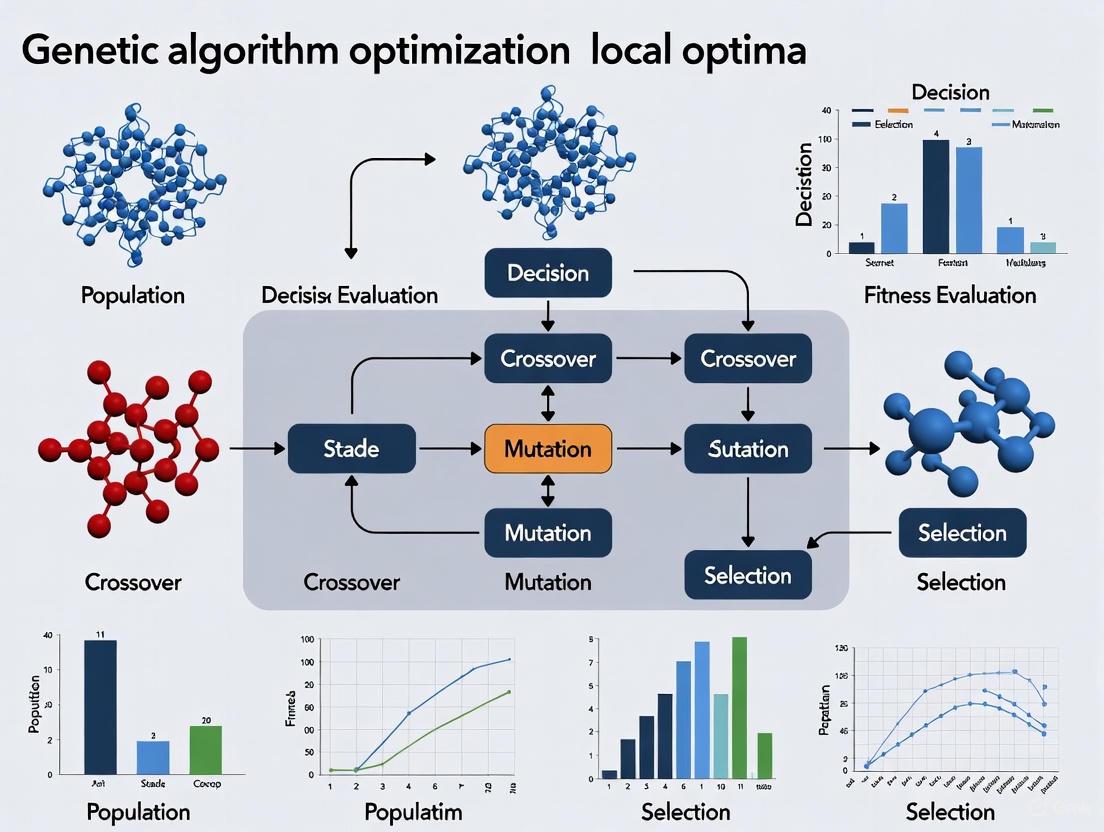
This article addresses the critical challenge of local optima in genetic algorithm (GA) optimization, a significant bottleneck in complex biomedical research problems like drug design and metabolic interaction prediction.
Beyond the Local Peak: Advanced Strategies to Overcome Local Optima in Genetic Algorithms for Drug Discovery
Abstract
This article addresses the critical challenge of local optima in genetic algorithm (GA) optimization, a significant bottleneck in complex biomedical research problems like drug design and metabolic interaction prediction. We explore the foundational theory of local optima and their impact on GA performance, then delve into advanced hybrid methodologies such as chaos theory integration and reinforced GAs that enhance global search capabilities. The guide provides actionable troubleshooting and optimization techniques, including population diversity management and adaptive operators, validated through comparative analysis with other optimization algorithms. Tailored for researchers and drug development professionals, this resource synthesizes cutting-edge strategies to improve the robustness, efficiency, and success rate of GA-driven discoveries in clinical and pharmaceutical applications.
Understanding the Maze: Defining Local Optima and Their Impact on Genetic Algorithm Convergence
What Are Local Optima? Mathematical Definitions and Practical Consequences in Search Spaces
Technical Definitions: Classifying Local Optima
In optimization, a local optimum is a solution that is the best within a particular region of the search space but is not necessarily the best overall solution (the global optimum) [1]. Imagine a landscape with hills and valleys: a local optimum is a hilltop higher than its immediate surroundings, but not the highest point in the entire landscape [2].
The following table summarizes the key mathematical definitions and tests for identifying local optima.
| Concept | Mathematical Definition | Test/Condition |
|---|---|---|
| Local Maximum | A point ( x^* ) where ( f(x^) \geq f(x) ) for all ( x ) in a neighborhood around ( x^ ) [3]. | For twice-differentiable functions: ( f'(x^) = 0 ) and ( f''(x^) < 0 ) [3]. |
| Local Minimum | A point ( x^* ) where ( f(x^) \leq f(x) ) for all ( x ) in a neighborhood around ( x^ ) [3]. | For twice-differentiable functions: ( f'(x^) = 0 ) and ( f''(x^) > 0 ) [3]. |
| Saddle Point | A stationary point that is neither a local maximizer nor a local minimizer [3]. | For a twice-differentiable function of two variables, a sufficient condition is that the determinant of the Hessian matrix at the point is negative [3]. |
| Global Optimum | The best possible solution across the entire search space [1]. | Often impossible to guarantee without exhaustive search, but can be approached with robust global optimization techniques. |
For functions of multiple variables, the Hessian matrix (H) of second-order partial derivatives is crucial. If H(( x^* )) is negative definite, then ( x^* ) is a local maximizer. If H(( x^* )) is positive definite, then ( x^* ) is a local minimizer [3]. A saddle point is often associated with an indefinite Hessian [3].
Visualizing the Problem: The Search Space Landscape
The following diagram illustrates the relationship between different types of optima in a search space.
Optimization Search Space
Experimental Protocols: Investigating and Overcoming Local Optima
This section details a methodology from recent literature that explicitly addresses the challenge of local optima in a real-world optimization problem.
Case Study: Facility Layout Optimization with a Hybrid Genetic Algorithm
A 2025 study proposed a New Improved Hybrid Genetic Algorithm (NIHGA) to solve the facility layout problem in reconfigurable manufacturing systems, a complex challenge where traditional algorithms often converge to local optima [4].
1. Objective: To find a facility layout that minimizes material handling and reconfiguration costs, a problem known to have a complex, multi-modal search space [4].
2. Algorithm Workflow: The following diagram outlines the workflow of the NIHGA, highlighting components designed to avoid local optima.
NIHGA Workflow for Escaping Local Optima
3. Key Anti-Local-Optima Mechanisms:
- Chaotic Initialization: The initial population is generated using an improved Tent map from chaos theory. This ensures high diversity from the start, making premature convergence to a poor local optimum less likely [4].
- Dominant Block Mining: The algorithm uses association rule theory to identify "dominant blocks" (high-quality gene combinations) from the best individuals. This reduces problem complexity and guides the search more efficiently [4].
- Adaptive Chaotic Perturbation: After standard genetic operations (crossover and mutation), a small chaotic perturbation is applied specifically to the best solution. This acts as a targeted local search, helping to kick the solution out of a local optimum's basin of attraction [4].
4. Outcome: The NIHGA was shown to be superior to traditional methods in both accuracy and efficiency, demonstrating the effectiveness of its integrated approach to overcoming local optima [4].
Troubleshooting Guide: FAQs on Local Optima
Q1: My genetic algorithm converges quickly, but the solution is poor. Is this a sign of being trapped in a local optimum? A: Yes, premature convergence is a classic symptom. This occurs when a lack of population diversity causes the algorithm to exploit a small, sub-optimal region of the search space too early [2]. To confirm, run the algorithm multiple times from different random starting points. If it consistently converges to the same or similar sub-optimal solutions, you are likely dealing with a local optimum.
Q2: What is the fundamental difference between a local optimum and a saddle point? A: A local optimum is the best point in its immediate vicinity [2]. In contrast, a saddle point is a stationary point (where the gradient is zero) that is neither a local maximum nor minimum. At a saddle point, the function curves up in some directions and down in others [3]. While an algorithm may slow down near a saddle point, it is not trapped in the same way and can potentially escape by following a direction of descent.
Q3: How can I tell if my solution is a local vs. global optimum for a complex, real-world problem? A: For NP-hard problems, it is often impossible to guarantee a solution is globally optimal without an exhaustive search, which is computationally infeasible [4]. The best practice is to use strong global search techniques:
- Run the algorithm many times with different initial conditions.
- Use algorithms with built-in mechanisms for exploration (e.g., simulated annealing's occasional acceptance of worse solutions [2], or chaotic perturbation in GAs [4]).
- Compare results from different algorithms (e.g., compare a GA result with one from a Particle Swarm Optimization). A solution that is consistently found and is superior to others is a good candidate for the global optimum.
Q4: Are local optima always a bad thing? A: Not necessarily. In some applications, finding a "good enough" solution quickly is more important than finding the absolute best solution. Local search algorithms that converge to local optima can be highly efficient for providing satisfactory solutions in such complex search spaces [2]. The key is to know the requirements of your project.
The Scientist's Toolkit: Research Reagent Solutions
The following table lists key computational tools and strategies used in the fight against local optima, as featured in the cited experiments.
| Tool / Strategy | Function in Optimization | Role in Overcoming Local Optima |
|---|---|---|
| Chaotic Maps (e.g., Tent Map) | A deterministic system that produces ergodic, non-repeating sequences. Used to initialize populations or generate perturbations [4]. | Enhances exploration by ensuring initial population diversity and applying non-random, adaptive perturbations to escape local attractors [4]. |
| Association Rule Learning | A rule-based machine learning method to find interesting relationships between variables in a database. Used for "dominant block mining" [4]. | Reduces problem complexity and guides the search by identifying and preserving high-quality building blocks (schemata) from fit individuals, preventing their disruption [4]. |
| Tabu Search | A metaheuristic that uses memory structures (a "tabu list") to record recently visited solutions [2] [5]. | Prevents cycling back to recently visited local optima, forcing the search to explore new, promising regions [2]. |
| Simulated Annealing | A probabilistic technique inspired by the annealing process in metallurgy. It occasionally accepts worse solutions [2]. | Allows the algorithm to "jump" out of local optima by accepting downhill moves, with the probability of such acceptance decreasing over time [2]. |
| Hybridization (e.g., GA-PSO) | Combining two or more optimization algorithms into a single pipeline [4]. | Leverages the strengths of different algorithms; for example, using GA for broad exploration and PSO for fine-tuned exploitation, balancing the search to avoid premature convergence [4]. |
Troubleshooting Guide: Frequent Convergence Issues
FAQ 1: Why does my GA consistently converge to a suboptimal solution early in the process?
Problem: Premature convergence occurs when a population loses genetic diversity too quickly, causing the search to settle for a local optimum rather than the global one. This is often because an individual that is significantly fitter than others in a small population reproduces excessively, dominating the gene pool before the search space is adequately explored [6].
Diagnosis and Solutions:
- Symptom: The algorithm's performance improves rapidly in the first few generations but then stalls at a fitness level far below the known optimum.
- Verification: Monitor the population's diversity. A rapid drop in genotypic or phenotypic diversity metrics confirms this issue.
- Solutions:
- Increase Population Size: A small population does not provide enough solution space for accurate results. Increasing the size provides a more extensive search base [6].
- Adjust Selection Pressure: Using less aggressive selection methods (e.g., reducing the bias towards the very fittest individuals) can help maintain diversity. Consider Stochastic Universal Sampling or a lower scaling factor in roulette wheel selection to prevent a few "super individuals" from dominating early [7].
- Use Elitism Judiciously: While elitism (carrying the best individuals to the next generation) helps preserve good solutions, an elite group that is too large can reduce diversity and stall progress. A common configuration is to select only the top 10% as elites [7].
- Implement "Competitive Immigrants": Instead of adding purely random immigrants, create competitive ones by mating a random immigrant with a selected parent from the population. This introduces new genetic material in a more competitive form, helping to maintain diversity and fitness throughout the run [8].
FAQ 2: Why does my GA fail to find better solutions even after many generations, despite having diversity?
Problem: The algorithm has converged, potentially to a local optimum, and the standard genetic operators (crossover and mutation) are not powerful enough to escape this region of the search space. The "building blocks" (high-quality schemata) may not be being effectively identified and combined [9] [10].
Diagnosis and Solutions:
- Symptom: The average and best fitness of the population have reached a plateau for a significant number of generations without improvement.
- Verification: Analyze the effectiveness of crossover. If offspring are not significantly different or better than their parents, the crossover operator may be ineffective.
- Solutions:
- Adopt Deep Crossover Schemes: Traditional crossover performs a single recombination, producing only two offspring per parent pair. Deep crossover performs multiple recombination steps with the same parent pair, allowing for a more intensive exploitation of the parental genes and a higher probability of discovering high-quality gene patterns (building blocks) [10]. The workflow for a two-level deep crossover is illustrated below.
- Tune Mutation Parameters: A mutation rate that is too low may lead to genetic drift and an inability to escape local optima. Conversely, a rate that is too high can destroy good solutions. Increase the mutation rate slightly from very low settings (e.g., 0.5%), but use elitism to protect the best-found solutions [9] [8].
- Employ Speciation Heuristics: Penalize crossover between candidate solutions that are too similar. This encourages population diversity and helps prevent the entire population from clustering around a local optimum [9].
Diagram 1: Deep Crossover with Two Levels. This shows how multiple crossover operations on a parent pair create a larger, more diverse offspring pool for selection.
FAQ 3: Why does my GA performance degrade when I move from a test function to my real-world computational model?
Problem: The fitness function evaluation for complex, high-dimensional real-world problems (e.g., biophysical models of drug interaction or neural stimulation) is often computationally prohibitive. Repeated expensive evaluations become the bottleneck, and the GA may not get enough generations to find a good solution [9] [8].
Diagnosis and Solutions:
- Symptom: The algorithm is slow, and each generation takes a very long time to compute. Progress is minimal relative to the computational time invested.
- Verification: Profile your code. If over 90% of the time is spent on the fitness function evaluation, this is the limiting factor.
- Solutions:
- Use Approximate Fitness Models: Replace the exact, computationally expensive fitness function with a faster, approximated version (e.g., a surrogate model like a neural network or Gaussian process) for the majority of generations, only using the exact function for validation [9].
- Modify Mutation for the Domain: Standard binary mutation can bias the solution. For temporal pattern optimization (e.g., in neuromodulation), a Pulse Mutation Method (PMM) is more effective. Instead of flipping bits, which biases the pulse frequency, PMM randomly chooses to add, remove, or move a pulse, introducing no frequency bias [8].
- Implement Variable Pattern Length (VPL): For problems involving pattern design, start with shorter patterns for faster convergence in early generations. Then progressively increase the pattern length across generations by replicating and concatenating sub-segments, allowing the discovery of low-frequency features without sacrificing initial speed [8].
Experimental Protocols for Overcoming Standard Operator Limitations
Protocol 1: Implementing and Benchmarking a Deep Crossover Scheme
This protocol is based on research that introduced deep crossover schemes to enhance the canonical GA's performance on combinatorial problems like the Traveling Salesman Problem (TSP) [10].
1. Objective: To evaluate whether deep crossover schemes can produce better solutions than the canonical GA by reducing the chance of getting stuck in local optima.
2. Methodology:
- Algorithm Design:
- Control: Canonical GA with a single crossover operation per parent pair.
- Intervention: Implement a GA with a deep crossover scheme (e.g., 2-level, 3-level). At each mating event, the selected parent pair undergoes crossover multiple times, creating a pool of offspring (e.g., 4 offspring for 2-level, 8 for 3-level). The best offspring from this pool are then selected for the next generation.
- Benchmark Problem: Use standard TSP instances (e.g., from TSPLIB).
- Performance Metric: Use the Gap metric to measure the percentage deviation of the algorithm's solution from a known optimum or a best-known solution.
- Parameters:
- Population size: 500
- Crossover type: Ordered Crossover (OX)
- Mutation: Swap mutation (2%)
- Selection: Tournament selection
3. Key Findings Summary (Comparative Data): The following table summarizes hypothetical results based on the described research, showing how different deep crossover configurations might perform against the canonical GA [10].
| Algorithm Variant | Average Gap (%) (over 10 runs) | Generations to Converge | Computational Time per Run (s) |
|---|---|---|---|
| Canonical GA | 5.2% | 150 | 120 |
| GA with 2-Level Crossover | 3.1% | 110 | 155 |
| GA with 3-Level Crossover | 2.7% | 95 | 190 |
| GA with Memetic Crossover | 2.9% | 100 | 165 |
Table 1: Sample Performance Comparison of Deep Crossover Schemes on TSP. Data is illustrative of trends reported in research [10].
Protocol 2: Modifying GA Repopulation for Biomedical Pattern Design
This protocol is derived from a study that designed optimal temporal patterns of electrical neuromodulation for neurological therapy, a problem relevant to computational drug and therapy development [8].
1. Objective: To test modified GA repopulation strategies for improving convergence speed and accuracy in designing binary temporal patterns.
2. Methodology:
- Control: A standard GA with roulette wheel selection, two-point crossover, probabilistic bit-flip mutation (0.5%), and random immigrants.
- Intervention Group: A modified GA incorporating:
- Pulse Mutation Method (PMM): As described in FAQ 3.
- Competitive Immigrants (CI): As described in FAQ 1.
- Variable Pattern Length (VPL): Start with a base pattern length (e.g., 1/10 of final length) and increase it over generations.
- Predictive Immigrants (PI): Track features of high-scoring patterns and generate new immigrants that incorporate these features.
- Evaluation: Test on both benchmark functions and a biophysically-based computational model of neural stimulation. The fitness function is specific to the therapeutic goal (e.g., activating a specific neural population while avoiding others).
3. Workflow: The following diagram outlines the modified GA repopulation process, highlighting the introduced strategies.
Diagram 2: Modified GA Repopulation Workflow. Dashed lines indicate the non-standard modifications added to the canonical GA process to improve performance.
The Scientist's Toolkit: Key Research Reagents and Solutions
This table details essential "methodological reagents" for experiments aimed at overcoming the limitations of standard GA operators.
| Research Reagent | Function / Role in Experiment | Example / Notes |
|---|---|---|
| Deep Crossover Scheme | A multi-level recombination operator that performs crossover multiple times on the same parent pair to intensify the search for good "building blocks." | Used to investigate complex variable interactions and improve the inheritance of good genes [10]. Variants include 2-level, 3-level, and memetic crossover. |
| Pulse Mutation Method (PMM) | A domain-specific mutation operator for temporal pattern design that prevents bias in average pulse frequency by adding, removing, or moving pulses. | Critical for applications in neuromodulation therapy design where maintaining a specific pulse density is important [8]. |
| Competitive Immigrants (CI) | A diversity-maintenance mechanism that creates immigrants by mating a random individual with a high-fitness parent, making new genetic material more competitive. | Helps prevent premature convergence without degrading the average population fitness, as pure random immigrants often do [8]. |
| Speciation Heuristic | A penalization mechanism applied during selection or crossover that discourages mating between solutions that are genotypically too similar. | Promotes population diversity and helps the algorithm explore different regions of the search space in parallel, avoiding a single local optimum [9]. |
| Surrogate Fitness Model | A computationally efficient approximate model (e.g., Neural Network, Linear Regression) used in place of an expensive, high-fidelity simulation. | Allows for a much higher number of generations to be run when facing budget or time constraints for fitness evaluation [9]. |
Frequently Asked Questions
What is a local optimum and why is it a problem in drug discovery? A local optimum is a solution that is the best within its immediate "neighborhood" of possible solutions but is not the absolute best solution (the global optimum) for the entire problem. In drug discovery, this means an algorithm might settle on a molecular structure or a drug interaction prediction that seems good initially but is ultimately suboptimal. This can lead to missed opportunities for more effective, safer, or cheaper drugs, contributing to the high cost and slow pace of development [11] [12].
My GA for molecular optimization is converging too quickly to similar structures. What can I do? Quick convergence often indicates that your population lacks diversity and is trapped in a local optimum. Strategies to overcome this include:
- Implement Elitism with Caution: While carrying the best performers to the next generation is good, ensure it doesn't dominate the gene pool. Decouple the number of elite compounds from those used to seed new mutations and crossovers to maintain diversity [13].
- Hybrid Algorithms: Combine a global search algorithm (like a GA or Differential Evolution) with a local search method (like Sequential Least Squares Programming). This allows a broad exploration of the chemical space followed by a refined local search, providing a trade-off between finding global optima and computational efficiency [14].
How can I improve the chemical diversity of molecules generated by my evolutionary algorithm?
- Utilize Diverse Reaction Sets: Use a large and diverse library of in silico chemical reactions (e.g., the 94-reaction set in AutoGrow4) to perform mutations. This expands the range of possible chemical transformations beyond simple modifications [13].
- Inspect Complementary Libraries: The small-molecule fragments used in reactions significantly impact diversity. Use filtered, commercially available fragment libraries (e.g., from ZINC15) that are rich in different functional groups to enable the generation of novel structures [13].
My DDI prediction model has high accuracy but low real-world applicability. What am I missing? This is a common issue when models learn statistical correlations instead of underlying biological mechanisms. To improve real-world relevance:
- Incorporate Mechanistic Data: Move beyond just structural features. Integrate data on specific mechanisms like Absorption, Distribution, Metabolism, and Excretion (ADME), as well as drug-target pathways. Models like DDINet that predict mechanism-wise interactions (e.g., excretion, metabolism) offer more interpretable and actionable results [15].
- Leverage Multi-Model Data: Combine different data types, such as molecular graphs (for structural information) and knowledge graphs (for known interactions and biological pathways), to create a more holistic model. Techniques like Graph Convolutional Networks (GCNs) are well-suited for this [16].
Are deep learning models a solution to the local optima problem? Deep learning (DL) can be a powerful component of a solution, but it is not a silver bullet. DL models can act as highly accurate fitness functions to guide an evolutionary algorithm, evaluating complex properties more effectively than simple scoring functions [17]. They can also be used as decoders to convert evolved molecular fingerprints (like ECFP) back into valid chemical structures (SMILES strings), ensuring chemical validity during evolution without relying on hard-coded rules [17]. However, DL models themselves can get stuck in local optima during training.
Troubleshooting Guides
Problem 1: Population Diversity Loss in Molecular Optimization
Symptoms: The genetic algorithm converges on very similar molecules within a few generations. The fitness score stops improving early, and the best compounds share a common, limited chemical scaffold.
Diagnosis: The algorithm is likely trapped in a local optimum, unable to explore a wider chemical space.
Solutions:
- Adjust Genetic Operator Parameters:
- Increase Mutation Rate: Temporarily increase the mutation rate to introduce more randomness and explore new regions of the chemical space.
- Diversify Crossover: Ensure the crossover operator is recombining genetically distinct parents, not just similar ones.
- Implement a Hybrid DE-SLSQP Approach: For complex optimization problems, such as designing non-equally spaced arrays (an analogy for complex molecular scaffolds), a hybrid method can be highly effective [14]. The framework below illustrates how this strategy balances global and local search:
Table 1: Key Parameters for the DE-SLSQP Hybrid Algorithm [14]
| Parameter | Recommended Setting | Function |
|---|---|---|
| Population Size | 20 individuals | Balances diversity with computational cost. |
| Individual Encoding | Excitation vector x→ ∈ [-1,1]^2N |
Represents the design variables (e.g., molecular features). |
| Spacing Distance | d→ ∈ [0.4,1]^N-1 |
Constrains the structure to feasible configurations. |
| Stopping Condition | Maximum generations | Controls the duration of the global search. |
Problem 2: Poor Generalization in DDI Prediction Models
Symptoms: The model performs well on training data but fails to predict novel or previously unseen drug-drug interactions. Predictions lack biological plausibility.
Diagnosis: The model is overfitting to correlations in the training data and not learning the underlying causal molecular mechanisms.
Solutions:
- Adopt a Mechanism-Wise Deep Learning Architecture: Implement a model like DDINet, which uses deep sequential learning (LSTM, GRU) with an attention mechanism to predict and classify DDIs based on specific biological mechanisms (e.g., Metabolism, Excretion) [15]. This forces the model to learn features relevant to how drugs actually interact in the body. The workflow for such an approach is as follows:
- Use Multi-Source Data Fusion: Enhance your model's input features. Instead of relying solely on drug chemical structures, incorporate additional data such as:
Table 2: Performance of DDINet for Mechanism-Wise DDI Prediction [15]
| Mechanism | Training Loss | Validation Loss | Precision | Recall | F1-Score |
|---|---|---|---|---|---|
| Excretion | 0.1443 | 0.3276 | 0.94 | 0.94 | 0.94 |
| Absorption | 0.1504 | 0.1503 | 0.94 | 0.94 | 0.94 |
| Metabolism | 0.4428 | 0.4600 | 0.95 | 0.95 | 0.95 |
| Excretion Rate (Higher Serum) | 0.0691 | 0.0778 | 0.94 | 0.94 | 0.94 |
| Average | - | - | 0.94 | 0.94 | 0.95 |
Experimental Protocols
Protocol 1: De Novo Molecular Design Using a Deep Learning-Guided GA
This protocol is adapted from the evolutionary design method that uses deep learning to guide a genetic algorithm, effectively navigating around local optima [17].
Objective: To evolve a seed molecule to optimize a specific property (e.g., light-absorbing wavelength) while maintaining chemical validity.
Materials:
- Seed Molecule: Starting compound in SMILES format.
- Encoding Function: Function to convert a SMILES string into an Extended-Connectivity Fingerprint (ECFP) vector (e.g., using the RDKit library with a length of 5000).
- Decoding Function: A trained Recurrent Neural Network (RNN) to convert an ECFP vector back into a valid SMILES string.
- Property Prediction Function: A trained Deep Neural Network (DNN) to predict the target property from an ECFP vector.
- Genetic Algorithm Framework: Software to perform mutation and crossover on ECFP vectors.
Procedure:
- Encoding: Transform the seed molecule
m0into its ECFP vectorx0. - Initial Population: Create a population of vectors
P0 = {z1, z2, ..., zL}by applying mutation operators tox0. - Decoding & Validation: Convert each vector
ziin the population into a SMILES stringmiusing the RNN decoder. Check the chemical validity of eachmi(e.g., using the RDKit library). - Fitness Evaluation: Predict the property
tifor each valid molecule using the DNN:ti = f(e(mi)). The fitness is based on how closetiis to the target value. - Selection & Evolution: Select the top-performing ECFP vectors as parents. Generate a new population
Pnby applying crossover and mutation to these parents. - Iteration: Repeat steps 3-5 for a set number of generations or until a convergence criterion is met.
- Output: Select the best-fit molecule from the final generation.
Protocol 2: Assessing Local Optima in Optimization Problems
This protocol is based on an experimental study that analyzed the prevalence of local optima in complex synthesis problems [14].
Objective: To empirically determine the quality and distribution of local optima in a specific optimization problem relevant to your research (e.g., molecular docking score optimization).
Materials:
- A mathematical optimizer capable of local search (e.g., Sequential Least Squares Programming - SLSQP).
- A defined objective function and constraints for your problem.
Procedure:
- Problem Definition: Clearly define your optimization problem, including the design variables and constraints.
- Repeated Local Search: Run the SLSQP optimizer a large number of times (e.g., 500 repetitions), each time starting from a different, randomly generated initial solution.
- Solution Collection: Record the final objective value and the solution found in each run.
- Data Analysis:
- Plot a histogram of the final objective values.
- Analyze the distribution. A narrow distribution of high-quality results suggests that local optima are not a severe problem. A wide distribution with many poor results indicates a "needle-in-a-haystack" problem where the global optimum is hard to find.
The Scientist's Toolkit
Table 3: Essential Research Reagents and Software for Evolutionary Drug Discovery
| Item | Function | Example / Source |
|---|---|---|
| AutoGrow4 | An open-source genetic algorithm for de novo drug design and lead optimization. It uses reaction-based chemistry and docking to evolve molecules [13]. | http://durrantlab.com/autogrow4 |
| RDKit | Open-source cheminformatics toolkit. Used for manipulating molecules, calculating fingerprints, and checking chemical validity [13] [17]. | https://www.rdkit.org |
| Gypsum-DL | Converts SMILES strings into 3D molecular models with alternate ionization and tautomeric states, preparing ligands for docking [13]. | http://durrantlab.com/gypsum-dl |
| ZINC15 Library | A curated database of commercially available chemical compounds. Used as a source for molecular fragments and seed compounds [13]. | https://zinc15.docking.org |
| Rcpi Toolkit | A tool for extracting biochemical features from drug molecules (e.g., from SMILES format) for use in machine learning models [15]. | https://github.com/nanxstats/Rcpi |
| DDI Datasets | Publicly available datasets of known drug-drug interactions, essential for training and validating DDI prediction models. | DrugBank, Kaggle [15] |
Frequently Asked Questions
1. What is the fundamental difference in how these strategies avoid getting stuck in local optima?
Population-based global search strategies, like Genetic Algorithms (GAs), maintain a diverse pool of candidate solutions. This diversity allows them to explore different regions of the search space simultaneously. Even if one part of the population converges on a local optimum, other individuals can discover a path toward the global optimum. GAs specifically use genetic operators: crossover combines traits from different parents, potentially creating new, high-quality solutions, while mutation introduces random changes, helping the population escape the area of attraction of a local optimum [19] [20]. In contrast, single-solution local search strategies, like the elitist (1+1) EA, operate on one candidate at a time. They typically only accept moves that improve the solution. To escape a local optimum, they must rely on a single, often unlikely, mutation that jumps directly to a better region across a "fitness valley," which can be inefficient if the valley is wide [20].
2. My GA is converging too quickly to a sub-optimal solution. What parameters should I adjust?
Premature convergence often indicates a loss of genetic diversity. You can adjust the following parameters to promote more exploration [21]:
- Increase the Mutation Rate: A higher rate introduces more randomness, helping to break out of local optima. Typical values range from 0.001 to 0.1. For a binary chromosome, a starting point can be 1 / (chromosome length) [21].
- Increase the Population Size: A larger population naturally maintains more diversity. For complex problems, consider a size between 100 and 1000 individuals [21].
- Decrease the Selection Pressure: If using tournament selection, try reducing the tournament size. This makes it easier for less-fit individuals (which might carry useful genetic material) to be selected for reproduction [21].
- Review Crossover Rate: While a high rate (e.g., 0.8) is common, if it is too high, it can break down good solutions too quickly. Experiment with values between 0.6 and 0.9 [21].
3. How do I represent my problem for a Genetic Algorithm, and what crossover method should I use?
The representation, or "encoding," depends entirely on your problem:
- Binary Vector: Used for feature selection or the knapsack problem, where each gene indicates the presence (1) or absence (0) of an item [22].
- Permutation of Integers: Used for ordering problems like the Traveling Salesman Problem (TSP) or scheduling, where each gene represents a city or a task [23].
The crossover method should match your encoding:
- Single-Point Crossover: A crossover point is randomly selected, and the segments from two parents are swapped. Simple but can have positional bias [24].
- Two-Point Crossover: Two points are selected, and the segment between them is swapped. Reduces positional bias compared to single-point [24].
- Uniform Crossover: For each gene, the parent from whom it is inherited is chosen randomly based on a coin toss. This is highly explorative but may require modifications for problems like TSP to avoid illegal solutions (e.g., duplicate cities) [24].
- Order Crossover (OX): Designed for permutations. A subsequence from one parent is copied to the child, and the remaining genes are filled in the order they appear from the second parent, preserving the permutation property [23].
4. When should I choose a local search method over a global method like a GA?
Local search methods are often more suitable in the following scenarios [25]:
- The problem's fitness landscape is known to be convex or unimodal (free of significant local optima).
- You have a good initial solution from domain knowledge, and you need to refine it efficiently.
- Computational resources are extremely limited, as local search typically evaluates fewer solutions per iteration.
- The objective function is smooth and differentiable, making it amenable to efficient gradient-based methods.
For complex, multi-modal problems with a rugged landscape, or when you have little prior knowledge about where the optimum lies, a population-based global search like a GA is generally more robust [25].
Comparison of Search Strategies
The table below summarizes the core differences between the two search paradigms.
| Feature | Population-Based Global Search (Genetic Algorithm) | Single-Solution Local Search (e.g., (1+1) EA) |
|---|---|---|
| Core Principle | Mimics natural evolution using a population of solutions [23]. | Iteratively improves a single solution via local perturbations [20]. |
| Mechanism for Escaping Local Optima | Crossover & Mutation: Diversity in the population and random mutations allow exploration across the search space [20]. | Mutation Only: Relies on a single, large-effect mutation to jump to a better region [20]. |
| Key Strength | Robust exploration of complex, multi-modal search spaces; less dependent on initial guess [25]. | Can be very efficient for refining solutions in smooth, unimodal landscapes. |
| Key Weakness | Higher computational cost per generation; requires tuning of several parameters [22] [21]. | High risk of premature convergence to a local optimum, especially in rugged landscapes [19] [20]. |
| Performance on Fitness Valleys | Can traverse valleys by accepting temporary fitness decreases (non-elitism) or through recombination. Efficiency depends on valley depth [20]. | Must jump across the valley in a single mutation. Efficiency depends on valley length, and can be exponentially slow [20]. |
Experimental Protocol: Comparing Strategies on a Model Problem
This protocol outlines how to empirically compare a Genetic Algorithm against a local search algorithm using a model fitness landscape that contains a known "fitness valley."
1. Objective: To compare the efficiency and robustness of a GA and a (1+1) EA in finding the global optimum on a fitness function designed with a local optimum and a global optimum separated by a valley.
2. Model Fitness Function: A constructed "valley" function can be defined on a Hamming path (a path where solutions are Hamming neighbors). The function has the following characteristics [20]:
- Local Optimum: A point with high fitness.
- Valley: A sequence of points with lower fitness leading away from the local optimum.
- Global Optimum: A point with the highest fitness, located on the other side of the valley. The difficulty of the problem is tuned by the length (number of steps between optima) and depth (fitness drop in the valley) parameters.
3. Algorithms & Setup:
- Genetic Algorithm (Global Search)
- Encoding: Binary strings.
- Initialization: Randomly generated population.
- Selection: Tournament selection (e.g., size 3).
- Crossover: Single-point crossover with a rate of 0.8.
- Mutation: Bit-flip mutation with a rate of 0.05.
- Replacement: Generational with elitism (keep the best 1-2 individuals).
- (1+1) EA (Local Search)
- Initialization: A single random solution.
- Mutation: Each bit is flipped independently with a probability of (1/n) (where (n) is the chromosome length).
- Selection: Elitist. The offspring replaces the parent only if its fitness is better.
4. Measured Metrics:
- Success Rate: The proportion of independent runs in which the algorithm finds the global optimum.
- Mean Best Fitness: The average of the best fitness found across all runs after a fixed number of generations.
- Mean Time to Solution: The average number of function evaluations required to find the global optimum.
Workflow Visualization
The following diagram illustrates the high-level workflow and logical structure of the two contrasting search strategies.
The Scientist's Toolkit: Essential Research Reagents
The table below lists key components and their functions for implementing and analyzing search algorithms in optimization research.
| Item | Function & Explanation |
|---|---|
| Fitness Function | The objective function that quantifies the quality of any candidate solution. It is the primary guide for the search process [23]. |
| Solution Encoding (Chromosome Representation) | The method for mapping a potential solution to a data structure (e.g., binary string, permutation) the algorithm can manipulate [22]. |
| Mutation & Crossover Operators | The "variation operators." Mutation introduces random changes for exploration, while crossover combines parent solutions to exploit good building blocks [22]. |
| Selection Mechanism | The strategy for choosing which solutions get to reproduce (e.g., Tournament, Roulette Wheel). It controls the selection pressure toward fitter solutions [21]. |
| Benchmark Problems with Known Optima | Well-understood test functions (e.g., NK landscapes, TSP instances) used to validate, compare, and tune algorithm performance [20]. |
| Performance Metrics | Quantitative measures like Success Rate, Mean Best Fitness, and Mean Evaluations to Solution used to compare algorithm performance objectively [20]. |
Evolving the Algorithm: Advanced Hybrid GA Methodologies for Biomedical Challenges
Frequently Asked Questions (FAQs)
Q1: Why is my hybrid GA-SA model converging to a suboptimal solution too quickly? This is a classic sign of premature convergence, often caused by an imbalance between exploration (GA) and exploitation (SA). The SA component may be too weak, failing to adequately refine promising solutions found by the GA. To address this, you can intensify the local search by increasing the number of SA iterations applied to high-fitness individuals or by adjusting the SA cooling schedule to cool down more slowly, allowing for a broader search at higher temperatures [26].
Q2: How do I set the initial temperature for the Simulated Annealing component? A common and practical method is to calculate the initial temperature based on the initial population's diversity. One approach is to set the initial temperature ( T_0 ) to the difference between the highest and lowest penalty (or cost) values in the initial population generated by the genetic algorithm. This automatically scales the temperature to the specific problem instance [26].
Q3: What is a good stopping criterion for the hybrid algorithm? Multiple stopping criteria can be used in conjunction:
- Generation Count: A simple maximum number of generations.
- Solution Stagnation: Stop when the best solution has not improved for a predefined number of generations.
- Final Temperature: For the SA component, the process can stop when the temperature reaches a very low value ( ( T{final} ) ), where no further improvements are expected. One method to estimate this is ( Tf = \frac{Em - E{m'}}{\ln(\nu)} ) , where ( Em ) is the estimated global minimum, ( E{m'} ) is the next best cost value, and ( \nu ) is the number of moves between them [27].
Q4: How can I handle the high computational cost of the hybrid approach? The fitness evaluation (e.g., docking score in drug design) is often the bottleneck. Consider these strategies:
- Fitness Caching: Store and reuse fitness scores for identical individuals across generations.
- Initial Population Quality: Use chaotic maps or other methods to generate a high-quality, diverse initial population, which can lead to faster convergence [4].
- Adaptive Operator Rates: Dynamically adjust the rate of mutation/crossover based on population diversity to focus computational resources more effectively.
Q5: How do I decide between different neighborhood structures for the local search? The choice depends on your problem's solution representation. For permutation-based problems (like scheduling), you can implement multiple structures and select one randomly at each iteration [26]. Common structures include:
- Swap: Exchange two random elements in a solution sequence.
- Move/Relocate: Take one element and insert it at a different random position.
- Inversion: Reverse the order of a subsequence of elements. Using multiple structures helps prevent the search from getting stuck.
Troubleshooting Guides
Problem: Poor Final Solution Quality
| Symptom | Possible Cause | Solution |
|---|---|---|
| The algorithm consistently returns solutions that are significantly worse than known benchmarks or expected results. | - Weak Local Search: The SA component is not effectively exploiting the regions found by the GA.- Poor GA Exploration: The GA is not finding promising regions for SA to refine.- Overly Rapid Cooling: SA is quenching too fast. | - Intensify Local Search: Increase the number of SA iterations per individual [28].- Enhance GA Diversity: Introduce chaos-based initialization [4] or increase the population size.- Slower Annealing Schedule: Use a slower cooling rate (e.g., a higher value of ( r ) in ( T{new} = r \times T{old} ) ). |
Problem: Excessively Long Run Time
| Symptom | Possible Cause | Solution |
|---|---|---|
| The algorithm takes an impractically long time to reach a stopping criterion without a corresponding improvement in solution quality. | - Inefficient Fitness Function: The objective function is computationally expensive.- Overly Large Population/Generations.- Ineffective Local Search: SA is making too many non-improving moves. | - Optimize Code: Profile and optimize the fitness evaluation code.- Adjust Parameters: Reduce population size or maximum generations and increase elitism [13].- Tune SA Parameters: Increase the cooling rate or reduce the number of iterations per temperature level. |
Problem: Population Diversity Collapse
| Symptom | Possible Cause | Solution |
|---|---|---|
| The population becomes genetically homogeneous early in the run, halting progress. | - Over-Selection Pressure: The selection operator is too greedy.- Loss of Genetic Material: High mutation/crossover rates destroying good building blocks (dominant blocks). | - Use Less Greedy Selection: Implement tournament selection with a smaller tournament size [26].- Implement Dominant Block Mining: Use association rules to identify and protect high-quality gene combinations (building blocks) from being disrupted [4]. |
Experimental Protocols & Methodologies
Protocol: Implementing a Basic HGASA for Scheduling
This protocol is adapted from a presentation scheduling problem, which is analogous to university course timetabling [26].
1. Solution Encoding:
- Encode the solution as a matrix (e.g., a slot-by-presentation matrix). A value of '1' indicates a presentation is assigned to a specific slot.
- This matrix serves as the chromosome in the GA and the candidate solution in SA.
2. Initialization:
- Generate an initial population of chromosomes randomly, ensuring no hard constraints (e.g., venue availability) are violated.
3. Genetic Algorithm Loop (Steady-State):
- Selection: Use tournament selection (size 2) to select parent chromosomes.
- Crossover: Perform two-point crossover on the parent matrices.
- Repair: Implement a repair function post-crossover to fix any violated hard constraints (e.g., two presentations in the same slot).
- Mutation: Swap the slots of two randomly selected presentations.
- Replacement: Replace the two worst chromosomes in the population with the two new children.
4. Simulated Annealing Local Search:
- Initial Candidate: Select the best solution from the GA population.
- Initial Temperature (( T_0 )): Set to the difference between the highest and lowest penalty in the GA population.
- Neighborhood Generation: Randomly apply one of several neighborhood structures to the current solution to create a neighbor. Examples include:
Neighbourhood Structure 1: Swap timeslots for two presentations with a common supervisor.Neighbourhood Structure 2: Change a presentation's venue, keeping time constant.Neighbourhood Structure 3: Move a presentation to a random empty slot.
- Acceptance Criteria: Always accept improving moves. Accept worsening moves with a probability of ( e^{(-\Delta E)/T} ), where ( \Delta E ) is the change in penalty cost.
- Cooling Schedule: Use an exponential cooling schedule: ( T{new} = r \times T{old} ), where ( r ) is a cooling rate (e.g., 0.85).
5. Termination:
- Stop after a fixed number of generations or when the SA temperature falls below a threshold.
Protocol: Hybrid GA for De Novo Drug Design (AutoGrow4)
This protocol outlines the hybrid GA used in AutoGrow4 for drug discovery, which incorporates elements of local search through its operators [13].
1. Solution Representation:
- Represent candidate drugs as SMILES strings.
2. Initial Population (Generation 0):
- Start with a set of seed molecules (e.g., molecular fragments for novel design or known ligands for lead optimization).
3. Population Generation Operators:
- Elitism: A subset of the fittest compounds from the previous generation advances unchanged.
- Mutation (Chemical Reaction): Perform an in silico reaction on a parent compound. One reactant is the parent, the other is from a library of small-molecule fragments (e.g., from Zinc15). This acts as a focused local search in chemical space.
- Crossover (Merger): Identify the largest common substructure between two parent compounds and generate a child by randomly combining their decorating moieties.
4. Fitness Evaluation:
- Docking: Use programs like AutoDock Vina to dock the 3D model of the compound into the target protein's binding site.
- Fitness Score: The primary fitness is the predicted binding affinity (docking score).
5. Selection:
- Compounds are selected for the next generation based on their fitness scores, guiding the search toward better-binding molecules.
Workflow and Algorithm Diagrams
HGASA High-Level Workflow
This diagram illustrates the overall flow of a typical Hybrid Genetic Algorithm with Simulated Annealing.
Simulated Annealing Local Search Process
This diagram details the inner loop of the Simulated Annealing component.
The Scientist's Toolkit: Research Reagent Solutions
The following table lists key computational tools and concepts used in developing and implementing hybrid GA architectures.
| Item Name | Function / Purpose |
|---|---|
| Tournament Selection | A selection operator in GA that chooses the best individual from a small random subset of the population. This helps maintain selection pressure while preserving diversity [26]. |
| Two-Point Crossover | A crossover method where two points are selected in the parent chromosomes, and the segment between them is swapped. This helps preserve good building blocks (dominant blocks) better than one-point crossover [26]. |
| Exponential Cooling Schedule | A common method in SA to reduce temperature, defined by ( T{new} = r \times T{old} ), where ( 0 < r < 1 ). It provides a smooth and controlled transition from exploration to exploitation [26]. |
| Neighborhood Structures | A set of operations (e.g., swap, move, relocate) used in SA to generate new candidate solutions from the current one. Using multiple, randomized structures prevents search stagnation [26]. |
| Penalty Function | A function that quantifies constraint violations in a solution. It transforms a constrained optimization problem into an unconstrained one by adding a penalty to the fitness score for each violation [26]. |
| Chaotic Maps (e.g., Tent Map) | Used to generate the initial population for the GA. Chaos theory provides high diversity and ergodicity, improving the quality of the starting points and helping avoid premature convergence [4]. |
| Association Rules / Dominant Block Mining | A data mining technique used to identify and preserve high-quality gene combinations (building blocks) in high-fitness individuals. This reduces problem complexity and improves algorithmic efficiency [4]. |
| RDKit | An open-source cheminformatics toolkit. In drug-discovery GAs like AutoGrow4, it is used for critical operations like manipulating SMILES strings, performing crossovers, and applying molecular filters [13]. |
| AutoDock Vina | A widely used molecular docking program. It serves as the fitness function in structure-based drug design GAs by predicting the binding affinity of a generated compound to a target protein [13]. |
| Gypsum-DL | A software tool that converts 1D SMILES strings into 3D molecular models with optimized protonation, tautomeric, isomeric, and ring-conformational states. This prepares compounds for docking in a virtual screening pipeline [13]. |
Frequently Asked Questions (FAQs)
Q1: Why is initial population diversity critical in Genetic Algorithms, and how does chaos theory help? Initial population diversity is a fundamental determinant for the global search capability of a Genetic Algorithm (GA). A diverse population helps in exploring different regions of the search space simultaneously, thereby reducing the probability of premature convergence on local optima [29] [30]. Chaos theory contributes through chaotic maps, which are deterministic systems that exhibit ergodicity, non-periodicity, and high sensitivity to initial conditions [31]. When used for population initialization, these maps can generate individuals that are spread more uniformly across the search space compared to purely random methods, providing a better foundation for the GA's exploration and exploitation phases [29] [32].
Q2: What are the specific drawbacks of the basic Tent Map that necessitate an "Improved" version? The basic Tent Map, while useful, has documented limitations that can affect the performance of the GA. Two primary drawbacks are:
- Finite Precision and Short Periods: When implemented on digital computers with finite precision, the basic Tent Map can suffer from short cycle lengths and degenerate into periodic orbits, which undermines the desired randomness and diversity [33] [34].
- Undesirable Fixed Points: The map can fall into "annulling traps" or "fixed points" (e.g., converging to zero), especially at specific parameter values, which stalls the sequence generation [33]. Improved versions, such as the Modified Skew Tent Map (M-STM), incorporate perturbations or other functions (like the sine function) to overcome these traps, resulting in a wider chaotic range and higher sensitivity, which in turn enhances the quality of the generated sequences [33].
Q3: My GA with chaotic initialization is converging rapidly but to a sub-optimal solution. What might be going wrong? Rapid convergence to a sub-optimal solution often indicates a loss of diversity in the early generations. While chaotic initialization provides a superior starting point, your other genetic operators might be too aggressive. Consider the following:
- Review Selection Pressure: If your selection operator is too strong (e.g., always selecting only the very best individuals), it can quickly eliminate the diversity introduced by the chaotic initialization. Consider using selection strategies that preserve some less-fit individuals [35].
- Adjust Crossover and Mutation Rates: A very high crossover rate can lead to premature convergence by rapidly homogenizing the population. Conversely, a mutation rate that is too low cannot reintroduce lost diversity. Tuning these parameters is essential [35] [9]. You may also consider introducing a small adaptive chaotic perturbation after crossover and mutation to help the population escape local optima [29].
Q4: How do I validate that the chaotic sequence used for initialization has good statistical properties? The validity of a chaotic sequence is confirmed through both its dynamical properties and statistical test suites.
- Dynamical Analysis: Plot the bifurcation diagram to visualize the map's behavior across different parameter values, confirming it remains chaotic and does not have large periodic windows. Calculate the Lyapunov Exponent (LE); a positive and large LE indicates high sensitivity to initial conditions and strong chaotic behavior [33].
- Statistical Testing: Use standardized test batteries like the NIST SP 800-22 suite to evaluate the randomness of the generated number sequence. A well-designed chaotic PRNG should pass a high percentage of these tests [33] [34].
Troubleshooting Guides
Problem: Premature Convergence Despite Chaotic Initialization
Symptoms: The algorithm's fitness improves very quickly and then stalls. The population's individuals become very similar to each other within a few generations, and no significant improvements are observed thereafter.
Diagnosis and Solutions:
| Step | Diagnosis | Solution |
|---|---|---|
| 1 | Check Chaotic Map Performance | Verify that your Improved Tent Map has a positive and sufficiently large Lyapunov Exponent. Reject parameter values where the map exhibits periodic behavior [33]. |
| 2 | Audit Genetic Operators | Analyze the balance between your operators. Reduce selection pressure (e.g., use tournament selection instead of pure elitism for all individuals) and slightly increase the mutation probability to reintroduce diversity [35] [9]. |
| 3 | Implement Chaotic Perturbation | Introduce a small, adaptive chaotic perturbation to the population after standard genetic operations. This acts as a fine-tuning mechanism and can nudge the population out of local attractors [29]. |
| 4 | Hybridize with a Local Search | Consider a memetic algorithm approach. Use the GA for global exploration and employ a local search method (e.g., gradient-based, if applicable) for exploitation around promising solutions found by the GA. |
Problem: Degenerate Chaotic Sequences
Symptoms: The initial population lacks diversity. The chaotic map sequence gets stuck at a fixed point or enters a short, repeating cycle.
Diagnosis and Solutions:
| Step | Diagnosis | Solution |
|---|---|---|
| 1 | Check Parameter Values | Ensure the control parameter of the Tent Map is within its chaotic range. Avoid values that are known to cause periodic behavior or convergence [32]. |
| 2 | Introduce a Perturbation Mechanism | Switch to a proven Improved Tent Map. For example, use the Modified Skew Tent Map (M-STM) that incorporates a sine function and a perturbation term to prevent the sequence from falling into an annulling trap [33]. The mathematical form is: T(x,p) = { sin(( (1-p)/(1+p) - π*x/p ) * 10^5 ) for -1≤x<p; sin(( (1-p)/(1+p) - π*(1-x)/(1-p) ) * 10^5 ) for p<x≤1 } |
| 3 | Use High-Precision Data Types | Implement the chaotic map using high-precision floating-point arithmetic (e.g., double or higher) to mitigate the effects of finite precision in digital computers that lead to short cycles [34]. |
Experimental Protocols & Data
Protocol 1: Initializing a GA Using an Improved Tent Map
This protocol details the steps to generate an initial population for a GA using the Improved Tent Map.
Workflow Diagram: Chaotic Population Initialization
Materials and Reagents:
| Item | Function in the Experiment |
|---|---|
| Improved Tent Map (e.g., M-STM [33]) | The core chaotic function used to generate a pseudo-random, ergodic sequence for sampling the search space. |
| Initial Seed (x₀) | The starting point for the chaotic map; small changes here produce vastly different sequences due to sensitivity. |
| Control Parameter (μ/p) | A parameter value that keeps the map in a chaotic regime, ensuring non-periodic and complex output. |
| High-Precision Arithmetic Library | Software/hardware support for high-precision calculations to prevent numerical degradation of the chaotic sequence. |
Methodology:
- Define Solution Space: Identify the boundaries and dimensions of the problem you are optimizing.
- Configure Chaotic Map: Select an Improved Tent Map (e.g., M-STM) and set its parameter
pto a value within the chaotic region (e.g., 0.4) [33]. - Initialize Sequence: Choose a random initial seed
x₀within the map's domain (e.g., [0, 1]). - Generate Sequence: Iterate the chaotic map to produce a long sequence of values:
xₙ₊₁ = T(xₙ, p). - Scale Values: Map each value from the chaotic sequence to a valid value within your solution space. For example, if optimizing a variable
zin [Zmin, Zmax], calculate:z = Z_min + xₙ * (Z_max - Z_min). - Construct Individuals: Use the scaled values to build the chromosomes of the initial population until the desired population size is reached.
Protocol 2: Comparing Chaotic Maps for Initialization
This protocol outlines a benchmark experiment to compare the performance of different chaotic maps for population initialization.
Workflow Diagram: Performance Comparison Experiment
Quantitative Data from Literature: Table 1: Comparison of Chaotic Map Properties [33]
| Chaotic Map | Key Characteristic | Lyapunov Exponent (Typical) | Known Issues |
|---|---|---|---|
| Logistic Map | Simple, widely studied | ~0.69 (for r=4) | Narrow chaotic parameter range, "high sides and low middle" distribution [32] |
| Basic Tent Map | Piecewise linear, uniform ideality | Sensitive to parameters | Vulnerable to annulling traps and finite precision effects [33] |
| Modified Skew Tent Map (M-STM) | Sine-modified, perturbed | >1.0 (higher is better) | Wider chaotic region, overcomes fixed points, higher computational cost [33] |
Table 2: Performance of GA with Chaotic Initialization on Benchmark Problems
| Application Domain | Algorithm | Key Performance Finding | Source |
|---|---|---|---|
| Multimodal Function Optimization | GA with Chaotic Crossover | Leads to more efficient computation compared to traditional GA | [36] |
| Facility Layout Optimization | Chaos GA (Improved Tent Map) | Enhanced initial population quality/diversity; superior in accuracy and efficiency | [29] |
| Solving Nonlinear Systems | Chaotic Enhanced GA (CEGA) | ~76% average improvement, faster convergence, prevents solution repetition | [31] |
| Traveling Salesman Problem | GA with Heuristic Seeding | Heuristic (non-random) initialization results in faster convergence to better solutions | [30] |
Frequently Asked Questions (FAQs)
1. What is the fundamental advantage of RGA over traditional Genetic Algorithms in SBDD? Traditional GAs rely on random-walk-like exploration for crossover and mutation, leading to unstable performance and an inability to transfer knowledge between different drug design tasks, despite the shared underlying binding physics. RGA uses neural models pre-trained on native complex structures to intelligently prioritize profitable design steps, suppressing this random behavior. This results in more stable optimization, better knowledge transfer, and ultimately, molecules with superior binding affinity [37] [38].
2. How does the Evolutionary Markov Decision Process (EMDP) reformulate the design process? The EMDP is a key innovation in RGA that reformulates the evolutionary process as a Markov Decision Process. Unlike traditional RL where the state is a single agent, in EMDP, the state is the entire population of molecules. This allows the neural policy to make decisions based on the collective state of the evolving solutions, guiding the population as a whole toward more promising regions of the chemical space [38].
3. My RGA is converging to suboptimal molecules. How can I improve the exploration of the chemical space? This issue, known as premature convergence, can be addressed by checking the following:
- Mutation Rate: Ensure your mutation rate is not too low. The mutation operation introduces random changes to an individual's policy (e.g., neural network weights) to maintain diversity. A typical mutation rate can be around 0.01 to 0.05 [39].
- Policy Network Pre-training: Verify that your neural models were properly pre-trained on diverse native complex structures. This pre-training equips the model with prior knowledge of binding physics, enabling more intelligent exploration from the start [37] [38].
- Population Diversity: Implement mechanisms like tournament selection to maintain a healthy level of diversity in your population, preventing early dominance by a single suboptimal solution [39].
4. What are the computational bottlenecks when running RGA on a new protein target? The primary bottlenecks are:
- Fitness Evaluation: Each call to the molecular docking oracle (e.g., Autodock, Vina) is computationally expensive. RGA improves sample efficiency, but docking remains the main cost [38] [40].
- Neural Model Inference: The forward passes of the 3D neural network to guide crossover and mutation add overhead, though this is typically less than the docking cost. Strategies to mitigate this include using a replay buffer to store and reuse past fitness evaluations, thus avoiding redundant oracle calls [41].
5. Can I use RGA for targets without a known 3D structure? RGA is explicitly designed for structure-based drug design (SBDD), meaning it requires the 3D structure of the target protein as input. If an experimental structure is unavailable, you might use a high-quality homology model predicted by tools like AlphaFold2, as the rise of accurate protein structure prediction has been a key driver for SBDD methods [38].
Troubleshooting Guides
Issue 1: Unstable Optimization Performance Between Independent Runs
Problem: Significant variance in final results (e.g., docking scores of best-designed molecules) when the RGA is run multiple times from different random seeds.
Diagnosis: This indicates that the algorithm is overly sensitive to initial conditions, a hallmark of the random-walk behavior that RGA aims to suppress. High variance between runs makes it difficult to trust the worst-case performance of the algorithm.
Solution:
- Verify Pre-training: Ensure your policy network was pre-trained on a diverse set of protein-ligand complexes. This provides a stable, knowledge-based foundation for the policy, reducing its reliance on random exploration [37].
- Check Fine-tuning: The policy should be fine-tuned during the optimization phase on the specific target. As the policy fine-tunes, it should become more specialized, leading to more stable and intelligent guidance in later stages. Empirical results show that variance should decrease after about 500 oracle calls [38].
- Adjust Selection Pressure: In your selection operator (e.g., tournament selection), a very small tournament size may not sufficiently select for good policies. Consider moderately increasing the tournament size to provide more consistent pressure toward high-fitness individuals [39].
Issue 2: Poor Sample Efficiency and Slow Convergence
Problem: The algorithm requires an excessively large number of expensive docking oracle calls to find a high-affinity ligand.
Diagnosis: The guidance from the neural policy is not effective enough, causing the algorithm to explore unpromising regions of the chemical space.
Solution:
- Implement a Replay Buffer: Integrate an experience replay buffer that stores past evaluations. When a molecule similar to a previously evaluated one is generated, the stored fitness can be reused, drastically reducing the number of calls to the docking oracle [41].
- Architecture Adaptation: Consider using a framework that dynamically adapts the neural network architecture guiding the search. Methods like ATGEN can trim the network to a minimal, effective configuration, leading to faster inference and convergence, and reducing computation during inference by over 90% [41].
- Hybrid Refinement: Introduce a local search mechanism. For instance, use a gradient-based method like backpropagation as a mutation operator to fine-tune the parameters (e.g., ligand conformations or policy weights) after crossover, leading to faster local convergence [41].
Issue 3: The Algorithm Gets Struck in Local Optima
Problem: The population's fitness stops improving early on, converging to a solution that is not globally optimal.
Diagnosis: The algorithm is exploiting a small region of the chemical space and lacks mechanisms to escape.
Solution:
- Knowledge Transfer: Leverage the pre-training of RGA on multiple targets. This "shared binding physics" knowledge helps the model generalize and avoid overfitting to a single task's local optima. Ablation studies show that training on different targets improves overall performance [37] [38].
- Dynamic Mutation Rates: Implement an adaptive mutation rate that increases if the population diversity drops below a certain threshold.
- Architectural Mutations: Beyond simple weight mutations, introduce operators that can modify the architecture of the policy network or the representation of the molecules themselves, allowing for more radical exploration. This is a feature of advanced neuroevolution techniques [41].
Experimental Protocols & Data
Key Experiment: Optimization Performance on Diverse Disease Targets
Objective: To evaluate the binding affinity optimization performance of RGA against traditional and baseline methods across various disease-related protein targets.
Methodology:
- Target Selection: A set of disease targets with known 3D structures is selected.
- Baseline Algorithms: The following algorithms are compared:
- RGA (Proposed): The full Reinforced Genetic Algorithm with pre-training.
- RGA-pretrain: A variant without pre-training.
- RGA-KT: A variant without knowledge transfer (trained on a single target).
- Autogrow 4.0: A traditional genetic algorithm for molecular optimization [38].
- Graph-GA: A graph-based genetic algorithm.
- Evaluation Metric: The primary metric is the docking score, with results reported as TOP-K scores (e.g., TOP-100, TOP-10, TOP-1), which represent the best docking scores found in the top K molecules.
Results Summary (Structured Data): The following table summarizes the expected outcomes, based on published results. Lower (more negative) docking scores indicate tighter binding [38].
Table 1: Comparative Performance of Optimization Algorithms in SBDD
| Algorithm | TOP-100 Score | TOP-10 Score | TOP-1 Score | Stability (Variance) |
|---|---|---|---|---|
| RGA (Proposed) | -10.2 ± 0.3 | -11.5 ± 0.4 | -12.8 ± 0.5 | Very Low |
| RGA-pretrain | -9.1 ± 0.6 | -10.3 ± 0.7 | -11.2 ± 0.8 | Medium |
| RGA-KT | -8.8 ± 0.8 | -9.9 ± 0.9 | -10.9 ± 1.0 | High |
| Autogrow 4.0 | -9.5 ± 1.2 | -10.8 ± 1.3 | -11.9 ± 1.4 | High |
| Graph-GA | -8.5 ± 1.0 | -9.5 ± 1.1 | -10.5 ± 1.2 | High |
Workflow Visualization
The following diagram illustrates the integrated workflow of the Reinforced Genetic Algorithm, highlighting how neural guidance is infused into the traditional evolutionary cycle.
The Scientist's Toolkit: Essential Research Reagents & Materials
Table 2: Key Resources for RGA Implementation in SBDD
| Category | Item / Software | Description & Function |
|---|---|---|
| Target Structure | Protein Data Bank (PDB) | Primary source for obtaining 3D macromolecular structures of disease targets [40]. |
| Ligand Database | ZINC Database | Publicly available database of commercially available compounds for virtual screening and initial population generation [40]. |
| Docking Software | Autodock, DOCK, GOLD | Programs used as the "oracle" for fitness evaluation, calculating the docking score (binding affinity) of a designed ligand [40]. GOLD specifically uses Genetic Algorithms. |
| 3D Neural Model | Policy Network | A neural model that takes 3D structures of the target and ligands as input. It is pre-trained on native complexes and fine-tuned during optimization to guide evolutionary operators [37] [38]. |
| Algorithmic Framework | RGA Codebase | The official implementation of the Reinforced Genetic Algorithm, typically provided in a GitHub repository (e.g., futianfan/reinforced-genetic-algorithm) [38]. |
| Fitness Function | Docking Score | A scoring function that approximates the binding free energy between a ligand and its target. This is the primary objective to minimize during optimization [37] [40]. |
Technical FAQ: Genetic Algorithm Implementation
Q1: Our genetic algorithm consistently converges to suboptimal solutions (local optima) when predicting AUC ratios. What strategies can help?
- A: Premature convergence is a common challenge. Implement the following strategies to enhance global search:
- Adaptive Chaotic Perturbation: Introduce small, adaptive chaotic perturbations to the best solution after crossover and mutation operations. This technique, inspired by improved Tent maps, helps kick the solution out of local optima without losing progress [4].
- Tournament Selection with Diversity: Use tournament selection with a carefully chosen tournament size (e.g., 15% of the population). This maintains a balance between exploitation (using good solutions) and exploration (searching new areas). A size that is too large leads to premature convergence, while one that is too small results in a random walk [42].
- Hybrid Approach: Combine the global search capabilities of the GA with a local search method for fine-tuning. Furthermore, use association rule theory to mine "dominant blocks" or high-quality gene combinations from the best individuals to guide the creation of new solutions, which reduces problem complexity [4].
Q2: How do we determine the optimal population size and number of generations to balance accuracy and computational cost?
- A: There is a critical trade-off between population size and the number of generations [43].
- Parameter Tuning is Key: Parameters like mutation probability, crossover probability, and population size must be tuned for the specific problem class. An excessively small population lacks diversity, while an overly large one wastes computational resources [9].
- Validation-Based Termination: A recommended approach is to use a population size that provides sufficient genetic diversity and terminate the algorithm based on a validation metric. Run the algorithm until the improvement in the highest ranking solution's fitness (e.g., prediction accuracy on a validation set) reaches a plateau over successive generations [9].
Q3: What is the recommended fitness function for evaluating predicted versus observed AUC ratios?
- A: The core of the GA is a fitness function that minimizes the difference between predicted and observed Area Under the Curve (AUC) ratios. A study successfully predicted AUC ratios within 50-200% of observed values by using a workflow that involved an initial parameter estimation via GA, followed by refinement using Bayesian orthogonal regression on all data. This two-step process enhances the robustness and accuracy of the final parameter estimates [44].
Troubleshooting Experimental Protocols
Protocol: Genetic Algorithm Workflow for DDI Prediction
This protocol outlines the steps for developing a GA to predict the extent of drug-drug interactions (DDIs), measured by the ratio of the victim drug's AUC with and without the perpetrator.
1. Problem Definition and Representation:
- Objective: Find the set of unknown parameters (e.g., fraction metabolized fm, inhibitory potency IC50) that best predict the observed clinical AUC ratios from DDI studies.
- Individual Representation: Encode the parameters to be optimized (e.g., CRCYP2C8, IRCYP2B6) into a "chromosome." This can be a real-valued array where each gene represents a parameter [44] [42].
2. Initialization: - Generate an initial population of candidate solutions (e.g., 100-1000 individuals) by randomly assigning values to the parameters within a physiologically plausible range [9].
3. Fitness Evaluation:
- Fitness Function: For each individual in the population, calculate the fitness. A common approach is to use an objective function that sums the squared differences between the predicted and observed AUC ratios for all DDIs in the training dataset [44]. A lower value indicates a better fit.
- Prediction Model: Use a pharmacokinetic model to generate the predicted AUC ratio. A standard model is the Rowland and Matin equation: AUC_ratio = 1 / [fm / (1 + [I]/Ki) + (1 - fm)], where [I] is the inhibitor concentration and Ki is the inhibition constant [45].
4. Selection: - Employ a selection method such as tournament selection to choose parents for the next generation. This involves randomly selecting a small subgroup from the population and choosing the fittest individual from that subgroup to be a parent, which helps maintain diversity [42].
5. Genetic Operators: - Crossover (Recombination): Recombine pairs of parent chromosomes to produce offspring. For real-valued representation, a common method is crossover split, where a random locus point is chosen, and segments of the parameter arrays are swapped between two parents [42]. - Mutation: Introduce random changes to a small proportion of genes in the new offspring (e.g., by adding a small random number to a parameter). This operator preserves population diversity and explores new regions of the solution space [9].
6. Termination and Validation: - Repeat steps 3-5 for multiple generations (e.g., 100-1000). Terminate the run when a stopping criterion is met, such as a maximum number of generations or a lack of significant improvement in fitness [9]. - Critical Step: Perform external validation using a separate, held-out dataset of clinical DDI studies not used during the optimization phase. This assesses the model's predictive performance and generalizability [44].
Protocol: In Vitro Reaction Phenotyping for CYP2C8 and CYP2B6
This protocol describes standard in vitro methods to characterize a drug's metabolism by specific CYP enzymes, which provides essential input parameters (like fm) for the GA model.
1. System Preparation: - Obtain in vitro systems: Human Liver Microsomes (HLMs) or a panel of cDNA-expressed recombinant CYP enzymes (rCYP) for CYP1A2, 2B6, 2C8, 2C9, 2C19, 2D6, and 3A4 [45]. - Prepare incubation mixtures containing the enzyme source, cofactor (NADPH), and buffer.
2. Chemical Inhibition Assay: - Incubate the drug candidate (substrate) at a therapeutic concentration with HLMs in the presence and absence of selective chemical inhibitors. - Use montelukast as a selective CYP2C8 inhibitor [46] [45]. - Use (S)-(+)-N-3-benzyl-nirvanol or ticlopidine as a selective CYP2B6 inhibitor [45]. - Run control incubations with a non-selective inhibitor to define non-specific metabolism.
3. Recombinant Enzyme Panel Assay: - Incubate the drug candidate with individual rCYP isoforms. - Measure the rate of metabolite formation for each isoform.
4. Data Analysis:
- Fraction Metabolized (fm): For the chemical inhibition assay, the fm for a specific CYP is estimated by the percentage decrease in metabolite formation in the presence of its selective inhibitor compared to the control. For the rCYP panel, the fm is calculated from the relative activity of each rCYP, scaled using an Intersystem Extrapolation Factor (ISEF) to reflect native human liver enzyme abundance [45].
- Kinetic Parameters: Determine the Michaelis-Menten constant (Km) and maximum velocity (Vmax) from substrate concentration-varying experiments. CLint (intrinsic clearance) is calculated as Vmax/Km [45].
Workflow Visualization
GA-Based DDI Prediction Workflow
DDI Prediction Mechanism
Research Reagent Solutions
Table 1: Essential Reagents for In Vitro CYP DDI Assessment
| Reagent / System | Function / Application | Key Examples & Specifics |
|---|---|---|
| Recombinant CYP Enzymes (rCYP) | Individual CYP isoform expression for reaction phenotyping to determine enzyme-specific metabolism [45]. | Panels include CYP1A2, 2B6, 2C8, 2C9, 2C19, 2D6, 3A4 [45]. |
| Human Liver Microsomes (HLM) | Pooled or individual donor liver microsomes used as a native enzyme source for inhibition and phenotyping studies [45]. | Used in chemical inhibition assays and for determining correlation with CYP activities [45]. |
| Selective Chemical Inhibitors | To inhibit specific CYP enzymes in HLM assays, allowing calculation of the fraction of metabolism (fm) by that pathway [45]. | CYP2C8: Montelukast [46] [45]. CYP2B6: (S)-(+)-N-3-benzyl-nirvanol, Ticlopidine [45]. |
| Positive Control Substrates | Validates enzyme activity in the experimental system [45]. | CYP2C8: Amodiaquine, Paclitaxel [46]. CYP2B6: Bupropion, Efavirenz [45]. |
| Selective CYP2C8 Inhibitors | Used in clinical DDI studies and as positive controls in vitro to define strong CYP2C8 inhibition [46] [47]. | Gemfibrozil (strong inhibitor), Clopidogrel, Deferasirox (moderate inhibitors) [46] [47]. |
Table 2: Key Parameters for GA-based DDI Prediction of CYP2C8 and CYP2B6
| Parameter | Description | Role in GA Model | Example Values / Drugs |
|---|---|---|---|
| AUC Ratio | Ratio of substrate AUC with/without perpetrator. Metric for DDI magnitude [44]. | Fitness Function Target: The primary clinical data the GA aims to predict accurately. | Target for prediction [44]. |
| Fraction Metabolized (f~m~) | Fraction of drug clearance via a specific enzyme [45]. | Key Input/Estimated Parameter: Critical for predicting the victim drug's susceptibility to interactions. | High f~m~ > 0.9 indicates major pathway [45]. |
| Inhibitory Potency (K~i~, IC~50~) | Concentration of inhibitor causing half-maximal effect [46]. | Key Input/Estimated Parameter: Determines the perpetrator's strength. GA may estimate related parameters (e.g., IR~CYP2C8~) [44]. | Estimated by the GA from clinical DDI data [44]. |
| CYP2C8 substrates | Drugs whose metabolism is primarily mediated by CYP2C8 [46]. | Validation Set: Used to test model predictions. | Repaglinide (sensitive), Montelukast, Pioglitazone, Rosiglitazone [46]. |
| CYP2B6 substrates | Drugs metabolized mainly by CYP2B6 [45]. | Validation Set: Used to test model predictions. | Bupropion (sensitive), Efavirenz [47] [45]. |
FAQs: Fundamental Concepts and Setup
Q1: What is a Reinforced Genetic Algorithm (RGA) and how does it differ from a traditional Genetic Algorithm (GA) in drug design?
A1: A Reinforced Genetic Algorithm (RGA) is an advanced optimization method that integrates neural networks with a traditional genetic algorithm to guide the evolutionary process. In structure-based drug design (SBDD):
- Traditional GA: Relies on random selection for crossover and mutation operations. It does not utilize protein target structure to inform design steps, leading to a "random-walk-like" exploration, unstable performance, and no knowledge transfer between tasks [37] [38] [48].
- Reinforced GA (RGA): Uses E(3)-equivariant neural networks to intelligently prioritize profitable design steps (like selecting parents for crossover and choosing mutation types) based on the 3D structure of the protein target and ligand. This suppresses random-walk behavior and leverages shared binding physics knowledge across different protein targets, leading to more stable and efficient optimization [37] [38] [48].
Q2: What are the primary technical advantages of using RGA for binding affinity optimization?
A2: The key advantages of RGA, as demonstrated in empirical studies, include:
- Superior Optimization Performance: RGA achieves better binding affinity (docking scores) and top-100/10/1 scores compared to other state-of-the-art baselines [38] [49].
- Enhanced Sample Efficiency & Robustness: RGA requires fewer expensive oracle calls (like molecular docking simulations) and demonstrates significantly smaller variance between independent runs compared to traditional GAs, indicating improved robustness to random initializations [38] [48].
- Knowledge Transfer: Neural networks in RGA can be pre-trained on native complex structures from various targets. This allows the model to utilize shared knowledge of binding physics, improving performance on new targets and reducing the number of required simulations [37] [48].
Q3: My research focuses on overcoming local optima in GA. How does RGA specifically address this challenge?
A3: RGA tackles the problem of local optima through several integrated mechanisms:
- Informed Exploration: The policy networks guide the search towards promising regions of the chemical space based on learned 3D structural patterns, reducing wasted exploration on unproductive random walks that often trap traditional GAs in local optima [37] [48].
- Population-based RL Framework: The Evolutionary Markov Decision Process (EMDP) formulates the state as the entire population of molecules. This allows the algorithm to make decisions based on collective diversity, helping to escape local optima by considering a broader search space [48].
- Balanced Global/Local Search: The combination of crossover (enabling global traversal) and mutation (enabling local traversal) remains, but both are now guided by the neural network. This intelligent balance helps in exploring new areas while refining promising candidates, a key strategy for avoiding premature convergence [48].
Troubleshooting Guides: Common Experimental Issues
Problem 1: High Variance in Optimization Results Between Repeated Runs
Symptoms: Significant fluctuations in the best docking scores achieved across different runs of the algorithm with different random seeds.
Diagnosis and Solutions:
- Cause: Inherent Randomness in Traditional GA. This is a known limitation of traditional GAs, which randomly select parents and mutation types [38].
- Solution 1: Implement the Reinforced Guidance Policy. The core solution is to employ RGA. The policy networks are specifically designed to suppress this random-walk behavior. As demonstrated in experiments, RGA shows a smaller standard deviation in performance across runs, especially in later optimization phases [38].
- Solution 2: Ensure Proper Pre-training. Verify that the neural models have been adequately pre-trained on a diverse set of native protein-ligand complex structures. This provides a stable initial policy for informed decision-making [37] [48].
- Solution 3: Check Fine-Tuning Parameters. If the variance remains high during the fine-tuning phase, review the reinforcement learning parameters, such as the learning rate and reward scaling, to ensure stable policy updates.
Problem 2: Poor Synthetic Accessibility or Drug-Likeness of Generated Molecules
Symptoms: The designed molecules, while having good predicted binding affinity, violate common medicinal chemistry principles (e.g., poor QED score) or appear difficult to synthesize.
Diagnosis and Solutions:
- Cause: Atom-wise Generation Paradigm. Some deep generative models build molecules atom-by-atom, which can lead to invalid structures or unusual chemistries that are hard to synthesize [49].
- Solution 1: Leverage Fragment-based Actions. RGA, as implemented in studies, often uses a fragment-based molecular editing strategy inspired by known chemical reactions. This ensures that the generated molecules are built from realistic, drug-like fragments, greatly improving synthetic accessibility and drug-likeness [49] [48].
- Solution 2: Curate the Fragment Library. The quality of the generated molecules depends on the fragment library. Ensure your initial fragment library is derived from approved drugs or known bioactive molecules under predefined retrosynthetic rules to guarantee synthesizability [49].
- Solution 3: Incorporate Additional Fitness Constraints. Modify the reward function in the RGA to include penalties for poor drug-likeness (e.g., QED) or synthetic accessibility (SA) scores, directly optimizing for these properties alongside binding affinity [49].
Problem 3: Inability to Effectively Utilize 3D Structural Information of the Protein Target
Symptoms: The algorithm fails to design molecules that show shape or energetic complementarity to the binding pocket, resulting in suboptimal docking scores.
Diagnosis and Solutions:
- Cause: Ligand-Centric Optimization. Many general molecular optimization methods treat the docking score as a black-box oracle and do not explicitly model the 3D interactions between the ligand and the protein pocket [48].
- Solution 1: Employ a Structure-aware Neural Network. RGA uses an E(3)-equivariant neural network that explicitly takes the 3D coordinates of the target protein's binding site and the ligand as input. This architecture is crucial for modeling geometric and energetic complementarity [48].
- Solution 2: Verify Input Data Quality. Ensure the input protein structure (from sources like AlphaFold [50] or PDB) and the generated ligand conformations are correctly processed and aligned. Errors in 3D coordinate input will mislead the policy network.
- Solution 3: Pre-train on Diverse Complexes. As done in RGA, pre-training the network on a wide range of protein-ligand complex structures (e.g., from CrossDocked2020) teaches the model the general principles of molecular recognition before task-specific fine-tuning [48].
Experimental Protocols & Data Presentation
Key Experimental Workflow for RGA in SBDD
The following diagram outlines the core workflow of the Reinforced Genetic Algorithm for drug design.
Quantitative Performance Comparison
The table below summarizes the binding affinity optimization performance of RGA compared to other state-of-the-art methods, as reported in the literature [38] [49]. Lower docking scores (Vina score, in kcal mol⁻¹) indicate stronger binding.
Table 1: Comparative Performance of Molecular Optimization Methods on a Standard Test Set
| Method | Type | Average Vina Score (↓) | Best Vina Score (↓) | Success Rate of Valid Poses | Sample Efficiency (Variance) |
|---|---|---|---|---|---|
| Reinforced GA (RGA) | GA + Neural Guide | -9.8 | -11.5 | ~80% | Low |
| AutoGrow 4.0 | Traditional GA | -9.1 | -10.9 | ~79% | High |
| Pocket2Mol | Deep Generative Model | -8.5 | -10.2 | 55.5% | Medium |
| GraphBP | Deep Generative Model | -7.9 | -9.5 | 0.5% | Medium |
| 3D-MCTS | Search-based (Fragment) | -10.1 | -11.8 | 79.7% | Low |
The Scientist's Toolkit: Essential Research Reagents & Solutions
Table 2: Key Resources for Implementing RGA for SBDD
| Resource Name | Type | Function in the Experiment | Example/Reference |
|---|---|---|---|
| Protein Structure Data | Input Data | Provides the 3D coordinates of the target binding pocket. | PDB, AlphaFold Protein Structure Database [50] |
| Fragment Library | Input Data | A collection of chemically viable fragments used as building blocks for crossover and mutation. | Derived from drug databases via retrosynthetic rules [49] |
| Molecular Docking Software | Oracle Function | Computes the predicted binding affinity (docking score) between a ligand and protein. | AutoDock Vina [49] [48] |
| CrossDocked2020 Dataset | Training Data | A large set of docked protein-ligand complexes for pre-training the policy networks. | ~22.5 million binding conformations [48] |
| E(3)-Equivariant Neural Network | Algorithm Component | The core model that processes 3D structural data to guide evolutionary operations. | As described in RGA paper [37] [48] |
| High-Performance Computing (HPC) | Infrastructure | Accelerates computationally intensive steps like molecular docking and neural network training. | Clusters with GPUs/CPUs; specialized hardware like Anton or MHPC512 [50] |
Escaping the Trap: Practical Techniques to Enhance Robustness and Avoid Premature Convergence
In genetic algorithm (GA) optimization, maintaining population diversity is not just beneficial—it is critical for avoiding premature convergence on local optima, which represent suboptimal solutions in your search space. Local optima are points where the objective function attains a minimum or maximum value relative to its immediate neighbors, but not the global best solution [51]. When your GA population lacks diversity, it loses its exploratory power and may become trapped in these regions, ultimately failing to discover higher-quality solutions.
This technical support guide provides researchers, scientists, and drug development professionals with practical methodologies to enhance population diversity through two powerful approaches: chaos-enhanced initialization and niche techniques. By implementing these strategies, you can significantly improve your GA's ability to navigate complex, multi-modal search spaces commonly encountered in scientific domains from drug discovery to ecological modeling [52] [4].
Troubleshooting Guide: Common Diversity Issues & Solutions
FAQ: What are the primary indicators that my GA is suffering from poor population diversity?
Symptoms:
- Rapid convergence in early generations
- Identical or nearly-identical individuals dominating the population
- Consistent stagnation of fitness improvement despite continued iterations
- Failure to discover known optimal solutions in benchmark tests
Diagnostic Steps:
- Calculate population entropy or average Hamming distance between solutions over generations.
- Track the proportion of unique individuals in each generation.
- Monitor when the best fitness value plateaus relative to total generations.
FAQ: Why do traditional initialization methods often fail to provide sufficient diversity?
Traditional random initialization can create solutions clustered in specific regions of the search space, leaving other promising areas unexplored. This lack of comprehensive coverage from the start limits the algorithm's potential to find global optima, especially in high-dimensional problems common in drug development and medical science [25] [4].
Chaos-Enhanced Initialization: Protocols & Implementation
Experimental Protocol: Implementing Chaos-Enhanced Initialization
Chaotic maps generate populations with better distribution and coverage of the search space by using deterministic yet seemingly random sequences sensitive to initial conditions [31] [4].
Step 1: Select an Appropriate Chaotic Map
Step 2: Initialize Parameters
- Generate initial value ( x_0 ) randomly in (0,1), excluding 0.25, 0.5, 0.75
- Set population size (N) and problem dimension (D)
Step 3: Population Generation
- For each dimension j in [1, D]:
- For each individual i in [1, N]:
- Iterate chaotic map: ( x{i,j} = \text{TentMap}(x{i-1,j}) )
- Scale ( x{i,j} ) to your parameter range: ( \text{individual}[j] = \text{lower}j + x{i,j} \cdot (\text{upper}j - \text{lower}_j) )
- For each individual i in [1, N]:
- For each dimension j in [1, D]:
Step 4: Validation
- Verify population distribution using spatial statistics
- Ensure coverage across all dimensions of your search space
Research Reagent Solutions: Chaos-Enhanced Initialization
| Component | Function in Protocol | Technical Specifications |
|---|---|---|
| Logistic Map | Generates chaotic sequences for solution coordinates | Equation: ( x{n+1} = r \cdot xn \cdot (1 - x_n) ), Parameter: r = 4 [31] |
| Improved Tent Map | Alternative chaotic map with uniform distribution | Avoids short cycles, provides ergodicity [4] |
| Chaotic Noise | Overcomes solution repetition during optimization | Applied when solutions repeat; uses logistic map [31] |
| Initial Population | Foundation for genetic evolution | Size typically 50-200 individuals; encoded as chromosomes [23] |
Performance Comparison: Standard vs. Chaos-Enhanced GA
Table: Quantitative improvements observed with chaos-enhanced initialization in solving Nonlinear Systems of Equations (NSEs) [31]
| Metric | Standard GA | Chaos-Enhanced GA (CEGA) | Improvement |
|---|---|---|---|
| Average Percentage of Improvement | Baseline | ~75.99% | Significant |
| Solution Repetition Rate | High | Reduced via chaotic noise | Enhanced diversity |
| Convergence Speed | Slower | Faster convergence rate | Reduced iterations |
| Local Optima Avoidance | Frequently trapped | Better escape capability | More robust search |
Niche Techniques: Maintaining Diversity Throughout Evolution
Experimental Protocol: Implementing Niche Techniques
Niche techniques, including fitness sharing and crowding, help maintain diversity throughout the evolutionary process by creating subpopulations that explore different regions of the search space simultaneously [20].
Step 1: Select Niche Method
- Fitness Sharing: Reduces the effective fitness of individuals in crowded regions
- Crowding: Replaces similar individuals rather than the least fit ones
Step 2: Implement Fitness Sharing
- Define niche radius ( \sigma_{\text{share}} ) based on your problem domain
- For each individual i, calculate shared fitness:
- ( mi = \sum{j=1}^N \text{sh}(d(i,j)) )
- ( \text{sh}(d) = \begin{cases} 1 - (d/\sigma{\text{share}})^\alpha & \text{if } d < \sigma{\text{share}} \ 0 & \text{otherwise} \end{cases} )
- ( f{\text{shared}}(i) = f(i) / mi )
Step 3: Implement Deterministic Crowding
- During replacement phase:
- Pair parents with most similar offspring
- Each offspring competes against its most similar parent for survival
- Preserves characteristics across generations
- During replacement phase:
Step 4: Tune Parameters
- Adjust niche radius based on desired cluster size
- Balance selection pressure to maintain multiple subpopulations
Troubleshooting Niche Techniques
FAQ: How do I determine the appropriate niche radius for my specific problem?
The optimal niche radius depends on your problem's characteristics and the desired number of peaks to maintain. For unknown landscapes:
- Initial Estimate: Start with ( \sigma_{\text{share}} = 0.1 \times \text{search space diameter} )
- Adaptive Approach: Implement dynamic radius adjustment based on current population distribution
- Empirical Testing: Conduct preliminary runs with different radii and monitor population distribution
FAQ: My niche technique is causing too-slow convergence. How can I balance diversity and convergence speed?
This common issue indicates excessive diversity maintenance overwhelming selection pressure:
- Solution 1: Reduce niche radius gradually over generations
- Solution 2: Implement adaptive parameters that shift focus from exploration to exploitation as run progresses
- Solution 3: Combine niche techniques with local search for intensification in promising regions
Advanced Hybrid Approach: Complete Diversity Framework
Experimental Protocol: Integrating Chaos and Niche Techniques
For challenging optimization problems with numerous local optima, combine chaos-enhanced initialization with niche techniques throughout the evolutionary process [4].
Step 1: Chaotic Initialization
- Generate initial population using Improved Tent Map
- Verify uniform distribution across search space
Step 2: Niche-Preserving Selection
- Implement tournament selection with fitness sharing
- Maintain archive of diverse solutions
Step 3: Diversity-Preserving Operators
- Apply adaptive mutation rates based on solution similarity
- Use crossover operators that preserve building blocks
Step 4: Chaotic Perturbation (When Stagnation Detected)
- Monitor population diversity metrics
- Apply small chaotic perturbations to a portion of population
- Use chaotic noise to escape local optima [31]
Research Reagent Solutions: Advanced Diversity Framework
| Component | Function in Protocol | Application Context |
|---|---|---|
| Improved Tent Map | Initial population generation | Creates well-distributed starting solutions [4] |
| Fitness Sharing | Maintains multiple subpopulations | Prevents convergence to single optimum [20] |
| Chaotic Perturbation | Escapes local optima during search | Applied when fitness stagnation detected [31] |
| Association Rules | Mines dominant blocks in population | Reduces problem complexity [4] |
| Adaptive Mutation | Preserves diversity without disruption | Balanced based on population statistics |
Validation & Metrics: Assessing Diversity Improvement
Experimental Protocol: Measuring Diversity Effectiveness
Step 1: Establish Baseline
- Run standard GA on your benchmark problem
- Record best fitness, convergence generation, and population metrics
Step 2: Implement Diversity Techniques
- Apply chaos-enhanced initialization and niche techniques
- Use identical parameters and termination conditions
Step 3: Quantitative Metrics
- Population Diversity: Calculate average Hamming distance between solutions
- Coverage Metric: Measure percentage of search space regions containing solutions
- Performance: Track best fitness, convergence rate, and success in finding global optimum
Step 4: Statistical Validation
- Conduct multiple independent runs
- Perform Wilcoxon signed-rank test or Friedman test for statistical significance [31]
Performance Benchmarks: Published Results
Table: Statistical performance improvements from chaos-enhanced genetic algorithms [31] [4]
| Algorithm | Problem Domain | Performance Improvement | Statistical Significance |
|---|---|---|---|
| CEGA | Nonlinear Systems of Equations | 75.99% average improvement | Wilcoxon test: p < 0.05 [31] |
| NIHGA | Facility Layout Design | Superior accuracy and efficiency | Friedman test: significant [4] |
| Chaos-GA | Manufacturing Systems | Better convergence quality | Outperformed traditional methods [4] |
In genetic algorithm (GA) optimization, a significant challenge researchers face is the problem of premature convergence to local optima—solutions that are better than their immediate neighbors but not the best possible in the entire search space [51]. This occurs when the algorithm loses population diversity and exploitation of current solutions overshadows exploration of the search space. For professionals in fields like drug development, where models often involve complex, high-dimensional search spaces, getting trapped in local optima can lead to suboptimal models and missed discoveries [11].
Traditional GAs use static parameters, which can limit their effectiveness. Adaptive genetic operators address this by dynamically tuning key parameters like mutation and crossover rates during the search process itself [53] [54]. This guide provides troubleshooting advice and methodologies for effectively implementing these adaptive strategies to overcome local optima and achieve more robust optimization outcomes.
# Core Concepts of Adaptive Operators
What are Adaptive Genetic Operators?
Adaptive genetic operators automatically adjust the algorithm's parameters—primarily mutation rate (mutation_rate) and crossover rate (crossover_rate)—based on the state of the search. The core principle is to balance exploration and exploitation: increasing exploration when the population is stagnating and increasing exploitation when the population is converging toward a promising area [53] [21].
Why are They Needed? The Limitations of Static Parameters
Static parameter settings present a fundamental trade-off:
- A high mutation rate explores more of the search space but can disrupt convergence.
- A low mutation rate favors exploitation but risks premature convergence [53].
Static parameters cannot navigate this trade-off dynamically. Adaptive strategies, by contrast, allow the algorithm to start with broad exploration and gradually shift toward refinement, a process that has been shown to outperform static, predefined parameter sets [53].
# Implementation Guide: Dynamic Tuning Strategies
Strategy 1: Linearly Adaptive Ratios (DHM/ILC and ILM/DHC)
This approach involves linearly increasing or decreasing the mutation and crossover rates over the generations.
- DHM/ILC (Decreasing High Mutation / Increasing Low Crossover): Begins with a high mutation rate (e.g., 100%) and a low crossover rate (e.g., 0%). Over successive generations, the mutation rate linearly decreases while the crossover rate increases. This is effective for promoting early exploration and later refinement, and has been found particularly effective with small population sizes [53].
- ILM/DHC (Increasing Low Mutation / Decreasing High Crossover): Operates in reverse, starting with low mutation and high crossover, and then increasing mutation while decreasing crossover. This strategy is more effective when using large population sizes [53].
Table 1: Linearly Adaptive Strategy Configuration
| Strategy | Initial State (Mutation/Crossover) | Final State (Mutation/Crossover) | Recommended Population Size |
|---|---|---|---|
| DHM/ILC | 100% / 0% | 0% / 100% | Small |
| ILM/DHC | 0% / 100% | 100% / 0% | Large |
Strategy 2: Adaptive Probabilities Based on Fitness and Generation
A more refined method adjusts probabilities based on individual fitness and search progress. The following workflow outlines a combined strategy that uses fitness-based adaptation for mutation and a generational rule for crossover.
Implementation Details:
Mutation Rate Adaptation: The mutation rate can be adjusted in two ways.
- On Stagnation: If the best fitness does not improve for a predefined number of generations (e.g., 50), the mutation rate is increased globally to boost exploration [21]. A simple implementation is
mutation_rate *= 1.5. - Per Individual: To preserve high-quality solutions and perturb low-quality ones, mutation can be made inversely proportional to an individual's fitness relative to the population's best fitness [54].
- On Stagnation: If the best fitness does not improve for a predefined number of generations (e.g., 50), the mutation rate is increased globally to boost exploration [21]. A simple implementation is
Crossover Rate Adaptation: A linear decrease strategy can be applied, where the crossover rate is reduced as the generation count exceeds a certain threshold. This helps transition from a phase that heavily combines existing solutions to one that refines them [53].
Strategy 3: Adaptive Operators with Dynamic Scoring (SparseEA-AGDS)
For complex problems like large-scale sparse optimization (common in neural network training or feature selection), more sophisticated strategies are used. The SparseEA-AGDS framework introduces two key mechanisms [54]:
- Adaptive Genetic Operator: The probabilities of crossover and mutation for an individual are updated based on its rank in the non-dominated front (e.g., Pareto front). This grants superior individuals increased chances for genetic operations, improving convergence and diversity.
- Dynamic Scoring Mechanism: The importance ("score") of each decision variable is recalculated each generation using a weighted accumulation method, based on changes in the non-dominated layers. This increases the chance that the most critical variables are involved in crossover and mutation.
# Experimental Protocol and Validation
Methodology for Comparing Strategies
To validate the effectiveness of any adaptive strategy, follow this experimental protocol, used in foundational studies [53]:
- Test Problems: Use standard optimization benchmarks like the Traveling Salesman Problem (TSP) or other problem-specific benchmarks (e.g., SMOP for sparse problems).
- Algorithm Setup:
- Population Encoding: Use a suitable representation (e.g., permutation encoding for TSP).
- Selection Operator: Implement a standard method like tournament selection.
- Comparison Baseline: Run the tests against GAs with static parameters, such as a 50/50 crossover/mutation ratio or the common static values of 0.9 for crossover and 0.03 for mutation.
- Evaluation Metrics: Track and compare:
- Best Fitness Over Generations: Measures convergence speed and solution quality.
- Population Diversity: Ensures the algorithm is not stagnating.
- Parameter Tuning Strategy:
- Start with default parameters (e.g., mutation = 0.05, crossover = 0.8).
- Change one parameter at a time while keeping others constant.
- Use a fixed random seed for reproducible, comparable runs.
- Log and visualize fitness and diversity over generations to detect stagnation [21].
Example: TSP Experiment Results
An experiment on TSP instances compared dynamic strategies (DHM/ILC, ILM/DHC) against static baselines [53].
Table 2: Performance Comparison on Traveling Salesman Problem
| Algorithm Strategy | Population Size | Average Solution Quality (TSP Distance) | Notes |
|---|---|---|---|
| Static (Crossover=0.9, Mutation=0.03) | 100 | 1250 | Common baseline |
| Static (50/50 Ratio) | 100 | 1310 | Suboptimal balance |
| DHM/ILC (Dynamic) | 100 | 1180 | Best for small populations |
| ILM/DHC (Dynamic) | 500 | 1150 | Best for large populations |
# Troubleshooting FAQ
Why is my algorithm converging too quickly to a suboptimal solution?
- Cause: This is a classic sign of premature convergence, often due to insufficient exploration (too low mutation rate) and/or loss of genetic diversity [21].
- Solution:
- Implement a stagnation detection mechanism. If fitness doesn't improve for N generations, trigger an increase in the mutation rate [21].
- Switch to a dynamic strategy like DHM/ILC that starts with a high mutation rate to maintain initial diversity [53].
- Check your selection pressure. Overly aggressive selection can cause premature convergence; consider reducing tournament size or using a rank-based method.
How do I handle the increased computational cost of adaptive GAs?
- Cause: Recalculating parameters and scores each generation adds overhead [11] [54].
- Solution:
- Optimize the fitness function, as it is the core of computational cost.
- Perform adaptive updates every few generations instead of every single one.
- For strategies like dynamic scoring, ensure the scoring calculation is efficient and does not involve overly complex operations [54].
My adaptive GA is oscillating and not converging steadily. What is wrong?
- Cause: Overly aggressive parameter changes can prevent stable convergence.
- Solution:
- Smooth the adjustments. Instead of making large, discrete jumps in parameters, use smaller, multiplicative factors (e.g.,
mutation_rate *= 1.1instead ofmutation_rate += 0.2) [21]. - Ensure that the criteria for adjustment (e.g., the definition of "stagnation") is not too sensitive. Increase the number of generations allowed without improvement before triggering a change.
- Smooth the adjustments. Instead of making large, discrete jumps in parameters, use smaller, multiplicative factors (e.g.,
How do I choose an initial value for the mutation rate?
- Guideline: A good rule of thumb for a starting point is to use the reciprocal of the chromosome length,
1 / chromosome_length[21]. For a binary chromosome of 100 bits, this would be 0.01. - Process: Start with this value and use the experimental tuning strategy outlined above to refine it. Remember that in adaptive strategies, the initial value is less critical than the rules governing its change over time.
# The Scientist's Toolkit: Research Reagent Solutions
Table 3: Essential Components for Implementing Adaptive Genetic Algorithms
| Component / Tool | Function / Purpose | Implementation Example |
|---|---|---|
| Fitness Function | Evaluates solution quality; guides the search direction. | A function calculating the total distance for a TSP tour. Must be computationally efficient [55]. |
| Stagnation Detector | Monitors search progress; triggers exploration. | A counter that increments if the best fitness doesn't change; resets when an improvement is found [21]. |
| Dynamic Probability Calculator | Adjusts mutation/crossover rates based on rules. | A function that increases mutation rate by 50% after 50 stagnant generations [21]. |
| Benchmarking Suite (e.g., TSPLib, SMOP) | Provides standardized problems to validate algorithm performance. | A set of TSP instances or large-scale sparse benchmarks to compare against static GAs [53] [54]. |
| Python (PyGAD Library) | Provides a flexible framework for rapidly building and testing GAs. | The pygad.GA module allows configuration of generations, parents mating, and mutation types [55]. |
Core Concepts and Definitions
FAQ: What is a fitness landscape in the context of evolutionary optimization? A fitness landscape is a conceptual model used to visualize the relationship between candidate solutions (genotypes or phenotypes) and their performance, as measured by a fitness function [56]. In this metaphor, each point in the landscape represents a solution, its location defines its characteristics relative to other solutions, and its height represents its fitness value. The goal of optimization is to navigate this landscape to find the highest peaks (for maximization) or the lowest valleys (for minimization) [56].
FAQ: What is the fundamental challenge posed by local optima? A local optimum is a solution that is the best within its immediate neighborhood but is not the best solution overall (the global optimum) [51]. Mathematically, for a minimization problem, a point x* is a local minimum if there exists a neighborhood N around x* such that f(x) ≤ f(x)* for all x in N [51]. The primary challenge is that many optimization algorithms, particularly gradient-based methods, can become trapped in these local optima, accepting no better neighboring solutions and thus failing to discover the global best solution [51].
FAQ: How does a "fitness seascape" differ from a static fitness landscape? A fitness seascape extends the static model by allowing the adaptive topography to shift over time or across changing environments [56]. Rather than a fixed map of peaks and valleys, seascapes describe surfaces where the optimal solutions change due to factors like environmental shifts, drug exposure in therapeutic development, immune surveillance, or co-evolution with other systems [56]. This dynamic is critical for accurately predicting adaptation in real-world scenarios like evolving pathogen resistance or fluctuating market conditions.
Common Problems and Troubleshooting
FAQ: My Genetic Algorithm (GA) converges too quickly to a suboptimal solution. What might be going wrong? This is a classic sign of premature convergence, often caused by a lack of population diversity or an overly greedy selection pressure.
- Troubleshooting Guide:
- Problem: Loss of genetic diversity in the initial population.
- Solution: Implement chaotic initialization. Using an Improved Tent map for generating the initial population can enhance its quality and diversity, providing a better starting point for the global search [4].
- Problem: The selection pressure is too high, causing domination by a few "super" individuals early on.
- Problem: The fitness function is deceptive, leading the algorithm away from the global optimum.
- Solution: Redesign the fitness function using techniques like fitness sharing or niching to maintain sub-populations in different regions of the fitness landscape [58].
- Problem: Loss of genetic diversity in the initial population.
FAQ: How can I design a fitness function that mitigates the exploration-exploitation trade-off? The exploration-exploitation trade-off is a central challenge in guiding a GA [57]. Exploration involves broadly searching the solution space for new and diverse solutions, while exploitation focuses on refining known good solutions [57]. Leaning too heavily on exploration leads to inefficiency and an inability to converge, whereas excessive exploitation causes the algorithm to get stuck in local optima [57]. A well-designed fitness function, combined with algorithmic strategies, helps balance this trade-off for a path of continuous improvement [57].
FAQ: What does a "rugged" fitness landscape mean, and why is it problematic? A rugged fitness landscape is one with many local peaks surrounded by deep valleys [56]. This maze-like property can make an allele (or solution component) that was once beneficial become deleterious later, forcing evolution to backtrack and making the optimization problem computationally "hard" [56]. Ruggedness significantly increases the probability of an algorithm becoming trapped in a local optimum.
Advanced Techniques and Reagents
Research Reagent Solutions for Fitness Landscape Engineering
The table below details key algorithmic "reagents" used to engineer more navigable fitness landscapes.
Table 1: Key Research Reagents for Fitness Function Engineering
| Reagent / Technique | Function | Considerations for Use |
|---|---|---|
| Chaotic Maps (e.g., Tent Map) | Enhances the quality and diversity of the initial population, preventing premature convergence from a poor starting point [4]. | Prefer over random seeding for complex, multi-modal problems. |
| Association Rules / Dominant Block Mining | Reduces problem complexity by identifying high-quality gene combinations (building blocks) from superior individuals to form artificial chromosomes [4]. | Improves computational efficiency and solution quality in combinatorial problems. |
| Adaptive Chaotic Perturbation | Applies a small, adaptive disturbance to the best solution after genetic operations, helping to kick the solution out of a local optimum [4]. | Effective for fine-tuning and local search escape. |
| Hybridization (e.g., GA-PSO, GA-SA) | Combines the global search capabilities of GA with the local search strengths of other algorithms like Particle Swarm Optimization (PSO) or Simulated Annealing (SA) [4]. | Addresses the balance between exploration (GA) and exploitation (PSO/SA). |
| Pareto Optimization | For multi-objective problems, it identifies a set of non-dominated solutions (Pareto front), representing optimal trade-offs without pre-defined weights [58]. | Preferred when the relative importance of objectives is unknown. Best for ≤4 objectives. |
| Weighted Sum with Penalties | Combines multiple objectives into a single scalar fitness value using predefined weights and penalizes constraint violations [58]. | Simpler than Pareto optimization but requires prior knowledge of goal priorities. Can miss solutions in non-convex regions [58]. |
Experimental Protocol: Implementing a Hybrid Genetic Algorithm with Chaos
This protocol outlines the methodology for implementing a New Improved Hybrid Genetic Algorithm (NIHGA) as described in Scientific Reports for facility layout design, which is applicable to other complex optimization problems [4].
Initialization:
- Generate the initial population of candidate solutions using a chaotic algorithm based on the Improved Tent map to ensure high diversity [4].
- Define the fitness function, which may be a weighted sum of multiple objectives (e.g., minimizing material handling costs, maximizing throughput) multiplied by penalty functions for any constraint violations [58].
Dominant Block Mining:
- Apply association rule theory to analyze the population of high-fitness individuals.
- Mine these individuals to identify frequently co-occurring gene patterns, termed "dominant blocks" [4].
- Use these dominant blocks to construct high-quality artificial chromosomes, effectively reducing the complexity of the search space [4].
Evolutionary Loop: While the stopping criterion is not met: a. Fitness Evaluation: Calculate the fitness score for each individual in the population using the defined fitness function [57] [58]. b. Selection: Select individuals for reproduction, favoring those with higher fitness scores [57]. c. Crossover: Perform matched crossover operations on the selected individuals' chromosomes to create offspring [4]. d. Mutation: Apply mutation operators to the offspring to introduce new genetic material [4]. e. Chaotic Perturbation: Apply a small adaptive chaotic perturbation to the genetically optimized optimal solution to help it escape local optima [4].
Termination and Analysis:
- The algorithm terminates when a maximum number of generations is reached or another convergence criterion is met.
- The final output is the best solution found, which should be validated against known benchmarks or through simulation.
Visualization of Workflows
The following diagrams, defined using the DOT language, illustrate key relationships and workflows. The color palette is restricted to the specified colors for nodes, edges, and text to ensure sufficient contrast and professional appearance.
Diagram 1: Fitness Landscape Search Dynamics (98 characters)
Diagram 2: Multi-Objective Fitness Evaluation (99 characters)
Diagram 3: Hybrid GA with Chaos & Blocks (95 characters)
Frequently Asked Questions (FAQs)
Q1: What is a "dominant block" in the context of genetic algorithm optimization? A dominant block (or building block) is a low-order, highly-fit schema (a template of solution features) that is identified through association rule mining as frequently occurring in high-quality solutions. These blocks represent promising partial solutions that can be recombined to form better overall solutions, thereby reducing problem complexity and speeding up convergence by focusing the search on the most productive regions of the solution space [4] [9].
Q2: Why would my genetic algorithm fail to identify useful dominant blocks?
This failure typically occurs due to improper parameter settings for the association rule mining process. If your minimum support threshold (minsup) is set too high, the algorithm will only find the most common but potentially suboptimal patterns. If set too low, you may get an overwhelming number of patterns, including noisy or irrelevant ones, which dilutes the quality of the dominant blocks [59] [60].
Q3: How can association rule mining help my GA escape local optima? Traditional GAs can converge prematurely when building blocks are disrupted by crossover or mutation. Association rule mining systematically identifies robust, high-performance partial solutions (dominant blocks) that persist across generations. By preserving and combining these verified blocks, the algorithm maintains a more diverse and high-quality gene pool, reducing the chance of getting trapped in suboptimal solutions [4] [9].
Q4: What is the relationship between the Apriori algorithm and dominant block mining? The Apriori algorithm is a fundamental method for association rule mining that uses a level-wise search to identify frequent itemsets. In dominant block mining, Apriori can be adapted to find frequently co-occurring gene patterns in the fittest individuals of a population. These frequent patterns then form the dominant blocks that guide the genetic search process [59] [60].
Q5: My dominant block mining implementation is computationally expensive. How can I optimize performance? Consider these optimization strategies: (1) Implement the FP-Growth algorithm as an alternative to Apriori, as it avoids costly candidate generation by using a compressed FP-tree structure [60]; (2) Use a vertical data format like Eclat which can be more efficient for certain dataset types [60]; (3) Apply sampling techniques to work with subsets of your population or solution features, especially during early generations [4].
Troubleshooting Guides
Issue: Poor Quality Dominant Blocks Leading to Suboptimal Convergence
Symptoms:
- Algorithm converges faster but to inferior solutions
- Dominant blocks do not correlate with improved fitness
- Lack of diversity in evolved solutions
Diagnosis and Resolution:
Table: Troubleshooting Poor Quality Dominant Blocks
| Potential Cause | Diagnostic Steps | Resolution Actions |
|---|---|---|
| Insufficient support threshold | Calculate distribution of support values for mined rules; check if threshold is below median | Increase minsup parameter gradually; monitor block quality using fitness correlation metrics [59] |
| Inadequate population diversity | Measure population entropy and convergence metrics in early generations | Introduce chaotic initialization [4] or increase mutation rate temporarily to diversify gene pool [9] |
| Premature block fixation | Track frequency of dominant blocks across generations; look for rapid fixation | Implement a diversity preservation mechanism such as niche formation or speciation [9] |
| Incorrect gene representation | Analyze whether solution encoding captures meaningful building blocks | Revisit problem representation; consider different encoding schemes that better align with problem structure [4] |
Issue: Computational Overhead in Association Rule Mining
Symptoms:
- Unacceptable runtime for dominant block identification
- Memory exhaustion during frequent itemset generation
- Inability to scale to larger problems
Diagnosis and Resolution:
Table: Performance Optimization Strategies
| Bottleneck | Detection Method | Optimization Techniques |
|---|---|---|
| Too many candidate itemsets | Monitor growth of candidate sets between iterations; use profiling tools | Implement effective pruning strategies; use the Apriori principle to eliminate unpromising candidates early [59] |
| Frequent database scans | Measure I/O operations and memory usage | Transition to FP-Growth algorithm which requires only two database scans [60] |
| Long transaction lists | Check length of transaction ID sets (tidsets) | For sparse data, use dEclat variant with diffset instead of tidsets for more efficient memory usage [60] |
| Inefficient rule generation | Profile time spent on rule generation versus itemset mining | Use a hybrid GA-ARM approach that integrates rule mining directly into the evolutionary process [4] |
Experimental Protocols
Protocol 1: Identifying Dominant Blocks Using Association Rule Mining
Purpose: To systematically identify dominant blocks (frequent, high-quality gene combinations) from elite individuals in a genetic algorithm population.
Materials and Reagents:
Table: Research Reagent Solutions for Dominant Block Mining
| Item | Function | Implementation Example |
|---|---|---|
| Solution Encoder | Converts GA solutions to transaction items | Binary encoding: Each gene position-value combination becomes an item (e.g., "Gene1_Value0") [4] |
| Population Sampler | Selects elite solutions for analysis | Select top 20% of population by fitness for transaction database [4] |
| Apriori Algorithm | Mines frequent itemsets from solution transactions | Find gene combinations with support ≥ minsup [59] |
| Fitness Correlator | Validates quality of identified blocks | Calculate average fitness of solutions containing each candidate block [4] |
| Block Integrator | Incorporates dominant blocks into GA operations | Use mined blocks to guide crossover or create artificial chromosomes [4] |
Methodology:
- Initialization: Run standard GA for initial generations to develop population diversity
- Elite Selection: After each generation, select the top-performing 20% of solutions as the elite set [4]
- Transaction Formation: Convert each elite solution to a transaction containing items representing its genetic features
- Frequent Itemset Mining: Apply Apriori algorithm with appropriate
minsupthreshold to identify frequently co-occurring gene patterns [59] - Quality Validation: Calculate the average fitness of solutions containing each frequent itemset
- Block Designation: Designate itemsets with both high frequency and high fitness correlation as dominant blocks
- Integration: Use dominant blocks to guide crossover operations or create artificial chromosomes for subsequent generations [4]
Protocol 2: Evaluating Effectiveness of Dominant Block Mining
Purpose: To quantitatively assess whether dominant block mining improves convergence speed and solution quality compared to standard genetic algorithms.
Methodology:
- Experimental Setup: Implement two GA variants: (1) Standard GA, (2) GA with dominant block mining
- Parameter Configuration: Use identical parameters for both variants (population size, crossover/mutation rates, selection method)
- Performance Metrics: Track multiple performance indicators:
- Best and average fitness per generation
- Generations to convergence (stagnation threshold)
- Number of distinct dominant blocks identified
- Block survival rate across generations
- Statistical Analysis: Perform multiple runs with different random seeds and use statistical tests to compare performance
- Sensitivity Analysis: Test different
minsupandminconfvalues to determine optimal parameters [4] [59]
Workflow Visualization
Dominant Block Mining Workflow
Logic of Complexity Reduction via Association Rules
Implementing Small Adaptive Chaotic Perturbations to Escape Local Basins of Attraction
Frequently Asked Questions
1. What is the primary purpose of adding chaotic perturbations to a Genetic Algorithm? The main purpose is to help the algorithm escape from local optima (local basins of attraction) and improve the chances of finding the global optimum. Chaotic perturbations introduce structured randomness that enhances the diversity of the solution population, prevents premature convergence, and can speed up the overall convergence rate [31] [61] [62].
2. How do "adaptive" chaotic perturbations differ from standard ones? Standard chaotic perturbations are often applied with fixed parameters. Adaptive mechanisms automatically adjust the intensity or probability of these perturbations based on the algorithm's state, such as population diversity or convergence progress. This self-learning capability helps balance exploration and exploitation more effectively [62].
3. My algorithm is converging slower after adding chaos. What could be wrong? Excessively strong or frequent chaotic perturbations can disrupt the convergence process. It is recommended to implement an adaptive strategy that reduces the magnitude of perturbations as the algorithm progresses. This allows for strong exploration in early stages and finer exploitation (refinement) in later stages [31].
4. Which chaotic map should I choose for my optimization problem? Different maps have different properties. Common choices include the Logistic map, Tent map, and improved Tent map. The improved Tent map is often designed to avoid small periods and fixed points, thereby yielding better uniformity and ergodicity for population initialization [63] [64]. Testing multiple maps on your specific problem is the most reliable approach.
5. How can I quantify the improvement gained by using this technique? Performance can be measured by several metrics:
- Solution Quality: The value of the final objective function (e.g., lower error, higher fitness) [31].
- Convergence Speed: The number of iterations or function evaluations required to find a satisfactory solution [31] [62].
- Reliability: The success rate over multiple independent runs, or metrics like the average percentage of improvement over a baseline algorithm [31].
Troubleshooting Guides
Problem: Algorithm Still Trapped in Local Optima
Potential Causes and Solutions:
Cause 1: Insufficient Perturbation Strength The chaotic noise is too weak to move solutions out of deep local basins.
Cause 2: Poor Population Diversity The population has become too homogeneous before perturbations are applied.
- Solution: Integrate chaos at the initialization phase. Use a chaotic map to generate the initial population, ensuring a more diverse and ergodic spread across the search space from the start [63] [61]. Combine this with an elite selection strategy to preserve good solutions while maintaining diversity [62].
Cause 3: Infrequent Application of Chaos Perturbations are not applied often enough to prevent stagnation.
- Solution: Trigger chaotic perturbations adaptively when a lack of progress is detected (e.g., the best solution hasn't improved for a set number of generations). Alternatively, apply a small chaotic "jitter" to a percentage of the population every generation [31].
Problem: Unstable Convergence or Oscillatory Behavior
Potential Causes and Solutions:
Cause 1: Excessively Strong Perturbations The search process is being overly disrupted, preventing steady refinement of good solutions.
- Solution: Introduce an adaptive decay mechanism. Systematically reduce the magnitude of the chaotic perturbations as the iteration count increases. This follows a strategy of "global search first, local search later" [31].
Cause 2: Interaction with Crossover and Mutation The combined effect of chaotic perturbations and high rates of crossover/mutation is too disruptive.
- Solution: Use adaptive probabilities for crossover and mutation. Decrease them as the algorithm converges. Fine-tune these parameters in conjunction with the chaos parameters, as a tightly integrated system [62].
Cause 3: Poorly Suited Chaotic Map The selected map's statistical properties may not be ideal for the fitness landscape's characteristics.
Experimental Protocols & Data
Core Methodology for a Chaotic Enhanced GA (CEGA)
The following protocol is adapted from the CEGA proposed for solving nonlinear systems of equations [31].
1. Initialization:
- Define the fitness function, variable bounds, and GA parameters (population size, crossover/mutation rates).
- Chaotic Initialization: Generate the initial population not with pure randomness, but using a chaotic map (e.g., Logistic Map) to improve initial distribution and diversity.
2. Main Optimization Loop (for each generation):
- Evaluation: Evaluate the fitness of all individuals in the population.
- Selection: Perform selection (e.g., tournament, roulette wheel) to choose parents for reproduction.
- Crossover & Mutation: Apply genetic operators to create offspring.
- Chaotic Perturbation (Adaptive):
- Identify repeated solutions or solutions that have not improved.
- Apply chaotic noise to these stagnant solutions. The noise is generated by a chaotic map and scaled by an adaptive factor that can decay over time.
- Formula:
X_new = X_old + δ * Chaos(t), whereδis an adaptive scaling factor.
- Replacement: Form the new population for the next generation.
3. Termination:
- Check stopping criteria (e.g., max iterations, fitness threshold).
- Output the best-found solution.
Quantitative Performance Data
The table below summarizes results from various studies that implemented chaotic enhancements, demonstrating the potential effectiveness of the approach.
Table 1: Performance Comparison of Standard vs. Chaotic-Enhanced Algorithms
| Algorithm | Test Context / Problem | Performance of Standard Algorithm | Performance of Chaotic-Enhanced Algorithm | Key Metric |
|---|---|---|---|---|
| Chaos Genetic Algorithm [61] | Remote Sensing Image Classification (TM image of Huainan) | Overall Accuracy: 82.13%Kappa: 0.777 | Overall Accuracy: 88.26%Kappa: 0.853 | Classification Accuracy |
| Chaotic Enhanced GA (CEGA) [31] | Solving Nonlinear System of Equations (NSEs) | N/A (Baseline is traditional methods) | Average Percentage of Improvement: ~75.99% | Improvement over original GA |
| Chaotic Elite Adaptive GA (CEAGA) [62] | Task Allocation in Intelligent Unmanned Wireless Sensor Networks (IUWSNs) | Outperformed HGA, MBPSO, ISA | Superior network revenue compared to other stochastic methods | Network Revenue |
| CDAOA [63] [64] | Engineering Design & Benchmark Functions | Outperformed PSO, GA, DE | Superior convergence speed and solution quality | Solution Quality & Speed |
Visualization of a Typical Workflow
The following diagram illustrates the logical workflow of a Genetic Algorithm enhanced with adaptive chaotic perturbations.
Workflow of a Chaotic Enhanced Genetic Algorithm
The Scientist's Toolkit: Research Reagent Solutions
This table details key computational "reagents" used in implementing adaptive chaotic perturbations.
Table 2: Essential Components for Chaotic GA Implementation
| Item / Component | Function / Purpose | Implementation Notes |
|---|---|---|
| Logistic Map | A classic chaotic map used to generate noise sequences. Valued for its simplicity and well-understood chaotic behavior. | Formula: ( x{n+1} = \mu xn(1 - x_n) ), where ( \mu = 4 ) for full chaos. Can suffer from uneven distribution [63] [31]. |
| Tent Map | An alternative to the Logistic map, often providing a more uniform invariant distribution. | Formula: ( x{n+1} = \mu \cdot \min(xn, 1-x_n) ). An improved Tent map can avoid small periods and fixed points [63] [64]. |
| Cauchy Distribution | A probability distribution with heavy tails. Used for perturbation to enable larger, more exploratory jumps in the search space. | Helps enhance global search ability and diversity. Can be used to perturb the current best solution [63] [64]. |
| Lévy Flight | A random walk with step lengths following a heavy-tailed distribution. Combines many small steps with occasional large jumps. | Integrated into mutation operators (e.g., in Differential Evolution) to strengthen exploitation while maintaining escape potential [63] [64]. |
| Adaptive Scaling Factor (δ) | A parameter that controls the magnitude of the chaotic perturbation. An adaptive version changes over time. | Typically starts larger to promote exploration and decays as generations progress to allow fine-tuning, balancing global and local search [31] [62]. |
| Elite Selection Strategy | A mechanism that preserves a set of the best solutions from one generation to the next. | Prevents the loss of good solutions due to chaotic disruption. Works in tandem with chaos to ensure convergence quality [62]. |
Benchmarking Success: Validating GA Performance Against Traditional and Modern Optimizers
Frequently Asked Questions (FAQs)
Q1: Why does my genetic algorithm converge to a sub-optimal solution too quickly? This issue, known as premature convergence, often occurs when the population loses diversity, causing the algorithm to get trapped in a local optimum rather than finding the global best solution [9]. This can be caused by an imbalance between exploration (searching new areas) and exploitation (refining known good areas) [4] [51]. To address this:
- Increase Diversity: Introduce mechanisms like adaptive chaotic perturbation to escape local optima [4] or use speciation heuristics that penalize crossover between overly similar solutions to maintain population diversity [9].
- Review Selection Pressure: Overly aggressive selection of the fittest individuals can rapidly reduce diversity. Consider using selection techniques that preserve some less-fit solutions to ensure genetic diversity [9].
- Adjust Genetic Operators: Tune the mutation probability to introduce more randomness, or review your crossover strategy. An excessively high crossover rate can also lead to premature convergence [9].
Q2: How can I effectively tune my algorithm's parameters to improve performance? Parameter tuning is critical for balancing convergence speed and solution quality [65]. Key parameters include initial temperature (for simulated annealing-inspired GAs), cooling schedule, population size, and mutation/crossover probabilities [65] [9].
- Manual Experimentation: Manually adjust parameters and observe the algorithm's performance over multiple runs. While time-consuming, this builds intuition [65].
- Automatic Optimization: Use sophisticated methods like Bayesian Optimization or Evolutionary Algorithms to systematically search for optimal parameter settings, which is efficient for handling complex parameter interactions [65]. Heuristic approaches based on problem size and structure can also provide good starting points [65].
Q3: What are the definitive metrics for evaluating the performance of my genetic algorithm? A robust evaluation relies on three core metrics [65]:
- Solution Quality: Measures how close the algorithm's best solution is to the global optimum, typically assessed using the objective function value [65].
- Convergence Rate: The speed at which the algorithm reaches a satisfactory solution. A faster convergence rate indicates a more efficient algorithm [65].
- Computational Cost: The time and resources (e.g., number of function evaluations, memory usage) required to run the algorithm. This is especially important for large-scale or real-world problems [65] [9].
Q4: My algorithm is computationally expensive. How can I reduce its runtime? Computational cost is a common limitation, particularly for complex problems where a single fitness evaluation can take hours or days [9].
- Simplify the Fitness Function: If possible, use an approximated fitness function that is computationally efficient while still providing a reasonable guide for the search [9].
- Leverage Dominant Blocks: For specific problems like facility layout, use association rule theory to mine dominant blocks in the population. This reduces problem complexity and increases solving speed [4].
- Optimize Population Size: An excessively large population wastes computational resources. Ensure the population size is appropriate for the problem's complexity [9].
Performance Metrics and Diagnostics
To effectively troubleshoot, you must systematically collect and analyze data. The table below summarizes the key performance metrics to track, their definitions, and how to interpret them.
Table 1: Key Performance Metrics for Genetic Algorithm Analysis
| Metric Category | Specific Metric | Definition & Measurement | Interpretation & Implication |
|---|---|---|---|
| Solution Quality | Best-Known Fitness | The value of the objective function for the best solution found in a run [65]. | Lower values (for minimization) indicate higher quality. Comparing across runs helps assess reliability. |
| Average Population Fitness | The mean value of the objective function across all individuals in a population [23]. | Tracks overall population improvement. A large gap from the best fitness may indicate high diversity. | |
| Convergence Speed | Generations to Convergence | The number of generations until the solution quality stops improving significantly [65]. | Fewer generations suggest faster convergence. Too few may signal premature convergence. |
| Convergence Rate | The rate of improvement in solution quality over time (iterations) [65]. | A steep initial rate is desirable. A slow rate may require parameter adjustment. | |
| Computational Cost | Execution Time | Total clock time required for the algorithm to complete [65]. | Directly impacts practical usability. Should be considered alongside solution quality. |
| Function Evaluations | The total number of times the fitness function is calculated [9]. | A more hardware-independent measure of cost. Critical if fitness evaluation is expensive. |
Experimental Protocols for Enhanced Performance
The following protocols, drawn from recent research, provide detailed methodologies to implement advanced techniques for overcoming local optima.
Protocol 1: Implementing Chaos-Enhanced Population Initialization This protocol aims to enhance the diversity and quality of the initial population, leading to better global search capability [4].
- Define the Solution Space: Identify the genetic representation and boundaries for each gene.
- Select a Chaos Model: Utilize the improved Tent map for its uniform distribution and ergodicity properties [4].
- Generate Chaotic Sequences: Produce a sequence of chaotic numbers within the range [0, 1].
- Map to Solution Space: Scale the chaotic numbers to fit the defined boundaries of each gene in the chromosome.
- Construct Population: Repeat steps 3-4 until the entire initial population is generated. This population serves as the starting point for the standard GA process.
Protocol 2: Applying Adaptive Chaotic Perturbation This method introduces small, adaptive perturbations to the best solution found by the GA to help it escape local optima [4].
- Run Standard GA: Execute the genetic algorithm until convergence to an optimal or near-optimal solution.
- Identify Target Solution: Select the genetically optimized optimal solution for perturbation.
- Calculate Perturbation Strength: The magnitude of the perturbation should be adaptive, often based on the current diversity of the population or the progress of the search.
- Apply Chaotic Perturbation: Use a chaotic map (e.g., the improved Tent map) to generate a small, random perturbation and apply it to the target solution.
- Evaluate and Replace: Calculate the fitness of the perturbed solution. If it is better, it can replace the original in the population, injecting new genetic material.
Protocol 3: Mining Dominant Blocks using Association Rules This technique reduces problem complexity by identifying and preserving high-quality building blocks (schemata) within chromosomes [4].
- Identify Superior Individuals: From the population, select a group of individuals with the highest fitness scores.
- Mine Gene Combinations: Apply association rule theory to analyze the selected superior individuals and identify frequent and effective gene combinations (dominant blocks) [4].
- Form Artificial Chromosomes: Combine the mined dominant blocks to form new, high-quality artificial chromosomes.
- Integrate into Population: Introduce these artificial chromosomes into the population, often replacing the least fit individuals. This guides the search towards more promising regions of the solution space.
Visualization of Algorithm Behavior
Visualizing the algorithm's behavior is crucial for diagnosing issues like premature convergence or excessive wandering. The following diagrams illustrate key concepts and workflows.
GA Troubleshooting Workflow
Performance Evaluation in GA Cycle
The Scientist's Toolkit: Research Reagent Solutions
Table 2: Essential Components for Advanced Genetic Algorithm Research
| Tool or Component | Function & Role in Optimization |
|---|---|
| Chaotic Maps (e.g., Tent Map, Logistic Map) | Used to generate diverse initial populations and adaptive perturbations. Their ergodicity and non-repetition help cover the search space more uniformly and escape local optima [4]. |
| Association Rule Learning Algorithms | Data mining techniques used to identify dominant blocks (high-quality schemata) from superior individuals, thereby reducing problem complexity and guiding the search [4]. |
| Fitness Function Approximation Models | Surrogate models (e.g., neural networks, Gaussian processes) that approximate the expensive true fitness function, drastically reducing computational cost during the search process [9]. |
| Specialized Selection Operators (e.g., Tournament, Roulette Wheel) | Mechanisms to choose parents for reproduction based on fitness. They control selection pressure, balancing exploration and exploitation to prevent premature convergence [66] [23]. |
| Hybrid Algorithm Frameworks | Architectures that combine GA with other metaheuristics (e.g., PSO, Simulated Annealing) to leverage their complementary strengths for both global and local search [4] [66]. |
Core Concepts: Understanding the Algorithms
This section addresses fundamental questions about the core principles and applicability of Genetic Algorithms (GAs) and Local Search Optimization (LSO) in drug design.
FAQ 1: What is the fundamental difference in how GAs and Local Search explore a drug design space?
The fundamental difference lies in their search strategy. Genetic Algorithms (GAs) are population-based, maintaining and evolving a diverse set of potential solutions (e.g., a pool of different molecular structures) throughout the optimization process. This allows them to explore multiple regions of the solution space concurrently, which is a form of global exploration [67] [68]. In contrast, Local Search Optimization (LSO) is single-solution based. It starts with one candidate solution and iteratively moves to a better solution in its immediate "neighborhood" (e.g., a molecule that differs by a single atom or bond). This makes it primarily a method for local exploitation [67] [19].
FAQ 2: When should I prefer a Genetic Algorithm over a Local Search method for my drug discovery problem?
You should prefer a Genetic Algorithm when facing complex, multimodal problems—that is, problems where the fitness landscape (the map of all possible solutions and their quality) has many peaks (local optima). GAs are less likely to become trapped in a local optimum that is not the global best solution [67] [68]. They are particularly suitable for:
- De novo molecular design: Generating novel molecular structures from scratch [69].
- Optimizing discrete properties: Handling problems where parameters are categorical, such as choosing molecular fragments or determining the presence/absence of specific functional groups [19] [9].
- Large, poorly understood search spaces: Problems where you have little prior knowledge to form a good initial guess [67].
FAQ 3: In what scenarios is a Local Search method a more appropriate choice?
Local Search methods are more appropriate when you have a good initial solution and need to refine it efficiently. They excel in situations where the solution space is relatively smooth and the goal is to find the local optimum quickly [67]. This is often the case in:
- Lead optimization: Making small, iterative improvements to a promising drug candidate to enhance its potency or reduce side effects [70].
- Molecular docking confirmation: Refining the binding pose of a ligand within a protein's active site after an initial placement [71] [72].
- Computationally expensive evaluations: When each evaluation of the objective function (e.g., a binding affinity calculation) is very slow, and the algorithm's lower computational cost per iteration is critical [67].
Performance & Quantitative Comparison
This section provides a data-driven comparison of algorithm performance on specific drug design tasks, presented in tabular format for clear, quick reference.
Table 1: Head-to-Head Performance Comparison on Drug Design Benchmarks
| Problem Instance | Algorithm | Key Performance Metric | Result | Interpretation |
|---|---|---|---|---|
| Mestranol Similarity Optimization [69] | Vanilla Genetic Algorithm | Top-10 Score | Baseline | Traditional GA performance |
| Gradient GA (Proposed Method) | Top-10 Score | ~25% Improvement | Gradient information significantly enhances efficiency and final solution quality. | |
| Molecular Docking (Pose Prediction) [71] [72] | Simulated Annealing (Local Search) | Optimization Success Rate | Baseline | Effective but can get stuck in local minima. |
| Genetic Algorithm | Optimization Success Rate | Comparable or Better | Better at finding the true docked configuration in complex search spaces. | |
| GA-Local Search Hybrid | Optimization Success Rate & Speed | Superior Performance | Combines global exploration of GA with local refinement of LSO. | |
| Traveling Salesman Problem (Model Workflow) [73] | Genetic Algorithm (GA) | Solution Quality & Mutation Rate | Finds good solutions; >50% of solutions mutate | High mutation rate can indicate disruption of good "building blocks". |
| Memetic Algorithm (GA + Local Search) | Solution Quality & Mutation Rate | Finds better solutions; <10% of solutions mutate | Local search efficiently refines solutions, reducing the need for disruptive mutation. |
Advanced Hybrid Strategies
This section covers advanced topics related to combining the strengths of both algorithms to overcome their individual limitations.
FAQ 4: What are Memetic Algorithms, and how do they help overcome local optima?
Memetic Algorithms (MAs) are a powerful class of hybrid algorithms that combine the global exploration of a population-based Genetic Algorithm with the local exploitation of one or more Local Search methods [73]. The local search acts as a "refinement" step applied to individuals within the population, aggressively pushing them toward a local optimum.
This hybrid approach directly addresses the thesis challenge of overcoming local optima. The GA component is responsible for broadly exploring the search space and discovering promising regions, while the local search component deeply exploits these regions to find the best solution within them. Research has shown that MAs find significantly better solutions than standard GAs for complex problems like molecular docking and the Traveling Salesman Problem (a proxy for complex molecular optimization) while reducing the need for random, disruptive mutations [73].
FAQ 5: How can I incorporate gradient information into a Genetic Algorithm for drug design?
A recent innovation called the Gradient Genetic Algorithm (Gradient GA) addresses the purely random walk behavior of traditional GAs [69]. The methodology involves:
- Differentiable Proxy: Training a Graph Neural Network (GNN) as a surrogate model to approximate the non-differentiable objective function (e.g., drug likeness, binding affinity). This GNN maps discrete molecular graphs to a continuous, differentiable embedding space [69].
- Gradient-Based Proposal: Using the Discrete Langevin Proposal (DLP) to guide the generation of new candidate molecules. The DLP uses gradient information from the GNN surrogate to shift the probability of proposing new molecules toward those that are likely to have higher fitness, making the search more informed and efficient [69]. This approach has demonstrated up to a 25% improvement in performance metrics compared to the vanilla genetic algorithm [69].
The following diagram illustrates the core workflow of this advanced hybrid approach.
Experimental Protocols & Methodologies
This section provides detailed, step-by-step protocols for implementing key algorithms discussed in this article.
Protocol 1: Implementing a Standard Genetic Algorithm for Molecular Optimization
This protocol outlines the core steps for applying a GA to a typical drug design problem, such as generating molecules with desired properties [69] [9].
- Representation (Genotype): Encode a molecule into a string (chromosome). This can be a SMILES string, a graph representation, or a binary fingerprint [9].
- Initialization: Generate an initial population of molecules randomly or by sampling from a existing database.
- Fitness Evaluation: Calculate the fitness of each molecule in the population using the objective function (e.g., quantitative estimate of drug-likeness (QED), synthetic accessibility score (SA), or a predicted binding affinity from a machine learning model).
- Selection: Select parent molecules for breeding, with a probability proportional to their fitness (e.g., using tournament selection [67]).
- Crossover (Recombination): Create offspring by combining fragments from two parent molecules. In a graph-based GA, this could involve swapping molecular subgraphs [69] [67].
- Mutation: Introduce small random changes to the offspring with a low probability (e.g., altering an atom type, adding/removing a bond, or changing a ring structure) [67].
- Termination Check: If the maximum number of generations is reached or the population fitness has converged (plateaued), stop and output the best molecule(s). Otherwise, return to Step 3.
Protocol 2: Implementing a Local Search (Hill Climbing) for Lead Optimization
This protocol is suited for refining a single, promising drug candidate [19] [67].
- Initial Solution: Start with a known lead compound.
- Neighborhood Generation: Define and generate the "neighborhood" of the current molecule. This involves making all possible small, pre-defined structural changes (e.g., replacing a -Cl with -F, adding a -CH3 group, or creating a closely related analog).
- Evaluation: Evaluate the fitness (e.g., predicted binding affinity) of all molecules in the neighborhood.
- Selection: Move to the molecule in the neighborhood that has the highest fitness score.
- Iteration: Repeat steps 2-4 as long as an improvement in fitness is found.
- Termination: The algorithm terminates when no better molecule can be found in the neighborhood of the current solution, indicating a local optimum has been reached.
Protocol 3: Setting Up a Memetic Algorithm for Molecular Docking
This protocol combines GA and LSO for high-accuracy docking pose prediction, as used in software like AutoDock [71] [72].
- Global Phase (GA): Run a standard Genetic Algorithm for a fixed number of generations to explore the conformational space of the ligand within the protein's binding site. Use a moderate population size.
- Local Refinement Phase (LSO): Periodically (e.g., every N generations), take the best individuals in the current population and subject them to a local search. This involves performing a hill-climbing or gradient-based optimization on the ligand's translational, rotational, and torsional degrees of freedom to minimize the binding energy.
- Reintegration: The refined solutions from the local search phase are reintroduced into the main population, replacing lower-fitness individuals.
- Continuation: Continue the cycle of global exploration and local refinement until the convergence criteria are met.
The Scientist's Toolkit: Essential Research Reagents & Software
This table lists key computational tools and methodological components essential for conducting experiments in this field.
Table 2: Key Research Reagent Solutions for Algorithmic Drug Design
| Item Name | Type | Primary Function in Experiment |
|---|---|---|
| Graph Neural Network (GNN) [69] | Computational Model | Serves as a differentiable surrogate to approximate objective functions, enabling gradient-based guidance in discrete molecular spaces. |
| Discrete Langevin Proposal (DLP) [69] | Sampling Algorithm | A method that utilizes gradient information to propose new candidate molecules, shifting the search towards higher-fitness regions. |
| AutoDock / GOLD [72] | Molecular Docking Software | Widely used software packages that implement Genetic Algorithms and hybrid GA-Local Search methods for predicting ligand-receptor binding modes. |
| QM/MM Methods [70] | Simulation Method | Hybrid Quantum Mechanics/Molecular Mechanics calculations provide highly accurate binding energy evaluations for fitness scoring in small, critical populations. |
| Molecular Dynamics (MD) [70] | Simulation Method | Used for post-processing and validating the stability of top-ranked solutions (e.g., docked poses) generated by the optimization algorithm. |
| FRED, Surflex-Dock [72] | Molecular Docking Software | Examples of docking programs that use systematic search methods (incremental construction) as an alternative to stochastic GA-based search. |
Troubleshooting Common Experimental Issues
This section provides practical solutions to frequently encountered problems when running these algorithms.
FAQ 6: My Genetic Algorithm is converging too quickly to a sub-optimal solution. What can I do?
This problem, known as premature convergence, occurs when the population loses diversity too early. Several remedies exist:
- Increase Mutation Rate: Temporarily or adaptively increase the mutation probability to reintroduce genetic diversity [9]. However, an excessively high rate can turn the search into a random walk, so careful tuning is needed.
- Implement Niching/Speciation: Use techniques that penalize crossover between very similar solutions. This encourages population diversity and helps protect promising but unique "building blocks" from being overwhelmed by a single dominant solution [9].
- Use Elitist Strategy: Ensure the best individual(s) from one generation are always carried over to the next. This guarantees that the best-found solution is not lost, allowing you to run the algorithm for more generations with less risk [68].
- Try a Hybrid Approach: Incorporate a Local Search (Memetic Algorithm) to deeply exploit promising solutions found by the GA, which can help push past shallow local optima [73].
FAQ 7: The computational cost of evaluating each candidate molecule is prohibitively high. How can I make the process more efficient?
This is a major bottleneck in real-world drug design. Strategies to mitigate it include:
- Surrogate-Assisted Evolution: Replace the expensive objective function (e.g., a molecular dynamics simulation) with a cheaper-to-evaluate surrogate model, such as a machine learning predictor trained on previous evaluations. The Gradient GA's use of a GNN is an example of this [69].
- Fitness Approximation: Use a lower-fidelity but faster method for preliminary evaluations. For example, use a quick scoring function to screen a large population and only apply the expensive, high-fidelity calculation to the top-performing candidates.
- Parallelization: Genetic Algorithms are "embarrassingly parallel" as each individual in a population can be evaluated independently. Leverage high-performance computing (HPC) clusters to evaluate fitness in parallel, dramatically reducing wall-clock time [67] [9].
The logical relationship between the core algorithms and the advanced hybrid strategies discussed in this technical guide is summarized below.
Frequently Asked Questions (FAQs)
Q1: My Genetic Algorithm converges to a suboptimal solution. What are proven strategies to enhance its global search ability? A common issue is premature convergence, where the population loses diversity too quickly. Several strategies from recent research can mitigate this:
- Integrate Chaotic Maps: Using an improved Tent map to generate the initial population can enhance its quality and diversity, providing a better starting point for the evolutionary process [4].
- Hybridize with Local Search: Incorporating a local search operator or combining GA with other algorithms can improve local exploitation. For example, applying a small adaptive chaotic perturbation to the genetically optimized optimal solution helps refine the result and escape local optima [4].
- Employ Block-based Methods: Using association rule theory to mine dominant blocks (superior gene combinations) from high-quality individuals can reduce problem complexity and guide the search more efficiently [4].
Q2: For a high-dimensional engineering design problem, should I choose a GA or PSO? The choice depends on whether your priority is handling complex constraints or computational speed. Recent benchmarking offers insights:
- Genetic Algorithms (GAs) are particularly effective for problems with complex constraints and mixed variable types (continuous, discrete, integer). Their robustness and ability to handle combinatorial problems make them suitable for facility layout design [4] and land cover mapping [52].
- Particle Swarm Optimization (PSO) often demonstrates superior computational efficiency in continuous search spaces. Its simplicity and efficient update rules can lead to faster convergence [74] [75]. For instance, a specialized Active Subspace PSO (ASPSO) was shown to enhance the average optimum found by 14% and drastically improve consistency (reducing standard deviation by over ten times) in a multiscale design problem [75].
Q3: How do modern metaheuristics like ACO and Dialectical Search address the problem of premature convergence? These algorithms introduce mechanisms that structurally challenge the current best solution to avoid stagnation.
- Ant Colony Optimization (ACO) can be fused with a dynamic weight scheduling strategy. This strategy monitors the system state in real time and dynamically adjusts the algorithm's parameters. This enhances search orientation, accelerates convergence, and helps avoid local optima [76].
- Dialectical Search (DS) is a cognitively inspired framework that operates on the principle of "Thesis, Antithesis, and Synthesis." It systematically generates an "Antithesis" (a structural opposite of the current best solution) and then combines them to produce a refined "Synthesis." This internal challenge mechanism actively counteracts confirmation bias within the search process, promoting robustness [77]. Empirical results show DS achieves state-of-the-art solution quality with exceptional computational efficiency, running approximately 20% faster than a standard Genetic Algorithm [77].
Q4: In drug dose optimization, why is Bayesian Optimization often preferred over population-based metaheuristics? Drug development trials have unique constraints that Bayesian methods are designed to meet.
- Sample Efficiency: Bayesian Optimization constructs a probabilistic model of the objective function and uses it to direct queries to the most informative regions. This is critical in clinical trials where sample sizes are very limited and each data point is costly [78].
- Explicit Uncertainty Modeling: It naturally incorporates uncertainty, allowing for a formal risk-benefit tradeoff when identifying the Optimal Biological Dose Combination (OBDC). The two-stage COMIC design, for example, efficiently leverages data from one patient indication to accelerate dose optimization for others, a process that is difficult to achieve with standard GA or PSO [78].
Performance Benchmarking Tables
The following tables summarize quantitative performance data from recent studies to facilitate algorithm selection.
Table 1: Comparative Performance on Engineering and Design Problems
| Algorithm | Application Context | Key Performance Metrics vs. Traditional Methods | Key Strengths |
|---|---|---|---|
| Hybrid GA (NIHGA) [4] | Facility Layout Design | Superior accuracy and efficiency | Handles complexity and constraints via chaos theory and association rules. |
| ACO with Dynamic Weights [76] | Power Dispatching | 20% reduction in avg. dispatch time; 15% higher resource utilization [76] | Adapts to real-time system changes; strong global search. |
| Active Subspace PSO [75] | Reverse Osmosis System Design | 14% better average optimum; >10x lower std. deviation [75] | High convergence speed and result consistency in continuous spaces. |
| Dialectical Search (DS) [77] | General Global Optimization | Solution quality matching top performers; ~20% faster runtime than GA [77] | Excellent balance of high solution quality and computational efficiency. |
Table 2: Characteristics and Preferred Application Domains
| Algorithm | Primary Inspiration | Convergence Speed | Handling of Discrete Variables | Ideal Application Domain |
|---|---|---|---|---|
| Genetic Algorithm (GA) | Biological Evolution | Moderate | Excellent (native via encoding) | Combinatorial problems, layout design, feature selection [4] [52] |
| Particle Swarm Optimization (PSO) | Social Behavior of Birds | Fast | Fair (requires special encoding) | Continuous parameter optimization, neural network training [74] [75] |
| Ant Colony Optimization (ACO) | Foraging Behavior of Ants | Slow to Moderate | Excellent | Pathfinding, scheduling, routing problems [76] |
| Bayesian Optimization | Bayesian Statistics | Sample-Efficient (for expensive functions) | Fair | Hyperparameter tuning, drug dose-finding with limited trials [78] |
Detailed Experimental Protocols
To ensure reproducible benchmarking, here are detailed methodologies for key experiments cited.
Protocol 1: Benchmarking a New Improved Hybrid GA (NIHGA) for Facility Layout
- 1. Initialization: Generate the initial population using a chaos-based method with an improved Tent map to ensure high diversity [4].
- 2. Dominant Block Mining: Apply association rule theory to the population to identify frequent and high-quality gene combinations (dominant blocks). Use these to construct artificial chromosomes [4].
- 3. Genetic Operations: Perform matched crossover and mutation operations on the layout encoding strings [4].
- 4. Chaotic Perturbation: Apply a small, adaptive chaotic perturbation to the best solution found by the genetic operations to perform a fine-grained local search and escape local optima [4].
- 5. Evaluation: Compare the final solution against traditional methods using metrics like material handling cost, layout efficiency, and computational time [4].
Protocol 2: Implementing ACO with Dynamic Weight Strategy for Power Dispatching
- 1. System Modeling: Model the power dispatching problem as a graph where paths represent potential dispatching schemes. Pheromone trails represent the desirability of each scheme [76].
- 2. Real-Time Monitoring: Continuously monitor the power system for real-time status changes, such as load fluctuations and equipment operating parameters [76].
- 3. Dynamic Weight Adjustment: Dynamically adjust the weight parameters (e.g., heuristic importance, pheromone influence) in the ACO's state transition rule based on the real-time system data [76].
- 4. Pheromone Update: Allow ants to construct solutions and update pheromone trails, reinforcing the paths corresponding to efficient dispatching schemes [76].
- 5. Validation: Evaluate performance by comparing the average dispatch time and resource utilization rate against a traditional static ACO and other baseline methods [76].
Protocol 3: Executing the COMIC Bayesian Design for Drug Combination
- 1. Utility Function Definition: Define a utility function that quantifies the risk-benefit trade-off for different dose combinations across multiple patient indications [78].
- 2. First-Stage Optimization: In the first indication, adaptively assign patients to dose combinations to estimate the dose-response relationship and optimize the utility function [78].
- 3. Information Borrowing: Use the data and model from the first stage as an informative prior to accelerate the dose optimization process in subsequent indications [78].
- 4. Dose Prioritization: Incorporate pharmacodynamic endpoint data to determine which drug component in the combination should be prioritized for dose escalation [78].
- 5. Performance Assessment: Validate the design through comprehensive simulation studies under various scenarios, measuring the probability of correctly identifying the OBDC and the required sample size [78].
Workflow Visualization
The Scientist's Toolkit: Key Research Reagents
Table 3: Essential Computational Tools and Benchmark Problems
| Item Name | Function in Research | Example Application in Metaheuristics |
|---|---|---|
| Chaotic Maps (e.g., Tent Map) | Generates diverse, non-repeating initial populations to improve algorithm convergence and global search capability [4]. | Used in Hybrid GA for facility layout to prevent premature convergence [4]. |
| Association Rule Learning | Mines dominant "gene blocks" from high-fitness individuals to reduce problem complexity and guide the search [4]. | Applied in NIHGA to identify superior machine layout patterns [4]. |
| Active Subspace (AS) Method | Reduces problem dimensionality by identifying directions of greatest output variation, streamlining the optimization search space [75]. | Integrated with PSO (ASPSO) for efficient optimization of reverse osmosis systems [75]. |
| High-Dimensional Model Representation (HDMR) | Acts as a computationally cheap surrogate model to approximate expensive, high-fidelity simulations (e.g., CFD) [75]. | Used in multiscale design to replace time-consuming PDE solves, enabling faster optimization [75]. |
| Utility Function | Quantifies the trade-off between multiple, often conflicting, objectives (e.g., efficacy vs. toxicity) into a single scalar value [78]. | Central to Bayesian dose-finding designs like COMIC for identifying the optimal risk-benefit dose [78]. |
FAQs: Understanding Two-Phase Enhanced Genetic Algorithms
FAQ 1: What is a "Two-Phase Enhanced Genetic Algorithm," and how does it fundamentally differ from a traditional GA?
A Two-Phase Enhanced Genetic Algorithm is an advanced hybrid optimization method that integrates a local search strategy into the global search framework of a traditional GA. The core difference lies in its structured approach to overcoming local optima. A traditional GA relies solely on stochastic operators (selection, crossover, mutation) for exploration and can prematurely converge. The two-phase model systematically alternates between:
- Phase 1 - Global Exploration: The standard GA operations explore the broad search space to identify promising regions.
- Phase 2 - Local Exploitation: A directed local search (e.g., gradient-based, heuristic) intensifies the search within these promising regions to refine solutions and navigate out of shallow local optima. This explicit exploitation phase directly addresses the thesis challenge of escaping local optima, leading to better final solutions and faster convergence [69].
FAQ 2: My GA consistently gets stuck in local optima when optimizing complex molecular structures. How can a two-phase approach help?
This is a classic symptom of a standard GA's inability to sacrifice short-term fitness for long-term gains on complex, multimodal landscapes. A two-phase enhancement mitigates this by incorporating gradient information or other problem-specific knowledge during the local exploitation phase. For instance, the Gradient Genetic Algorithm (Gradient GA) uses a neural network to create a differentiable approximation of the objective function. It then employs the Discrete Langevin Proposal (DLP) to guide mutations toward the gradient direction, even in discrete molecular spaces. This provides a more informed search direction than random mutation, effectively pulling the solution out of local optima and toward the global optimum [69].
FAQ 3: I am concerned about the computational cost. Does the added complexity of a second phase justify the performance gain?
While the per-generation cost is higher due to the local search, the overall computational efficiency is often superior. The key metric is the number of function evaluations or the total time required to reach a solution of a specific quality. The two-phase approach typically achieves a target near-optimal gap in far fewer generations. For example, the Gradient GA demonstrated a significant improvement in convergence speed alongside a 25% improvement in solution quality for drug molecular design tasks [69]. The reduction in the number of generations needed to converge usually outweighs the added cost per generation.
FAQ 4: How do I choose an appropriate local search strategy for my drug discovery problem?
The choice depends on the nature of your search space and the properties you are optimizing. The table below summarizes strategies based on the search result content:
| Local Search Strategy | Core Mechanism | Ideal for Problem Type | Key Consideration |
|---|---|---|---|
| Gradient-Based (e.g., DLP) [69] | Uses gradient of a differentiable surrogate model to guide steps. | Continuous or discrete spaces with a smooth underlying landscape. | Requires a trainable surrogate model (e.g., GNN) for the objective. |
| Metaheuristic-based Tuning [79] | Uses a second metaheuristic (e.g., World Cup Optimization) to fine-tune parameters. | Problems where optimal algorithm parameters are hard to set a priori. | Adds a layer of complexity; must tune the secondary optimizer. |
FAQ 5: Are two-phase GAs suitable for high-dimensional problems like de novo drug design?
Yes, they are particularly suited for such challenges. High-dimensional spaces are vast, and traditional GAs may scale poorly, requiring exponentially more resources. Two-phase GAs make the search more efficient by focusing computational effort. Tools like AutoGrow4 use a GA framework for de novo drug design, and its modular architecture allows for the integration of two-phase enhancements. By employing a local search phase to optimize chemical structures in promising areas of the chemical space, these algorithms can more effectively navigate the complexity of molecular design [13].
Troubleshooting Guides
Issue 1: Premature Convergence in Molecular Optimization
Problem: The population diversity collapses quickly, and the algorithm converges to a suboptimal molecule.
| Symptom | Possible Cause | Solution |
|---|---|---|
| Rapid loss of genetic diversity in early generations. | Selection pressure is too high; population size is too small. | Implement tournament selection with a moderate tournament size (e.g., 15% of population) to balance exploration and exploitation [42]. Increase the population size. |
| All molecules in the population become structurally similar. | Insufficient mutation rate; crossover is not generating enough novelty. | Adjust the mutation probability upward. Introduce a speciation heuristic that penalizes crossover between overly similar individuals to maintain diversity [9]. |
| The algorithm is exploiting a good but suboptimal region. | Lack of a directed mechanism to escape the local optimum. | Integrate a gradient-guided mutation phase using a method like Discrete Langevin Proposal (DLP) to provide a informed push towards better regions [69]. |
Issue 2: Unacceptable Computational Overhead
Problem: The algorithm is too slow, especially after integrating the local search phase.
| Symptom | Possible Cause | Solution |
|---|---|---|
| The local search phase is computationally expensive. | The local search is applied to too many individuals or is too thorough. | Apply the local search operator only to the top-performing elite individuals in each generation [13]. Limit the number of iterations or steps of the local search. |
| Fitness evaluation (e.g., molecular docking) is the bottleneck. | The objective function is inherently complex and time-consuming. | Use a surrogate model. Train a fast, approximate model (e.g., a Graph Neural Network) to predict molecular properties and use it for initial screening, reserving the full evaluation only for the most promising candidates [69]. |
| General slow performance across all operations. | Inefficient implementation of genetic operators. | Leverage optimized cheminformatics libraries like RDKit (as used in AutoGrow4) for operations like crossover and mutation, which are faster than custom geometric methods [13]. |
Issue 3: Algorithm Fails to Find Improved Solutions (Stagnation)
Problem: The algorithm runs for many generations but shows no improvement in the best or average fitness.
| Symptom | Possible Cause | Solution |
|---|---|---|
| Fitness plateaus for an extended period. | The search is trapped in a wide, flat local optimum. | Introduce a restart mechanism: if no improvement is seen for N generations, re-initialize a portion of the population with random individuals while keeping the elite. |
| Newly generated offspring are consistently worse than parents. | Genetic operators are too disruptive or not effective. | Tune parameters for crossover and mutation. Implement a filtration step (like in AutoGrow4) to discard generated molecules with undesirable properties before costly docking, ensuring only viable candidates are evaluated [13]. |
| The local search cannot find improving directions. | The local search strategy is unsuitable for the fitness landscape. | Switch or hybridize the local search method. For example, if a gradient-based method fails due to noise, combine it with a simple hill-climbing or simulated annealing approach. |
Experimental Protocol & Quantitative Data
Detailed Methodology for a Gradient-Enhanced GA Experiment
This protocol is based on the Gradient GA approach for drug molecular design [69].
1. Objective: To optimize a molecule for a desired property (e.g., binding affinity, similarity to a target molecule).
2. Algorithm Setup:
- Base GA: Use a standard genetic algorithm with a population of molecular graphs.
- Genetic Operators:
- Crossover: Combine subgraphs from two parent molecules.
- Mutation: Randomly alter atoms or bonds in a molecule.
- Gradient Enhancement Phase (Key Addition):
- Differentiable Surrogate: A Graph Neural Network (GNN) is trained to approximate the non-differentiable objective function (e.g., a docking score). The GNN maps a molecule to a vector embedding and a predicted score.
- Gradient-Guided Search: The Discrete Langevin Proposal (DLP) is used. For a molecule represented by its GNN embedding
v, a new candidate is generated by sampling from a distribution centered atv + α * ∇U(v), where∇U(v)is the gradient of the surrogate objective function, andαis a step size. This steers mutations in a promising direction.
3. Experimental Steps:
- Initialization: Generate an initial population of random, valid molecules.
- Evaluation: Score all molecules in the population using the true (and costly) objective function.
- Surrogate Training: Train the GNN surrogate model on the current population and their scores.
- Generation of New Population: a. Selection: Select the fittest molecules based on their true scores. b. Crossover & Standard Mutation: Create offspring using traditional operators. c. Gradient-Guided Mutation: Apply the DLP to a subset of selected molecules to generate improved offspring using the surrogate model's gradients.
- Iteration: Repeat steps 2-4 for a fixed number of generations or until convergence.
The following table summarizes the performance gains of enhanced GAs as reported in the search results.
| Algorithm (Task) | Performance Metric | Result | Compared To |
|---|---|---|---|
| Gradient GA (Drug Molecular Design) [69] | Top-10 Score (Mestranol Similarity) | ~25% improvement | Vanilla Genetic Algorithm |
| Gradient GA (Drug Molecular Design) [69] | Convergence Speed | Significant acceleration and more stable convergence | Traditional GA (relies on random walk) |
| AutoGrow4 (PARP-1 Inhibitor Design) [13] | Predicted Binding Affinity | Generated compounds with better predicted affinity | FDA-approved PARP-1 inhibitors (positive controls) |
The Scientist's Toolkit: Research Reagent Solutions
| Item | Function in a Two-Phase GA Experiment |
|---|---|
| Graph Neural Network (GNN) [69] | Serves as a differentiable surrogate model to approximate the objective function, enabling the calculation of gradients for molecular graphs. |
| Discrete Langevin Proposal (DLP) [69] | A sampling method that allows the use of gradient information to guide mutations in discrete spaces (e.g., molecular graphs). |
| RDKit [13] | An open-source cheminformatics toolkit used to efficiently perform molecular operations like crossover, mutation, and property calculation within the GA. |
| AutoDock Vina [13] | A molecular docking program used as a fitness function to evaluate the binding affinity of generated drug molecules to a target protein. |
| Gypsum-DL [13] | A tool for converting molecular SMILES strings into 3D models with diverse protonation, tautomeric, and isomeric states, preparing molecules for docking. |
| World Cup Optimization (WCO) [79] | An example of a metaheuristic algorithm that can be used as a local search phase for parameter tuning within the broader GA framework. |
Workflow and Signaling Pathways
Diagram 1: Two-Phase GA High-Level Workflow
Diagram 2: Gradient GA's Detailed Local Exploitation Phase
Frequently Asked Questions (FAQs)
Q1: My genetic algorithm converged quickly but to a suboptimal solution. What strategies can I use to escape local optima? You are likely experiencing premature convergence [80]. Effective strategies include:
- Implementing Adaptive Mutation Rates: Dynamically adjust the mutation rate based on population diversity or fitness progress to help the algorithm escape local traps [80].
- Introducing Chaotic Search: Integrate chaotic maps, like the improved Tent map, to enhance population diversity and ergodicity, preventing the algorithm from getting stuck [4].
- Employing Niching Techniques: Use methods like fitness sharing or crowding to maintain population diversity by promoting the coexistence of distinct subpopulations [80].
- Hybridizing with Local Search: Apply a small adaptive chaotic perturbation or a local search to the genetically optimized optimal solution to refine results and explore nearby spaces [4].
Q2: How can I verify if my GA is performing well on a clinical dataset with severe class imbalance? For imbalanced clinical datasets, standard accuracy can be misleading [81]. You should:
- Monitor a Suite of Metrics: Track precision, recall, F1-score, and the Area Under the Receiver Operating Characteristic Curve (ROC-AUC). The Average Precision (AP) curve is also particularly informative for imbalanced data [81].
- Use GA for Synthetic Data Generation: Generate synthetic minority class samples optimized through a fitness function. This approach has been shown to outperform traditional methods like SMOTE and ADASYN on metrics such as F1-score and AUC-ROC [81].
- Validate on Diverse Datasets: Test the algorithm's generalizability on multiple benchmark clinical datasets (e.g., Credit Card Fraud Detection, PIMA Indian Diabetes) to ensure robust performance [81].
Q3: What are the signs of low genetic diversity in my population, and how can I address it? Signs of low diversity include fitness value plateaus and a significant reduction in the genetic variation between individuals [80]. To maintain diversity:
- Measure Diversity: Calculate metrics like Hamming distance for bitstring problems or Euclidean distance for continuous problems to quantify population variation [80].
- Use Diversity-Aware Selection: Implement selection techniques like restricted tournament selection that consider both fitness and an individual's dissimilarity to others in the population [80].
- Inject New Genetic Material: Re-initialize parts of the population or introduce random immigrants if diversity falls below a set threshold [80].
Q4: How can I reduce the computational cost of a GA for a high-dimensional problem like medical image segmentation? To enhance computational efficiency:
- Optimize the Model Architecture: Use the GA to search for an optimal neural network design within a defined search space. Research has achieved a dice similarity coefficient of 99.17% using only 26% of the parameters of a baseline model (U-NET3+), significantly reducing computational demands [82].
- Mine Dominant Blocks: Apply association rule theory to mine dominant blocks (superior gene combinations) in the population. This reduces problem complexity and increases solving speed [4].
- Leverage Neural Architecture Search (NAS): Use an encoded NAS search space to automatically design a network architecture that is both high-performing and parameter-efficient [82].
Troubleshooting Guides
Issue 1: Premature Convergence
Problem: The population becomes homogeneous too quickly, stagnating at a local optimum rather than the global optimum [51] [80].
Diagnosis:
- Check if the best fitness plateaus for a significant number of generations.
- Calculate the average Hamming distance in the population; a consistently low value indicates high homogeneity [80].
Solution Steps:
- Increase Mutation Rate: Start by slightly increasing the mutation probability (
P_mut) to reintroduce diversity [80]. - Implement Adaptive Mutation: If the problem persists, switch to an adaptive mutation rate that increases when population diversity drops [80].
- Apply a Hybrid Chaos-GA Approach: Use a chaotic algorithm based on an improved Tent map to generate a high-quality, diverse initial population. Follow this with small adaptive chaotic perturbations on the best solution after genetic operations [4].
- Adopt a Diversity-Aware Selection Method: Replace standard selection with a method like fitness sharing, which reduces the effective fitness of similar individuals, encouraging the selection of more diverse solutions [80].
Issue 2: Poor Performance on Imbalanced Clinical Data
Problem: The model is biased towards the majority class, leading to poor detection of minority class instances (e.g., failing to identify rare diseases) [81].
Diagnosis:
- Review performance metrics. High accuracy coupled with very low recall or F1-score for the minority class is a clear indicator.
Solution Steps:
- Implement a GA-Based Synthetic Data Generator:
- Fitness Function: Use a classifier like Logistic Regression or Support Vector Machine (SVM) to fit the original data and define a fitness function that maximizes minority class representation [81].
- Population Initialization: Initialize the population with real minority class instances [81].
- Evolution: Evolve synthetic data samples using standard GA operations (selection, crossover, mutation).
- Evaluate Synthesized Data: Use the generated synthetic data to augment your training set. Retrain your model and validate its performance using a comprehensive set of metrics (F1-score, ROC-AUC, AP) [81].
- Compare Against Benchmarks: Compare the results against those obtained using traditional methods like SMOTE or ADASYN to confirm the performance improvement [81].
Issue 3: High Computational Complexity in Model Optimization
Problem: The GA takes too long to find a satisfactory solution when optimizing complex models, such as deep learning architectures for medical image segmentation.
Diagnosis:
- Profile the code to identify bottlenecks, often found in the fitness evaluation step for large models.
Solution Steps:
- Define a Constrained Search Space: Encode the neural network architecture search (NAS) space to limit the GA to exploring a finite set of meaningful configurations [82].
- Utilize Association Rules: Mine the population for dominant blocks (high-performing gene combinations) using association rules. This reduces the dimensionality of the problem [4].
- Integrate Elitism and Efficient Selection: Preserve the best-performing individuals across generations to ensure convergence stability and use efficient selection methods like tournament selection [23] [80].
- Leverage Transfer Learning: Where possible, use pre-trained components to reduce the computational cost of evaluating each candidate model's fitness [82].
Experimental Data and Protocols
Table 1: Performance of GA-Optimized Lung Segmentation Model vs. Baseline
| Model | Dice Similarity Coefficient (%) | Number of Parameters | Key Features |
|---|---|---|---|
| Baseline UNET3+ | High (Baseline) | 100% (Baseline) | Standard encoder-decoder architecture [82] |
| GA-UNET3+ | 99.17 | ~26% of baseline | AI-driven framework with multi-scale feature extraction; GA-optimized network configuration [82] |
Table 2: Comparison of Data-Level Methods for Handling Imbalanced Datasets
| Method | Key Principle | Best Reported AUC-ROC (Example Dataset) | Advantages | Limitations |
|---|---|---|---|---|
| SMOTE [81] | Generates synthetic samples by interpolating between minority instances. | Varies by dataset and classifier. | Simple, widely adopted. | Can cause overfitting and amplify noise [81]. |
| ADASYN [81] | Similar to SMOTE, but focuses on harder-to-learn minority instances. | Varies by dataset and classifier. | Adapts decision boundary towards difficult examples. | Can also overfit and is computationally more complex than SMOTE [81]. |
| GA-Based Synthesis [81] | Uses genetic algorithms to evolve synthetic minority class samples. | Outperformed SMOTE, ADASYN, GAN, and VAE on Credit Card Fraud, PIMA Diabetes, and PHONEME datasets. | Less prone to overfitting; does not require large sample size; optimizes for classifier performance. | Requires design of a problem-specific fitness function [81]. |
Detailed Protocol: GA for Synthetic Data Generation on Imbalanced Clinical Datasets
Objective: To generate synthetic data for the minority class that improves classifier performance on imbalanced clinical datasets, outperforming state-of-the-art methods [81].
Materials/Reagents:
| Item | Function in the Experiment |
|---|---|
| Imbalanced Clinical Dataset (e.g., PIMA Diabetes, Credit Card Fraud) | The raw data to be balanced; serves as the foundation for the fitness function and initial population [81]. |
| Base Classifier (e.g., Logistic Regression, SVM) | Used to create the fitness function by modeling the underlying data distribution [81]. |
| Genetic Algorithm Framework | The core engine for evolving synthetic data samples through selection, crossover, and mutation [81]. |
| Performance Metrics (F1-score, ROC-AUC, AP) | Quantitative measures to evaluate the quality of the generated data and the final classifier performance [81]. |
Methodology:
- Fitness Function Definition:
- Train a base classifier (e.g., Logistic Regression or SVM) on the original imbalanced dataset.
- Use the resulting model to define a fitness function. The goal of the GA will be to generate data that maximizes this function, effectively creating samples that are recognized as strong minority class instances by the model [81].
- Population Initialization:
- Initialize the GA population with instances randomly selected from the true minority class in the original dataset [81].
- Evolutionary Process:
- Evaluation: Calculate the fitness of each individual (a potential synthetic data point) using the defined fitness function.
- Selection: Select parent individuals for reproduction, favoring those with higher fitness. Tournament selection is a suitable method [23].
- Crossover & Mutation: Recombine parents (crossover) and introduce random changes (mutation) to create offspring. This explores new regions of the solution space.
- Replacement: Form a new generation by replacing less-fit individuals with the newly created offspring, often while preserving the best individuals (elitism) [80].
- Termination and Validation:
- Repeat Step 3 for a set number of generations or until performance converges.
- Add the best-evolved synthetic data to the original training set to create a balanced dataset.
- Train a final target model (e.g., a neural network) on this balanced dataset and evaluate its performance on a held-out, pristine test set using metrics like F1-score and AUC-ROC [81].
Workflow and Diagnostic Diagrams
Enhanced GA Workflow for Clinical Data
GA Performance Diagnostic Framework
Conclusion
Overcoming local optima is not a singular task but requires a sophisticated toolkit of strategies, including hybrid architectures, chaos theory, and adaptive operators. The integration of these advanced techniques transforms genetic algorithms from prone-to-stall tools into robust engines for discovery, particularly in the high-stakes field of drug development. As evidenced by applications in structure-based drug design and metabolic interaction prediction, enhanced GAs can achieve near-optimal solutions with remarkable efficiency. The future of biomedical GA application lies in deeper integration with domain knowledge and AI models, such as using pre-trained neural networks to inform the evolutionary process. This promises to accelerate the pace of drug discovery, personalize treatment plans, and ultimately navigate the complex fitness landscapes of human biology with unprecedented precision. Embracing these evolved algorithms will be pivotal for researchers aiming to solve the next generation of clinical optimization challenges.
References
- 1. – Knowledge and References – Taylor & Francis Local optima [https://taylorandfrancis.com/knowledge/Engineering_and_technology/Engineering_support_and_special_topics/Local_optima/?trk=article-ssr-frontend-pulse_little-text-block/]
- 2. Discuss the concept of local optima and how it influences ... [https://www.geeksforgeeks.org/artificial-intelligence/local-optima-and-influence-of-effectiveness-of-local-search-algorithms/]
- 3. methods for economic theory: 5.2 Mathematical Local optima [https://mjo.osborne.economics.utoronto.ca/index.php/tutorial/index/1/LON]
- 4. New improved hybrid genetic algorithm for optimizing ... [https://www.nature.com/articles/s41598-025-97526-x]
- 5. sciencedirect.com/topics/ mathematics / local - optimum [https://www.sciencedirect.com/topics/mathematics/local-optimum]
- 6. Genetic Algorithms: The Reality [https://www.doc.ic.ac.uk/project/examples/2005/163/g0516312/Algorithms/Reality.html]
- 7. A Complete Guide to Genetic Algorithm - Advantages ... [https://www.analytixlabs.co.in/blog/genetic-algorithm/]
- 8. An improved genetic algorithm for designing optimal temporal ... [https://pmc.ncbi.nlm.nih.gov/articles/PMC5730972/]
- 9. Genetic algorithm [https://en.wikipedia.org/wiki/Genetic_algorithm]
- 10. Deep crossover schemes for genetic algorithms [https://www.sciencedirect.com/science/article/abs/pii/S2210650225002524]
- 11. Go beyond the limits of genetic algorithm in daily covariate ... [https://pmc.ncbi.nlm.nih.gov/articles/PMC10982092/]
- 12. Analyzing and Overcoming Local Optima in Complex Multi ... [https://arxiv.org/abs/2404.08501]
- 13. AutoGrow4: an open-source genetic algorithm for de novo ... [https://jcheminf.biomedcentral.com/articles/10.1186/s13321-020-00429-4]
- 14. An experimental study on local and global optima of linear ... [https://www.sciencedirect.com/science/article/abs/pii/S1568494623008773]
- 15. A novel deep sequential learning architecture for drug ... [https://www.nature.com/articles/s41598-025-93952-z]
- 16. Predicting drug-drug interactions: A deep learning ... [https://www.sciencedirect.com/science/article/pii/S0933365725001204]
- 17. Evolutionary design of molecules based on deep learning ... [https://www.nature.com/articles/s41598-021-96812-8]
- 18. Opportunities and Challenges of Using Big Data to Detect ... [https://pmc.ncbi.nlm.nih.gov/articles/PMC6617974/]
- 19. A genetic algorithm based global search strategy for ... [https://pmc.ncbi.nlm.nih.gov/articles/PMC4294074/]
- 20. How to Escape Local Optima in Black Box Optimisation [https://pmc.ncbi.nlm.nih.gov/articles/PMC6438649/]
- 21. Best Practices for Tuning Genetic Algorithm Parameters [https://www.woodruff.dev/day-31-best-practices-for-tuning-genetic-algorithm-parameters/]
- 22. Crossover and mutation: An introduction to two operations ... [https://blogs.sas.com/content/iml/2021/10/18/crossover-mutation.html]
- 23. The Ultimate Guide to Genetic Algorithms [https://yugensys.com/2024/08/01/tech-guide-to-genetic-algorithms/]
- 24. Crossover in Genetic Algorithm [https://www.geeksforgeeks.org/machine-learning/crossover-in-genetic-algorithm/]
- 25. A Complete Guide to Genetic Algorithm — Advantages ... [https://medium.com/@byanalytixlabs/a-complete-guide-to-genetic-algorithm-advantages-limitations-more-738e87427dbb]
- 26. Hybrid Genetic Algorithm-Simulated Annealing (HGASA ... [https://github.com/rayjasson98/Hybrid-Genetic-Algorithm-Simulated-Annealing-for-Presentation-Scheduling]
- 27. Simulated Annealing : Methods and Real-World Applications [https://sites.gatech.edu/omscs7641/2024/02/19/simulated-annealing-methods-and-real-world-applications/]
- 28. A Hybrid Genetic Algorithm and Simulated Annealing ... [https://comdem.org/index.php/comdem/article/view/13781]
- 29. New improved hybrid genetic algorithm for optimizing facility ... [https://pmc.ncbi.nlm.nih.gov/articles/PMC12219139/]
- 30. An Efficiency Boost for Genetic Algorithms: Initializing the ... [https://www.mdpi.com/2076-3417/14/8/3151]
- 31. Chaotic Enhanced Genetic Algorithm for Solving the ... [https://pmc.ncbi.nlm.nih.gov/articles/PMC9019409/]
- 32. Tent map – Knowledge and References [https://taylorandfrancis.com/knowledge/Engineering_and_technology/Systems_%26_control_engineering/Tent_map/]
- 33. A new modified Skew Tent Map and its application in ... [https://www.sciencedirect.com/science/article/abs/pii/S0920548923001071]
- 34. Cryptographic Grade Chaotic Random Number Generator ... [https://www.mdpi.com/2224-2708/12/5/73]
- 35. How to avoid getting stuck on local optimum, for genetic ... [https://cs.stackexchange.com/questions/54828/how-to-avoid-getting-stuck-on-local-optimum-for-genetic-algorithms]
- 36. Genetic Algorithm using Theory of Chaos [https://www.sciencedirect.com/science/article/pii/S187705091501056X]
- 37. Reinforced Genetic Algorithm for Structure-based Drug ... [https://arxiv.org/abs/2211.16508]
- 38. GitHub - futianfan/ reinforced - genetic - algorithm : Structure-based... [https://github.com/futianfan/reinforced-genetic-algorithm]
- 39. for Genetic Learning... - GeeksforGeeks Algorithm Reinforcement [https://www.geeksforgeeks.org/machine-learning/genetic-algorithm-for-reinforcement-learning-python-implementation/]
- 40. Structure-Based Functional Design of Drugs: From Target ... [https://pmc.ncbi.nlm.nih.gov/articles/PMC3644978/]
- 41. evolving dynamic neural networks using genetic algorithms ... [https://link.springer.com/article/10.1007/s10462-025-11382-9]
- 42. From Theory to Practice: Designing Genetic Algorithms ... [https://medium.com/@atbender/from-theory-to-practice-designing-genetic-algorithms-to-solve-complex-optimization-problems-cbb2ae44296]
- 43. GAAPO: Genetic Algorithmic Applied to Prompt Optimization [https://arxiv.org/html/2504.07157v3]
- 44. A genetic algorithm-based approach for the prediction of ... [https://pubmed.ncbi.nlm.nih.gov/38777239/]
- 45. A Review of CYP-Mediated Drug Interactions [https://www.mdpi.com/2218-273X/14/1/99]
- 46. CYP2C8-Mediated Drug–Drug Interactions and the Factors ... [https://pmc.ncbi.nlm.nih.gov/articles/PMC12450030/]
- 47. FDA's Examples of Drugs that Interact with CYP Enzymes ... [https://www.fda.gov/drugs/drug-interactions-labeling/healthcare-professionals-fdas-examples-drugs-interact-cyp-enzymes-and-transporter-systems]
- 48. Reinforced Genetic Algorithm for Structure-based Drug Design [https://ar5iv.labs.arxiv.org/html/2211.16508]
- 49. A flexible data-free framework for structure-based de novo ... [https://pmc.ncbi.nlm.nih.gov/articles/PMC10631243/]
- 50. 蛋白质动态结构解析研究进展 [https://lifescience.sinh.ac.cn/202507/20250716.htm]
- 51. Overcoming Optimization Challenges and Local Optima [https://medium.com/funny-ai-quant/mastering-the-maze-overcoming-optimization-challenges-and-local-optima-8451d7f0e452]
- 52. Genetic algorithm optimization of ensemble learning ... [https://www.sciencedirect.com/science/article/pii/S1470160X2500706X]
- 53. Choosing Mutation and Crossover Ratios for Genetic ... [https://www.mdpi.com/2078-2489/10/12/390]
- 54. Evolution algorithm with adaptive genetic operator and ... [https://www.nature.com/articles/s41598-025-91245-z]
- 55. A Guide to Genetic 'Learning' Algorithms for Optimization [https://towardsdatascience.com/a-guide-to-genetic-learning-algorithms-for-optimization-e1067cdc77e7/]
- 56. Fitness landscape [https://en.wikipedia.org/wiki/Fitness_landscape]
- 57. Fitness Functions in Genetic Algorithms: Evaluating Solutions [https://medium.com/@sowmy3010/fitness-functions-in-genetic-algorithms-evaluating-solutions-1b998f38d6b9]
- 58. Fitness function [https://en.wikipedia.org/wiki/Fitness_function]
- 59. Association Rule Mining [https://medium.com/@Programmer-RD-AI/association-rule-b8a5450b0ff4]
- 60. Mining Association Rule - an overview | ScienceDirect Topics [https://www.sciencedirect.com/topics/computer-science/mining-association-rule]
- 61. Remote sensing image classification by the Chaos Genetic ... [https://www.sciencedirect.com/science/article/pii/S0895717709003574]
- 62. A Novel Chaotic Elite Adaptive Genetic Algorithm for Task ... [https://www.mdpi.com/2076-3417/13/17/9870]
- 63. A chaotic arithmetic optimization algorithm with Cauchy ... [https://www.nature.com/articles/s41598-025-13539-6]
- 64. A chaotic arithmetic optimization algorithm with Cauchy ... [https://pmc.ncbi.nlm.nih.gov/articles/PMC12301490/]
- 65. Chapter 5 - Analyzing and Refining the Algorithm [https://algorithmafternoon.com/books/simulated_annealing/chapter05/]
- 66. A review on genetic algorithm: past, present, and future [https://pmc.ncbi.nlm.nih.gov/articles/PMC7599983/]
- 67. Genetic Algorithms vs. Local Search Optimization ... [https://www.geeksforgeeks.org/artificial-intelligence/genetic-algorithms-vs-local-search-optimization-algorithms-in-ai/]
- 68. Genetic algorithms for the solution of optimisation problems ... [https://economicsnetwork.ac.uk/cheer/ch13_1/ch13_1p16.htm]
- 69. Gradient Genetic Algorithm for Drug Molecular Design [https://arxiv.org/html/2502.09860v1]
- 70. A review of the current trends in computational approaches ... [https://link.springer.com/article/10.1186/s12982-024-00229-3]
- 71. A Comparison of Global and Local Search Methods in ... [https://www.scribd.com/document/2603723/icgasub]
- 72. Molecular Docking and Structure-Based Drug Design ... [https://pmc.ncbi.nlm.nih.gov/articles/PMC6332083/]
- 73. Combining Genetic Algorithm with Local Search Method in ... [https://www.mdpi.com/2079-9292/13/20/4126]
- 74. Particle Swarm Optimization: Advances, Applications, and ... [https://www.techscience.com/cmc/v82n2/59521]
- 75. A rapid-convergent particle swarm optimization approach ... [https://www.nature.com/articles/s44172-024-00289-y]
- 76. Optimization of A comprehensive dispatching system ... [https://www.nature.com/articles/s41598-025-22913-3]
- 77. Dialectical search: a cognitively inspired framework for ... [https://link.springer.com/article/10.1007/s43995-025-00219-9]
- 78. A Bayesian Dose Optimization Design for Drug Combination ... [https://pubmed.ncbi.nlm.nih.gov/40386962/]
- 79. Contrast enhancement of medical images using a new ... [https://pmc.ncbi.nlm.nih.gov/articles/PMC6785505/]
- 80. Chapter 6 - Implementing the Genetic Algorithm [https://algorithmafternoon.com/books/genetic_algorithm/chapter06/]
- 81. Optimizing imbalanced learning with genetic algorithm [https://www.nature.com/articles/s41598-025-09424-x]
- 82. AI-driven genetic algorithm-optimized lung segmentation for ... [https://pmc.ncbi.nlm.nih.gov/articles/PMC12215051/]