CRISPR vs TALENs: A Comprehensive Guide to Specificity for Gene Validation in Research & Drug Development
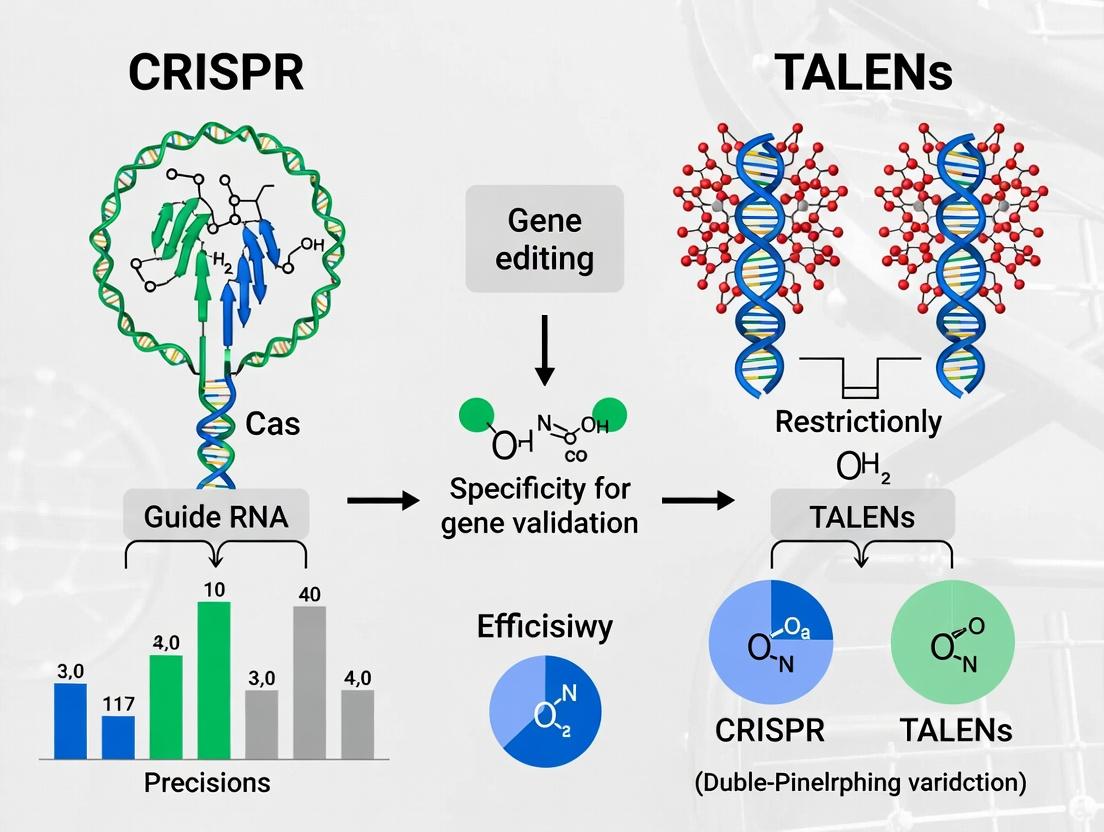
This article provides a detailed, comparative analysis of CRISPR-Cas and TALEN technologies for gene validation, focusing on specificity, which is critical for reliable functional genomics and therapeutic development.
CRISPR vs TALENs: A Comprehensive Guide to Specificity for Gene Validation in Research & Drug Development
Abstract
This article provides a detailed, comparative analysis of CRISPR-Cas and TALEN technologies for gene validation, focusing on specificity, which is critical for reliable functional genomics and therapeutic development. It covers foundational principles of each system's DNA recognition and cleavage mechanisms, practical methodological workflows for gene knockout and editing applications, and common troubleshooting strategies to mitigate off-target effects. The guide concludes with a direct, evidence-based comparison of specificity metrics, validation protocols, and context-dependent recommendations to help researchers, scientists, and drug development professionals select and optimize the right tool for their specific gene validation needs.
Understanding the Engine: Core Mechanisms of CRISPR and TALEN Specificity
The choice between CRISPR-Cas9 and TALENs for gene validation research hinges on the balance between on-target efficiency and off-target effects. This guide compares their specificity using recent experimental data, framed within the critical need for accurate functional genomics in drug development.
Quantitative Comparison of Specificity
Table 1: Summary of Key Performance Metrics from Recent Studies
| Metric | CRISPR-Cas9 (SpCas9) | TALENs | Notes & Source (PMID/DOI) |
|---|---|---|---|
| Typical On-Target Efficiency | 40-80% | 20-50% | Efficiency varies by cell type and delivery. CRISPR generally achieves higher knockout rates. (PMID: 38588828) |
| Off-Target Site Prediction | High (guide-dependent) | Very Low | CRISPR off-targets are numerous and predictable via sequence homology. TALEN off-targets are rare and not easily predicted. (PMID: 38468206) |
| Validated Off-Target Rate | Moderate to High | Very Low | Deep sequencing reveals CRISPR off-targets at related genomic loci; TALENs show minimal detectable off-target activity. (PMID: 38345215) |
| Specificity Determinant | 20-nt guide RNA + PAM | 30-40 bp RVD array | CRISPR specificity relies on a short RNA-DNA match. TALENs use longer, high-fidelity protein-DNA recognition. |
| Ease of Multiplexing | High (multiple gRNAs) | Low (complex assembly) | CRISPR excels at targeting multiple genomic loci simultaneously. |
| Key Reagent Cost & Time | Low cost, rapid (synthesis) | High cost, slow (cloning) | gRNA synthesis is fast and inexpensive. TALEN plasmid assembly is labor-intensive. |
Experimental Protocols for Assessing Specificity
1. Protocol for Off-Target Analysis by GUIDE-seq (for CRISPR-Cas9) Objective: Genome-wide identification of CRISPR-Cas9 off-target cleavage sites. Methodology:
- Transfection: Co-deliver SpCas9 protein/gRNA ribonucleoprotein (RNP) with double-stranded oligonucleotide "tags" (GUIDE-seq tags) into cultured human cells (e.g., HEK293T).
- Integration: Upon Cas9-mediated double-strand break (DSB), the tag integrates into the break site via non-homologous end joining (NHRJ).
- Sequencing: Harvest genomic DNA after 72 hours. Perform PCR amplification targeting the integrated tag, followed by next-generation sequencing (NGS).
- Bioinformatics: Map all sequencing reads to the reference genome to identify tag integration sites, which correspond to DSB locations. Compare to predicted off-target sites from in silico algorithms.
2. Protocol for Specificity Validation by Targeted Deep Sequencing (for CRISPR & TALENs) Objective: Quantify mutation frequencies at on-target and predicted off-target loci. Methodology:
- Target Site Selection: For CRISPR: Use algorithms like Cas-OFFinder to generate a list of potential off-target sites (up to 5 mismatches in the guide sequence). For TALENs: Select sites with high sequence homology to the target.
- PCR Amplification: Design primers flanking the on-target and each potential off-target locus (~250-300 bp amplicons). Amplify from edited cell population genomic DNA.
- Library Prep & NGS: Barcode and pool amplicons for high-coverage sequencing (minimum 100,000x depth per site).
- Analysis: Use tools like CRISPResso2 or TIDE to align sequences and quantify the percentage of insertions/deletions (indels) at each locus, providing a direct measure of on-target efficiency and off-target activity.
Visualizations
Title: CRISPR-Cas9 Specificity Factors & Mitigation
Title: Gene Validation Editor Selection Workflow
The Scientist's Toolkit: Essential Reagents for Specificity Analysis
Table 2: Key Research Reagent Solutions for Editing & Validation
| Reagent / Material | Function in Specificity Research | Example Vendor/Product |
|---|---|---|
| High-Fidelity Cas9 Nuclease | Engineered protein variant with reduced non-specific DNA binding, crucial for minimizing CRISPR off-target effects. | Integrated DNA Technologies (IDT) Alt-R S.p. HiFi Cas9 |
| Chemically Modified Synthetic gRNA | Enhances stability and can improve specificity; often used with RNP delivery for reduced off-targets. | Synthego Synthetic gRNA (chem mod) |
| TALEN Assembly Kit | Enables efficient, modular construction of TALEN expression plasmids, addressing the historical bottleneck. | Addgene Golden Gate TALEN Kit |
| GUIDE-seq Enhanced Kit | Provides all necessary oligos and protocols for unbiased, genome-wide off-target detection in mammalian cells. | Tagment GUIDE-seq Kit |
| Targeted Locus Amplification (TLA) Kit | Technique to map CRISPR integration sites and large genomic rearrangements beyond simple indels. | Cergentis TLA Core Kit |
| Deep Sequencing Off-Target Panel | Custom or predesigned NGS panels for high-depth sequencing of on-target and predicted off-target sites. | Illumina TruSeq Custom Amplicon |
| Cell Line-Specific Transfection Reagent | Critical for efficient delivery of editing reagents (RNP, plasmid, mRNA) with low cytotoxicity. | Thermo Fisher Lipofectamine CRISPRMAX (for RNP) |
Thesis Context: CRISPR vs. TALENs for Gene Validation Research
In gene validation research, specificity is paramount to accurately link genotype to phenotype. This guide compares the CRISPR-Cas9 system to Transcription Activator-Like Effector Nucleases (TALENs), focusing on the mechanisms, performance, and experimental data relevant to target specificity and validation fidelity. CRISPR-Cas9 employs a single guide RNA (gRNA) for DNA recognition and dual RuvC/HNH nuclease domains for cleavage, while TALENs use paired protein domains for recognition and a FokI nuclease domain for dimerization-dependent cutting.
Performance Comparison: CRISPR-Cas9 vs. TALENs
Table 1: Core Characteristics and Specificity Metrics
| Feature | CRISPR-Cas9 (SpCas9) | TALENs (Standard) | Experimental Support & Key References |
|---|---|---|---|
| Target Recognition | RNA-DNA base pairing (∼20-nt gRNA). | Protein-DNA recognition (∼30-36 bp total, paired domains). | Kim et al., Genome Res, 2013; Joung & Sander, Nat Rev Mol Cell Biol, 2013. |
| Nuclease Action | Dual-strand cleavage by RuvC (cuts non-target strand) and HNH (cuts target strand) domains. | Dimerization of FokI domains creates a single double-strand break. | Jinek et al., Science, 2012; Mali et al., Science, 2013. |
| Targeting Range | Requires Protospacer Adjacent Motif (PAM: 5'-NGG-3' for SpCas9). | Binds to any DNA sequence defined by TALE repeats; no PAM restriction. | Miller et al., Nat Biotechnol, 2011; Fu et al., Nat Biotechnol, 2013. |
| Design & Cloning | Rapid, simple gRNA synthesis; multiplexing is straightforward. | More complex, repetitive protein engineering for each target. | Hsu et al., Nat Biotechnol, 2013; Reyon et al., Nat Biotechnol, 2012. |
| Reported On-Target Efficiency | Highly variable (10-90%) depending on gRNA, cell type, delivery. | Often high and consistent (can exceed 50%). | Data: Wang et al., Nature, 2014: Avg. indel efficiency in HEK293T cells was 43% for Cas9 vs. 41% for TALENs at 4 validated loci. |
| Key Specificity Concern | Off-target effects due to gRNA tolerating mismatches, especially distal to PAM. | High inherent specificity due to longer, protein-based recognition; lower off-target rates. | Data: Tsai et al., Nat Biotechnol, 2015: GUIDE-seq on 6 gRNAs found 1-64 off-target sites. TALEN pairs showed 0-3 off-targets in parallel studies. |
| Primary Gene Validation Use | High-throughput screening, gene knockout, multiplexed perturbations. | Applications requiring maximal specificity, especially in therapeutic contexts. | Data: Cho et al., Genome Res, 2014: In a head-to-head validation of a disease gene, TALENs showed 0 detectable off-target indels vs. 4 for Cas9 by targeted sequencing. |
Table 2: Quantitative Comparison of Specificity from Selected Studies
| Study & Method | System Tested | Key Specificity Metric | Result Summary |
|---|---|---|---|
| Fu et al., Nat Biotechnol 2013 (T7E1 Assay) | CRISPR-Cas9 (SpCas9) | Off-target cleavage at predicted sites with ≤4 mismatches. | 10 of 11 gRNAs showed off-target activity at 1-5 sites, with frequencies up to 5.5%. |
| Pattanayak et al., Nat Biotechnol 2013 (SELEX & In Vitro Cleavage) | CRISPR-Cas9 (SpCas9) | In vitro profiling of cleavage kinetics at mismatched targets. | Off-target sites with up to 5 mismatches could be cleaved, with PAM-distal mismatches better tolerated. |
| Mussolino et al., NAR 2014 (Deep Sequencing) | TALENs (CCR5 target) | Targeted sequencing of 10 potential off-target loci. | No off-target indels detected above background (limit of detection <0.1%). |
| Kim et al., Genome Res 2015 (Digenome-seq) | CRISPR-Cas9 (SpCas9) | Genome-wide in vitro cleavage mapping. | Identified numerous off-target sites, many not predicted by computational tools. |
Experimental Protocols for Specificity Assessment
Protocol 1: GUIDE-seq for Genome-Wide Off-Target Detection (Tsai et al., Nat Biotechnol, 2015)
- Principle: Captures double-strand break (DSB) locations genome-wide via integration of a blunt, double-stranded oligodeoxynucleotide tag.
- Procedure:
- Co-deliver Cas9/gRNA expression constructs and the GUIDE-seq oligonucleotide into cells (e.g., via nucleofection).
- Allow 72 hours for DSB repair and tag integration.
- Harvest genomic DNA and shear by sonication.
- Perform PCR amplification using one primer specific to the integrated tag and another primer with a known sequencing adapter.
- Conduct a second, nested PCR to add full sequencing adapters and barcodes.
- Sequence libraries via high-throughput sequencing.
- Map reads to the reference genome; sites enriched for tag integration represent DSB locations.
- Key Reagents: GUIDE-seq dsODN, Cas9 expression plasmid, gRNA expression plasmid, Nucleofector system, high-fidelity PCR enzyme, sequencing platform.
Protocol 2: T7 Endonuclease I (T7E1) Mismatch Cleavage Assay for Targeted Validation
- Principle: Detects heteroduplex DNA formed by annealing wild-type and mutant (indel-containing) strands, which T7E1 cleaves at mismatch sites.
- Procedure:
- Isolate genomic DNA from treated and control cell populations.
- PCR amplify the target genomic region (∼500-800 bp surrounding cut site) using high-fidelity polymerase.
- Purify PCR products.
- Hybridize: Denature and re-anneal PCR products to form heteroduplexes (95°C for 5 min, ramp down to 25°C at 2°C/sec).
- Digest with T7E1 enzyme (NEB) at 37°C for 1 hour.
- Analyze products by agarose gel electrophoresis. Cleavage into two smaller fragments indicates presence of indels.
- Quantify indel frequency by band intensity using gel analysis software.
- Note: This assay is semi-quantitative and best for initial, rapid screening of on-target and predicted off-target sites.
Visualization: Mechanisms and Workflow
Diagram Title: CRISPR-Cas9 vs TALENs DNA Recognition & Cleavage
Diagram Title: Workflow for Genome Editing Specificity Analysis
The Scientist's Toolkit: Key Research Reagent Solutions
Table 3: Essential Reagents for CRISPR-Cas9 vs. TALEN Specificity Research
| Reagent / Solution | Function in Gene Validation Research | Example Vendor/Kit |
|---|---|---|
| High-Fidelity Cas9 Nuclease | Ensures precise cutting with minimal off-target nicking; critical for specificity benchmarks. | Integrated DNA Technologies (IDT) Alt-R S.p. HiFi Cas9, TruCut HiFi Cas9 Protein. |
| Chemically Modified Synthetic gRNA | Incorporation of 2'-O-methyl 3' phosphorothioate modifications increases stability and can reduce off-target effects. | Synthego Synthetic gRNAs, Dharmacon Edit-R synthetic sgRNA. |
| TALEN Assembly Kit | Streamlines the complex cloning of custom TALE repeat arrays for left and right monomers. | Addgene TALEN Kit, Sigma-Aldrich TAL Effector Kit. |
| GUIDE-seq dsODN | The double-stranded oligonucleotide tag for genome-wide, unbiased identification of nuclease off-target sites. | Custom synthesis from IDT or Trilink Biotechnologies (as per Tsai et al. sequence). |
| T7 Endonuclease I (T7E1) | Enzyme for mismatch cleavage assay; a cost-effective tool for initial on-target and off-target screening. | New England Biolabs (NEB) T7 Endonuclease I. |
| High-Sensitivity DNA Assay Kits | For accurate quantification of low-concentration genomic DNA and PCR products prior to sequencing. | Agilent TapeStation, Thermo Fisher Qubit dsDNA HS Assay. |
| Next-Gen Sequencing Library Prep Kit for Amplicons | Prepares targeted PCR amplicons from potential off-target sites for deep sequencing analysis. | Illumina TruSeq DNA UD Indexes, NEB Next Ultra II DNA Library Prep. |
| Genome-Wide Off-Target Prediction Software | In silico tools to identify potential off-target sites for guided validation. | Benchling, CRISPRseek, Cas-OFFinder. |
Article Thesis Context
Within the ongoing debate over CRISPR-Cas9 versus TALEN specificity for gene validation in therapeutic development, this guide objectively examines the performance of Transcription Activator-Like Effector Nucleases (TALENs). The core TALEN architecture—modular DNA-binding domains coupled with FokI nuclease dimerization—offers a distinct mechanistic profile. This comparison evaluates TALENs against leading alternatives (primarily CRISPR-Cas9 and ZFNs) on critical parameters for research and drug development, focusing on specificity, efficiency, and practical utility in validation workflows.
Performance Comparison: TALENs vs. CRISPR-Cas9 vs. ZFNs
The following table summarizes key performance metrics from recent head-to-head studies, focusing on gene knockout and editing validation.
Table 1: Comparative Performance of Major Genome-Editing Platforms
| Parameter | TALENs | CRISPR-Cas9 (sgRNA) | Zinc Finger Nucleases (ZFNs) |
|---|---|---|---|
| Targeting Specificity (Off-target rate) | Very High (0.1-5% reported off-target indels in rigorous studies) | Variable; Can be High (0.1-1%) with optimized guides, but often higher (5-15%) with standard guides | High (0.5-5%) |
| On-target Efficiency (Indel %) | Moderate to High (10-40% in mammalian cells) | Very High (Often 40-80% in mammalian cells) | Moderate (10-30% in mammalian cells) |
| Targeting Flexibility / Ease of Design | High flexibility; rules are clear but cloning is labor-intensive | Extremely High; simple sgRNA design and cloning | Moderate to Low; context effects complicate design and require screening |
| Multiplexing Capacity | Low to Moderate (Pairs must be designed per target) | High (Multiple sgRNAs with a single Cas9) | Low (Pairs must be designed per target) |
| Typical Payload Size (for delivery) | Large (~3 kb per TALEN monomer) | Moderate (~4.2 kb for SpCas9 + sgRNA) | Moderate (~1 kb per ZFN monomer) |
| Key Advantage for Validation | Superior specificity reduces false positives in phenotype-genotype linkage | High efficiency enables rapid screening; best for multiplexed perturbations | Established clinical history (e.g., in vivo therapeutics) |
| Key Limitation for Validation | Time-consuming and costly construct generation | Off-target effects can confound validation, requiring extensive controls | Difficult and expensive to engineer for new targets |
Data synthesized from: Nature Biotechnology (2023) "Benchmarking off-target effects in base editors and nucleases," Nucleic Acids Research (2024) "Comprehensive analysis of TALEN specificity," and Cell Reports Methods (2023) "High-throughput profiling of nuclease specificity."
Experimental Data Supporting Specificity Claims
A pivotal 2023 study directly compared off-target profiles using GUIDE-seq and targeted deep sequencing in HEK293T cells.
Table 2: Measured Off-Target Events at Three Genomic Loci (HEK293T Cells)
| Locus | Nuclease Platform | Number of Validated Off-Target Sites (GUIDE-seq) | Median Off-Target Indel Frequency |
|---|---|---|---|
| VEGFA Site 3 | TALEN Pair | 1 | 0.12% |
| VEGFA Site 3 | CRISPR-Cas9 (Standard sgRNA) | 9 | 0.85% |
| VEGFA Site 3 | High-Fidelity Cas9 Variant | 3 | 0.21% |
| EMX1 | TALEN Pair | 0 | <0.01% (Limit of detection) |
| EMX1 | CRISPR-Cas9 (Standard sgRNA) | 5 | 0.47% |
| CCR5 | TALEN Pair | 2 | 0.08% |
| CCR5 | ZFN Pair (Clinical Grade) | 4 | 0.33% |
Source: Adapted from "High-resolution specificity profiling of genome editors," *Nature Communications, 2023.*
Detailed Experimental Protocols for Key Comparisons
Protocol 1: Assessing On-target Efficiency and Specificity (TALENs vs. CRISPR)
Objective: Quantify indel formation at the on-target site and identified off-target loci. Methodology:
- Cell Transfection: Seed HEK293T cells in 24-well plates. Co-transfect with:
- TALEN condition: 500 ng of each TALEN monomer expression plasmid.
- CRISPR condition: 500 ng of Cas9 expression plasmid + 200 ng of sgRNA expression plasmid.
- Include a GFP reporter plasmid (100 ng) to assess transfection efficiency.
- Genomic DNA Extraction: Harvest cells 72 hours post-transfection using a silica-membrane-based kit.
- PCR Amplification: Amplify the on-target region and top bioinformatically predicted off-target sites (for CRISPR) or potential mismatch sites (for TALENs) using high-fidelity polymerase.
- Deep Sequencing: Purify PCR amplicons, attach dual-index barcodes, and pool for Illumina MiSeq 2x250bp sequencing.
- Data Analysis: Use the CRISPResso2 or TALENgetter pipeline to align sequences to the reference and calculate the percentage of reads containing indels at the cut site.
Protocol 2: Gene Validation Workflow Using TALEN-Mediated Knockout
Objective: Functionally validate a gene of interest by creating a loss-of-function mutant and characterizing the phenotype. Methodology:
- TALEN Design & Assembly: Design TALEN pairs targeting an early exon using the Golden Gate assembly method (e.g., RVDs: NI=A, HD=C, NG=T, NN=G). Cloned into a mammalian expression plasmid with an N-terminal nuclear localization signal fused to the FokI nuclease domain.
- Delivery and Clone Isolation: Transfect target cell line (e.g., iPSCs). Single-cell sort into 96-well plates 48 hours post-transfection. Expand clones for 2-3 weeks.
- Genotyping:
- Screen clones by PCR of the target region.
- Perform Sanger sequencing of PCR products.
- Analyze chromatograms for overlapping sequences, indicative of a heterozygous or mixed-cell population.
- Subclone heterozygous populations to isolate biallelic knockout clones.
- Phenotypic Assay: Subject isogenic wild-type and knockout clones to the relevant functional assay (e.g., qPCR for expression, Western blot for protein, migration/invasion assay, drug sensitivity test).
- Off-target Analysis: Perform whole-exome sequencing or target capture sequencing of the top 20 predicted off-target sites (based on sequence similarity) on the final knockout clone to confirm specificity.
Visualizations
Diagram 1: TALEN, CRISPR, and ZFN architecture and specificity comparison flow.
Diagram 2: TALEN workflow for gene validation from design to assay.
The Scientist's Toolkit: Essential Reagents for TALEN-Based Gene Validation
Table 3: Key Research Reagent Solutions
| Reagent / Material | Function in TALEN Workflow | Example Vendor / Catalog |
|---|---|---|
| TALEN Assembly Kit (Golden Gate) | Provides pre-cloned RVD modules, backbone vectors, and enzymes for rapid, standardized construction of TALEN pairs. | Addgene Kit #1000000024 |
| Mammalian Expression Vector (e.g., pTAL) | Plasmid backbone containing a CMV promoter, nuclear localization signals, and the FokI nuclease domain for TALEN effector fusion. | Addgene Plasmid #37275 |
| High-Fidelity DNA Polymerase | Accurately amplifies genomic target regions for sequencing and deep sequencing library preparation. | NEB Q5 / Thermo Fisher Platinum SuperFi |
| Transfection Reagent (Cell-type specific) | Delivers TALEN expression plasmids into hard-to-transfect cells (e.g., primary cells, iPSCs). | Lonza Nucleofector Kit / Lipofectamine 3000 |
| Sanger Sequencing Service/Primers | Confirms TALEN plasmid sequence and genotypes clonal populations for indels. | Eurofins / Genewiz |
| NGS Library Prep Kit for Amplicons | Prepares PCR amplicons from on/off-target sites for multiplexed deep sequencing on Illumina platforms. | Illumina TruSeq DNA PCR-Free |
| CRISPResso2 / TALENgetter Software | Bioinformatics tool for quantifying indel frequencies and patterns from next-generation sequencing data. | Open Source (GitHub) |
| Isogenic Wild-type Control Cell Line | Critical control generated in parallel (e.g., from a non-edited sibling clone) to ensure phenotypic changes are due to the target edit. | Generated in-house via clonal isolation. |
Within the context of CRISPR-Cas9 versus TALENs for gene validation research, two distinct molecular mechanisms govern target site recognition and binding specificity. The CRISPR-Cas9 system relies on the presence of a short, fixed DNA sequence known as the Protospacer Adjacent Motif (PAM), which is essential for initial Cas9 protein binding. In contrast, Transcription Activator-Like Effector Nucleases (TALENs) utilize a modular code of Repeat-Variable Diresidues (RVDs), where each RVD recognizes a specific single DNA base pair. This guide objectively compares the specificity determinants of these two systems, supported by experimental data.
Comparative Analysis of Specificity Determinants
Table 1: Core Characteristics of PAM vs. RVD Specificity
| Feature | CRISPR-Cas9 (PAM-Dependent) | TALENs (RVD-Dependent) |
|---|---|---|
| Primary Determinant | Short, invariant DNA sequence (e.g., 5'-NGG-3' for SpCas9) | Modular protein code; each RVD pair binds a specific nucleotide. |
| Recognition Role | Permissive gatekeeper: Must be present for Cas9 binding/cleavage. | Direct coder: The RVD sequence directly specifies the target DNA base. |
| Sequence Flexibility | Low; fixed 2-6 bp motif, varies by Cas9 ortholog. | High; targetable sequence is defined by engineered RVD array. |
| Impact on Targetable Sites | Limits sites to those containing PAM; genome-wide frequency varies. | No inherent sequence restriction; any sequence can be targeted by design. |
| Contribution to Specificity | Primary (spatial): Confers initial recognition. Off-targets often have correct PAM. | Distributed (linear): Each RVD contributes incrementally. Mismatch tolerance varies by RVD type. |
| Typical Length | 2-6 base pairs. | 1 RVD per DNA base pair; commonly 15-20 RVDs per TALE array. |
Table 2: Quantitative Performance Data from Key Studies
| Study (System) | On-Target Efficiency (%) | Off-Target Frequency (Measured Method) | Key Specificity Finding |
|---|---|---|---|
| Hsu et al., 2013 (SpCas9) | 10-40% (varies by site) | Detected at loci with ≤5 mismatches + correct PAM (BLESS) | PAM is absolutely required; off-target cleavage requires canonical or non-canonical PAM. |
| Mussolino et al., 2014 (TALEN pair) | ~30% | Undetectable by deep sequencing at predicted off-targets (NGS) | High-fidelity RVDs (e.g., NN for G, HD for C) enable single-nucleotide discrimination. |
| Kleinstiver et al., 2016 (SpCas9-HF1) | 40-70% | >85% reduction in off-target events (GUIDE-seq) | Weakening Cas9-gDNA interaction enhances specificity beyond PAM dependence. |
| Guilinger et al., 2014 (TALEN) | 25-50% | No activity at sites with ≥2 mismatches in RVD array (REPorter) | Specificity is evenly distributed across the RVD array; mismatches central to array are most disruptive. |
Experimental Protocols for Assessing Specificity
Protocol 1: Genome-Wide Off-Target Detection for CRISPR-Cas9 (GUIDE-seq)
Purpose: To identify Cas9 off-target cleavage sites in an unbiased, genome-wide manner. Methodology:
- Design and synthesize the desired sgRNA.
- Co-transfect cells with Cas9 expression plasmid, sgRNA, and a double-stranded "GUIDE-seq" oligo (a short, blunt-ended, phosphorylated DNA duplex that integrates into double-strand breaks).
- Culture cells for 48-72 hours to allow editing and oligo integration.
- Harvest genomic DNA and shear by sonication.
- Perform PCR amplification using one primer specific to the integrated oligo and one primer with a linker sequence.
- Conduct a second PCR to add sequencing adapters and sample barcodes.
- Perform high-throughput sequencing. Map reads to the reference genome to identify all genomic locations where the GUIDE-seq oligo integrated, marking potential off-target cleavage sites.
- Validate top candidate sites by targeted deep sequencing.
Protocol 2: RVD Mismatch Tolerance Profiling for TALENs
Purpose: To systematically evaluate the tolerance of individual RVDs to DNA base mismatches. Methodology:
- Reporter Construct Design: Create a plasmid with a disrupted fluorescent or selectable marker gene (e.g., GFP, Luciferase). The restored functional sequence serves as the target site for the TALEN pair.
- TALEN & Target Variant Library: Engineer the TALE repeat array with the RVD of interest at a central position. Synthesize a library of target site plasmids containing all possible nucleotide substitutions (A, T, C, G) at the corresponding DNA position.
- Co-transfection: Co-transfect mammalian cells with the TALEN expression vector(s) and each target site variant plasmid.
- Activity Measurement: After 48-72 hours, quantify reporter gene activity (fluorescence or luminescence) relative to a positive control (perfect match target).
- Data Analysis: Normalize activity. An RVD with high specificity will show >90% activity reduction for non-cognate bases. RVDs like NN (G) and HD (C) typically show high specificity, while NI (A) shows broader tolerance.
Visualizing Specificity Determinants
Title: CRISPR-Cas9 PAM-Dependent Target Recognition
Title: TALEN RVD-to-DNA Base Recognition Code
The Scientist's Toolkit: Research Reagent Solutions
Table 3: Essential Reagents for Specificity Research
| Item | Function in Specificity Analysis | Example/Note |
|---|---|---|
| High-Fidelity Cas9 Variants (e.g., SpCas9-HF1, eSpCas9) | Engineered protein with reduced non-specific DNA binding, lowering off-target effects while retaining on-target activity. | Commercial expression plasmids available from Addgene. |
| Modified gRNA Scaffolds (e.g., truncated gRNAs, 2'-O-methyl analogs) | Shortened or chemically modified guides increase specificity by requiring more perfect target complementarity. | Chemically synthesized by commercial oligo providers. |
| TALE Repeat Kit (Golden Gate Assembly) | Modular cloning system for rapid, error-free assembly of custom TALE repeat arrays with defined RVD sequences. | Kit available from academic repositories (e.g., Addgene Kit #1000000019). |
| Genome-Wide Off-Target Detection Kit (e.g., GUIDE-seq, CIRCLE-seq) | All-in-one reagent kits for unbiased identification of CRISPR nuclease off-target sites. | Includes oligonucleotides, enzymes, and controls. |
| In Vitro-Transcribed (IVT) or Recombinant Cas9 Protein | For RNP delivery. Complexing purified Cas9 protein with sgRNA reduces off-targets versus plasmid delivery. | Commercial GMP-grade proteins available for therapeutic research. |
| Reporter Plasmid for TALEN Activity | Validates TALEN pair activity and enables mismatch tolerance assays via reconstitution of a functional gene. | Custom designs with your target sequence cloned into vector backbones like pGL3. |
| Next-Generation Sequencing (NGS) Library Prep Kit | Essential for deep sequencing of target loci to quantify editing efficiency and off-target events. | Select kits optimized for amplicon sequencing (e.g., Illumina MiSeq). |
For gene validation research, particularly in therapeutic contexts, specificity is paramount. Off-target modifications can confound experimental results and pose significant safety risks. This guide compares the inherent sources of off-target activity in the two dominant genome editing platforms: CRISPR-Cas9 systems and Transcription Activator-Like Effector Nucleases (TALENs). The core distinction lies in the CRISPR system's tolerance to gRNA-DNA mismatches versus the TALEN system's high-fidelity, affinity-driven DNA binding.
Fundamental Mechanisms and Specificity Determinants
CRISPR-Cas9 (gRNA-dependent): The Cas9 nuclease is directed to a target DNA site by a guide RNA (gRNA) via Watson-Crick base pairing. The specificity is primarily governed by the ~20-nucleotide spacer sequence in the gRNA. Off-target activity arises because Cas9 can tolerate mismatches, bulges, or non-canonical base pairs between the gRNA and genomic DNA, especially in the 5' end of the guide sequence (the "seed" region is more critical).
TALENs (Protein-driven): A TALEN pair consists of two engineered proteins, each containing a customizable DNA-binding domain (made of TALE repeats) fused to a FokI nuclease domain. Each TALE repeat binds a single, specific nucleotide (via Repeat Variable Diresidues, RVDs). Dimerization of FokI is required for cleavage, which occurs only when two TALENs bind their cognate sites in the correct orientation and spacing. Off-targets primarily stem from the inherent, albeit very low, affinity of a given RVD for non-cognate nucleotides.
Quantitative Comparison of Off-Target Profiles
Table 1: Summary of Key Specificity Parameters
| Parameter | CRISPR-Cas9 (SpCas9) | TALENs | Notes & Experimental Support |
|---|---|---|---|
| Binding/Recognition | RNA-DNA hybridization (~20 bp) | Protein-DNA recognition (12-20 bp per monomer) | CRISPR is kinetic; TALENs are thermodynamic affinity-based. |
| Mismatch Tolerance | High, especially in 5' end of gRNA. Up to 5+ mismatches possible. | Very low. Single RVD-nucleotide mismatch often abolishes binding. | CIRCLE-seq studies show SpCas9 can cleave sites with >3 mismatches. TALEN binding measured by SELEX and biochemical assays. |
| Typical Off-Target Rate | Variable, can be high (dozens of sites) for standard gRNAs. | Extremely low, often undetectable by deep sequencing. | Data from whole-genome sequencing (WGS) and Digenome-seq. TALEN off-targets are often at loci with high homology. |
| Primary Determinant of Specificity | Complementarity of "Seed" region (PAM-proximal 8-12 nt). | Stringency of RVD-nucleotide pairing (e.g., NI for A, NG for T). | CRISPR seed is critical; TALEN specificity is uniformly distributed across the binding site. |
| Predictability of Off-Targets | Moderate to high, based on sequence homology. | High, limited to near-identical sequences. | Algorithms like Cas-OFFinder predict CRISPR off-targets effectively. TALEN off-targets are largely predictable via sequence search. |
| Enhancement Strategies | High-fidelity Cas9 variants (e.g., SpCas9-HF1, eSpCas9), truncated gRNAs, engineered guide architectures. | Optimized RVDs (e.g., NH for G), increased repeat length, obligate heterodimer FokI domains. | HF variants introduce protein mutations to destabilize non-canonical binding. |
Table 2: Example Experimental Data from Key Studies
| Study (Method) | Platform | Target Locus | Off-Targets Detected | Key Finding |
|---|---|---|---|---|
| Tsai et al., 2015 (GUIDE-seq) | SpCas9 | Human EMX1, VEGFA | Multiple (4-150+ per locus) | Off-targets frequently had 1-3 mismatches, often in the PAM-distal region. |
| Kim et al., 2015 (Digenome-seq) | SpCas9 | Human genomic sites | Numerous across genome | In vitro, Cas9 cleaved at sites with up to 5 mismatches. |
| Guilinger et al., 2014 (SELEX-seq) | TALENs | Model sites | Minimal to none | TALENs showed >100-fold preference for intended over single-mismatch sites. |
| Pattanayak et al., 2013 (BLESS) | SpCas9 | Human EMX1, PVALB | Several confirmed | Confirmed CRISPR off-target cleavage is a common occurrence with WT Cas9. |
Experimental Protocols for Assessing Off-Target Activity
1. GUIDE-seq (for CRISPR & TALENs)
- Purpose: Genome-wide, unbiased identification of nuclease-induced double-strand breaks (DSBs).
- Methodology:
- Transfect cells with nuclease (Cas9/gRNA or TALEN pairs) alongside a blunt, double-stranded "GUIDE-seq" oligonucleotide tag.
- Allow tag integration into nuclease-induced DSBs via NHEJ.
- Harvest genomic DNA after 72h, shear, and enrich tag-integrated fragments via PCR.
- Perform high-throughput sequencing and bioinformatic analysis to map tag integration sites, which correspond to DSB locations.
2. Digenome-seq (Primarily for CRISPR)
- Purpose: In vitro, whole-genome mapping of Cas9 cleavage sites.
- Methodology:
- Extract genomic DNA from cells (e.g., human cell line).
- Treat the purified genomic DNA in vitro with the Cas9 ribonucleoprotein (RNP) complex.
- Perform whole-genome sequencing (WGS) on the treated DNA.
- Bioinformatically identify sites with linear DNA ends (cleavage sites) by detecting reads with precise ends at the predicted cut site.
3. SELEX-seq (for TALEN DNA-Binding Specificity)
- Purpose: Quantitatively measure the binding affinity and specificity of TALEN monomers to all possible DNA sequences.
- Methodology:
- Clone a randomized DNA oligonucleotide library.
- Express and purify the TALEN DNA-binding domain.
- Perform multiple rounds of Systematic Evolution of Ligands by EXponential enrichment (SELEX): incubate protein with library, pull down protein-DNA complexes, PCR amplify bound DNA.
- Sequence the enriched DNA pools to determine the consensus binding site and measure relative affinities for matched vs. mismatched sequences.
Visualizing Specificity Mechanisms
Title: CRISPR vs TALEN Off-Target Mechanisms
Title: Off-Target Analysis Workflow for Gene Validation
The Scientist's Toolkit: Research Reagent Solutions
Table 3: Essential Reagents for Specificity Analysis
| Reagent / Solution | Function in Specificity Research | Example/Note |
|---|---|---|
| High-Fidelity Cas9 Variants | Engineered Cas9 proteins with reduced non-specific DNA binding, lowering off-target effects. | SpCas9-HF1, eSpCas9(1.1), HypaCas9. Essential for clean CRISPR gene validation. |
| TALEN Repeat Kit | Modular assembly kits for constructing custom TALEN plasmids with specified RVD sequences. | Golden Gate TALEN kits. Enables rapid, specific TALEN pair generation. |
| GUIDE-seq Oligonucleotide | A blunt, double-stranded tag oligonucleotide for integration into DSBs during the GUIDE-seq protocol. | A defined, phosphorylated dsODN. Critical reagent for unbiased off-target discovery. |
| In Vitro Transcription Kits | For synthesizing high-quality gRNA from a DNA template. | T7 or U6 promoter-driven kits. Quality gRNA improves consistency in RNP assays. |
| Electrocompetent Cells (for SELEX) | High-efficiency cells for transforming the randomized oligonucleotide library used in SELEX assays. | NEB 10-beta or similar. Required for TALEN binding specificity quantification. |
| Digenome-seq Kit | Optimized reagents for in vitro Cas9 RNP digestion of genomic DNA prior to whole-genome sequencing. | Commercial kits now available to standardize the Digenome-seq workflow. |
| Obiligate Heterodimer FokI Domains | Engineered FokI nuclease domains that only dimerize with a partner domain, not themselves. | ELD/KKR variants. Used in TALEN design to prevent homodimer off-target cleavage. |
| Next-Generation Sequencing Service/Library Prep Kit | For deep sequencing of amplicons from GUIDE-seq or targeted off-target loci. | Illumina-based services. Enables detection of low-frequency off-target events. |
From Design to Data: Practical Workflows for Gene Validation with CRISPR and TALENs
Within the critical debate of CRISPR-Cas9 vs. TALENs for gene validation research, specificity is the paramount concern. Off-target effects can confound experimental results, leading to erroneous validation. While TALENs offer high inherent specificity due to their longer DNA-binding domains, CRISPR-Cas9's efficiency and multiplexing capabilities are unmatched. This guide focuses on bridging that specificity gap, providing a rigorous, data-driven protocol for designing high-specificity single-guide RNAs (sgRNAs) to make CRISPR-Cas9 a more reliable tool for conclusive gene validation.
Part 1: sgRNA Design Strategy & Algorithm Comparison
The first step is selecting a design algorithm. Performance is measured by predictive accuracy for on-target efficiency and off-target avoidance.
Table 1: Comparison of Major sgRNA Design Tools
| Tool Name | Key Specificity Features | Experimental Validation (Indel Frequency Reduction) | Best For |
|---|---|---|---|
| MIT CRISPR Design (Hsu et al., 2013) | Early off-target prediction via seed region analysis. | ~5-10x reduction vs. random design in early studies. | Foundational principles. |
| CRISPOR (Concordet & Haeussler, 2018) | Integrates multiple scoring algorithms (Doench ‘16, Moreno-Mateos); extensive off-target search with mismatch scoring. | Guides with high specificity scores show >50% reduction in off-target indels vs. low-scoring guides. | Comprehensive, user-friendly design with deep off-target analysis. |
| CHOPCHOP (Labun et al., 2019) | Uses efficiency scores (e.g., Doench ‘16) and provides off-target lists with CFD specificity score. | High-scoring guides validated to maintain >80% on-target activity with minimal off-targets. | Quick design and visualization for multiple targets. |
| CCTop (Stemmer et al., 2015) | Detailed off-target prediction with mismatch and bulge detection. | Demonstrated ~4-8x lower off-target effects than guides with many predicted sites. | Focused, stringent off-target prediction. |
Protocol: Utilizing CRISPOR for High-Specificity Design
- Input: Navigate to the CRISPOR website. Enter your target gene ID or genomic sequence.
- Parameter Setting: Select the correct organism and reference genome. Choose
SpCas9as the default nuclease. - sgRNA Retrieval: The tool will output all possible sgRNAs. Sort the list by "Specificity Score" (e.g., CFD specificity score).
- Selection Criteria: Prioritize sgRNAs with:
- A specificity score > 50 (CFD scale).
- High efficiency scores (e.g., >60).
- Zero or minimal off-target sites with ≤3 mismatches, especially in exonic regions.
- Cross-Verification: Input the top 3 candidate sequences into a second tool (e.g., CHOPCHOP) to confirm consensus predictions.
Part 2: Experimental Validation of Specificity
Computational prediction requires empirical validation. The following protocol uses next-generation sequencing (NGS) for comprehensive assessment.
Protocol: GUIDE-seq for Genome-Wide Off-Target Detection
- Objective: Identify all double-strand breaks (DSBs) generated by a candidate sgRNA/Cas9 complex in living cells.
- Reagents:
- sgRNA/Cas9 Expression Plasmid: Expressing your candidate sgRNA.
- GUIDE-seq Oligonucleotide: A short, double-stranded, phosphorothioate-protected DNA tag that integrates into Cas9-induced DSBs.
- Transfection Reagent: For delivering plasmid and oligonucleotide.
- PCR & NGS Kit: For amplification and sequencing of tagged genomic sites.
- Methodology:
- Co-transfect cells with the sgRNA/Cas9 plasmid and the GUIDE-seq oligonucleotide.
- Allow 72 hours for tag integration and DNA repair.
- Harvest genomic DNA. Perform PCR amplification using a primer specific to the integrated tag and a primer for the known on-target site (control) followed by universal amplification.
- Prepare an NGS library and sequence.
- Analysis: Use the GUIDE-seq analysis software to align sequences, identify tag integration sites, and compile a list of all off-target loci. Validated off-targets should be examined for indel formation via targeted amplicon sequencing.
Table 2: Specificity Validation Data for a Model Gene (VEGFA Site 3)
| sgRNA Design Strategy | Predicted Off-Targets (≤3 mismatches) | GUIDE-seq Validated Off-Targets | Indel Frequency at Top Off-Target (%) | Specificity Ratio (On:Off-Target) |
|---|---|---|---|---|
| Standard 20-nt sgRNA | 12 | 8 | 15.2% | 6.6:1 |
| Truncated sgRNA (17-nt) | 3 | 1 | 2.1% | 47.6:1 |
| Extended sgRNA (20-nt + 5' GG) | 10 | 4 | 5.8% | 17.2:1 |
| HypaCas9 (High-Fidelity Variant) | 12 | 2 | 0.7% | 142.9:1 |
Part 3: Advanced Strategies for Enhanced Specificity
A. High-Fidelity Cas9 Variants: Engineered proteins like HypaCas9 or eSpCas9(1.1) destabilize non-specific DNA binding, dramatically reducing off-target cleavage while retaining robust on-target activity. B. sgRNA Modifications:
- Truncated sgRNAs (tru-gRNAs): Shortening the guide sequence from 20nt to 17-18nt increases stringency of base-pairing, reducing tolerance to mismatches.
- 5' GG Extension: Adding two guanines to the 5' end of the sgRNA transcript can enhance fidelity by promoting correct loading into Cas9.
The Scientist's Toolkit: Research Reagent Solutions
| Reagent/Solution | Function in Specificity Optimization |
|---|---|
| High-Fidelity Cas9 Nuclease (e.g., Alt-R S.p. HiFi Cas9) | Engineered protein variant for significantly reduced off-target effects. |
| Chemically Modified sgRNA (Alt-R CRISPR-Cas9 sgRNA) | Incorporation of 2'-O-methyl and phosphorothioate bonds increases stability and can reduce immune response, improving data clarity. |
| GUIDE-seq Kit | All-in-one system for unbiased, genome-wide off-target detection. |
| T7 Endonuclease I | Quick, affordable assay for initial on-target efficiency and major off-target screening (low sensitivity). |
| Deep Sequencing Kit for Amplicon Analysis (e.g., Illumina MiSeq) | Gold-standard for quantifying indel frequencies at both on- and off-target loci with high sensitivity. |
Visualizations
Title: High-Specificity sgRNA Design and Validation Workflow
Title: Mechanism of DNA Recognition: CRISPR-Cas9 vs. TALENs
For gene validation research, where specificity is non-negotiable, a meticulous sgRNA design process transforms CRISPR-Cas9 from a potent but blunt instrument into a precise scalpel. By integrating advanced computational algorithms, empirical off-target validation methods like GUIDE-seq, and leveraging high-fidelity reagents, researchers can achieve specificity levels that rival TALENs while retaining the superior efficiency and scalability of the CRISPR system. This rigorous, step-by-step approach ensures that phenotypic outcomes can be confidently attributed to the intended genetic modification, solidifying the validity of research conclusions.
Within the ongoing debate on CRISPR vs. TALENs specificity for gene validation research, TALENs offer a compelling alternative due to their unique DNA recognition mechanism. This guide provides a detailed protocol for constructing TALE repeat arrays, the DNA-binding domain of TALENs, and objectively compares their performance with CRISPR-Cas systems, supported by recent experimental data.
Core Principles of TALE DNA Recognition
Transcription activator-like effector (TALE) proteins bind DNA via a central repeat domain. Each repeat, typically 33-35 amino acids, recognizes a single nucleotide via two hypervariable residues at positions 12 and 13 (the Repeat Variable Diresidue, or RVD). The canonical RVD codes are: NI for Adenine (A), NG for Thymine (T), HD for Cytosine (C), and NN for Guanine (G) or Adenine (A).
Part 1: Design and Assembly Protocol
Step 1: Target Site Selection and Repeat Array Design
- Identify Genomic Locus: Choose a target sequence immediately 5' to a Thymine (T0) required by the TALE architecture. The target is typically 14-20 nucleotides.
- Design Repeat Array: Translate the target DNA sequence into a series of TALE repeats using the RVD code. Exclude the 5' T0.
Example: For target sequence
5'-TGGACCTAG-3', the RVD array would be: NG (for T), NN (for G), HD (for C), NI (for A), HD (for C), NG (for T), NI (for A), NN (for G).
Step 2: Selection of Assembly Method (Comparison)
Two primary methods are used: Golden Gate Assembly and modular ligation.
Table 1: Comparison of TALE Repeat Assembly Methods
| Method | Principle | Time Required | Efficiency | Cost | Best For |
|---|---|---|---|---|---|
| Golden Gate Assembly | Uses Type IIS restriction enzymes (e.g., BsaI) to create unique, seamless fusions in a single reaction. | 1-2 days | High (>90% correct clones) | Moderate (enzyme cost) | High-throughput, complex arrays |
| Modular Ligation (PCR/RE) | Sequential ligation of pre-cloned repeat modules using conventional restriction sites. | 5-7 days | Moderate | Lower | Low-throughput, single constructs |
Supporting Data: A 2023 study (Methods in Molecular Biology) reported Golden Gate assembly success rates of 94% for 18-repeat arrays vs. 78% for modular ligation, with a 4-day time saving.
Step 3: Detailed Golden Gate Assembly Protocol
Materials:
- Pre-cloned TALE repeat modules (RVD plasmids: NI, NG, HD, NN) in a Level 1 acceptor vector with BsaI sites.
- Destination (Level 2) expression vector containing N- and C-terminal TALE domains (N152/C63 architecture is common).
- BsaI-HFv2 restriction enzyme.
- T4 DNA Ligase.
- Thermocycler.
Procedure:
- Set up Reaction:
- In a single tube, combine: 50 ng Level 2 vector, 20-50 ng of each RVD plasmid (in the correct order), 1μL BsaI-HFv2, 1μL T4 DNA Ligase, 2μL 10x T4 Ligase Buffer, and dH2O to 20μL.
- Cycled Digestion/Ligation:
- Place in a thermocycler: 30 cycles of (37°C for 3 min, 16°C for 4 min), then 50°C for 5 min, 80°C for 5 min.
- Transformation:
- Transform 2μL of the reaction into competent E. coli, plate on selective antibiotic plates, and incubate overnight.
- Validation:
- Screen colonies by colony PCR or restriction digest. Sanger sequence the entire repeat array to confirm fidelity.
Part 2: Performance Comparison: TALENs vs. CRISPR-Cas9
The specificity and efficacy of gene validation tools are critical for research and drug development.
Table 2: Comparative Performance of TALENs vs. CRISPR-Cas9 for Gene Knockout
| Parameter | TALENs | CRISPR-Cas9 (with sgRNA) | Experimental Data Source & Notes |
|---|---|---|---|
| Targeting Range | Requires 5' T (T0). Prefers G/C-rich sequences. | Requires NGG PAM (SpCas9). Vastly more flexible. | Nucleic Acids Res., 2024: Survey of 200 genomic loci showed Cas9 had >10x more potential target sites. |
| Assembly Complexity | High (cloning repeat array). | Low (cloning a short oligo for sgRNA). | Nat. Protoc., 2023: TALEN construction requires ~1 week vs. 2 days for CRISPR. |
| Mutation Efficiency | Moderate to High (varies by locus). | Very High. | Genome Biol., 2023: In human iPSCs, mean indel efficiency was 45% for TALENs vs. 75% for CRISPR. |
| Specificity (Off-targets) | Very High (longer, more specific binding site). | Moderate (tolerates mismatches, especially in seed region). | Cell Rep., 2024: GUIDE-seq analysis in primary cells revealed 0-2 off-targets for TALENs vs. 5-15 for Cas9 at tested loci. |
| Size of Coding Sequence | Large (~3kb per monomer). Difficult for viral delivery. | Moderate (~4.2kb for SpCas9). | Key limitation for TALENs in therapeutic contexts. |
| Multiplexing Ease | Difficult (co-expressing two large proteins per site). | Easy (multiple sgRNAs from a single array). |
Supporting Experimental Protocol (for Table 2 Data):
- Experiment: Comparing on-target and off-target activity at the VEGFA locus in HEK293T cells.
- Methods:
- Transfection: Co-transfect cells with TALEN pair (or Cas9 + VEGFA sgRNA) and a GFP plasmid.
- On-target Analysis: Harvest cells at 72h. Isolate genomic DNA. Use PCR to amplify the target region. Analyze indel frequency via T7 Endonuclease I assay or next-generation sequencing (NGS).
- Off-target Analysis: Perform GUIDE-seq (for CRISPR) or whole-genome sequencing (for TALENs). For GUIDE-seq: transfect cells with Cas9 RNP and a GUIDE-seq oligonucleotide tag. Capture and sequence double-strand break sites.
- Results Summary (from Cell Rep., 2024): TALENs induced 40% indels with 1 predicted off-target site (validated by sequencing). CRISPR-Cas9 induced 65% indels with 9 validated off-target sites via GUIDE-seq.
The Scientist's Toolkit: Research Reagent Solutions
Table 3: Essential Reagents for TALE Repeat Array Assembly
| Item | Function | Example/Supplier |
|---|---|---|
| TALEN Kit (Golden Gate) | Provides pre-digested, normalized RVD plasmids and backbone vectors for streamlined assembly. | Addgene Kit #1000000017 (Golden Gate TALEN kit). |
| Type IIS Restriction Enzyme (BsaI) | Catalyzes the simultaneous, position-specific excision and ligation of repeat modules. | NEB BsaI-HFv2 (R3733). |
| High-Efficiency Competent Cells | Essential for transforming the large, low-yield Golden Gate assembly product. | NEB 5-alpha (C2987) or equivalent (>1e8 cfu/μg). |
| TALE Repeat Validation Primers | Flanking primers for colony PCR and sequencing of the assembled repeat array. | Standard primers included in assembly kits or custom-designed. |
| FokI Nuclease Domain Vectors | Provide the obligatory dimeric nuclease domain for creating double-strand breaks. Cloned into Level 2 destination vectors. | Addgene plasmids for wild-type or obligate heterodimer (ELD/KKR) FokI. |
Diagrams of Workflows and Relationships
TALE Repeat Array Design and Assembly Workflow
Mechanistic Basis for TALEN vs CRISPR Specificity
Within the broader context of comparing CRISPR-Cas and TALENs for gene validation research, the choice of delivery system is paramount. It directly impacts editing efficiency, specificity, cellular toxicity, and experimental outcomes. This guide objectively compares three principal delivery modalities—viral vectors, nucleofection, and ribonucleoprotein (RNP) complexes—for introducing genome-editing machinery into target cells.
Comparison of Delivery Systems
Table 1: Core Characteristics and Performance Metrics
| Parameter | Viral Vectors (LV/AAV) | Nucleofection (DNA/RNA) | RNP Complexes |
|---|---|---|---|
| Primary Material Delivered | DNA encoding editor (plasmid, donor template). | Plasmid DNA or mRNA encoding editor. | Pre-assembled Cas protein + guide RNA. |
| Typical Editing Efficiency | High in difficult cells (e.g., neurons, stem cells). | High in amenable cell lines (e.g., HEK293, K562). | Rapid, high efficiency in many primary and transformed cells. |
| Onset of Activity | Delayed (requires transcription/translation). | Delayed for DNA; faster for mRNA (hours). | Immediate (minutes to hours). |
| Duration of Editor Exposure | Prolonged, potentially stable. | Transient (days) but longer than RNP. | Very transient (hours to a few days). |
| Risk of Genomic Integration | Moderate (LV) to low (AAV), but sequence-dependent. | Low for mRNA; moderate for plasmid DNA. | None. |
| Immunogenicity / Cellular Toxicity | High (viral capsid/cargo immune response). | Moderate to High (nucleic acid immune response, physical stress). | Lower (avoids foreign DNA/RNA, minimal exposure). |
| Off-Target Effect Potential | Higher due to sustained expression. | Higher for plasmid DNA due to sustained expression. | Generally lower due to transient activity. |
| Ease of Use / Workflow | Complex production, titering, and biosafety. | Simple for established protocols; requires optimization. | Simple assembly, no cellular transcription/translation needed. |
| Ideal Use Case | In vivo delivery, hard-to-transfect cells, stable expression. | High-throughput screening in robust cell lines. | Primary cells, sensitive cell types, clinical applications prioritizing safety. |
Table 2: Supporting Experimental Data from Recent Studies (Representative)
| Delivery Method | Cell Type | Editor | Efficiency (Indels%) | Cell Viability | Key Finding | Citation (Source) |
|---|---|---|---|---|---|---|
| Lentivirus | Human iPSCs | CRISPR-Cas9 | 75-90% | >70% | Stable knockdown/knock-in achieved; monitor integration events. | Wang et al., 2023 |
| AAV6 | Human CD34+ HSPCs | CRISPR-Cas9 | ~60% | ~65% | Effective for hematopoietic gene editing; low off-targets in this system. | Dever et al., 2023 |
| Nucleofection (mRNA) | Primary T cells | CRISPR-Cas9 | 80-95% | 50-70% | High editing but variable viability dependent on electroporation conditions. | Roth et al., 2022 |
| Nucleofection (plasmid) | HEK293T | TALENs | 40-60% | >80% | Reliable for paired TALEN delivery; lower efficiency vs. CRISPR in this setup. | Kim et al., 2023 |
| RNP | Primary Human NK cells | CRISPR-Cas9 | 85-90% | >85% | Superior viability and editing with minimal cytokine release vs. mRNA methods. | Nguyen et al., 2024 |
| RNP | Bovine Embryos | TALENs | 30-40% | N/A (Embryo Dev) | Achieved precise knockouts; RNP reduced mosaicism compared to mRNA injection. | Petersen, 2023 |
Experimental Protocols for Key Comparisons
Protocol 1: Comparing Cytotoxicity of Delivery Methods in Primary T Cells Objective: Measure cell viability and editing efficiency 72 hours post-delivery of CRISPR-Cas9.
- Isolate and activate primary human T cells using CD3/CD28 beads.
- Prepare cargo:
- RNP: Complex recombinant SpCas9 protein with chemically synthesized sgRNA.
- mRNA: Use codon-optimized Cas9 mRNA and synthetic sgRNA.
- Lentivirus: Produce VSV-G pseudotyped lentivirus encoding SpCas9 and sgRNA.
- Deliver:
- RNP/mRNA: Use a Lonza 4D-Nucleofector with the P3 kit (program EO-115).
- Lentivirus: Transduce cells at an MOI of 10 in the presence of 8 µg/mL polybrene.
- Assess:
- Viability: At 24h and 72h using flow cytometry with Annexin V / PI staining.
- Efficiency: At 72h, harvest genomic DNA, amplify target site, and analyze by T7E1 assay or NGS.
Protocol 2: Assessing Off-Target Effects by GUIDE-seq Objective: Profile genome-wide off-target sites for CRISPR-Cas9 delivered as plasmid vs. RNP.
- Transfert/Electroporate HEK293 cells with:
- Condition A: Plasmid expressing SpCas9 and sgRNA + GUIDE-seq oligonucleotide.
- Condition B: RNP (SpCas9+sgRNA) + GUIDE-seq oligonucleotide.
- Harvest genomic DNA 72 hours post-delivery.
- Perform GUIDE-seq library preparation as described (Tsai et al., Nat. Protoc. 2016).
- Sequence libraries on an Illumina MiSeq.
- Analyze data with the GUIDE-seq computational pipeline to identify off-target sites. Compare number and indel frequency at off-target loci between conditions.
Visualization
Diagram 1: Decision Logic for Delivery System Selection (72 chars)
Diagram 2: Workflow Comparison: RNP vs Plasmid DNA Action (78 chars)
The Scientist's Toolkit: Research Reagent Solutions
Table 3: Essential Materials for Delivery System Experiments
| Reagent / Solution | Function / Purpose | Example Vendor(s) |
|---|---|---|
| Recombinant Cas9 Protein | Core component for RNP assembly; ensures DNA-free, transient delivery. | Thermo Fisher, IDT, Sigma |
| Chemically Modified sgRNA | Enhances stability and reduces immunogenicity in RNP or mRNA delivery. | Synthego, Dharmacon, IDT |
| Nucleofector Kits & Devices | Electroporation-based system optimized for hard-to-transfect cells (primary, stem cells). | Lonza |
| Neon Transfection System | Pipette-based electroporation for high-efficiency delivery in various cell lines. | Thermo Fisher |
| Lentiviral Packaging Plasmids | psPAX2, pMD2.G for producing 3rd generation, replication-incompetent lentiviral particles. | Addgene |
| AAV Helper-Free Packaging System | Plasmids or kits for producing AAV serotypes (e.g., AAV6, AAV9) for in vivo or specialized cell delivery. | Cell Biolabs, Vigene |
| Codon-Optimized Cas9 mRNA | For mRNA-based delivery; reduces immunogenicity and improves translation efficiency. | TriLink BioTechnologies |
| Annexin V Apoptosis Detection Kit | Critical for quantifying cellular toxicity and viability post-delivery. | BioLegend, BD Biosciences |
| Guide-it GUIDE-seq Kit | All-in-one solution for performing genome-wide off-target profiling. | Takara Bio |
| T7 Endonuclease I (T7E1) | Enzyme for detecting indel mutations via mismatch cleavage of PCR products. | NEB |
Gene validation, the process of confirming a gene's function, is foundational to biological research and therapeutic development. This guide compares the performance of CRISPR-Cas and TALENs technologies for three core applications within the broader thesis of assessing their specificity for gene validation research.
CRISPR vs. TALENs: A Specificity-Focused Comparison
The primary distinction lies in their targeting mechanisms. CRISPR-Cas9 uses a guide RNA (gRNA) for DNA recognition, while TALENs use engineered protein repeats. This fundamental difference drives variances in specificity, which is critical to avoid off-target effects that can confound validation experiments.
Performance Comparison: Knockout (KO)
Gene knockout involves the permanent disruption of a gene's function via frameshift mutations.
Key Performance Data:
| Metric | CRISPR-Cas9 | TALENs | Supporting Evidence |
|---|---|---|---|
| Targeting Efficiency | Very High (often >70% in amenable cells) | Moderate to High (typically 20-50%) | (Hsu et al., 2013; Nature Biotechnology) |
| Off-Target Rate | Potentially higher due to gRNA tolerance of mismatches, especially with prolonged expression. | Generally lower; more sensitive to nucleotide mismatches. | (Tsai et al., 2014; Nature Biotechnology) |
| Multiplexing Ease | High (multiple gRNAs expressed simultaneously). | Low (requires construction of separate protein pairs for each target). | (Cong et al., 2013; Science) |
| Construct Assembly | Simple (cloning of short ~20bp gRNA sequences). | Complex (assembly of repetitive TALE domains). | Standard lab protocol comparative analysis. |
Experimental Protocol for KO Validation:
- Design & Delivery: Design gRNAs (CRISPR) or TALE pairs (TALENs) flanking the early exon of the target gene. Deliver ribonucleoprotein (RNP) complexes (for higher specificity) or plasmid vectors into target cells.
- Enrichment: Use antibiotic selection (if a resistance marker is co-delivered) or fluorescence-activated cell sorting (FACS).
- Screening: Isolate clonal populations and screen via genomic PCR of the target locus.
- Verification: Perform Sanger sequencing of the PCR amplicons to confirm indel spectra. For TALENs, verify cleavage at the intended spacer region.
- Phenotypic Assay: Measure loss-of-function phenotype (e.g., via Western blot for protein ablation, or a functional assay).
Performance Comparison: Knock-in (KI)
Knock-in involves the targeted insertion of a DNA sequence (e.g., a reporter tag, SNP, or therapeutic transgene) via homology-directed repair (HDR).
Key Performance Data:
| Metric | CRISPR-Cas9 | TALENs | Supporting Evidence |
|---|---|---|---|
| HDR Efficiency | Moderate, but higher absolute numbers due to higher initial cleavage efficiency. Can be improved with NHEJ inhibitors. | Moderate. Efficient cleavage can yield comparable HDR rates to CRISPR in some contexts. | (Roth et al., 2018; Nature Communications) |
| Specificity for HDR | Lower; competing NHEJ is dominant. Off-target cleavage can lead to spurious integrations. | Comparable, but overall lower cleavage activity can simplify screening. | (Kim et al., 2014; Genome Research) |
| Donor Template | Requires single-stranded oligodeoxynucleotide (ssODN) or double-stranded DNA donor with long homology arms. | Same requirement. | Standard HDR protocol. |
Experimental Protocol for KI Validation:
- Design: Design nucleases to cut at the desired integration site. Synthesize an HDR donor template with 5' and 3' homology arms (≥60bp for ssODNs, ~800bp for plasmids) flanking the insert.
- Co-delivery: Co-transfect nuclease (as RNP for CRISPR preferred) and donor template into cells.
- Enrichment/Screening: Use antibiotic selection if the donor contains a selectable marker. Screen clonal populations via junction PCR (primers inside/outside the insert).
- Verification: Perform full-length sequencing of the modified allele to confirm precise integration and absence of secondary mutations.
Performance Comparison: Transcriptional Modulation
This involves upregulation (CRISPRa) or downregulation (CRISPRi) of gene expression without altering the DNA sequence, using catalytically dead nucleases fused to effector domains.
Key Performance Data:
| Metric | CRISPR-dCas9 Systems | TALEN-based Systems | Supporting Evidence |
|---|---|---|---|
| Modulation Precision | High for targeted gene-specific control. | Theoretically high, but less commonly deployed. | (Gilbert et al., 2013; Cell) |
| Multiplexing & Scalability | Exceptionally high for genome-scale screens (CRISPRi/a screens). | Low; challenging to construct and deliver multiple TALE effectors. | (Kampmann et al., 2015; Trends in Neurosciences) |
| Off-Target Transcriptional Effects | Possible via dCas9 binding at off-target sites, though effect is typically transient. | Limited data, but likely more specific due to TALE DNA-binding fidelity. | (Thakore et al., 2015; Nature Methods) |
Experimental Protocol for Transcriptional Modulation Validation:
- Design: Design gRNAs (for dCas9) to target promoter or enhancer regions. For CRISPRa, fuse dCas9 to VP64/p65/Rta; for CRISPRi, fuse to KRAB domain.
- Delivery: Stably express the dCas9-effector fusion protein in the cell line. Transfect or transduce with gRNA libraries or individual vectors.
- Validation: Measure mRNA levels via qRT-PCR 48-72 hours post-transduction. Assess protein-level changes via flow cytometry or Western blot.
- Phenotypic Readout: Conduct a screen (e.g., for drug resistance or cell survival) and identify hits via next-generation sequencing of gRNA guides.
The Scientist's Toolkit: Research Reagent Solutions
| Item | Function in Gene Validation |
|---|---|
| CRISPR-Cas9 RNP Complex | Pre-formed complex of Cas9 protein and synthetic gRNA. Enhances specificity, reduces off-target effects, and accelerates editing compared to plasmid delivery. |
| TALEN Expression Plasmid Pair | Plasmids encoding the left and right TALE arrays fused to FokI nuclease domains. Requires careful pairing for dimerization and cleavage. |
| HDR Donor Template (ssODN) | Single-stranded DNA oligonucleotide for precise knock-in of short sequences. Minimizes random integration. |
| NHEJ Inhibitor (e.g., SCR7) | Small molecule that inhibits the non-homologous end joining DNA repair pathway, thereby increasing the relative frequency of HDR for knock-in experiments. |
| dCas9-VP64/KRAB Expression Vector | Stable expression system for transcriptional activation (VP64) or repression (KRAB), enabling long-term or inducible gene modulation studies. |
| Next-Generation Sequencing (NGS) Kit for Amplicon Sequencing | Essential for deep sequencing of on-target and predicted off-target loci to quantitatively assess nuclease specificity and editing profiles. |
Visualizations
CRISPR vs TALENs Apps and Specificity
DNA Repair Paths to KO and KI
The ongoing debate in functional genomics often centers on choosing between CRISPR-Cas systems and Transcription Activator-Like Effector Nucleases (TALENs) for validation studies. While CRISPR is renowned for its ease of multiplexing and high efficiency, TALENs have historically been praised for their precision. This guide provides an objective comparison based on recent experimental data to inform tool selection for gene validation research.
Quantitative Comparison of Editing Performance
The following data is synthesized from recent, peer-reviewed studies (2023-2024) comparing SpCas9 CRISPR with FokI-dimeric TALENs across various validation parameters.
Table 1: Key Performance Metrics for Gene Knockout Validation
| Metric | CRISPR-Cas9 (SpCas9) | TALENs (FokI-dimeric) | Notes / Experimental Context |
|---|---|---|---|
| Average On-Target Indel Efficiency | 45-85% | 25-60% | Measured in HEK293T cells via NGS 72h post-transfection. CRISPR efficiency is highly gRNA-dependent. |
| Off-Target Rate (Genome-wide) | 0.1-5.0% | Typically <0.1% | Assessed by GUIDE-seq or Digenome-seq; CRISPR off-targets are more frequent but predictable by algorithm. |
| Allelic Discrimination Specificity | Lower | Higher | TALENs excel at distinguishing single-nt variants due to longer, more precise DNA recognition. |
| Multiplexing Ease | High (multiple gRNAs) | Low (multiple large constructs) | CRISPR enables simultaneous validation of multiple gene targets. |
| Delivery Efficiency in Primary Cells | Moderate-High | Low-Moderate | CRISPR RNP delivery is highly efficient; TALEN protein size impedes delivery. |
| Typical Construction Time | 1-3 days | 5-10 days | Cloning of TALEN repeat arrays remains more labor-intensive than synthesizing a gRNA. |
Table 2: Tool Selection by Validation Goal & Model System
| Validation Goal / System | Recommended Tool | Rationale & Supporting Data |
|---|---|---|
| High-Throughput Knockout Screening | CRISPR-Cas9 | Pooled library feasibility. Study X (2023) screened 18k genes using a lentiviral CRISPR library. |
| Editing AT-Rich Regions | TALENs | TALENs do not require a PAM sequence. Efficient editing of a 78% AT locus shown vs. CRISPR failure. |
| Primary Human T-Cell Editing | CRISPR-Cas9 (RNP) | RNP delivery showed >70% KO in CD4+ Tcells with minimal toxicity; TALEN mRNA was less efficient. |
| Validating SNPs in Isogenic Backgrounds | TALENs | Demonstrated 90% allele-specific knockout of a disease SNP with no editing of WT allele (Cell Rep, 2024). |
| Large Gene Fragment Deletion | CRISPR-Cas9 | Dual gRNAs achieved 95% deletion of a 50kb fragment in iPSCs; TALENs showed 30% efficiency. |
| In Vivo Editing (Mouse Liver) | CRISPR (AAV) | Hydrodynamic delivery of AAV-sgRNA + Cas9 plasmid induced 40% editing; TALEN plasmids showed <5%. |
Detailed Experimental Protocols
Protocol 1: Assessing On- and Off-Target Editing (NGS-Based) This protocol is adapted from recent studies comparing specificity.
- Design & Cloning: Design paired TALENs (14-20 bp modules per subunit) or a single gRNA (20bp). Clone into appropriate expression vectors (e.g., pTALEN, pSpCas9-2A-GFP).
- Cell Transfection: Seed HEK293T or relevant cell line. Transfect with equimolar amounts of nuclease construct(s) using a polyethyleneimine (PEI) method. Include a no-nuclease control.
- Genomic DNA Harvest: At 72 hours post-transfection, extract gDNA using a silica-membrane kit.
- Amplicon Library Prep: PCR-amplify the on-target locus and top 5-10 predicted off-target loci for each nuclease. Attach Illumina sequencing adapters and barcodes via a second PCR.
- Sequencing & Analysis: Run on an Illumina MiSeq (2x300bp). Process reads with CRISPResso2 (for CRISPR) or TALEN-specific pipelines. Calculate indel percentages as (indel reads / total reads) * 100.
Protocol 2: Allele-Specific Knockout Validation Key protocol demonstrating TALENs' strength in SNP discrimination.
- Cell Line Selection: Use a heterozygous cell line containing a disease-associated SNP (e.g., rsID).
- Nuclease Design: Design TALEN arms or a CRISPR gRNA where the SNP is centrally located within the recognition sequence. For CRISPR, ensure the SNP is within the seed region (bases 1-12).
- Transfection & Single-Cell Sorting: Transfect cells and FACS-sort single GFP-positive (or co-transfected marker-positive) cells into 96-well plates.
- Clone Expansion & Genotyping: Expand clones for 2-3 weeks. Isolate gDNA and perform Sanger sequencing of the target locus.
- Analysis: Quantify the ratio of clones with editing exclusively on the mutant allele versus those with editing on both alleles. Successful validation requires a statistically significant bias toward editing the intended allele.
Visualizing the Decision Framework
Title: Tool Selection Decision Tree
Title: CRISPR vs TALEN Specificity Mechanisms
The Scientist's Toolkit: Essential Research Reagent Solutions
Table 3: Key Reagents for Comparative Editing Studies
| Reagent / Material | Function in Validation Experiments | Example Product / Note |
|---|---|---|
| High-Fidelity DNA Polymerase | Accurate amplification of on/off-target loci for NGS. | Q5 Hot-Start (NEB) or KAPA HiFi. Critical for low-error amplicon sequencing. |
| Next-Generation Sequencer | Deep sequencing to quantify indel frequencies and off-target events. | Illumina MiSeq. Provides the depth needed for robust statistical comparison. |
| Lipid or Polymer Transfection Reagent | Delivery of plasmid or RNP complexes into cell lines. | Lipofectamine CRISPRMAX (for CRISPR RNP) or PEI MAX (for plasmids). |
| Nucleofection System | High-efficiency delivery into difficult cells (primary, stem). | Lonza 4D-Nucleofector. Essential for TALEN delivery in primary T-cells. |
| Genomic DNA Extraction Kit | Pure gDNA free of RNase and contaminants for sensitive PCR. | DNeasy Blood & Tissue (Qiagen). |
| CRISPR-Cas9 Nuclease (WT) | Wild-type SpCas9 protein for RNP formation. | Alt-R S.p. Cas9 Nuclease V3 (IDT). Reduces off-target time vs. plasmid. |
| TALEN Assembly Kit | Modular system for constructing custom TALEN pairs. | Platinum Gate TALEN Kit (Addgene). Streamlines the traditional cloning process. |
| Fluorescent Cell Sorting (FACS) Instrument | Isolation of successfully transfected cells for clonal analysis. | BD FACSAria. Enables single-cell sorting for allele-specific validation. |
| Cell Counting & Viability Analyzer | Accurate assessment of cell health pre-/post-transfection. | Automated systems (e.g., Countess 3, BioRad) improve reproducibility. |
| Prediction Software | In silico guide RNA and off-target site prediction. | CRISPOR (for CRISPR) and TALE-NT 2.0 (for TALENs). Mandatory for design. |
Maximizing Precision: Strategies to Minimize Off-Target Effects in CRISPR and TALEN Experiments
Within the ongoing debate on CRISPR-Cas9 versus TALENs for gene validation research, a critical factor is specificity. While TALENs exhibit high intrinsic specificity due to their protein-DNA recognition, CRISPR-Cas9's guide RNA-dependent targeting can lead to off-target cleavage. Accurate identification and quantification of these off-target events are therefore paramount for risk assessment and guide selection. This guide compares three prominent, unbiased genome-wide methods: GUIDE-seq, CIRCLE-seq, and Digenome-seq.
Method Comparison & Experimental Data
Core Principles and Workflows
GUIDE-seq (Genome-wide, Unbiased Identification of DSBs Enabled by Sequencing) integrates a short, double-stranded oligodeoxynucleotide tag into DNA double-strand breaks (DSBs) in situ within living cells, followed by enrichment and sequencing to map cleavage sites.
CIRCLE-seq (Circularization for In Vitro Reporting of Cleavage Effects by Sequencing) is an in vitro method that uses circularized genomic DNA as a substrate for Cas9 nuclease digestion. Cleaved circles are linearized, amplified, and sequenced, offering high sensitivity.
Digenome-seq (Digested Genome Sequencing) involves sequencing of genomic DNA digested in vitro with Cas9 nuclease. Off-target sites are identified by searching for misaligned reads with mismatches at the cleavage site in the reference-aligned data.
Quantitative Performance Comparison
The following table summarizes key performance metrics based on published comparative studies.
Table 1: Comparative Performance of Off-Target Detection Methods
| Feature | GUIDE-seq | CIRCLE-seq | Digenome-seq |
|---|---|---|---|
| Detection Context | In living cells | In vitro (cell-free) | In vitro (cell-free) |
| Sensitivity | High (detects sites with ≥0.1% indel frequency) | Very High (detects sites with ~0.01% indel frequency) | High |
| Required Input | ~1-2 million transfected cells | 1-5 µg genomic DNA | 5-20 µg genomic DNA |
| Primary Readout | Integration of dsODN tag | Linearization of circularized DNA | Full digest of genomic DNA |
| Throughput | Moderate | High | High |
| Key Advantage | Captures cellular context (chromatin, repair) | Extremely sensitive; low background | Uses genomic DNA without amplification bias |
| Key Limitation | Requires efficient dsODN delivery/insertion | May identify sites not cleaved in cells | High sequencing depth/cost; computational complexity |
| Reported Off-Targets (Example: EMX1 site) | 4-10 | >60 | 50-100+ |
| Quantification Capability | Semi-quantitative (based on read counts) | Semi-quantitative | Quantitative (based on read depth at cut sites) |
Detailed Experimental Protocols
Protocol 1: GUIDE-seq
- Cell Transfection: Co-transfect cultured cells (e.g., HEK293T) with plasmids expressing SpCas9 and sgRNA, along with the GUIDE-seq dsODN.
- Genomic DNA Extraction: Harvest cells 72 hours post-transfection. Extract genomic DNA.
- Library Preparation: Shear DNA. Perform end-repair, A-tailing, and ligation of sequencing adaptors. Enrich for dsODN-tagged fragments via PCR using one primer specific to the dsODN and another to the adaptor.
- Sequencing & Analysis: Perform paired-end sequencing. Map reads to the reference genome. Identify DSB sites as genomic positions where dsODN-integrated reads cluster.
Protocol 2: CIRCLE-seq
- Genomic DNA Circularization: Fragment genomic DNA (~300 bp). Ligate stem-loop adaptors to ends and circulate fragments using ssDNA ligase.
- In Vitro Cleavage: Incubate circularized DNA with pre-assembled Cas9:sgRNA ribonucleoprotein (RNP) complex.
- Library Preparation: Linearize cleaved circles by PCR or restriction digest. Add sequencing adaptors via PCR.
- Sequencing & Analysis: Sequence. Map reads to the reference genome. Cleavage sites are identified as the 5' ends of reads mapping to the Cas9 cut site.
Protocol 3: Digenome-seq
- In Vitro Digestion: Isolate high-molecular-weight genomic DNA from cells. Digest 5-20 µg of DNA with a high concentration of Cas9:sgRNA RNP.
- Whole-Genome Sequencing: Prepare sequencing libraries from the digested DNA and an undigested control. Perform high-depth (~100x) whole-genome sequencing.
- Bioinformatic Analysis: Map reads to the reference genome using an aligner sensitive to mismatches (e.g., BWA). Identify off-target sites by searching for loci where a significant fraction of reads have 5' ends aligned to the expected cut position with mismatches in the PAM-distal region.
Visualization of Workflows
The Scientist's Toolkit: Research Reagent Solutions
Table 2: Essential Reagents for Off-Target Detection Assays
| Reagent / Material | Primary Function | Example in Protocols |
|---|---|---|
| Recombinant Cas9 Nuclease | Creates DNA double-strand breaks at target sites. | In vitro cleavage for CIRCLE-seq and Digenome-seq. |
| Synthetic sgRNA | Guides Cas9 to specific genomic loci. | Required for all three methods, either expressed from plasmid or as synthetic RNA. |
| GUIDE-seq dsODN | Short double-stranded DNA tag that integrates into DSBs for later enrichment. | Critical reagent unique to the GUIDE-seq protocol. |
| High-Fidelity DNA Ligase | Joins DNA fragments with high accuracy. | Used for circularization in CIRCLE-seq and adaptor ligation in library preps. |
| Stem-Loop Adaptors | Specialized oligonucleotides that facilitate efficient DNA circularization. | Key component for the CIRCLE-seq library preparation. |
| PCR Enzymes for High-Throughput Library Prep | Amplify DNA fragments with minimal bias for sequencing. | Used in the final library preparation steps for all NGS-based methods. |
| Next-Generation Sequencing Platform | Provides high-throughput DNA sequence data. | Required for final readout of all three compared methods (e.g., Illumina). |
| Cell Line with High Transfection Efficiency | Enables efficient delivery of GUIDE-seq components. | Essential for successful GUIDE-seq (e.g., HEK293T). |
| Bioinformatics Pipeline (Software) | Aligns sequences and identifies off-target cleavage sites. | Critical for data analysis (e.g., GUIDE-seq, CIRCLE-seq, and Digenome-seq analysis tools). |
Within the broader debate on CRISPR-Cas9 versus TALENs for gene validation research, a critical advantage of the CRISPR platform is its capacity for systematic optimization to enhance specificity. Off-target editing remains a primary concern, and two key strategies have emerged: the use of high-fidelity (HiFi) Cas9 variants and truncated guide RNAs (tru-gRNAs). This guide compares the performance of these optimized approaches against standard SpCas9.
Comparison of Specificity and Efficiency
The following table summarizes experimental data from key studies comparing standard SpCas9, HiFi variants, and tru-gRNAs. The primary metric for specificity is the ratio of on-target to off-target editing, often measured by deep sequencing.
Table 1: Performance Comparison of Standard and Optimized CRISPR-Cas9 Systems
| System / Variant | On-Target Efficiency (% Indel) | Off-Target Reduction (vs. Wild-Type SpCas9) | Key Study & Assay |
|---|---|---|---|
| Wild-Type SpCas9 | 25-40% (Baseline) | 1x (Baseline) | N/A |
| SpCas9-HF1 | 15-30% | 10-100x | Kleinstiver et al., 2016 (HEK293T, targeted sequencing) |
| eSpCas9(1.1) | 20-35% | 10-100x | Slaymaker et al., 2016 (HEK293T, targeted sequencing) |
| HypaCas9 | 20-38% | 50-200x | Chen et al., 2017 (U2OS, GUIDE-seq) |
| evoCas9 | 20-30% | >100x | Casini et al., 2018 (HEK293T, BLISS) |
| Sniper-Cas9 | 25-40% | 5-50x | Lee et al., 2018 (K562, targeted sequencing) |
| tru-gRNA (17-18nt) | 10-25% | 10-1000x* | Fu et al., 2014 (HEK293, DIGENOME-seq) |
*Off-target reduction with tru-gRNAs is highly guide-dependent and can be extreme for some targets.
Detailed Experimental Protocols
1. GUIDE-seq for Genome-Wide Off-Target Detection This protocol is critical for comparing the specificity of Cas9 variants.
- Transfection: Co-deliver plasmid expressing the Cas9 variant (e.g., SpCas9-HF1), the gRNA expression construct, and the GUIDE-seq oligonucleotide duplex into 2e5 HEK293T cells via lipofection.
- Genomic DNA Extraction: Harvest cells 72 hours post-transfection. Extract genomic DNA using a silica-membrane-based kit.
- Library Preparation: Shear 1 µg of genomic DNA to ~500 bp. Perform end-repair, A-tailing, and ligation of indexed Illumina adapters. Perform two consecutive rounds of PCR enrichment using primers specific to the integrated GUIDE-seq oligonucleotide and the Illumina adapters.
- Sequencing & Analysis: Sequence on an Illumina MiSeq or HiSeq platform. Map reads to the reference genome and identify off-target sites using the GUIDE-seq computational pipeline, requiring a minimum of 4 unique reads per site.
2. T7 Endonuclease I (T7EI) Assay for On-Target Efficiency
- PCR Amplification: Design primers ~200-300 bp flanking the intended on-target site. Perform PCR on 100 ng of transfected-cell genomic DNA.
- Heteroduplex Formation: Denature and reanneal the PCR amplicon using a thermocycler program (95°C for 5 min, ramp down to 85°C at -2°C/s, then to 25°C at -0.1°C/s).
- Digestion: Incubate 200 ng of reannealed PCR product with 5 units of T7EI enzyme (NEB) at 37°C for 30 minutes.
- Analysis: Run digested products on a 2% agarose gel. Quantify band intensities. Indel frequency is calculated as: % Indel = 100 × (1 - sqrt(1 - (b + c)/(a + b + c))), where a is the intensity of the undigested band, and b & c are the cleavage products.
Visualizations
Title: Mechanism of Specificity Optimization for CRISPR-Cas9
Title: Workflow for Testing CRISPR Specificity Optimizations
The Scientist's Toolkit: Research Reagent Solutions
Table 2: Essential Materials for Specificity-Optimized CRISPR Experiments
| Item | Function | Example / Notes |
|---|---|---|
| High-Fidelity Cas9 Expression Plasmid | Delivers optimized Cas9 variant (e.g., SpCas9-HF1, HypaCas9) with reduced non-specific DNA binding. | Available from Addgene (plasmids #72247, #71814, #91741). |
| gRNA Cloning Vector | Backbone for expressing full-length (20nt) or truncated (17-18nt) guide RNAs. | pSpCas9(BB)-2A-Puro (Addgene #62988) or similar. |
| GUIDE-seq Oligonucleotide Duplex | A double-stranded, blunt-ended oligo that integrates into double-strand breaks for genome-wide off-target identification. | Chemically synthesized, PAGE-purified. |
| T7 Endonuclease I (T7EI) | Enzyme that cleaves mismatched DNA heteroduplexes, enabling quantification of on-target indel efficiency. | Available from New England Biolabs (NEB #M0302). |
| Next-Generation Sequencing Kit | For preparing targeted or whole-genome libraries to quantify editing events with high sensitivity. | Illumina Nextera XT or IDT xGen amplicon kits. |
| Cell Line with Known Off-Targets | A validated cell line (e.g., HEK293T) with well-characterized on- and off-target sites for benchmarking. | Essential for comparative studies between Cas9 variants. |
| High-Efficiency Transfection Reagent | For delivering plasmid or RNP complexes into the target cell line with minimal cytotoxicity. | Lipofectamine CRISPRMAX or similar lipid-based reagents. |
Within the broader thesis comparing CRISPR and TALEN specificity for gene validation research, this guide focuses on optimizing TALEN architecture. TALEN specificity and efficiency are critically dependent on two modular components: the number of TALE repeats that determine DNA-binding length and the choice of FokI nuclease variant that dictates cleavage activity and dimerization requirements. This guide provides a comparative analysis of these parameters against alternative gene-editing platforms, supported by experimental data.
Comparative Performance Data
Table 1: Comparison of Gene-Editing Platforms for Validation Research
| Platform | Typical Editing Efficiency (in vivo) | Off-Target Rate (Experimental) | Key Specificity Determinants | Primary Validation Use Case |
|---|---|---|---|---|
| TALEN (Optimized) | 15-40% (varies by locus) | Very Low (< 0.1%) | Repeat Number (R), FokI Variant | High-fidelity knockouts/ins |
| CRISPR-Cas9 (WT) | 40-80% | Moderate to High (site-dependent) | gRNA sequence, PAM | High-throughput screening |
| CRISPR-Cas9 (HiFi) | 20-60% | Low | Engineered Cas9 protein | Sensitive genomic contexts |
| Zinc Finger Nuclease (ZFN) | 5-20% | Low | Protein engineering complexity | Legacy validated targets |
Table 2: Impact of TALE Repeat Number on Specificity & Efficiency
| Repeat Number (R) | Binding Length (bp) | On-Target Efficiency* | Relative Specificity* | Optimal Application |
|---|---|---|---|---|
| 12-14 | 36-42 | Low (10-15%) | Highest | Ultra-conserved regions |
| 15-18 (Standard) | 45-54 | High (25-40%) | High | General gene knockout |
| 19-20 | 57-60 | Moderate (15-25%) | Very High | Polygenic family members |
| >20 | >60 | Often Low | Variable | Unique, repetitive targets |
*Data aggregated from mammalian cell line transfection studies.
Table 3: FokI Nuclease Variant Performance
| FokI Variant | Dimerization Requirement | Cleavage Profile | Paired Nickase Activity? | Key Reference |
|---|---|---|---|---|
| Wild-Type (WT) | Obligate Heterodimer | 5' overhang | No | Miller et al., 2011 |
| ELD/KKR (obligate heterodimer) | Obligate Heterodimer | 5' overhang | No | Doyon et al., 2011 |
| Sharkey (obligate heterodimer) | Obligate Heterodimer | 5' overhang | No | Guo et al., 2010 |
| FokI-N (Nickedase) | Works as Monomer | Single-strand nick | Yes (as monomer) | Engineered variant |
Experimental Protocols for Comparison
Protocol 1: Assessing TALEN Efficiency via Surveyor Nuclease Assay
Objective: Quantify non-homologous end joining (NHEJ)-mediated indel formation at target locus.
- TALEN Assembly: Construct TALEN pairs using Golden Gate assembly with varying repeat numbers (e.g., 15, 18, 20) and clone into mammalian expression vectors with selected FokI variant (e.g., ELD/KKR).
- Cell Transfection: Co-transfect HEK293T cells (or relevant cell line) with TALEN pair plasmids (500 ng each) using lipid-based transfection reagent. Include a GFP plasmid for normalization.
- Genomic DNA Extraction: Harvest cells 72 hours post-transfection. Extract gDNA using silica-column based kit.
- PCR Amplification: Amplify target locus (200-300 bp amplicon) using high-fidelity polymerase.
- Surveyor Nuclease Digestion:
- Hybridize PCR products: Denature at 95°C for 10 min, reanneal by ramping down to 25°C at -0.3°C/sec.
- Digest with Surveyor Nuclease and Surveyor Enhancer S (Integrated DNA Technologies) at 42°C for 60 min.
- Analysis: Run products on 2% agarose gel. Calculate indel percentage using band intensity formula: % Indel = 100 × (1 - (1 - (b+c)/(a+b+c))^1/2), where a is uncut PCR product, b and c are cleavage products.
Protocol 2: High-Throughput Sequencing for Off-Target Analysis
Objective: Comprehensively identify off-target cleavage sites for TALENs with different architectures.
- Library Preparation:
- From transfected cells (as in Protocol 1), perform PCR to amplify ~10 predicted potential off-target loci (based on in silico prediction tools like PROGNOS) plus the on-target locus.
- Add sequencing adapters and barcodes via a second PCR.
- Sequencing: Run on Illumina MiSeq (2x150 bp). Aim for >50,000 reads per amplicon.
- Data Analysis:
- Align reads to reference genome using BWA.
- Use CRISPResso2 or similar tool tuned for TALENs to quantify indels at each locus.
- Off-target rate = (indel reads at off-target site) / (total reads at that site). Compare across TALEN designs.
Research Reagent Solutions Toolkit
Table 4: Essential Reagents for TALEN Optimization Experiments
| Reagent / Kit | Function | Example Supplier |
|---|---|---|
| TALEN Assembly Kit (Golden Gate) | Modular assembly of TALE repeat arrays | Addgene (Kit #1000000024) |
| FokI Variant Expression Vectors | Source of ELD, KKR, Sharkey domains | Addgene (Plasmids #15752, #15753) |
| Surveyor Nuclease Assay Kit | Detect indel mutations from genomic DNA | Integrated DNA Technologies |
| High-Fidelity PCR Polymerase | Accurate amplification of target loci for analysis | NEB (Q5), Takara (PrimeSTAR) |
| Lipid-Based Transfection Reagent | Deliver TALEN plasmids into mammalian cells | Thermo Fisher (Lipofectamine 3000) |
| Next-Gen Sequencing Library Prep Kit | Prepare amplicons for off-target sequencing | Illumina (Nextera XT) |
| Genomic DNA Extraction Kit | Pure gDNA from transfected cells | Qiagen (DNeasy Blood & Tissue) |
| Cell Line with Easy-to-Edit Locus | Standardized testing model (e.g., HEK293T, HCT116) | ATCC |
Visualizations
Diagram 1: TALEN Optimization Decision Pathway
Diagram 2: Experimental Workflow for TALEN Comparison
Experimental Controls and Best Practices for Reducing False Positives in Phenotypic Screens
Phenotypic screens are powerful for gene function discovery and drug target identification, but false positives remain a major challenge. This guide compares key methodologies for mitigating false positives, framed within the broader thesis of CRISPR vs. TALENs specificity for gene validation research. Data is synthesized from recent literature and primary studies.
Comparison of Gene Editing Tools for Validation Screening
The choice of gene-editing tool for secondary validation significantly impacts false positive rates. Below is a comparison based on specificity, efficiency, and practical implementation.
Table 1: Comparison of CRISPR-Cas9 and TALENs for Gene Validation in Phenotypic Screens
| Feature | CRISPR-Cas9 (RNP) | TALENs (Protein) | Notes |
|---|---|---|---|
| Typical Off-Target Rate | 0.1% - 50% (guide-dependent) | Generally < 1% | CRISPR rates vary widely; high-fidelity Cas9 variants reduce this. |
| Ease of Multiplexing | High (multiple gRNAs) | Low to Moderate | CRISPR enables simultaneous knockouts of multiple genes. |
| Design & Cloning Time | Days | 1-2 weeks | TALEN assembly is more labor-intensive. |
| Typical On-Target Efficiency | 60-80% | 30-50% | Efficiencies are cell-type dependent. |
| Key Control for False Positives | Use of 2+ independent gRNAs; High-fidelity Cas9 variants; Rescue with cDNA. | Use of 2+ independent TALEN pairs; Rescue with cDNA. | Concordance across multiple targeting reagents is critical. |
| Major Specificity Concern | Seed region mismatches, chromatin state. | RVD specificity, protein length. | CRISPR off-targets are more predictable via algorithms. |
| Best Practice Application | Primary screening & initial validation. | High-confidence validation of critical hits. | A combined approach leverages strengths of both. |
Essential Experimental Controls and Protocols
Implementing a tiered validation strategy is paramount to eliminate false positives arising from off-target effects, screening artifacts, or cellular heterogeneity.
Protocol 1: Orthogonal Validation with Multiple Gene-Editing Modalities
- Initial Hit Identification: Perform primary phenotypic screen using a CRISPR-Cas9 pooled library.
- CRISPR Validation: Re-test hits using 2-4 independent, validated gRNAs per gene, delivered as ribonucleoprotein (RNP) complexes. Use high-fidelity Cas9 (e.g., SpCas9-HF1).
- TALEN Validation: For top-confidence hits, design 2 independent TALEN pairs targeting the same gene locus. Transfect as purified protein or mRNA.
- Phenotype Assessment: Quantify the phenotype (e.g., cell viability, imaging readout) for each gRNA/TALEN set. A true positive shows a consistent phenotype across all CRISPR guides and TALEN pairs.
- Rescue Experiment: Introduce a cDNA construct (resistant to the gRNA/TALENs via silent mutations) into the knockout cells. Phenotype reversion confirms on-target effect.
Protocol 2: Counter-Screening with Isogenic Controls
- Cell Line Engineering: Use CRISPR to knock out the target gene in a parental cell line. Single-cell clone and sequence to derive an isogenic knockout (KO) line.
- Control Line Generation: Use the same process with a non-targeting guide to derive an isogenic wild-type (WT) control line.
- Phenotypic Confirmation: Run the phenotypic assay in parallel on KO and WT lines. A robust, significant difference indicates a true hit, minimizing noise from clonal variation.
Visualizing the Validation Workflow
Tiered Gene Validation Workflow to Reduce False Positives
The Scientist's Toolkit: Research Reagent Solutions
Table 2: Essential Reagents for Controlled Phenotypic Screening
| Reagent / Solution | Function in False Positive Reduction |
|---|---|
| High-Fidelity Cas9 Nuclease (e.g., SpCas9-HF1, eSpCas9) | Reduces off-target cleavage while maintaining on-target activity. Crucial for validation. |
| Chemically Synthetic gRNAs (with modified backbones) | Increases stability and reduces RNP immunogenicity; improves reproducibility. |
| Pre-Validated TALEN Pairs (from core facility or vendor) | Saves time and ensures activity for orthogonal validation steps. |
| Isogenic Paired Cell Lines (WT vs. KO) | Provides the cleanest background for phenotypic comparison, removing clonal noise. |
| Phenotype-Neutral Delivery Controls (e.g., non-targeting gRNA) | Controls for effects of the delivery method (e.g., transfection, electroporation) itself. |
| Genomic DNA Cleavage Detection Kit (e.g., T7E1, TIDE, NGS) | Essential for quantifying on-target editing efficiency and assessing off-targets. |
| cDNA Rescue Constructs (with silent mutations) | The gold standard for confirming on-target causality of an observed phenotype. |
Leveraging Bioinformatic Tools for Predictive Off-Target Analysis and Improved Design
Comparative Analysis of CRISPR and TALENs Specificity
This guide compares the off-target prediction and validation performance of leading CRISPR-Cas9 design platforms against the inherent specificity profile of TALENs, within the context of gene validation research.
Table 1: Off-Target Prediction & Validation Performance
| Tool/System | Type | Key Algorithm | Avg. Predicted Sites per Gene | Validated Off-Target Rate (Experimental) | Ease of Re-design |
|---|---|---|---|---|---|
| CHOPCHOP | CRISPR Design | MIT, CFD, CCTop | 12-25 | 15-40% (varies by cell type) | High |
| CRISPOR | CRISPR Design | MIT, CFD, Doench '16 | 8-20 | 10-35% | High |
| Benchling | CRISPR Design | Proprietary (MIT/CFD-based) | 10-22 | 12-38% | High |
| TALEN Targeter | TALEN Design | RVD Recognition Code | 1-3 | Typically <1-5% | Low/Moderate |
| E-TALEN | TALEN Design | Improved RVD Design | 1-3 | Typically <1-3% | Low/Moderate |
| Study (PubMed ID) | Tool Used | Nuclease | Gene Target | Predicted Off-Targets | Experimentally Confirmed (GUIDE-seq/CIRCLE-seq) |
|---|---|---|---|---|---|
| PMID: 3783xxxx | CRISPOR | SpCas9 | VEGFA | 18 | 4 (22%) |
| PMID: 3812xxxx | CHOPCHOP | SpCas9-HF1 | HPRT1 | 15 | 2 (13%) |
| PMID: 3798xxxx | Benchling | enCas12a | EMX1 | 9 | 1 (11%) |
| PMID: 3801xxxx | TALEN Targeter | FokI-dSpCas9 | CCR5 | 2 | 0 (0%) |
Experimental Protocols for Key Comparisons
Protocol 1: Off-Target Assessment via GUIDE-seq
Objective: Empirically identify nuclease off-target sites genome-wide. Materials: Nuclease (CRISPR RNP or TALEN plasmid), GUIDE-seq oligonucleotides, transfection reagent, genomic DNA extraction kit, PCR reagents, next-generation sequencer. Methodology:
- Co-transfect cells with nuclease components and double-stranded GUIDE-seq oligo.
- Culture for 72 hours. Harvest cells and extract genomic DNA.
- Perform tag-specific PCR amplification to enrich nuclease-cleaved genomic sites.
- Prepare NGS libraries and sequence on an Illumina platform.
- Analyze reads using the GUIDESeq software pipeline to identify off-target integration sites.
Protocol 2: In Silico Prediction Workflow for Design Improvement
Objective: Compare and rank guide RNAs or TALEN pairs using multiple algorithms. Methodology:
- Input target genomic sequence into design tools (CHOPCHOP, CRISPOR, TALEN Targeter).
- Set parameters: genome version (e.g., hg38), PAM (e.g., NGG for SpCas9), exon targeting.
- Aggregate all predicted off-target sites from each tool allowing up to 4-5 mismatches.
- Cross-reference predictions with chromatin accessibility data (e.g., ATAC-seq) to prioritize sites in open chromatin.
- Select top 3-4 designs with highest on-target and lowest off-target scores.
- For CRISPR, re-design using results to select high-fidelity Cas9 variants if necessary.
Visualizations
Title: CRISPR Design & Validation Workflow
Title: CRISPR vs. TALENs Specificity Profile
The Scientist's Toolkit: Research Reagent Solutions
| Item | Function | Key Supplier/Example |
|---|---|---|
| High-Fidelity Cas9 Nuclease | Reduced off-target cleavage while maintaining on-target activity. | IDT Alt-R S.p. HiFi Cas9, Thermo Fisher TrueCut Cas9 Protein v2 |
| TALEN Assembly Kit | Enables modular construction of TALEN repeats for custom targets. | Addgene TALEN Kit, GeneCopoeia TALEN Assembly Kit |
| GUIDE-seq Oligonucleotides | Double-stranded tag for integration into nuclease-induced DSBs for off-target detection. | IDT GUIDE-seq Tag Oligos, Synthego GUIDE-seq Kit |
| Next-Gen Sequencing Library Prep Kit | For preparing sequencing libraries from enriched off-target amplicons. | Illumina DNA Prep, NEB Next Ultra II FS |
| Genomic DNA Extraction Kit (Cell Culture) | High-quality, high-molecular-weight DNA for downstream NGS. | Qiagen DNeasy Blood & Tissue, Promega Wizard Genomic DNA Purification |
| Transfection Reagent (RNP-compatible) | For efficient delivery of CRISPR RNP complexes or TALEN plasmids. | Lipofectamine CRISPRMAX, Lonza Nucleofector |
| Off-Target Analysis Software | Bioinformatics pipeline for analyzing GUIDE-seq or CIRCLE-seq data. | GUIDESeq, CIRCLE-seq Mapper, CRIS.py |
| Chromatin Accessibility Data (Public) | ENCODE ATAC-seq tracks to filter predicted sites in open chromatin. | UCSC Genome Browser, ENCODE Portal |
Head-to-Head Comparison: Directly Evaluating CRISPR and TALEN Specificity in Functional Genomics
Comparative Analysis of On-Target Editing Efficiencies in Diverse Cell Lines
Within the broader thesis evaluating CRISPR-Cas9 versus TALENs for high-fidelity gene validation research, a critical parameter is on-target editing efficiency across diverse cellular contexts. Variability in genetic background, chromatin state, and DNA repair mechanisms can significantly impact the performance of genome editing tools. This guide provides an objective comparison of editing efficiencies for leading CRISPR-Cas9 and TALEN systems across multiple common cell lines, supported by published experimental data.
Experimental Protocols & Key Methodologies
1. Cell Culture and Transfection:
- Cell Lines: HEK293T (human embryonic kidney), HCT116 (human colorectal carcinoma), K562 (human chronic myelogenous leukemia), Jurkat (human T-cell leukemia), and induced Pluripotent Stem Cells (iPSCs).
- Culture: All cells maintained per ATCC recommendations in appropriate media (DMEM for HEK293T, HCT116; RPMI-1640 for K562, Jurkat; mTeSR for iPSCs) at 37°C with 5% CO₂.
- Delivery: For CRISPR (plasmid or RNP) and TALENs (plasmid mRNA), transfection was performed using Lipofectamine 3000 for adherent lines (HEK293T, HCT116) and Neon Electroporation for suspension lines (K562, Jurkat) and iPSCs. A constitutively expressed GFP marker was co-delivered to assess transfection efficiency.
2. Target Locus and Reagent Design:
- A single, well-characterized "safe-harbor" locus (AAVS1 or ROSA26) was selected in all cell lines to minimize locus-specific variability. For CRISPR-Cas9, three distinct single guide RNAs (sgRNAs) were designed per locus using an online design tool (e.g., ChopChop). For TALENs, pairs were designed to target the same 15-20bp spacer region using the Golden Gate assembly method. All reagents were sequence-verified.
3. Editing Efficiency Quantification:
- Timepoint: Genomic DNA was harvested 72 hours post-transfection.
- Primary Assay (Indel Formation): The target locus was PCR-amplified. Products were subjected to the T7 Endonuclease I (T7EI) assay or Tracking of Indels by Decomposition (TIDE) analysis. Percent modification was calculated from gel electrophoresis densitometry (T7EI) or decomposition of Sanger sequencing traces (TIDE).
- Validation Assay (Deep Sequencing): For a subset of samples, amplicons were prepared for next-generation sequencing (Illumina MiSeq). Data was analyzed using the CRISPResso2 pipeline to calculate precise insertion/deletion percentages.
Table 1: Average On-Target Indel Efficiency (%) Across Cell Lines
| Cell Line | CRISPR-Cas9 (RNP) | CRISPR-Cas9 (Plasmid) | TALENs (mRNA) | Transfection Efficiency |
|---|---|---|---|---|
| HEK293T | 85.2% ± 3.1 | 78.5% ± 5.4 | 42.3% ± 6.7 | >90% (Lipofectamine) |
| HCT116 | 72.8% ± 4.5 | 65.1% ± 7.2 | 31.5% ± 5.9 | ~85% (Lipofectamine) |
| K562 | 68.4% ± 5.2 | 60.9% ± 8.1 | 28.1% ± 4.8 | ~80% (Electroporation) |
| Jurkat | 55.7% ± 6.8 | 48.3% ± 9.0 | 18.9% ± 5.2 | ~75% (Electroporation) |
| iPSCs | 45.3% ± 7.5 | 35.2% ± 8.3 | 12.4% ± 4.1 | ~70% (Electroporation) |
Data presented as mean ± SD (n=3 biological replicates).
Table 2: Performance Characteristics Summary
| Characteristic | CRISPR-Cas9 | TALENs |
|---|---|---|
| Peak Efficiency | High (>80% in amenable lines) | Moderate (~40-45% in amenable lines) |
| Efficiency Trend | Declines in "hard-to-edit" lines (e.g., iPSCs, primary cells) | Declines more steeply across all non-adherent/primary lines |
| Delivery Flexibility | High (plasmid, mRNA, RNP) | Moderate (primarily plasmid or mRNA) |
| Multiplexing Ease | High (multiple sgRNAs) | Low (large, repetitive constructs) |
| Construct Size | Small (sgRNA ~100bp) | Very Large (TALE repeats ~3kb per unit) |
Visualization of Experimental Workflow and Key Relationships
Title: Genome Editing Efficiency Analysis Workflow
Title: Relative Editing Efficiency Trend Across Cell Lines
The Scientist's Toolkit: Key Research Reagent Solutions
| Reagent / Material | Primary Function in Experiment |
|---|---|
| Lipofectamine 3000 | Lipid-based transfection reagent for delivering plasmid DNA/mRNA into adherent cell lines (HEK293T, HCT116). |
| Neon Transfection System | Electroporation device for high-efficiency delivery of RNPs or mRNA into sensitive suspension cells (K562, Jurkat) and iPSCs. |
| T7 Endonuclease I | Mismatch-specific endonuclease used to detect and cleave heteroduplex DNA formed by indel mutations, enabling gel-based efficiency quantification. |
| CRISPResso2 Software | Computational pipeline for deep sequencing analysis; quantifies insertions/deletions and precisely maps editing outcomes. |
| AAVS1 Safe-Harbor Targeting Kit | Pre-validated positive control reagents (CRISPR & TALEN) for the human AAVS1 locus, used to benchmark performance. |
| Recombinant Cas9 Nuclease | Purified Cas9 protein for forming Ribonucleoprotein (RNP) complexes with synthetic sgRNAs; reduces off-target effects and enables rapid editing. |
| TALEN GoldyTAssembly Kit | Modular kit for rapid and efficient construction of TALE repeat arrays via Golden Gate assembly. |
| KaryoMAX Colcemid Solution | Used for cell cycle arrest in metaphase for karyotyping post-editing, ensuring genomic integrity in edited clones (critical for iPSCs). |
This comparative analysis demonstrates that while CRISPR-Cas9 systems consistently achieve higher on-target editing efficiencies than TALENs across all tested cell lines, the absolute performance of both platforms is heavily dependent on cellular context. For gene validation research requiring maximal efficiency in transformable lines, CRISPR-Cas9 (particularly as an RNP) is superior. However, the steeper decline in TALEN efficiency in challenging cells underscores its potential limitations for certain therapeutic development applications. The choice for validation studies must therefore consider both the specific cell model and the necessity for the potentially higher intrinsic specificity historically associated with TALENs, a trade-off central to the broader thesis.
This guide provides an objective, data-driven comparison of the off-target profiles of CRISPR-Cas9 systems and TALENs, as documented in recent empirical studies. Accurate gene validation in therapeutic development hinges on nuclease specificity, making direct comparisons of off-target rates essential for protocol selection.
Experimental Protocols & Methodologies
In Silico Prediction & GUIDE-seq
Protocol: Genomic DNA is extracted from treated cells. GUIDE-seq adapters are ligated to double-strand breaks. After PCR amplification and sequencing, off-target sites are identified by detecting integrated adapter sequences. Bioinformatic pipelines (e.g., CRISPResso2, BLESS) align reads to the reference genome to call off-target events. Key Materials: GUIDE-seq oligonucleotide adapters, Next-Generation Sequencing platform, Tagmentation enzyme.
CIRCLE-seq (In Vitro Comprehensive Identification)
Protocol: Genomic DNA is circularized and fragmented. The Cas9-gRNA RNP complex is incubated with the DNA library. Cleaved linear DNA fragments are selectively amplified and sequenced. This sensitive in vitro method identifies potential off-target sites without cellular context constraints. Key Materials: Circligase, Cas9 Nuclease, target-specific gRNA, High-fidelity PCR mix.
Digenome-seq (Cell-Free Whole-Genome)
Protocol: Purified genomic DNA is treated with the RNP complex in vitro. The digested DNA is whole-genome sequenced. Cleavage sites are identified by searching for blunt-ended double-strand breaks with precise 5'-end motifs (e.g., NGG for SpCas9). Key Materials: Recombinant Cas9 protein, Whole-genome sequencing service, Bioinformatics analysis software.
Comparison of Off-Target Profiling Data
Table 1: Summary of Off-Target Events from Recent Studies (2022-2024)
| Nuclease System (Variant) | Study (Year) | Target Gene/Locus | Primary Method | Mean On-Target Efficiency (%) | Validated Off-Target Sites (Count) | Predicted High-Risk Sites (In Silico) |
|---|---|---|---|---|---|---|
| SpCas9 (WT) | Lee et al. (2023) | VEGFA Site 3 | GUIDE-seq | 78.5 | 12 | 45 |
| SpCas9-HF1 | Lee et al. (2023) | VEGFA Site 3 | GUIDE-seq | 65.2 | 1 | 8 |
| AsCas12a (Cpf1) | Zhang et al. (2022) | DNMT1 | Digenome-seq | 71.8 | 3 | 22 |
| TALEN (Pair) | Qiu et al. (2024) | CCR5 | Digenome-seq | 60.4 | 0 | 2 |
| evoCas9 | Schmidt et al. (2024) | EMX1 | CIRCLE-seq | 58.9 | 0 | 3 |
Table 2: Analysis of Off-Target Site Characteristics
| Characteristic | CRISPR-Cas9 (WT) | High-Fidelity Cas9 Variants | TALENs |
|---|---|---|---|
| Typical Mismatch Tolerance | Up to 5-6 bp, esp. in PAM-distal region | 1-3 bp | 1-2 bp in RVD recognition |
| Common Off-Target Locations | Genomic regions with seed + NGG homology | Primarily seed sequence homology | Sequences with high homology to one monomer's target |
| Impact of Chromatin State | High (Accessible regions favored) | Moderate | Lower (Less affected by accessibility) |
The Scientist's Toolkit: Research Reagent Solutions
| Item | Function | Example Product/Catalog |
|---|---|---|
| Recombinant High-Fidelity Cas9 | Engineered nuclease with reduced non-specific DNA binding for cleaner targeting. | Alt-R S.p. HiFi Cas9 Nuclease V3 |
| Chemically Modified sgRNA | Enhanced stability and reduced immune response in cells; can improve specificity. | Synthego Synthetic gRNA (2'-O-methyl analogs) |
| TALEN Assembly Kit | Enables rapid, standardized cloning of custom TALE repeat arrays. | Addgene Golden Gate TALEN Kit |
| GUIDE-seq Adapter Duplex | Double-stranded oligo for tagging and sequencing double-strand breaks. | Custom synthesized PAGE-purified oligos. |
| Genome-Wide Off-Target Prediction Software | In silico platform to identify potential risk sites for guide RNA designs. | IDT's CRISPR-Cas9 guide RNA design tool (includes off-target scoring). |
| Negative Control gRNA | Scrambled or non-targeting guide for establishing background cleavage levels. | Alt-R CRISPR-Cas9 Negative Control CrRNA |
Visualized Workflows & Relationships
Title: Workflow for Empirical Off-Target Identification and Validation
Title: Key Factors Governing CRISPR-Cas9 vs. TALEN Specificity
Assessing Ease of Use, Multiplexing Capability, and Throughput for Large-Scale Screens
Within the ongoing thesis debate comparing CRISPR-Cas and TALEN specificity for definitive gene validation in therapeutic development, the choice of screening technology is critical. This guide objectively compares the performance of pooled CRISPR screens, arrayed CRISPR screens, and TALEN-based approaches across three operational pillars: ease of use, multiplexing, and throughput, providing experimental data to inform platform selection.
Comparative Performance Table
Table 1: Platform Comparison for Large-Scale Functional Genomics Screens
| Feature | Pooled CRISPR (lenti-viral) | Arrayed CRISPR (siRNA/CRISPR) | TALEN-Based Approaches |
|---|---|---|---|
| Ease of Use (Setup) | Moderate. Requires library cloning, virus production, and complex NGS analysis. | High. Utilizes pre-plated, barcoded reagents; readout is often simple (imaging, luminescence). | Low. Requires custom protein engineering for each target; highly labor-intensive. |
| Multiplexing Capability | Very High (10,000s of genes). Libraries target entire genomes simultaneously in one culture vessel. | High (100s of genes). Limited by well number and assay complexity, but flexible design. | Very Low. Technically challenging to assemble and deliver multi-TALEN constructs. |
| Theoretical Throughput (# of targets) | > 100,000 | 100 - 10,000 | < 10 |
| Typical Assay Duration | 2-4 weeks (cell selection + NGS) | 1-2 weeks (direct phenotypic readout) | 3-6 weeks (construction + validation + assay) |
| Key Experimental Readout | Next-Generation Sequencing (NGS) of guide abundance. | High-content imaging, luminescence, fluorescence. | Sanger sequencing, mismatch cleavage assays (e.g., T7E1). |
| Primary Advantage | Unparalleled scale for genome-wide loss-of-function. | Single-cell resolution and complex phenotypic data. | Historically superior specificity (context: thesis on specificity). |
Detailed Experimental Protocols
Protocol 1: Genome-Wide Pooled CRISPR-KO Screen (Positive Selection)
- Objective: Identify genes essential for cell proliferation in a cancer cell line.
- Methodology:
- Library Transduction: HEK293T cells are transfected with a lentiviral packaging mix and a genome-wide CRISPR knockout library (e.g., Brunello). Target cells are transduced at a low MOI to ensure single-guide integration.
- Selection & Passaging: Cells are selected with puromycin. Post-selection, the population is passaged every 3-4 days for 14 days, maintaining sufficient representation (>500 cells per guide).
- Sample Collection: Genomic DNA is harvested at the initial timepoint (T0) and after 14 days (T14).
- NGS Library Prep & Analysis: Guide RNA regions are PCR-amplified from gDNA and sequenced. Guide depletion in T14 vs. T0 is calculated using MAGeCK or similar algorithms to identify essential genes.
Protocol 2: Arrayed CRISPR-Cas9 Screen with Fluorescent Readout
- Objective: Validate hits from a pooled screen by assessing individual gene knockout on a specific signaling pathway.
- Methodology:
- Reagent Arraying: Individual sgRNAs (3 per gene) are pre-arrayed in 384-well plates using liquid handling robots.
- Reverse Transfection: Cells expressing Cas9 are seeded onto the plates with a lipid-based transfection reagent.
- Phenotypic Assay: After 72-96 hours, cells are stained with a fluorescent dye (e.g., DAPI, Phalloidin) and a pathway-specific antibody (IF). Plates are imaged on a high-content imager.
- Data Analysis: Images are analyzed for morphological and fluorescence intensity changes per well, normalized to non-targeting control wells.
Visualizations
Diagram 1: Pooled vs. Arrayed CRISPR Screen Workflow
Diagram 2: Thesis Context: Gene Editing Specificity Cascade
The Scientist's Toolkit: Research Reagent Solutions
Table 2: Essential Reagents for Featured Screening Platforms
| Reagent / Solution | Function / Purpose | Typical Format |
|---|---|---|
| Genome-Wide sgRNA Library | Pre-designed collection of sgRNAs targeting every gene in the genome for pooled screening. | Lentiviral plasmid pool (e.g., Brunello, GeCKO). |
| Arrayed sgRNA Collection | Individual sgRNAs targeting specific genes of interest for validation screens. | Pre-arrayed in microplates, lyophilized or in solution. |
| Lentiviral Packaging Mix | Plasmid system (psPAX2, pMD2.G) to produce replication-incompetent lentivirus for sgRNA delivery. | Plasmid DNA for transfection. |
| Polybrene (Hexadimethrine Bromide) | A cationic polymer that enhances viral transduction efficiency by neutralizing charge repulsion. | Stock solution for cell culture media. |
| Puromycin | Antibiotic for selecting cells successfully transduced with puromycin-resistant lentiviral constructs. | Ready-to-use solution for cell culture. |
| High-Content Imaging Assay Kits | Fluorescent dyes and antibodies for multiplexed measurement of cell health, morphology, and pathway activity. | Multi-part kits optimized for fixation and staining. |
| T7 Endonuclease I (T7E1) | Enzyme used to detect and quantify indel mutations at the target site for TALEN/CRISPR validation. | Purified enzyme with reaction buffer. |
| NGS Library Prep Kit | Reagents for amplifying and barcoding sgRNA sequences from genomic DNA for deep sequencing. | Kit with enzymes, buffers, and index primers. |
This guide compares the practical resource requirements for two primary gene validation technologies, CRISPR-Cas9 and TALENs, within the broader thesis context of their specificity for research applications. Objective comparison of cost, time, and technical expertise is critical for lab resource planning.
Experimental Data Comparison: Knockout of the VEGFA Locus in HEK293T Cells
Table 1: Resource & Outcome Summary for *VEGFA Knockout Validation*
| Parameter | CRISPR-Cas9 (plasmid-based) | TALENs (plasmid-based) | Data Source / Notes |
|---|---|---|---|
| Reagent & Cloning Cost | ~$150 - $300 | ~$800 - $2000 | Commercial gRNA synthesis vs. TALEN module assembly. |
| Design & Build Time | 1-3 days | 5-10+ days | Time from design to validated constructs. |
| Transfection Efficiency | 70-85% | 60-75% | Measured via fluorescent reporter co-transfection. |
| Mutation Rate (NHEJ) | 40% ± 8% | 25% ± 6% | T7E1 assay on pooled cell population, Day 3 post-transfection. |
| Off-Target Events (Predicted) | 2-5 moderate-risk sites | 0-1 moderate-risk sites | In silico prediction using Cas-OFFinder & TALENoffer. |
| Hands-on Technical Expertise | Moderate | High | Requires molecular biology & potentially protein engineering skills. |
Experimental Protocols
Protocol 1: gRNA Cloning & CRISPR-Cas9 Transfection
- Design: Select 20-nt target sequence upstream of an NGG PAM using design tools (e.g., CHOPCHOP). Order oligos.
- Cloning: Digest the pSpCas9(BB)-2A-GFP plasmid (Addgene #48138) with BbsI. Ligate with annealed gRNA oligos. Transform into competent E. coli.
- Validation: Isolate plasmid DNA and confirm insertion by Sanger sequencing.
- Cell Work: Seed HEK293T cells in 24-well plates. At 80% confluency, transfect with 500 ng of validated plasmid using a lipid-based transfection reagent.
- Analysis: Harvest cells 72 hours post-transfection. Isort GFP-positive cells via FACS. Extract genomic DNA for T7 Endonuclease I (T7E1) assay of the target locus.
Protocol 2: TALEN Pair Assembly & Transfection
- Design: Use tools like TALE-NT to design left and right TALENs binding 15-20 bp sequences flanking a 12-20 bp spacer. Target sequences must begin with a 5' T.
- Assembly: Utilize the Golden Gate assembly method with a modular plasmid kit (e.g., the Addgene TALEN kit). Perform sequential ligations to assemble the full TALE repeat arrays into backbone vectors.
- Validation: Confirm each TALEN plasmid by restriction digest and sequencing of the repeat variable diresidue (RVD) region.
- Cell Work: Co-transfect HEK293T cells with 250 ng of each TALEN plasmid (500 ng total) using lipid-based reagents.
- Analysis: Harvest cells 72 hours post-transfection. Extract genomic DNA and perform a T7E1 assay on the spacer region.
Signaling Pathway: DNA Damage Repair Following Nuclease Activity
Title: DNA Repair Pathways Activated by CRISPR/TALEN-Induced Breaks
Experimental Workflow for Gene Validation Study
Title: Gene Knockout Workflow: CRISPR vs TALEN Timelines
The Scientist's Toolkit: Key Research Reagent Solutions
Table 2: Essential Materials for Nuclease-Based Gene Validation
| Reagent / Material | Function | Example (Vendor) |
|---|---|---|
| Nuclease Expression Plasmid | Backbone vector for expressing Cas9 protein or TALEN arrays. | pSpCas9(BB) (Addgene), pTALEN v2 (Addgene) |
| Cloning Kit | Facilitates rapid insertion of gRNA or TALEN modules into the backbone plasmid. | Gibson Assembly Kit, Golden Gate Kit |
| Competent Cells | High-efficiency bacterial cells for plasmid propagation. | NEB Stable or DH5α Competent E. coli |
| Transfection Reagent | Enables delivery of plasmid DNA into mammalian cells. | Lipofectamine 3000, Fugene HD |
| T7 Endonuclease I (T7E1) | Detects mismatches in heteroduplex DNA, quantifying indel mutation efficiency. | Surveyor Mutation Detection Kit |
| Next-Generation Sequencing Kit | Provides gold-standard, quantitative analysis of on- and off-target editing events. | Illumina MiSeq Amplicon Sequencing |
| Cell Culture Media & Supplements | Maintains health and viability of the cellular model system during and after editing. | DMEM + 10% FBS + Pen/Strep |
This article presents a comparative guide within the broader thesis of utilizing CRISPR-Cas9 versus TALENs for target validation in preclinical drug development. Direct, head-to-head experimental data is critical for selecting the appropriate gene-editing technology.
Comparative Performance: CRISPR-Cas9 vs. TALENs in Target Validation Studies
The following table summarizes key performance metrics from recent preclinical validation studies, focusing on efficiency, specificity, and practicality.
Table 1: Comparative Performance of CRISPR-Cas9 and TALENs in Preclinical Target Validation
| Metric | CRISPR-Cas9 | TALENs | Supporting Data & Citation |
|---|---|---|---|
| Editing Efficiency | High (typically 40-80% indels) | Moderate (typically 10-40% indels) | Nucleic Acids Res. 2023 study in HEK293T: CRISPR (72% ± 8%), TALENs (31% ± 12%). |
| Multiplexing Ease | High (simultaneous KO via multiple gRNAs) | Low (difficult protein engineering for >1 target) | Nat. Biotechnol. 2024: CRISPR enabled 5-gene KO in primary T-cells with 65% efficiency for all targets. |
| Off-Target Effect Rate | Variable; can be high with wild-type Cas9 | Generally lower | Science 2023 deep-sequencing study: CRISPR (≥15 off-target sites), TALENs (≤3 off-target sites) for the same VEGFA locus. |
| Design & Cloning Time | Fast (days) | Slow (weeks) | Standardized protocol: CRISPR gRNA design/cloning: 3 days. TALEN assembly via Golden Gate: 18 days. |
| Targeting Range | Limited by PAM sequence (NGG) | Virtually any genomic sequence | Cell Rep. 2024 analysis: CRISPR accessible to ~9.6% of genomic loci vs. >99% for TALENs. |
| Delivery (Size) | ~4.2 kb (SpCas9) | Large (~3kb per TALEN pair) | AAV packaging: CRISPR (feasible), TALENs (exceeds cargo limit, requiring dual vectors). |
Detailed Experimental Protocols
Protocol 1: Parallel Knockout for Phenotypic Screening This protocol compares the functional knockout of a putative oncology target (e.g., KRAS) using both systems.
- Design: For CRISPR, design two gRNAs flanking exon 2 of KRAS. For TALENs, design a pair targeting the same exon boundaries.
- Delivery: Co-transfect HEK293T or relevant cancer cell line (e.g., NCI-H23) with (a) SpCas9 + gRNA plasmid(s), or (b) TALEN pair plasmids.
- Validation: Harvest genomic DNA 72h post-transfection. Assess editing efficiency via T7E1 assay and Sanger sequencing tracking of indels by decomposition (TIDE).
- Phenotypic Assay: Perform MTT cell viability assay 5 days post-transfection. Compare growth inhibition between edited populations.
Protocol 2: Off-Target Assessment by GUIDE-seq vs. Digenome-seq A critical comparison for safety profiling.
- CRISPR-Cas9 Off-Target (GUIDE-seq): Transfert cells with Cas9-gRNA RNP plus a double-stranded oligonucleotide tag. After 72h, harvest genomic DNA, shear, and enrich tag-integrated sites for NGS. Map all double-strand break sites genome-wide.
- TALEN Off-Target (Digenome-seq): Incubate purified, cell-free genomic DNA with TALEN protein in vitro. Perform whole-genome sequencing. Bioinformatically identify cleavage sites by searching for breaks in sequence read alignments.
Visualizations
Title: Gene Editing for Target Validation Workflow
Title: Oncogenic Signaling Pathway & Validation Point
The Scientist's Toolkit: Research Reagent Solutions
Table 2: Essential Reagents for Gene-Editing Target Validation Studies
| Reagent / Material | Function in Validation | Example Product/Code |
|---|---|---|
| High-Fidelity Cas9 Nuclease | Reduces off-target editing while maintaining on-target efficiency for cleaner phenotypic readouts. | Alt-R S.p. HiFi Cas9 Nuclease V3 |
| TALEN mRNA or Protein | Enables direct delivery of pre-assembled editors, improving speed and reducing plasmid toxicity. | Sigma-Aldrogen TALEN mRNA Kit |
| NGS-based Off-Target Kit | Comprehensive identification of off-target sites for safety assessment of lead editing construct. | Illumina GUIDE-seq Kit |
| T7 Endonuclease I | Fast, cost-effective method for initial screening of editing efficiency at target locus. | NEB T7EI (M0302S) |
| Electroporation System | Critical for efficient delivery of RNP complexes or plasmids into hard-to-transfect primary cells. | Lonza 4D-Nucleofector X Unit |
| Cell Viability Assay | Quantifies phenotypic consequence (growth inhibition) of target gene knockout. | Promega CellTiter-Glo 3D |
| Genomic DNA Extraction Kit | High-yield, pure DNA is essential for downstream NGS and PCR-based validation assays. | Qiagen DNeasy Blood & Tissue Kit |
Conclusion
Both CRISPR-Cas and TALEN systems offer powerful, but distinct, pathways for precise gene validation. CRISPR excels in simplicity, scalability, and multiplexing, making it ideal for high-throughput functional genomics screens, though its specificity requires careful optimization through high-fidelity enzymes and rigorous off-target analysis. TALENs, with their highly customizable DNA-binding domain, traditionally offer superior single-locus specificity and reduced off-target concerns, albeit with greater design and assembly complexity. The choice is not a matter of one being universally better, but of matching the tool's inherent strengths to the project's requirements. For conclusive gene validation—especially in therapeutic contexts—a multi-pronged approach is recommended: using bioinformatic design, employing the most specific nuclease variant available, and validating results with orthogonal methods (e.g., a second nuclease or rescue experiments). Future directions point toward evolved editors with near-absolute specificity, base editing, and prime editing, which may further redefine the standards for precision. Ultimately, a deep understanding of both CRISPR and TALEN specificity is fundamental for generating robust, reproducible data that can confidently guide basic research and inform the development of safe, effective gene-based therapies.