CRISPR-Select: A Comprehensive Guide to Functional Variant Analysis for Precision Drug Discovery
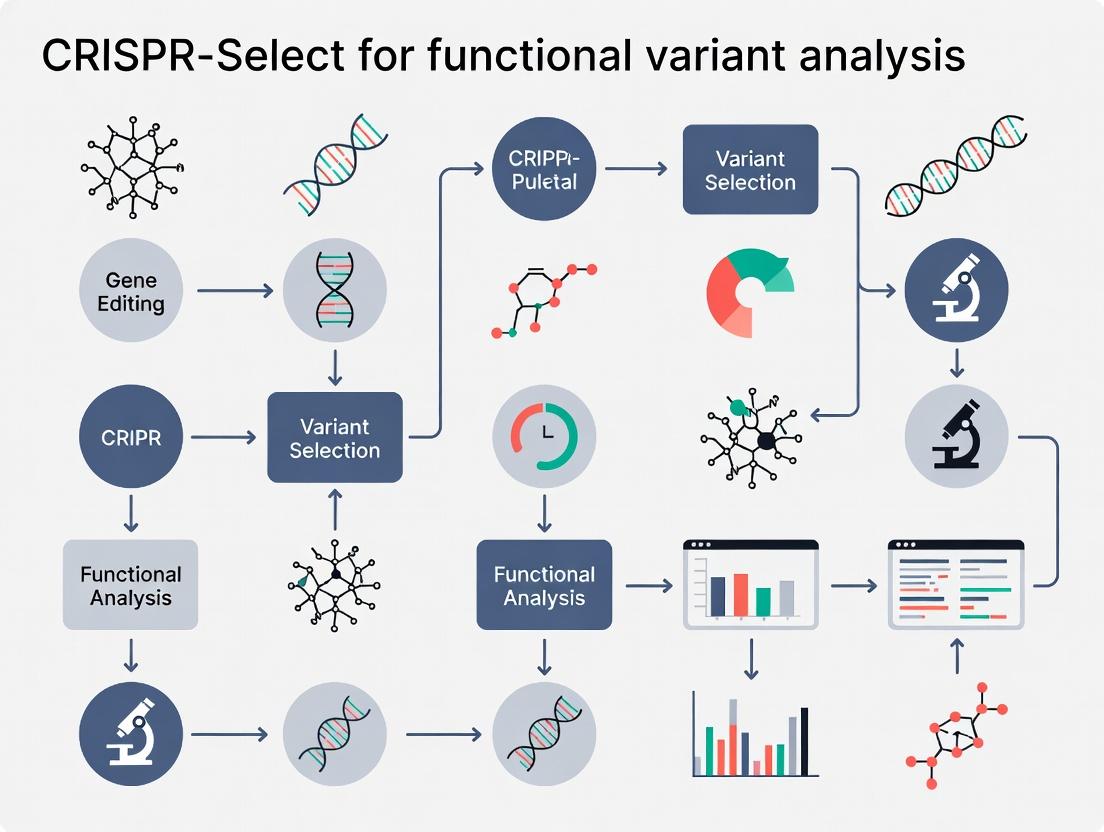
This article provides a complete framework for implementing CRISPR-Select technology, an advanced tool for high-throughput functional analysis of genetic variants.
CRISPR-Select: A Comprehensive Guide to Functional Variant Analysis for Precision Drug Discovery
Abstract
This article provides a complete framework for implementing CRISPR-Select technology, an advanced tool for high-throughput functional analysis of genetic variants. Designed for researchers and drug development professionals, it covers the foundational principles of the CRISPR-Select system, its application in identifying disease-relevant variants and therapeutic targets, best practices for optimization and troubleshooting, and comparative validation against other functional genomics methods. The guide synthesizes current methodologies to empower precise functional genomics in biomedical research.
What is CRISPR-Select? Core Principles and System Architecture for Variant Analysis
Standard pooled CRISPR-Cas9 knockout screens are powerful for identifying genes essential for specific phenotypes. However, they are limited to complete loss-of-function and suffer from high false-positive rates due to confounding factors like copy-number effects and the DNA damage response. CRISPR-Select (CRISPR with Synthetic Elements and Conditional Targeting) represents a paradigm shift, enabling high-throughput functional variant analysis. This methodology moves beyond simple knockouts to model precise genomic alterations—such as point mutations, indels, and targeted gene modifications—in their native chromatin context, allowing for the study of allele-specific functional consequences.
Framed within our broader thesis, CRISPR-Select is not merely a screening tool but a platform for functional genomics of genetic variation. It integrates synthetic DNA templates and conditional guide RNA (gRNA) logic to isolate the effects of specific variants from background biological noise, directly linking variant function to disease mechanisms and therapeutic targets.
Core Methodologies & Protocols
Protocol 1: CRISPR-Select Library Design for Functional Variant Interrogation
Objective: To design a gRNA and donor template library for interrogating a panel of single-nucleotide variants (SNVs) associated with drug resistance.
Materials:
- Genomic coordinates and reference/alternate sequences for target SNVs.
- CRISPR design software (e.g., CHOPCHOP, CRISPick).
- Oligonucleotide pool synthesis service.
Procedure:
- Target Selection: Curate a list of SNVs from genome-wide association studies (GWAS) or cancer sequencing data.
- gRNA Design: For each SNV, design two sets of gRNAs:
- "Mutant-Targeting" gRNAs: Protospacer adjacent motif (PAM)-sequences permitting selective targeting of the alternate allele.
- "Reference-Targeting" gRNAs: Control gRNAs targeting only the reference allele sequence.
- Donor Template Design: For each variant, synthesize a single-stranded oligodeoxynucleotide (ssODN) donor template containing the desired alteration (e.g., the alternate allele) flanked by ~60-90 bp homology arms matching the reference genome.
- Library Cloning: Clone pooled gRNA sequences into a lentiviral vector containing a conditional expression system (e.g., TRE3G inducible promoter) alongside a constant repair template cassette.
- Validation: Perform deep sequencing of the plasmid library to confirm representation and integrity.
Protocol 2: Pooled Screening with Allele-Specific Enrichment Analysis
Objective: To perform a positive selection screen identifying gain-of-function variants conferring resistance to a targeted therapy.
Cell Line: A549 (non-small cell lung cancer) cells expressing a doxycycline-inducible Cas9 (iCas9).
Workflow:
- Library Transduction: Transduce A549-iCas9 cells at a low MOI (~0.3) with the CRISPR-Select lentiviral library to ensure single-copy integration. Maintain >500x coverage per gRNA.
- Selection & Expansion: After puromycin selection, split cells into two arms:
- Experimental Arm: Treat with therapeutic agent (e.g., EGFR inhibitor, 1 µM).
- Control Arm: Maintain in DMSO.
- Induction & Editing: Add doxycycline (1 µg/mL) to both arms for 72 hours to induce Cas9 and initiate editing.
- Phenotypic Selection: Culture cells for 14-21 days, maintaining selective pressure in the experimental arm.
- Genomic DNA Extraction & Sequencing: Harvest genomic DNA from pre-selection and post-selection populations. Amplify the gRNA region via PCR and subject to high-throughput sequencing.
- Data Analysis: Align sequences to the reference library. Use MAGeCK or similar tools to calculate the log2 fold-change and statistical significance (FDR) for each gRNA/variant between experimental and control arms.
Table 1: Enriched Variants from a Model CRISPR-Select Screen for EGFR Inhibitor Resistance
| Gene | Variant (cDNA) | gRNA Type | Log2 Fold-Change (Drug vs. Ctrl) | FDR | Interpretation |
|---|---|---|---|---|---|
| EGFR | c.2369C>T (p.T790M) | Mutant-Targeting | 4.71 | 1.2e-08 | Known resistance variant strongly validated |
| KRAS | c.35G>A (p.G12D) | Mutant-Targeting | 3.85 | 5.8e-06 | Confers bypass resistance |
| PIK3CA | c.3140A>G (p.H1047R) | Mutant-Targeting | 2.12 | 0.003 | Modulates pathway dependency |
| EGFR | c.2369C>T (p.T790M) | Reference-Targeting | -0.15 | 0.89 | No enrichment, confirms allele-specificity |
Visualizing the CRISPR-Select Workflow & Pathway
Title: CRISPR-Select Functional Screening Workflow
Title: EGFR T790M-Mediated Resistance Pathway
The Scientist's Toolkit: Key Research Reagent Solutions
Table 2: Essential Materials for CRISPR-Select Screening
| Item | Function & Role in CRISPR-Select |
|---|---|
| Inducible Cas9 Cell Line | Enables temporal control of editing, separating editing events from downstream phenotypic selection, reducing false positives from DNA damage. |
| Lentiviral gRNA/Donor Pool | Delivers both the conditionally expressed allele-specific gRNA and the homologous repair template in a single vector for coordinated action. |
| Synthetic ssODN Donor Pool | Contains the precise variant to be introduced; short homology arms favor incorporation via homology-directed repair (HDR) over non-homologous end joining (NHEJ). |
| Doxycycline (or analog) | Small-molecule inducer for Cas9 and/or gRNA expression in Tet-On systems, providing the conditional "switch" for editing. |
| Next-Generation Sequencing (NGS) Kit | For high-throughput amplification and sequencing of the integrated gRNA barcodes from genomic DNA of cell populations. |
| Bioinformatics Pipeline (e.g., MAGeCK) | Specialized software to statistically analyze gRNA read counts, calculate enrichment, and identify significantly altered variants from screen data. |
Within the broader thesis on CRISPR-Select methodologies for functional variant analysis, the precise assembly of core molecular components is paramount. This document details application notes and protocols for three interdependent pillars: the design of single guide RNAs (gRNAs), the implementation of reporter systems for enrichment, and the application of selective pressures. Together, these form the foundational toolkit for high-throughput, functional genomics research in drug discovery and basic biology.
Application Notes & Protocols
gRNA Design for Functional Variant Enrichment
Application Note: Effective gRNA design must accomplish dual objectives: efficient target locus cleavage and the creation of a selection-linked genetic outcome. For CRISPR-Select, gRNAs are designed not only to cut but to promote homology-directed repair (HDR) that introduces or corrects a functional element linked to survival or reporter expression.
Protocol: Design and Cloning of Selection-Linked gRNAs
Step 1: Target Identification & gRNA Selection
- Identify the genomic region of the variant of interest (SNP, insertion, deletion).
- Using tools like CHOPCHOP, CRISPRscan, or the Broad Institute's gRNA design tool, select gRNAs with high on-target scores (typically >80) and minimal off-target potential within 50 bp of the variant.
- Critical Parameter: The gRNA must position the variant within the 5' proximal region of the protospacer adjacent motif (PAM) to maximize HDR template efficiency for that specific locus.
Step 2: HDR Template Design & Cloning
- Synthesize a single-stranded oligodeoxynucleotide (ssODN) or double-stranded donor template (~100-200 nt total).
- The template must contain: (1) The functional variant sequence, (2) Silent mutations (≥2) in the gRNA seed region to prevent re-cutting, (3) Flanking homology arms (40-80 nt each side).
- Clone the gRNA expression cassette (U6 promoter-gRNA scaffold) and the HDR template into a CRISPR-Select vector backbone containing a fluorescent reporter (e.g., GFP) for transfection tracking.
Step 3: Validation of Cutting Efficiency
- Transfect target cells (e.g., HEK293T) with the constructed plasmid and a Cas9 expression plasmid (if not all-in-one).
- Harvest genomic DNA 72 hours post-transfection.
- Perform T7 Endonuclease I (T7EI) or ICE (Inference of CRISPR Edits) analysis on PCR-amplified target region. Aim for >40% indel efficiency as a baseline for functional experiments.
Research Reagent Solutions
| Item | Function |
|---|---|
| All-in-one Cas9-gRNA Expression Vector | Ensures coordinated delivery of both nuclease and guide RNA. |
| Chemically Modified ssODN HDR Donor | Enhances stability and HDR rates; phosphorothioate bonds on ends recommended. |
| High-Efficiency Transfection Reagent | Critical for hard-to-transfect primary cells or stem cells. |
| T7 Endonuclease I Kit | Standardized kit for rapid, semi-quantitative validation of nuclease activity. |
| Next-Gen Sequencing Library Prep Kit | For deep sequencing validation of editing and HDR outcomes. |
Reporter Systems for Enrichment & Screening
Application Note: Reporter systems convert the desired genomic edit into a selectable or scorable phenotype. Fluorescent reporters enable FACS-based enrichment, while survival reporters (e.g., antibiotic resistance) apply continuous selective pressure.
Protocol: Implementing a Fluorescent Protein Reporter for HDR Enrichment
Step 1: Reporter Vector Construction
- Engineer a plasmid where a fluorescence reporter gene (e.g., BFP, mCherry) is expressed only upon successful HDR. Two common strategies:
- Splicing-Based: The reporter is in a separate, intron-disrupted exon. Corrective HDR restores the splice acceptor, leading to functional reporter expression.
- Promoter-Based: The reporter is placed downstream of a weak/inducible promoter. HDR introduces a strong, constitutive promoter upstream of the variant site, activating the reporter.
- Fuse the reporter via a P2A self-cleaving peptide to the gene of interest if knock-in is desired.
- Engineer a plasmid where a fluorescence reporter gene (e.g., BFP, mCherry) is expressed only upon successful HDR. Two common strategies:
Step 2: Co-delivery and Expression
- Co-transfect the target cells with (a) the Cas9/gRNA plasmid, (b) the HDR donor template, and (c) the reporter construct (if not integrated into the donor).
- Use a 1:3:3 molar ratio (Cas9/gRNA : Donor : Reporter) as a starting point. Optimize for each cell line.
Step 3: FACS Enrichment and Analysis
- At 96-120 hours post-transfection, dissociate cells and resuspend in FACS buffer (PBS + 2% FBS).
- Sort the top 5-20% of fluorescently positive cells using a flow cytometer with appropriate lasers and filters.
- Collect sorted cells for expansion or direct genomic DNA extraction for validation via sequencing.
Quantitative Data: Reporter System Performance
| Reporter Type | Typical Enrichment Fold (vs. Neg. Ctrl) | Time to Phenotype | Best Application |
|---|---|---|---|
| Fluorescent (e.g., GFP) | 10-100x | 48-96 hrs | FACS-based enrichment; transient assays. |
| Antibiotic Resistance | 100-1000x | 7-14 days | Long-term selection; pooled library screens. |
| Surface Marker (e.g., CD4) | 20-200x | 72-120 hrs | FACS or magnetic bead-based selection. |
| Dual Fluorescent (e.g., BFP/GFP) | 50-500x | 72-120 hrs | Distinguishing HDR from NHEJ events. |
Application of Selective Pressures
Application Note: Selective pressures physically isolate cells harboring the functional genetic variant. The choice of pressure (chemical, metabolic, fluorescence-based) depends on the experimental timeline and desired throughput.
Protocol: Pooled Library Screening with Puromycin Selection
Step 1: Library Transduction & Selection
- Generate a lentiviral library of CRISPR-Select constructs (gRNA + linked survival reporter).
- Transduce the target cell population at a low MOI (<0.3) to ensure single integration events. Include a non-targeting gRNA control pool.
- 24 hours post-transduction, begin selection with the appropriate antibiotic (e.g., 2 µg/mL puromycin). Maintain selection for 7-10 days, until all non-transduced control cells are dead.
Step 2: Genomic DNA Harvest & gRNA Amplification
- Harvest genomic DNA from a minimum of 1e7 cells per condition (selected and pre-selection reference) using a salting-out or column-based method.
- Perform a two-step PCR to amplify the integrated gRNA sequences from the genomic DNA. Use barcoded primers for multiplexed sequencing.
Step 3: NGS Sequencing & Analysis
- Pool PCR amplicons and sequence on an Illumina platform to obtain >500 reads per gRNA in the reference sample.
- Align sequences to the gRNA library reference. Quantify gRNA abundance changes (log2 fold-change) between selected and pre-selection pools using established algorithms (MAGeCK, DESeq2).
- Hit gRNAs are those significantly enriched (FDR < 0.1) in the selected population, pointing to functional variant sites conferring survival.
Title: CRISPR-Select gRNA Design and Screening Workflow
Title: Logic of Selective Pressure for Variant Enrichment
Application Note: CRISPR-Select for Functional Variant Analysis
This application note details the integration of CRISPR-Select, a precise genomic interrogation technology, into the core research paradigm of linking non-coding and coding genetic variants to their functional cellular consequences and impact on cellular fitness. This approach is central to modern functional genomics and target validation in drug discovery.
Core Quantitative Data on Variant Impact
Table 1: Quantitative Metrics for Linking Genotype to Phenotype
| Metric Category | Specific Measurement | Typical Assay | Relevance to Survival |
|---|---|---|---|
| Cellular Phenotype | Proliferation Rate (Doubling Time) | Incucyte/Time-lapse imaging | Direct surrogate for fitness; slower proliferation may indicate essential gene disruption. |
| Apoptosis/Cell Death (%) | Caspase-3/7 activation, Annexin V flow cytometry | Quantifies direct cytotoxic effect of variant or gene knockout. | |
| Cell Cycle Distribution (% in G1, S, G2/M) | Propidium Iodide staining & flow cytometry | Identifies arrest points induced by variant expression. | |
| Morphological Changes (e.g., Area, Circularity) | High-content imaging | Links genotype to structural phenotypes (e.g., oncogenic transformation). | |
| Molecular Phenotype | Gene Expression Fold-Change | RNA-seq, qPCR | Measures downstream transcriptional networks altered by the variant. |
| Protein Abundance/Modification | Western blot, Phospho-flow cytometry | Assesses signaling pathway activation or repression. | |
| Protein Localization Shift | Immunofluorescence, HCI | Determines mislocalization due to variant (e.g., nuclear/cytoplasmic). | |
| Genomic Integrity | DNA Damage Foci Count (γH2AX) | Immunofluorescence | Indicates variant-induced genomic instability. |
| Chromosomal Aberrations | Karyotyping, FISH | Links severe variants to structural variants. | |
| Functional Genomics | CRISPR Screen Fitness Score (log2 fold-change) | Pooled CRISPR-Cas9 screen | Gold-standard quantitative metric for gene essentiality in a given context. |
| Variant Effect Score (from CRISPR-Select) | Allele-specific enrichment/depletion sequencing | Directly quantifies the impact of a specific genetic variant on cellular proliferation/survival. |
Detailed Experimental Protocols
Protocol 1: CRISPR-Select for Functional Analysis of Non-Coding Variants
Objective: To determine if a non-coding Single Nucleotide Polymorphism (SNP) in an enhancer region affects the expression of a target gene and consequent cellular survival.
Materials: See "Research Reagent Solutions" table.
Procedure:
- Guide RNA (gRNA) Design: Design two sets of CRISPR-Cas9 gRNAs using a validated platform (e.g., CHOPCHOP, CRISPick). One set targets the genomic location containing the reference allele of the SNP. The other set targets the location containing the alternative allele. Include negative control (non-targeting) gRNAs.
- Cloning & Library Preparation: Clone pooled gRNAs into a lentiviral CRISPR-Cas9 vector (e.g., lentiGuide-Puro). Produce high-titer lentivirus.
- Cell Line Engineering: Infect target cell line (e.g., HEK293T, a relevant cancer line) expressing stable Cas9 with the lentiviral gRNA library at a low MOI (<0.3) to ensure single integration. Select with puromycin (e.g., 2 µg/mL) for 7 days.
- Population Passaging & Harvesting: Passage the pooled cell population every 3-4 days, maintaining representation >500x library coverage. Harvest genomic DNA (gDNA) from a sample at Day 0 (post-selection baseline) and at subsequent passages (e.g., Day 14, Day 21).
- Sequencing & Analysis: Amplify the gRNA cassette from gDNA by PCR. Perform next-generation sequencing (NGS) on amplicons. Align reads to the gRNA reference library.
- Variant Effect Scoring: Calculate the log2 fold-change in gRNA abundance for each allele-specific gRNA between time points using a model like MAGeCK. Depletion of gRNAs targeting one allele indicates that disrupting that specific allele is detrimental to cellular fitness, implying its functional importance.
Protocol 2: Linking Coding Variant Genotype to Drug Response Phenotype
Objective: To assess whether a specific somatic mutation (e.g., BRAF V600E) confers sensitivity or resistance to a targeted therapy.
Procedure:
- Isogenic Cell Line Generation: a. For a BRAF wild-type cell line (e.g., a melanoma line), use CRISPR-Cas9 and a single-stranded DNA donor template to introduce the V600E mutation (knock-in). b. Isolate single-cell clones. Validate homozygous editing via Sanger sequencing and subsequent NGS. c. Confirm the molecular phenotype by Western blot for elevated p-ERK levels.
- Phenotypic Screening: a. Seed validated isogenic pairs (WT and V600E) in 96-well plates. b. 24 hours later, treat with a serial dilution of a BRAF inhibitor (e.g., Vemurafenib, 0-10 µM). Include DMSO controls. c. After 72-96 hours, assay for: i. Viability: Using CellTiter-Glo 3D. ii. Apoptosis: Using Caspase-Glo 3/7 assay. d. Generate dose-response curves. Calculate IC50 and AUC values for each genotype.
- Survival Pathway Analysis: a. In parallel, treat isogenic cells with a single relevant dose of inhibitor (e.g., 1 µM Vemurafenib). b. Harvest protein lysates at 0, 1, 2, 4, and 8 hours post-treatment. c. Perform Western blot analysis for key pathway proteins: p-MEK, p-ERK, BIM, PARP cleavage. d. The BRAF V600E genotype is linked to a phenotype of pathway suppression and apoptosis induction upon treatment, unlike the WT.
Signaling Pathway & Experimental Workflow Diagrams
Title: Workflow for Linking Genotype to Phenotype
Title: BRAF V600E Signaling and Drug Inhibition
The Scientist's Toolkit: Research Reagent Solutions
Table 2: Essential Reagents for CRISPR-Select Functional Analysis
| Item | Function & Application | Example Product/Catalog |
|---|---|---|
| Nuclease & Delivery | High-efficiency nuclease for creating double-strand breaks. | S.p. Cas9 Nuclease (IDT, NEB) |
| Lentiviral gRNA Vector | Delivers gRNA expression cassette for stable integration and selection. | lentiGuide-Puro (Addgene #52963) |
| CRISPR-Select gRNA Library | Pooled, allele-specific gRNAs targeting variants of interest. | Custom synthesized array oligo pools (Twist Bioscience, Agilent) |
| Next-Generation Sequencing Kit | For deep sequencing of gRNA abundance from genomic DNA. | Illumina Nextera XT DNA Library Prep Kit |
| Cell Viability Assay | Luminescent quantitation of ATP as proxy for live cells. | CellTiter-Glo 3D (Promega, G9681) |
| Apoptosis Assay | Luminescent measurement of caspase-3/7 activity. | Caspase-Glo 3/7 Assay (Promega, G8091) |
| High-Content Imaging System | Automated microscopy for quantitative morphological phenotyping. | ImageXpress Micro Confocal (Molecular Devices) |
| Isogenic Cell Line Pair | Genetically matched control and variant lines for clean phenotype comparison. | Horizon Discovery (e.g., BRAF WT/V600E) |
| Pathway-Specific Antibodies | Detect protein abundance and activation states via Western blot. | Phospho-ERK1/2 (Cell Signaling, #4370) |
| Nucleic Acid Purification Kits | High-quality gDNA isolation for NGS library prep. | DNeasy Blood & Tissue Kit (Qiagen, 69504) |
Within the broader thesis on CRISPR-Select for functional variant analysis, this document outlines the core methodological advantages that enable precise and high-throughput interrogation of genetic function. The integration of pooled screening scalability, enhanced detection sensitivity, and robust quantitative output forms the cornerstone of modern functional genomics, accelerating target identification and validation in drug development.
Application Notes
Scalability: Enabling Genome-Wide Interrogation
Scalability refers to the capacity to assay thousands to millions of genetic perturbations in a single, unified experiment. This is primarily achieved through pooled lentiviral CRISPR library delivery.
Key Quantitative Metrics: Table 1: Scalability Benchmarks for Common Functional Genomics Screens
| Screen Type | Typical Library Size | Cells Required (Coverage) | Timeframe | Primary Readout |
|---|---|---|---|---|
| Genome-wide CRISPR-KO (e.g., Brunello) | ~76,000 sgRNAs | 200-500x coverage (~40-100M cells) | 4-6 weeks | NGS of sgRNA abundance |
| Focused CRISPRi/a (Pathway-specific) | 1,000 - 10,000 sgRNAs | 500-1000x coverage (~5-10M cells) | 3-4 weeks | NGS or FACS-based selection |
| CRISPR-Select for SNP analysis | 100 - 5,000 sgRNAs/rSNPs | 1000x+ coverage per variant | 2-3 weeks | Allele-specific NGS ratio |
Protocol 1.1: Pooled Lentiviral Library Production & Transduction Objective: Generate high-titer, representative lentivirus and transduce target cells at optimal MOI. Materials: HEK293T cells, lentiviral transfer plasmid library, psPAX2, pMD2.G, polybrene, puromycin. Procedure:
- Library Amplification: Transform electrocompetent E. coli with the pooled sgRNA plasmid library. Plate on large LB-agar plates with appropriate antibiotic to maintain >200x colony representation of the library. Harvest plasmid via maxiprep.
- Virus Production: In a 10cm dish, co-transfect HEK293T cells (70% confluency) with 10 µg library plasmid, 7.5 µg psPAX2, and 2.5 µg pMD2.G using PEI transfection reagent.
- Harvest: Collect virus-containing supernatant at 48h and 72h post-transfection. Filter through a 0.45µm PES filter, concentrate via ultracentrifugation (70,000 x g, 2h, 4°C), and aliquot.
- Titer Determination: Serially dilute virus on target cells under selection (e.g., puromycin). Calculate TU/mL based on colony counts.
- Library Transduction: Transduce target cells at an MOI of ~0.3-0.4 to ensure most cells receive a single sgRNA. Include a non-transduced control. After 48h, apply selection pressure for 5-7 days to eliminate untransduced cells.
Sensitivity: Detecting Subtle Phenotypic Changes
Sensitivity is the ability to detect statistically significant phenotypic shifts even for genes with modest effects. This is enhanced by improved sgRNA design, deep sequencing, and optimized experimental design.
Key Quantitative Metrics: Table 2: Factors Influencing Screening Sensitivity
| Factor | High Sensitivity Condition | Typical Impact on Hit Detection |
|---|---|---|
| sgRNA On-target Efficiency | >80% knockdown/KO efficiency | Enables detection of genes with subtle fitness effects (<20% change). |
| Sequencing Depth | >500 reads per sgRNA pre-selection | Reduces Poisson noise; allows detection of smaller fold-changes. |
| Biological Replicates | 3+ independent replicates | Lowers false discovery rate (FDR < 1%) for moderate-effect genes. |
| Selection Stringency | Optimal duration to avoid saturation | Distinguishes between strong and weak hits. |
Protocol 2.1: Deep Sequencing Library Preparation for sgRNA Abundance Quantification Objective: Accurately prepare NGS libraries to quantify sgRNA representation from genomic DNA. Materials: DNeasy Blood & Tissue Kit, Herculase II Fusion DNA Polymerase, AMPure XP beads, dual-indexing PCR primers. Procedure:
- Genomic DNA Extraction: Harvest a minimum of 1e7 cells per screening time point. Isolate gDNA using the DNeasy Kit. Elute in 100 µL. Quantify via Qubit.
- Primary PCR (Amplify sgRNA cassette): For each sample, set up 8x 50 µL reactions with 2 µg total gDNA split across them.
- 5 µL Herculase II buffer, 0.5 µL dNTPs, 1.5 µL forward primer (common), 1.5 µL reverse primer (common), 0.5 µL Herculase II polymerase, gDNA, nuclease-free water to 50 µL.
- Cycle: 98°C 2min; [98°C 20s, 60°C 20s, 72°C 30s] x 22 cycles; 72°C 3min.
- Pool & Clean: Pool reactions per sample. Clean up with 1.8x AMPure XP beads. Elute in 25 µL.
- Secondary PCR (Add Indices & Illumina Handles): Use 2 µL of cleaned primary PCR product as template.
- Use unique dual-index primer pairs for each sample.
- Cycle: 98°C 2min; [98°C 20s, 65°C 20s, 72°C 20s] x 12 cycles; 72°C 3min.
- Final Clean-up & Quantification: Pool indexed libraries. Perform a final 1x AMPure XP bead clean-up. Quantify by qPCR (KAPA Library Quant Kit). Sequence on an Illumina NextSeq (75bp single-end, targeting 500x mean coverage per sgRNA).
Quantitative Readouts: From Fitness Scores to Allelic Ratios
Quantitative readouts transform raw NGS counts into robust, comparable metrics like fitness scores (γ) or allelic imbalance ratios, enabling precise variant effect quantification.
Key Quantitative Metrics: Table 3: Common Quantitative Outputs in Functional Genomics
| Readout Type | Calculation | Interpretation | Typical Range |
|---|---|---|---|
| Log2 Fold Change (LFC) | log2(CountsTreatment / CountsControl) | Relative sgRNA/gene depletion/enrichment. | -4 to +4 |
| MAGeCK RRA Score | Robust Rank Aggregation of sgRNA LFCs | Gene-level significance; negative score indicates essentiality. | < 0 (Essential) |
| CRISPR-Select Allelic Ratio | (Variant Allele Count / Reference Allele Count) post-selection vs. input | Measures variant impact relative to isogenic control. | 0.1 to 10 |
Protocol 3.1: Quantitative Analysis of a CRISPR-Select Screen for Functional Variants Objective: Quantify the effect of a non-coding genetic variant on cellular fitness using CRISPR-Select (or analogous base-editing/nicking screens). Materials: Isogenic cell line pair (Variant/WT), sgRNA/nickase library targeting SNPs, NGS reagents, analysis pipeline (MAGeCK, custom scripts). Procedure:
- Library Design & Screening: Design sgRNAs that specifically target the genomic context of the SNP. Include >3 guides per allele and non-targeting controls. Perform pooled screen (as in Protocol 1.1) in both isogenic backgrounds.
- Sequencing & Raw Count Processing: Harvest genomic DNA at Day 0 (post-selection baseline) and Day 14+ (post-phenotypic selection). Prepare sequencing libraries (Protocol 2.1). Demultiplex and align reads to the sgRNA library manifest to generate raw count tables.
- Calculate Allele-Specific Effects:
- For each sgRNA, compute the log2(fold change) in abundance between final and initial time points within each genetic background.
- Compute the ΔLFC = LFC(Variant Background) - LFC(WT Background). This represents the variant-specific effect on cellular fitness, normalized for sgRNA intrinsic efficiency.
- Aggregate ΔLFCs across all sgRNAs targeting the same SNP using a robust mean (e.g., median) to generate a final "Variant Effect Score."
- Statistical Validation: Compare the distribution of ΔLFCs for targeting sgRNAs vs. non-targeting controls using a Mann-Whitney U test. A significant shift (p<0.01) indicates a functional variant impact.
Diagrams
Title: CRISPR-Select Workflow for Functional Variant Analysis
Title: From NGS Counts to Quantitative Scores
The Scientist's Toolkit: Research Reagent Solutions
Table 4: Essential Reagents for Scalable, Sensitive Functional Genomics Screens
| Reagent/Material | Supplier Examples | Critical Function |
|---|---|---|
| Genome-wide CRISPR Knockout Library (Brunello) | Addgene #73179 | Pre-designed, high-coverage sgRNA pool for human genome-wide loss-of-function screens. |
| Lentiviral Packaging Plasmids (psPAX2, pMD2.G) | Addgene #12260, #12259 | Essential second-generation packaging system for producing replication-incompetent lentivirus. |
| Polybrene (Hexadimethrine bromide) | Sigma-Aldrich | A cationic polymer that enhances viral transduction efficiency by neutralizing charge repulsion. |
| Puromycin Dihydrochloride | Thermo Fisher | Selection antibiotic for cells transduced with puromycin resistance-containing vectors. |
| Herculase II Fusion DNA Polymerase | Agilent | High-fidelity, high-yield polymerase for robust amplification of sgRNA cassettes from gDNA. |
| AMPure XP Beads | Beckman Coulter | Solid-phase reversible immobilization (SPRI) beads for precise size selection and clean-up of NGS libraries. |
| KAPA Library Quantification Kit | Roche | qPCR-based kit for accurate quantification of NGS library concentration prior to sequencing. |
| DNeasy Blood & Tissue Kit | Qiagen | Reliable, high-quality genomic DNA extraction from mammalian cells. |
| Isogenic Cell Line Pair (WT/Variant) | ATCC, Horizon Discovery | Genetically matched cell backgrounds essential for cleanly attributing phenotypic effects to a specific variant. |
Application Notes
Functional Validation of GWAS-Hit Variants
Genome-Wide Association Studies (GWAS) identify statistical associations between genetic variants and traits/diseases, but the vast majority are non-coding and of unknown function. CRISPR-Select enables direct functional interrogation by creating precise, single-nucleotide edits in relevant cellular models (e.g., iPSC-derived cell types, organoids) to assess phenotypic impact. This moves beyond correlation to establish causality.
Prioritization of Driver Mutations in Cancer
In cancer genomics, distinguishing driver mutations from passenger mutations is critical. CRISPR-Select allows for high-throughput, parallel editing of candidate variants in isogenic backgrounds, followed by competitive proliferation assays, drug sensitivity screens, or transformation assays in vitro and in vivo. Variants conferring a selective growth advantage are identified as potential drivers.
Mechanism of Action Studies for Variants
Once a variant is validated, CRISPR-Select-edited cell lines serve as a pristine platform to dissect molecular mechanisms. This includes analyzing changes in gene expression (RNA-seq, ATAC-seq), protein function (western blot, co-IP), chromatin interactions (ChIP-seq, Hi-C), and pathway activity (reporter assays).
Table 1: Quantitative Comparison of CRISPR-Select Applications
| Application | Typical Throughput | Key Readout | Major Challenge Addressed |
|---|---|---|---|
| GWAS Hit Validation | Medium (10s of variants) | Phenotypic assay (e.g., cytokine secretion, differentiation efficiency) | Linking non-coding variants to function |
| Driver Mutation Discovery | High (100s of variants) | Fitness score from pooled screen | Distinguishing drivers from passengers |
| Mechanistic Dissection | Low (1-2 variants) | Omics datasets (RNA-seq, ChIP-seq) | Establishing molecular causality |
Detailed Protocols
Protocol 1: Validating a Non-Coding GWAS Variant in an iPSC Model
Objective: Assess the impact of a GWAS-linked non-coding SNP on macrophage inflammatory response. Materials: Human iPSCs, CRISPR-Select reagents (Cas9 protein, synthetic sgRNA, ssODN donor), electroporator, macrophage differentiation kits, LPS, ELISA kits for TNF-α.
- Design & Synthesis: Design ssODN donor template containing the SNP (and a silent tracer mutation for screening). Synthesize high-fidelity Cas9 sgRNA and purified ssODN.
- Electroporation: Co-electroporate iPSCs with ribonucleoprotein complex (Cas9+sgRNA) and ssODN donor using a neon transfection system.
- Clonal Isolation & Genotyping: Single-cell sort edited iPSCs. Expand clones and perform PCR/sequencing to identify homozygous correctly edited clones. Select 2-3 independent clones.
- Differentiation & Assay: Differentiate edited and unedited control iPSCs into macrophages using a standardized 14-day protocol.
- Phenotyping: Stimulate macrophages with 100 ng/mL LPS for 24h. Measure TNF-α secretion via ELISA. Compare isogenic edited lines (risk vs. protective allele) using a t-test (n≥3 biological replicates).
Protocol 2: Pooled Screen for Oncogenic Driver Mutations
Objective: Identify which missense mutations from a tumor sample confer a growth advantage. Materials: Immortalized but non-transformed cell line (e.g., MCF10A), lentiviral CRISPR-Select library, puromycin, genomic DNA extraction kit, NGS reagents.
- Library Design & Cloning: Design a pooled lentiviral library where each sgRNA targets a specific point mutation present in patient tumors. Include 3-5 sgRNAs per variant and 500 non-targeting controls.
- Viral Production & Cell Infection: Produce lentivirus and transduce target cells at low MOI (<0.3) to ensure single integration. Select with puromycin for 72h.
- Passaging & Competition: Maintain infected cell population for 20-25 cell doublings, passaging regularly to maintain coverage.
- Genomic DNA Harvest & NGS: Harvest genomic DNA at Day 0 (post-selection) and Day 21. PCR amplify the sgRNA region and sequence on an Illumina platform.
- Analysis: Calculate sgRNA enrichment/depletion using MAGeCK or similar. Variants targeted by significantly enriched sgRNAs (FDR < 0.1) are candidate drivers.
Table 2: Research Reagent Solutions Toolkit
| Reagent/Category | Specific Example | Function in CRISPR-Select Workflow |
|---|---|---|
| Editing Machinery | Alt-R S.p. HiFi Cas9 Nuclease V3 | High-fidelity Cas9 enzyme for precise RNP formation, minimizing off-target edits. |
| Donor Template | Ultramer DNA Oligo (IDT) | Long, single-stranded DNA donor (up to 200nt) for HDR with high purity and yield. |
| Delivery Method | Neon Transfection System | Electroporation system optimized for RNP delivery into difficult cell lines (e.g., iPSCs, primary cells). |
| Screening Library | Custom CRISPRko/CRISPRai Library | Pooled sgRNA libraries for negative/positive selection screens to identify functional variants. |
| Validation Assay | Promega Lumit Immunoassay | Homogeneous, cell-based assay for rapid cytokine quantification from edited cell supernatants. |
| NGS Analysis | Illumina Nextera XT DNA Library Prep Kit | Prepares amplicons of edited genomic regions or sgRNA cassettes for deep sequencing validation. |
Visualizations
Diagram 1: GWAS Hit Validation Workflow (94 chars)
Diagram 2: Pooled Driver Mutation Screen (85 chars)
Diagram 3: Mechanistic Dissection After Validation (78 chars)
Step-by-Step Protocol: Implementing CRISPR-Select in Your Variant Functionalization Pipeline
Within the broader thesis on CRISPR-Select for functional variant analysis, the initial experimental design phase is critical. Defining a precise variant library and a focused biological question determines the success of downstream screening and validation. This application note details the framework and protocols for this foundational step, enabling researchers to systematically investigate genotype-phenotype relationships.
Core Concepts and Quantitative Framework
Table 1: Common Variant Library Types and Their Applications
| Library Type | Typical Size (Variants) | Design Method | Primary Biological Question Addressed | Common Application in Drug Development |
|---|---|---|---|---|
| Saturation Mutagenesis | 10^3 - 10^5 | All possible single amino acid/nucleotide changes within a target region. | Which residues are essential for function? | Identify drug-binding sites, discover gain-of-function mutations. |
| Disease-Associated Variant | 10^2 - 10^4 | Curated from genomic databases (e.g., gnomAD, ClinVar). | What is the functional impact of human genetic variation? | Prioritize variants for therapeutic targeting, understand disease mechanisms. |
| Directed Evolution | 10^7 - 10^10 | Random mutagenesis or DNA shuffling. | Which sequence combinations confer a desired phenotype? | Engineer proteins with enhanced stability, activity, or specificity. |
| Tiling Deletion | 10^1 - 10^2 | Systematic deletions of genomic segments. | Which domains are necessary for protein function or regulation? | Map functional domains for inhibitor design. |
Table 2: Key Design Parameters for CRISPR-Select Libraries
| Parameter | Considerations | Impact on Experiment |
|---|---|---|
| Variant Complexity (SNV, indel, etc.) | Defined by editing template design. | Affects repair efficiency and library cloning success. |
| Library Coverage (Guide RNAs per variant) | Typically 3-5 gRNAs per variant for robustness. | Increases confidence in phenotype calls, reduces false negatives. |
| Positive/Negative Control Inclusion | Essential for normalization and QC. | Enables plate-based normalization and assessment of screen dynamic range. |
| Delivery System (Lentivirus, RNP) | Lentivirus for stable integration; RNP for transient expression. | Determines experimental timeline, biosafety level, and editing kinetics. |
Detailed Experimental Protocols
Protocol 1: Designing a Saturation Mutagenesis Library for a Protein Domain
Objective: To create a library encoding all possible single amino acid substitutions within a defined protein domain (e.g., kinase catalytic domain) for functional screening.
Materials (Research Reagent Solutions):
- Oligo Pool Synthesis: Custom synthesized oligo pool (Twist Bioscience, Agilent). Function: Source of variant sequences.
- Cloning Vector: Lentiviral CRISPR-Cas9 backbone with puromycin resistance (Addgene #52963). Function: Library delivery and selection.
- Enzymes: NEBuilder HiFi DNA Assembly Master Mix (NEB). Function: High-fidelity library assembly.
- Competent Cells: Endura ElectroCompetent Cells (Lucigen). Function: High-efficiency transformation of large libraries.
- Qubit dsDNA HS Assay Kit (Thermo Fisher). Function: Accurate quantification of library DNA.
Methodology:
- Target Region Definition: Using a reference sequence, define the codon boundaries for the target domain.
- Oligo Design: For each target codon, design oligonucleotides where the three nucleotide positions are randomized (NNN) to encode all 64 possible codons, flanked by constant homology arms for cloning.
- Library Synthesis: Order the oligo pool. Perform primary PCR to add full-length homology arms.
- Golden Gate or Gibson Assembly: Clone the amplified variant pool into the digested lentiviral backbone using NEBuilder HiFi Master Mix.
- Electroporation: Transform the assembled DNA into Endura cells via electroporation to maximize library diversity. Plate on large-format LB-ampicillin plates.
- Harvest and QC: Scrape colonies, maxiprep the plasmid library. Sequence using NGS (MiSeq) to confirm variant representation and evenness.
Protocol 2: Curating a Disease-Associated Variant Library
Objective: To compile and clone a library of single nucleotide variants (SNVs) linked to a specific disease phenotype (e.g., cardiovascular disorders).
Materials (Research Reagent Solutions):
- Genomic Databases: gnomAD, ClinVar, dbSNP. Function: Source of variant allele frequency and pathogenicity data.
- Variant Effect Predictor (VEP) Tool (Ensembl). Function: Annotates variant consequences.
- Custom Array Synthesis (Twist Bioscience). Function: Synthesis of defined variant sequences.
- QIAprep Spin Miniprep Kit (Qiagen). Function: Plasmid purification for QC clones.
Methodology:
- Variant Mining: Query ClinVar for pathogenic/likely pathogenic variants in your gene(s) of interest. Cross-reference with gnomAD for population allele frequency.
- Filtering: Apply filters (e.g., missense only, allele frequency <0.1%, review status in ClinVar). Select a final list of 100-500 variants.
- Oligo & HDR Template Design: For each selected SNV, design a CRISPR guide RNA (crRNA) targeting the wild-type locus and a single-stranded oligodeoxynucleotide (ssODN) repair template encoding the variant with silent PAM-disrupting mutations.
- Library Cloning: Clone an array-synthesized oligo pool containing all variant sequences, with appropriate overhangs, into a lentiviral guide RNA expression vector (e.g., lentiGuide-Puro) via Golden Gate assembly.
- Validation: Sanger sequence 20-50 random clones from the transformed pool to confirm variant presence and absence of recombination.
The Scientist's Toolkit: Research Reagent Solutions
| Item | Vendor Example | Function in Variant Library Design |
|---|---|---|
| Custom Oligo Pool Synthesis | Twist Bioscience | Source DNA for building complex variant libraries. |
| High-Efficiency Cloning Kit | NEBuilder HiFi DNA Assembly Master Mix (NEB) | Seamless assembly of variant inserts into vectors. |
| Electrocompetent E. coli | Endura ElectroCompetent Cells (Lucigen) | Essential for achieving high transformation efficiency of large libraries. |
| Lentiviral Packaging System | Lenti-X 293T Cell Line (Takara) | Production of lentiviral particles for stable library delivery to target cells. |
| Next-Gen Sequencing Service | MiSeq Reagent Kit v3 (Illumina) | Quality control of library diversity and variant representation pre-screen. |
| Genome Database | gnomAD, ClinVar | Critical for curating clinically relevant variant lists. |
| Variant Annotation Tool | Ensembl VEP | Automates functional prediction of curated variants. |
Visualizing Workflows and Relationships
Title: Variant Library Design and Screening Workflow
Title: From Genomic Variant to Measurable Phenotype
Application Notes
This protocol provides a comprehensive guide for designing and synthesizing gRNA libraries for saturation mutagenesis and variant-targeting within the broader research thesis on CRISPR-Select for functional variant analysis. CRISPR-Select leverages pooled screening to link genetic variants to phenotypic outcomes, enabling high-throughput functional interrogation of genomic elements and disease-associated mutations. Effective gRNA library construction is the critical first step.
Key Applications:
- Saturation Mutagenesis: Systematically introducing all possible nucleotide substitutions within a target genomic region (e.g., a protein domain or enhancer) to comprehensively map functional residues.
- Variant-Targeting: Specifically interrogating known genetic variants (e.g., single nucleotide polymorphisms (SNPs) or patient-derived mutations) to assess their functional impact on disease etiology or drug response.
- CRISPR-Select Workflow Integration: The designed libraries enable the downstream steps of delivery, selection, and sequencing to establish causal genotype-phenotype relationships.
Design Considerations:
- For Saturation Mutagenesis: Libraries must achieve high coverage (≥ 3 gRNAs per codon/base) and minimize positional bias. Frameshift-prone sequences near protospacer adjacent motifs (PAMs) are prioritized for coding regions.
- For Variant-Targeting: gRNAs must be designed to specifically cleave the mutant or wild-type allele, considering SNP location relative to the PAM. Efficiency prediction algorithms are essential.
- Control Elements: Libraries must include non-targeting controls, essential gene-targeting positive controls, and safe-harbor targeting controls for normalization.
Table 1: Comparison of gRNA Library Design Strategies
| Strategy | Primary Goal | Avg. gRNAs per Target | Library Size Range | Key Design Tool | Critical Parameter |
|---|---|---|---|---|---|
| Saturation Mutagenesis | Comprehensive variant discovery | 3-5 per codon/base | 1,000 - 100,000+ gRNAs | CHOPCHOP, CRISPRscan | On-target efficiency score, Off-target minimization |
| Variant-Targeting | Functional validation of known variants | 2-3 per allele | 10 - 10,000 gRNAs | CRISPick, Elevation | SNP position relative to PAM, Allelic specificity |
| Tiling (for non-coding) | Functional element mapping | 1 gRNA every 5-20 bp | 100 - 50,000 gRNAs | UCSC Genome Browser + Design Tools | Genomic accessibility (ATAC-seq/DNase I data) |
Table 2: Common Synthesis Methods and Performance Metrics
| Synthesis Method | Fidelity (Error Rate) | Max Pool Complexity | Turnaround Time | Best Use Case |
|---|---|---|---|---|
| Array Oligo Synthesis | ~1/1000 bases | ~ 300,000 oligos | 2-4 weeks | Large, complex saturation libraries |
| Chip-based Synthesis | ~1/1000 bases | Up to 1 million oligos | 3-5 weeks | Genome-scale or multi-target projects |
| Cloned Plasmid Libraries | Very High (PCR/Clone) | ~ 10^5 - 10^6 clones | 4-8 weeks | Stable, reusable reference libraries |
| Enzymatic Assembly (e.g., Gibson) | High | ~ 10^4 variants | 1-2 weeks | Rapid, small-scale custom libraries |
Protocols
Protocol 1: Design of a Saturation Mutagenesis gRNA Library
Objective: To generate a library that enables all possible nucleotide substitutions across a 100-amino acid protein domain.
Materials: See "The Scientist's Toolkit" below.
Procedure:
Define Target Region:
- Input the genomic coordinates or sequence of the target domain (e.g., 300 bp) into a genome browser.
- Confirm exon boundaries and transcript isoforms.
Identify PAM Sites & Protospacers:
- Use a design tool (e.g., CHOPCHOP) to scan both DNA strands for NGG (SpCas9) or other relevant PAM sequences.
- Extract the 20-bp protospacer sequence immediately 5' to each PAM.
- For saturation, include all possible PAM sites within the region, not just the most efficient.
Filter and Select gRNAs:
- Filter out protospacers with >3 off-targets with 0-1 mismatches using a genome-wide search (e.g., Bowtie).
- Rank remaining gRNAs by predicted on-target efficiency score from the design tool.
- For each codon, select the top 3-5 gRNAs whose cleavage sites (typically 3-4 bp upstream of PAM) are distributed across the codon positions.
Design Oligos for Synthesis:
- For each selected protospacer, design a 90-110mer oligonucleotide containing (in order):
- Forward amplification primer site (constant).
- Variable 20-bp protospacer sequence.
- Constant gRNA scaffold sequence (compatible with your expression system, e.g., U6).
- Reverse amplification primer site (constant).
- Append unique molecular identifiers (UMIs) within the primer sites for downstream sequencing quality control.
- For each selected protospacer, design a 90-110mer oligonucleotide containing (in order):
Protocol 2: Design of a Variant-Targeting gRNA Library
Objective: To design gRNAs that selectively target mutant alleles of 50 known cancer-associated SNPs.
Materials: See "The Scientist's Toolkit" below.
Procedure:
Compile Variant List:
- Create a table with columns for: rsID, Chromosome, Position (hg38), Reference Allele, Mutant Allele, and Flanking Sequence (± 50 bp).
Assess PAM Disruption/Creation:
- For each variant, check if the SNP creates or disrupts a PAM sequence (e.g., generates or removes an "NGG") in either allele. This is ideal for maximal specificity.
Design Allele-Specific gRNAs:
- If the SNP is within the PAM: Design a single gRNA using the mutant PAM-containing allele.
- If the SNP is within the protospacer (most common):
- Design two gRNAs (20-bp protospacer + PAM) for each variant, one for each allele.
- Critical: Position the SNP within the seed region (positions 1-12 closest to the PAM) of the protospacer to maximize discriminatory power.
- The gRNA for the mutant allele should have a perfect match to the mutant sequence and a mismatch to the wild-type sequence in the seed region, and vice versa.
Predict and Filter for Specificity:
- Use tools like CRISPick or perform stringent off-target analysis requiring a seed-region mismatch for the non-targeted allele.
- Filter out any gRNA where the off-target profile against the alternate allele is not clean.
Protocol 3: Cloning of a gRNA Library into a Lentiviral Expression Vector
Objective: To generate a ready-to-use lentiviral gRNA expression library from synthesized oligo pools.
Materials: See "The Scientist's Toolkit" below.
Procedure:
Amplify Oligo Pool:
- Perform a limited-cycle (5-10 cycles) PCR on the synthesized oligo pool using primers that add appropriate restriction enzyme sites (e.g., BsmBI for lentiCRISPRv2) compatible with your vector.
Digest and Purify:
- Digest both the amplified PCR product and the destination lentiviral vector with the Type IIs restriction enzyme (e.g., BsmBI).
- Gel-purify the digested vector backbone and the pooled gRNA insert fragment.
Ligation and Transformation:
- Ligate the insert and vector at a high molar ratio (e.g., 5:1 insert:vector) using a high-efficiency ligase.
- Perform a large-scale electroporation into Endura or Stbl4 competent E. coli cells to ensure >100x library representation.
- Plate on large agar plates with appropriate antibiotic and incubate for 16-20 hours.
Library Harvest and Validation:
- Scrape all colonies and perform a maxiprep to obtain the plasmid library.
- Validate by next-generation sequencing (NGS) of the gRNA cassette region to confirm even representation and the absence of dropout or skewing.
Diagrams
Title: CRISPR-Select Workflow with gRNA Library Core
Title: gRNA Library Design Decision Logic
The Scientist's Toolkit
Table 3: Essential Research Reagents & Materials for gRNA Library Construction
| Item | Function & Explanation |
|---|---|
| Array-Synthesized Oligo Pool | The foundational reagent containing all designed variable gRNA sequences flanked by constant amplification sites. Enables parallel synthesis of thousands of unique sequences. |
| Type IIs Restriction Cloning Vector (e.g., lentiCRISPRv2) | Lentiviral backbone with BsmBI or BsaI sites for efficient, scarless insertion of the gRNA cassette. Allows for packaging and stable genomic integration. |
| High-Efficiency Electrocompetent E. coli (e.g., Endura) | Essential for transforming the ligated library mixture while maintaining maximum complexity and representation without bottlenecking. |
| Next-Generation Sequencing (NGS) Kit (e.g., Illumina MiSeq) | For quality control (QC) of the cloned plasmid library and for the final readout of gRNA abundance following phenotypic selection. |
| gRNA Design Software (e.g., CHOPCHOP, CRISPick) | Computational tools to identify target sites, predict on-target cutting efficiency, and evaluate potential off-target effects. |
| Genomic DNA Extraction Kit (Post-Selection) | To harvest integrated gRNA sequences from cellular genomic DNA after phenotypic selection for NGS library preparation. |
| PCR Enzymes for Limited-Cycle Amplification | High-fidelity polymerases are used to amplify the oligo pool or genomic gRNA regions without introducing skewing or errors during PCR. |
| Lentiviral Packaging System (e.g., psPAX2, pMD2.G) | Required in tandem with the gRNA library plasmid to produce functional lentiviral particles for efficient delivery into target cell populations. |
Within the broader thesis on CRISPR-Select for functional variant analysis, achieving uniform and high-coverage delivery of pooled genetic libraries is paramount. The efficacy of any screen hinges on the initial transduction step, which must introduce a diverse representation of library elements into the target cell population with minimal bias. This application note details current best practices for optimizing lentiviral transduction to maximize library coverage and minimize representation drift in challenging cell models relevant to drug development.
Key Considerations for Library Delivery
The goal is to achieve a high "infection rate" while maintaining a high "library representation." This is quantified by ensuring a high MOI (Multiplicity of Infection) and a large Cell Coverage (number of cells transduced relative to library complexity).
Quantitative Parameters for Optimization
Table 1: Critical Quantitative Parameters for Library Transduction
| Parameter | Definition | Ideal Target | Calculation/Measurement |
|---|---|---|---|
| Library Complexity (N) | Number of unique guide/variant elements in the pooled library. | Defined by library design. | Determined by next-generation sequencing (NGS) of plasmid library. |
| Transduction Efficiency (TE) | Percentage of cells that receive at least one viral vector. | > 50% for most screens; >90% for stringent coverage. | Measured by flow cytometry for a fluorescent marker (e.g., GFP). |
| Multiplicity of Infection (MOI) | Average number of viral integrants per cell. | 0.3 - 0.5 (for single-copy delivery). | MOI = (Viral Titer (TU/mL) * Volume (mL)) / Number of Cells. |
| Cell Coverage (C) | Ratio of successfully transduced cells to library complexity. | ≥ 500x - 1000x. | C = (Number of Cells Seeded * TE%) / N. |
| Percent Infection | Synonymous with Transduction Efficiency. | As high as possible without excessive multi-copy events. | Flow cytometry. |
| Viral Titer | Functional virus concentration (Transducing Units/mL). | Consistently high (≥ 1x10^8 TU/mL). | Determined by serial dilution on permissive cells (e.g., HEK293T). |
Table 2: Common Challenges & Optimization Reagents
| Challenge | Impact on Coverage | Potential Solution Reagents |
|---|---|---|
| Low Viral Titer | Requires large volumes, increases cost & toxicity. | Polybrene (hexadimethrine bromide, 4-8 µg/mL), Protamine Sulfate (5-10 µg/mL). |
| Cell-Type Specific Low TE | Poor viral entry/binding in primary or difficult cells. | Enhancement Solutions (e.g., Vectofusin-1, LentiBOOST), Spinoculation (centrifugation at 800-1200 x g for 30-120 min). |
| Cytotoxicity | Cell death reduces effective Cell Coverage. | Use of Poloxamer 407 (e.g., F108, 0.1-0.5%) to stabilize virus and cells; optimize polycation concentration. |
| Multi-copy Integration | Skews phenotype-genotype linkage. | Titrate MOI carefully to achieve target Percent Infection with MOI ~0.3-0.5. |
Detailed Protocol: Optimized Lentiviral Transduction for CRISPR-Select Library Delivery
Objective: To transduce a challenging cell model (e.g., primary T cells, iPSC-derived neurons) with a pooled CRISPR library at >500x coverage and <50% multi-copy integration.
Materials & Reagents (The Scientist's Toolkit)
Table 3: Research Reagent Solutions for Library Transduction
| Item | Function & Rationale |
|---|---|
| High-Complexity Pooled Lentiviral Library | Pre-titered library (≥1e8 TU/mL) encoding the CRISPR-select elements (e.g., gRNAs, barcoded variants). |
| Target Cells | Your specific cell model, proliferative and >95% viable at time of transduction. |
| Transduction Enhancer (e.g., LentiBOOST) | A non-cytotoxic polymer that increases viral attachment/fusion, critical for low-TE cell types. |
| Polybrene (Alternative) | A polycation that neutralizes charge repulsion between virus and cell membrane. More cytotoxic. |
| Cell Culture Media | Appropriate complete media for target cells, potentially with reduced serum during transduction. |
| Poloxamer 407 (F108) | A non-ionic surfactant to reduce viral aggregation and cytotoxicity, improving effective titer. |
| Hexadimethrine bromide | Synonymous with Polybrene. |
| Protamine Sulfate | Alternative polycation, sometimes less toxic than Polybrene for sensitive cells. |
Protocol Steps
Day -1: Cell Preparation
- Harvest and count target cells. Ensure viability >95%.
- Seed cells at a density that will be 40-60% confluent at the time of transduction (24 hours later). The total number of cells to seed is determined by:
Cells Needed = (Desired Cell Coverage * Library Complexity N) / Expected TE%- Example: For 500x coverage of a 50,000-element library with 40% expected TE:
(500 * 50,000) / 0.4 = 62.5 million cells. Seed this number across required plates/flasks.
Day 0: Transduction Perform all steps in a biosafety level 2 (BSL-2) cabinet.
- Pre-warm media and prepare virus-enhancer mix.
- Thaw viral library aliquot on ice.
- Prepare transduction medium: Normal growth media supplemented with the chosen enhancer (e.g., 1:100 dilution of LentiBOOST or 4 µg/mL Polybrene + 0.1% Poloxamer 407).
- Remove culture media from pre-seeded cells and gently wash once with PBS.
- Add the virus-enhancer mix. Calculate the volume of virus needed:
Virus Volume (mL) = (MOI * Number of Cells) / Viral Titer (TU/mL)- For MOI=0.4, 62.5e6 cells, Titer=2e8 TU/mL:
(0.4 * 62.5e6) / 2e8 = 0.125 mL (125 µL)of virus into the total transduction medium volume.
- Mix gently and add the solution to the cells.
- (Optional but recommended for low-TE cells: Spinoculation). Seal plates with Parafilm and centrifuge at 800 x g for 30-60 minutes at 32°C. If no spinoculation, incubate at 37°C.
- Incubate for 4-6 hours (or overnight if using low virus volume in a small amount of media).
- Remove virus-containing media and replace with fresh, pre-warmed complete growth media.
Day 1: Post-Transduction & Selection
- If your vector contains a selectable marker (e.g., puromycin resistance, GFP), begin appropriate selection or analyze transduction efficiency by flow cytometry for GFP 24-48 hours post-transduction.
- Critical Step: Harvest a representative sample of cells (~1e6) for genomic DNA extraction. This is the T0 timepoint for NGS analysis to assess initial library representation and copy number.
Data Analysis & Coverage Validation
The success of transduction is validated by sequencing the integrated library from the genomic DNA of the T0 population.
- Effective MOI Calculation: Analyze NGS data to determine the percentage of cells with 0, 1, or >1 integrations by tracking barcode diversity and frequency. Tools like MAGeCK or BAGEL can be used in count mode.
- Coverage Confirmation: Ensure that >95% of library elements are present in the T0 sample and that the distribution is even (low Gini index).
Diagram 1 Title: CRISPR Library Transduction Optimization Workflow
Diagram 2 Title: Mechanism of Viral Transduction & Enhancing Agents
Within the framework of CRISPR-Select for functional variant analysis, the strategic application of selective pressure is paramount. This process enriches or depletes cell populations based on the functional impact of genetic edits, enabling high-resolution analysis of variant function. The choice of assay—whether drug treatment, growth advantage, fluorescence-activated cell sorting (FACS), or others—directly determines the sensitivity, specificity, and biological relevance of the findings. These Application Notes provide a current, practical guide for researchers to implement these critical assays.
Quantitative Comparison of Selective Assays
The table below summarizes key performance metrics and applications for common selective assays used in CRISPR-Select screens.
Table 1: Comparative Analysis of Selective Pressure Assays
| Assay Type | Typical Enrichment Fold (Range) | Timeframe | Primary Readout | Best for Variant Effects On | Key Advantage | Key Limitation |
|---|---|---|---|---|---|---|
| Drug Treatment | 10-1000x | 1-4 weeks | DNA NGS (gDNA) | Drug target, resistance, metabolism | High clinical relevance; strong selection | Off-target drug effects can confound |
| Growth Advantage | 5-100x | 2-8 weeks | DNA NGS (gDNA) | Metabolism, proliferation, tumor suppression | Simple; no specialized reagents | Slow; confounded by fitness differences |
| FACS (Surface Marker) | 100-10,000x | 1-3 days | DNA NGS (sorted cells) | Cell signaling, differentiation, adhesion | Extremely fast and quantitative | Requires specific, expressed marker |
| FACS (Fluorescent Reporter) | 100-10,000x | 1-3 days | DNA NGS (sorted cells) | Transcriptional regulation, signaling pathways | Direct functional readout; high dynamic range | Requires engineered reporter cell line |
| Magnetic-Activated Cell Sorting (MACS) | 10-100x | 1-2 days | DNA NGS (sorted cells) | Surface protein expression | High cell viability; good for large cells | Lower resolution and purity vs. FACS |
| Metabolic Selection (e.g., Puromycin) | 100-1000x | 3-10 days | DNA NGS (gDNA) | Essential gene function, synthetic lethality | Very strong, tunable selection | Selection agent can be toxic |
Detailed Experimental Protocols
Protocol 3.1: Drug Treatment-Based Selection for Resistance Variant Identification
Objective: To enrich for CRISPR-induced genetic variants that confer resistance to a targeted therapeutic.
- Materials: Edited cell pool, target drug (e.g., Vemurafenib for BRAF), DMSO vehicle control, cell culture media, genomic DNA extraction kit, PCR reagents, NGS library prep kit.
- Procedure:
- Cell Preparation: Transduce your target cell line (e.g., A375 melanoma) with the CRISPR-Select variant library and select for transduced cells (e.g., with puromycin for 72h). Allow for DNA repair and variant expression (7-10 days).
- Baseline Sampling: Harvest 5e6 cells as the "T0" baseline. Extract gDNA.
- Drug Challenge: Split the remaining cell pool into treatment and vehicle control arms. Plate at appropriate density. Treat cells with a concentration of drug corresponding to IC90-IC99, as predetermined by dose-response curve. Maintain the vehicle control with equivalent DMSO.
- Selection & Passaging: Culture cells for 14-21 days, replenishing drug/vehicle with every medium change (typically every 3-4 days). Passage cells as needed to maintain sub-confluence. Monitor for outgrowth of resistant colonies.
- Endpoint Sampling: Harvest all surviving cells from treatment and control arms once control cells are near confluence. Extract gDNA.
- Sequencing Library Prep: Amplify the integrated variant barcode or target genomic region from T0 and endpoint gDNA samples via PCR. Prepare libraries for high-throughput sequencing.
- Analysis: Map sequencing reads to the variant library. Calculate the fold-enrichment of each variant in the drug-treated endpoint sample relative to the T0 baseline and the vehicle control.
Protocol 3.2: FACS-Based Selection Using a Fluorescent Reporter
Objective: To rapidly isolate cells where CRISPR edits modulate the activity of a specific signaling pathway.
- Materials: Reporter cell line (e.g., STING-dependent GFP reporter), edited cell pool, FACS buffer (PBS + 2% FBS), FACS sorter, gDNA extraction kit.
- Procedure:
- Reporter Cell Line Engineering: Stably integrate a pathway-specific fluorescent reporter (e.g., IFNβ promoter-driven GFP) into your parental cell line. Validate reporter responsiveness.
- Library Transduction & Expression: Transduce the reporter line with the CRISPR-Select library. Allow for editing and variant expression (7 days).
- Stimulation & Sorting: Stimulate the cell pool with the relevant pathway agonist (e.g., cGAMP for STING pathway) for 16-24 hours to induce reporter expression. Harvest cells and resuspend in ice-cold FACS buffer.
- Gating Strategy: Using the unstimulated, edited cell population as a reference, set gates to isolate the top 5-10% (high GFP) and bottom 5-10% (low/negative GFP) of cells from the stimulated population.
- Cell Sorting: Sort at least 1e6 cells from each population (high and low) into collection tubes. Also, harvest a pre-sort "input" sample.
- Recovery & Analysis: Pellet sorted cells, extract gDNA, and prepare sequencing libraries as in Protocol 3.1. Enriched variants in the "high" vs. "low" populations represent hits that potentiate or attenuate pathway activity, respectively.
Visualizing Assay Workflows and Pathways
Diagram 1: CRISPR-Select Assay Selection Logic
Diagram 2: Drug Selection Signaling Pathway Example
The Scientist's Toolkit: Essential Research Reagents
Table 2: Key Reagent Solutions for Selective Pressure Assays
| Reagent / Material | Function in Assay | Key Considerations & Examples |
|---|---|---|
| CRISPR-Select Variant Library | Delivers a pooled array of specific genetic variants (SNPs, indels) to cells for functional testing. | Design coverage of genomic region of interest; include unique barcodes for each variant. |
| Validated Target Drug | Applies therapeutic-relevant selective pressure to identify resistance/conferring variants. | Use clinical-grade inhibitors; pre-determine IC90-IC99 in parental cell line. |
| Fluorescent Reporter Cell Line | Provides a real-time, quantifiable readout of specific signaling pathway activity. | Ensure robust signal-to-noise ratio and pathway specificity (e.g., NF-κB, p53 reporters). |
| High-Affinity Antibodies (for FACS/MACS) | Enables isolation of cells based on surface protein expression levels. | Must be validated for sorting applications; check species/isotype compatibility. |
| Next-Generation Sequencing Kit | Quantifies the relative abundance of each variant before and after selection. | Choose kit compatible with amplicon size and sequencing platform (Illumina, MGI). |
| Cell Viability/Proliferation Assay | Measures baseline drug response or growth advantage (e.g., CellTiter-Glo). | Used for pre-screen dose calibration; essential for normalizing growth-based selections. |
| Genomic DNA Extraction Kit | Prepares high-quality, high-molecular-weight gDNA from bulk or sorted cell populations. | Optimized for low cell numbers (sorted populations) and high-throughput. |
| Polybrene / Transduction Enhancers | Increases viral transduction efficiency for uniform library delivery. | Can be cytotoxic; titrate for optimal balance in target cell line. |
Sample Harvesting and NGS Preparation for Enriched gRNA Quantification
Within the framework of a thesis on CRISPR-Select for functional variant analysis, the precise quantification of guide RNA (gRNA) abundance from pooled CRISPR screens is a critical step. This protocol details the optimized procedures for sample harvesting and Next-Generation Sequencing (NGS) library preparation specifically for enriched gRNA quantification, enabling the identification of genetic variants that confer a functional phenotype.
Key Research Reagent Solutions
The following table lists essential materials and their functions for this workflow.
| Item | Function/Explanation |
|---|---|
| Pooled Lentiviral gRNA Library | Delivers a diverse pool of gRNA constructs into a cell population for large-scale genetic perturbation. |
| Puromycin or Appropriate Antibiotic | Selects for cells successfully transduced with the lentiviral gRNA construct. |
| Genomic DNA (gDNA) Isolation Kit (e.g., QIAamp) | Efficiently extracts high-quality, high-molecular-weight gDNA from harvested cell pellets. |
| Barcoded PCR Primers (P5/P7 handles + i5/i7 indexes) | Amplifies the integrated gRNA cassette and appends unique dual indices and Illumina sequencing adapters in a single PCR. |
| High-Fidelity PCR Master Mix (e.g., KAPA HiFi) | Ensures accurate and efficient amplification of gDNA templates with minimal bias. |
| SPRIselect Beads | Performs size selection and clean-up of PCR-amplified libraries, removing primer dimers and large contaminants. |
| Qubit dsDNA HS Assay Kit | Precisely quantifies the concentration of the final double-stranded DNA library. |
| Bioanalyzer/Tapestation (HS DNA Kit) | Assesses library fragment size distribution and quality before sequencing. |
Detailed Experimental Protocols
Protocol A: Cell Harvesting and Genomic DNA Extraction
Objective: To harvest cell populations at baseline and post-selection time points and isolate high-quality gDNA for gRNA amplification.
Harvesting:
- For each population (e.g., T0 reference, selected, or control), wash cells once with 1x PBS.
- Pellet 1x10^7 to 1x10^8 cells by centrifugation (300 x g, 5 min). Carefully aspirate supernatant.
- Flash-freeze cell pellets in liquid nitrogen and store at -80°C until gDNA extraction.
gDNA Isolation (using spin-column method):
- Thaw pellets on ice. Resuspend in recommended lysis buffer with Proteinase K. Incubate at 56°C until completely lysed (1-3 hours).
- Follow manufacturer's protocol for binding, washing, and elution.
- Elute gDNA in nuclease-free water or TE buffer. Typical yield: 20-40 µg gDNA per 10^7 mammalian cells.
- Quantify gDNA using a spectrophotometer (e.g., Nanodrop). Assess purity (A260/A280 ~1.8). Note: Fluorometric methods (e.g., Qubit) are more accurate for PCR input calculations.
- Dilute gDNA to a working concentration of 100-200 ng/µL.
Protocol B: Two-Step PCR Amplification of gRNA Loci for NGS
Objective: To amplify integrated gRNA sequences from genomic DNA and append Illumina-compatible sequencing adapters and sample-specific barcodes.
Step 1: Primary PCR – Amplification of gRNA Cassette from gDNA
- Reaction Setup (50 µL):
- gDNA template: 2-4 µg (to ensure sufficient representation of a complex library)
- High-Fidelity PCR Master Mix: 25 µL
- Forward Primer (Library-specific, targets U6 promoter): 0.5 µM
- Reverse Primer (Library-specific, targets gRNA scaffold): 0.5 µM
- Nuclease-free water to 50 µL
- Thermocycling Conditions:
- 95°C for 3 min
- Cycle 25-28x: 98°C for 20 s, 60°C for 30 s, 72°C for 30 s
- 72°C for 5 min
- Hold at 4°C.
- Purification: Clean up the entire reaction using a 1:1 ratio of SPRIselect beads. Elute in 20-30 µL of water or EB buffer.
Step 2: Secondary PCR – Indexing and Adapter Addition
- Reaction Setup (50 µL):
- Purified Primary PCR product: 2-5 µL (as template)
- High-Fidelity PCR Master Mix: 25 µL
- Forward Primer (Full P5 flow cell + i5 index): 0.5 µM
- Reverse Primer (Full P7 flow cell + i7 index): 0.5 µM
- Nuclease-free water to 50 µL
- Thermocycling Conditions:
- 95°C for 3 min
- Cycle 8-12x: 98°C for 20 s, 62°C for 30 s, 72°C for 30 s
- 72°C for 5 min
- Hold at 4°C.
- Final Purification & QC: Clean up with a 0.8-1.0x ratio of SPRIselect beads. Elute in 20 µL. Quantify with Qubit and analyze size/profile (~210-250 bp) on a Bioanalyzer.
Data Presentation: Typical Yields and QC Metrics
The following tables summarize expected quantitative outcomes at key stages of the protocol.
Table 1: Expected gDNA Yield and Quality from Harvested Cells
| Cell Type | Cell Count Harvested | Expected gDNA Yield (µg) | Acceptable A260/A280 Ratio |
|---|---|---|---|
| HEK293T | 1 x 10^7 | 25 - 40 | 1.7 - 1.9 |
| K562 | 1 x 10^7 | 20 - 35 | 1.7 - 1.9 |
| Primary T Cells | 1 x 10^7 | 15 - 25 | 1.6 - 1.9 |
Table 2: Typical NGS Library Preparation Yields and Specifications
| Step | Input Material | Output Concentration (Qubit) | Expected Fragment Size (Bioanalyzer) |
|---|---|---|---|
| Primary PCR Clean-up | 50 µL PCR reaction | 15-30 ng/µL in 20 µL | Broad peak ~150-200 bp |
| Final Indexed Library | 50 µL PCR reaction | 20-50 nM in 20 µL | Sharp peak ~220 ± 10 bp |
Workflow and Pathway Visualizations
Diagram 1 Title: NGS Library Prep from CRISPR Pooled Cells
Diagram 2 Title: Protocol Role in Functional Variant Discovery
CRISPR-based functional genomics has revolutionized the identification of genetic variants that impact cellular fitness. Within the broader thesis of CRISPR-Select—a methodology for enriching and analyzing functional variants—downstream analysis is critical for translating screening hits into mechanistic understanding and drug discovery targets. This Application Note details protocols for analyzing next-generation sequencing (NGS) data from CRISPR screens to identify variants that confer selective growth advantages or disadvantages (fitness phenotypes), providing a direct link between genotype and cellular phenotype.
Key Workflow and Data Analysis Pipeline
Core Analytical Workflow
The standard downstream analysis pipeline progresses from raw sequencing data to high-confidence variant calls and phenotype associations.
Table 1: Key Steps in Variant Fitness Analysis Pipeline
| Step | Process | Primary Tool/Algorithm | Output |
|---|---|---|---|
| 1. Demultiplexing & QC | Separation of samples by barcode; assessment of read quality. | bcl2fastq, FastQC |
Per-sample FASTQ files; QC report. |
| 2. Read Alignment & Quantification | Alignment of reads to reference amplicon or genome; counting of gRNA/variant reads. | Bowtie2, BWA, CRISPResso2 |
SAM/BAM files; raw count table. |
| 3. Normalization & Fold-Change Calculation | Normalization for sequencing depth; calculation of log2 fold-change (LFC) between conditions (e.g., Day 0 vs. Final). | DESeq2, edgeR, MAGeCK |
Normalized counts; LFC per variant. |
| 4. Statistical Testing for Fitness | Identification of variants significantly enriched or depleted. | MAGeCK-VISPR, ssGSEA, Beta-binomial test |
p-value, FDR (q-value) per variant. |
| 5. Variant Annotation & Prioritization | Annotation with genomic context (e.g., amino acid change, CADD score); integration with external databases (gnomAD, ClinVar). | SnpEff, Ensembl VEP, ANNOVAR |
Annotated list of significant fitness variants. |
| 6. Hit Validation & Pathway Analysis | Validation in secondary assays; enrichment analysis of hits in biological pathways. | GSEA, Enrichr, STRING |
Validated hit list; enriched pathways (GO, KEGG). |
Critical Quantitative Metrics
Table 2: Essential Metrics for Interpreting Fitness Screens
| Metric | Definition | Interpretation | Typical Threshold for Significance | ||
|---|---|---|---|---|---|
| Log2 Fold-Change (LFC) | log2(CountFinal / CountInitial) | Magnitude of variant enrichment (positive) or depletion (negative). | LFC | > 1 (2-fold change) | |
| p-value | Probability of observing the data if the variant has no effect. | Measure of statistical significance. | p < 0.05 | ||
| False Discovery Rate (FDR) | Expected proportion of false positives among significant calls. | Controls for multiple hypothesis testing. | FDR (q-value) < 0.1 or 0.05 | ||
| Robust Z-score | (LFC - median LFC) / MAD of LFCs. | Normalized measure of effect size across screen. | Z | > 2 or 3 | |
| Gene Essentiality Score | Integrated score from dropout screens (e.g., CERES, Chronos). | Quantifies gene-level fitness impact. | Score < -0.5 (essential) |
Title: Variant Fitness Analysis Computational Workflow
Detailed Experimental Protocols
Protocol: NGS Library Preparation from CRISPR-Select Pooled Cells
Objective: To generate sequencing libraries from genomic DNA of harvested screening cells. Materials: See "Scientist's Toolkit" (Section 5). Procedure:
- Genomic DNA Extraction: Isolate high-molecular-weight gDNA from ≥1e6 pooled cells (Day 0 and endpoint samples) using a column-based kit. Elute in 50 µL TE buffer. Quantify via fluorometry.
- Primary PCR (Amplification of Target Locus):
- Set up 50 µL reactions: 100 ng gDNA, 0.5 µM locus-specific forward/reverse primers (containing partial Illumina adapters), 1X HiFi polymerase master mix.
- Cycle: 98°C 30s; 18 cycles of [98°C 10s, 65°C 30s, 72°C 45s]; 72°C 5 min.
- Purification: Clean up PCR products with 1X SPRIselect beads. Elute in 25 µL nuclease-free water.
- Indexing PCR (Add Full Illumina Adapters & Barcodes):
- Set up 25 µL reactions: 10 µL purified PCR product, 0.5 µM unique dual index primers (i7 and i5), 1X HiFi master mix.
- Cycle: 98°C 30s; 8 cycles of [98°C 10s, 55°C 30s, 72°C 45s]; 72°C 5 min.
- Final Library Purification & QC: Perform 0.9X SPRIselect bead cleanup. Quantify library by Qubit. Assess size distribution by Bioanalyzer (expect single peak ~300-500 bp). Pool libraries equimolarly for sequencing on an Illumina MiSeq or NovaSeq (150 bp paired-end, minimum 100x coverage per variant).
Protocol: Computational Analysis Using MAGeCK-VISPR
Objective: To identify variants with significant fitness effects from count data. Software: Install MAGeCK (version 0.5.9+). Procedure:
- Organize Count Files: Create a sample sheet (
samples.txt) with columns: SampleID, Condition, CountFile. - Run MAGeCK count:
mageck count -l library.csv -n output_prefix --sample-sheet samples.txt --fastq fq1.fastq fq2.fastq. This generates a count table. - Run MAGeCK test:
mageck test -k output_prefix.count.txt -t "Final" -c "Day0" -n result --control-sgrna negative_control_guides.txt. This performs negative binomial regression, outputting LFC and p-values for each variant. - Quality Control with VISPR: Use the VISPR web interface to visualize read count distribution, LFC reproducibility between replicates, and guide-level robustness.
- Output Interpretation: Key file:
result.gene_summary.txt. Prioritize variants with FDR < 0.05 and LFC > 1 (positive selection) or LFC < -1 (negative selection).
Pathway and Biological Context Analysis
Identifying fitness variants is followed by mapping their biological roles. Variants in genes involved in key signaling pathways (e.g., MAPK/ERK, PI3K/AKT) are common drivers of cellular fitness.
Title: Key Signaling Pathways for Fitness Variant Analysis
The Scientist's Toolkit
Table 3: Essential Research Reagent Solutions for Fitness Variant Analysis
| Item | Vendor Examples | Function in Protocol |
|---|---|---|
| Next-Gen Sequencing Kit | Illumina NovaSeq 6000 S4 Reagent Kit, MiSeq Reagent Kit v3 | Provides chemistry for cluster generation and sequencing-by-synthesis of variant libraries. |
| High-Fidelity PCR Master Mix | NEB Q5, KAPA HiFi HotStart ReadyMix | Ensures accurate amplification of target loci from gDNA with minimal error during library prep. |
| SPRIselect Beads | Beckman Coulter SPRIselect | For size selection and purification of PCR-amplified NGS libraries. |
| Genomic DNA Extraction Kit | Qiagen DNeasy Blood & Tissue Kit, Zymo Quick-DNA HMW Kit | Isolates high-quality, inhibitor-free gDNA from pooled cell populations. |
| CRISPR Variant Library | Custom synthesized (Twist Bioscience, Agilent) | Pooled library of DNA templates encoding the variants of interest, cloned into a delivery vector. |
| Cell Viability/Proliferation Assay | CellTiter-Glo, Incucyte live-cell analysis | Measures cellular fitness changes during screen for secondary validation. |
| Analysis Software Suite | MAGeCK, CRISPResso2, Broad Institute GATK | Open-source tools for read alignment, count quantification, and statistical testing. |
| Variant Annotation Database | dbSNP, gnomAD, COSMIC, ClinVar | Provides functional, population frequency, and clinical significance data for variant prioritization. |
Within the thesis that CRISPR-Select (also known as Base-Editing Enriched Sequencing or BE-SELECT) is a transformative tool for functional variant analysis, this case study demonstrates its application in oncology drug development. A primary challenge is the rapid emergence of tumor cell resistance, often driven by point mutations in drug targets or associated pathways. CRISPR-Select, which couples a cytosine or adenine base editor with a sgRNA library to install a defined spectrum of point mutations at a genomic locus, enables the systematic, in situ functional screening of variant alleles under therapeutic selection. This protocol details its use to identify de novo and known resistance variants to a novel tyrosine kinase inhibitor (TKI) targeting the oncoprotein KINASEX.
Key Application Notes
Objective: To identify amino acid substitutions in the kinase domain of KINASEX that confer resistance to the developmental drug TKX-001.
Hypothesis: Single nucleotide variants (SNVs) leading to specific missense mutations will alter the drug-binding pocket or kinase activity, allowing positive selection of resistant clones.
Experimental Workflow: The process involves designing a mutation-saturating sgRNA library, delivering it with a base editor into a cancer cell line sensitive to TKX-001, applying drug selection, and quantifying enriched variants via NGS.
Quantitative Data Summary:
Table 1: sgRNA Library Design Parameters for KINASEX Kinase Domain
| Parameter | Value | Description |
|---|---|---|
| Target Region | KINASEX exons 12-18 (AA 450-600) | Covers ATP-binding and catalytic domains. |
| Targeted Mutation Type | C•G to T•A (CBE) or A•T to G•C (ABE) | Enables transition mutations. |
| Library Size | ~1,200 sgRNAs | Tiling every targetable C or A within a 5-10bp window of PAM (NG). |
| Controls Included | 20 non-targeting sgRNAs, 10 sgRNAs targeting known resistant sites | For background and positive control normalization. |
Table 2: Sequencing and Enrichment Metrics Post-TKX-001 Selection
| Metric | Pre-Selection Pool | Post-Selection (TKX-001) | Fold-Enrichment (Post/Pre) |
|---|---|---|---|
| Total Sequencing Reads | 50 million | 50 million | - |
| sgRNAs Detected (>10 reads) | 1,180 | 950 | - |
| Median sgRNA Read Count | 3,850 | 4,100 | 1.06 |
| Top Hit sgRNA (Coding for V500M) | 4,200 | 215,000 | 51.2 |
| Known Resistant (T550I) sgRNA | 3,900 | 95,000 | 24.4 |
Detailed Experimental Protocols
Protocol 3.1: Design and Cloning of the Saturation-Mutation sgRNA Library
- Design: Using reference sequence NM_XXXXXX, identify all NGG PAM sites in the forward and reverse strands within exons 12-18 of KINASEX. For each PAM, design sgRNAs targeting Cs (for CBE) or As (for ABE) within a window approximately 13-18 nucleotides upstream of the PAM. Include control sgRNAs.
- Synthesis: Order the pooled oligo library commercially.
- Cloning: Amplify the oligo pool via PCR and clone into the BsmBI site of lentiviral sgRNA expression plasmid (e.g., lentiGuide-Puro) via Golden Gate assembly.
- Validation: Transform the assembly reaction into Endura electrocompetent cells, plate for >500x library coverage, and harvest plasmid DNA. Confirm library diversity by Sanger sequencing of 50-100 colonies.
Protocol 3.2: Cell Line Engineering, Selection, and Genomic DNA Extraction
- Cell Line: Use a TKX-001-sensitive human carcinoma line (e.g., HT-1080) expressing a stably integrated base editor (e.g., BE4max).
- Lentiviral Production: Produce lentivirus from the sgRNA library plasmid in Lenti-X 293T cells using standard packaging plasmids.
- Transduction: Transduce target cells at a low MOI (0.3-0.4) to ensure >95% of cells receive ≤1 sgRNA. Maintain at 500x library coverage.
- Selection: 48h post-transduction, apply puromycin (2 µg/mL) for 5 days to select transduced cells.
- Therapeutic Challenge: Split cells into two arms: A) DMSO vehicle control and B) TKX-001 at 5x IC₅₀. Culture for 14-21 days, replenishing drug/media every 3-4 days.
- Harvest: Extract genomic DNA from ≥1e7 cells per arm using the QIAamp DNA Blood Maxi Kit. Quantify by fluorometry.
Protocol 3.3: sgRNA Amplification, Sequencing, and Data Analysis
- PCR Amplification: Amplify the integrated sgRNA cassette from 10 µg gDNA per sample in duplicate 100µL reactions using indexing primers that add Illumina adapters and sample barcodes. Use a high-fidelity polymerase and limit cycles to prevent skewing (12-14 cycles).
- Sequencing: Pool purified PCR products and sequence on an Illumina MiSeq or NextSeq (75bp single-end, minimum 50 reads per sgRNA in pre-selection sample).
- Analysis: Align reads to the sgRNA reference library using Bowtie2. Count sgRNA reads per sample. Normalize counts to total reads per sample.
- Enrichment Scoring: Calculate log₂(fold-change) and statistical significance (e.g., MAGeCK MLE or RRA algorithm) for each sgRNA comparing TKX-001 to DMSO control. sgRNAs with FDR < 0.05 and log₂FC > 2 are considered significantly enriched.
The Scientist's Toolkit: Essential Research Reagent Solutions
Table 3: Key Reagents for CRISPR-Select Resistance Screening
| Reagent / Material | Function in Experiment | Example Product/Catalog |
|---|---|---|
| Cytosine Base Editor (BE4max) | Catalyzes C•G to T•A transitions for missense mutation introduction. | Plasmid: Addgene #112093 |
| Lentiviral sgRNA Backbone | Delivers and stably expresses the sgRNA library; confers puromycin resistance. | lentiGuide-Puro (Addgene #52963) |
| Lentiviral Packaging Mix | Produces replication-incompetent lentiviral particles for sgRNA library delivery. | psPAX2 & pMD2.G (Addgene #12260, #12259) |
| Next-Generation Sequencing Kit | Enables high-throughput quantification of sgRNA abundance pre- and post-selection. | Illumina MiSeq Reagent Kit v3 |
| Genomic DNA Extraction Kit | Provides high-quality, high-molecular-weight gDNA for sgRNA amplification. | QIAamp DNA Blood Maxi Kit (Qiagen 51194) |
| High-Fidelity PCR Master Mix | Accurately amplifies the integrated sgRNA region from gDNA with minimal bias. | KAPA HiFi HotStart ReadyMix (Roche) |
| Tyrosine Kinase Inhibitor (TKX-001) | The investigational therapeutic agent used as the selective pressure. | N/A (Developmental Compound) |
Visualization: Workflow and Pathway Diagrams
Title: CRISPR-Select Workflow for Drug Resistance Screening
Title: Mechanism of TKX-001 Resistance via Altered Binding
Optimizing CRISPR-Select: Troubleshooting Common Pitfalls and Enhancing Signal-to-Noise
Within the broader thesis on CRISPR-Select for functional variant analysis, this document addresses two critical bottlenecks that compromise screening integrity: low library representation and inefficient viral transduction. These pitfalls lead to skewed variant frequency data, loss of statistical power, and unreliable hit identification. The following application notes and protocols provide solutions to ensure robust and reproducible CRISPR-Select screens.
Table 1: Common Causes and Impacts of Low Library Representation
| Cause | Typical Metric (Pre-Amplification) | Impact on Screen | Recommended Threshold |
|---|---|---|---|
| Insufficient Input DNA for Library Prep | < 1 µg genomic DNA | High PCR duplication rates, loss of rare variants | ≥ 2 µg high-quality genomic DNA |
| Suboptimal PCR Cycle Number | > 18 cycles (Amplification 1) | Increased bias, reduced complexity | 12-14 cycles |
| Inadequate Library Pooling | < 1000x coverage per sgRNA | Loss of statistical significance for subtle phenotypes | ≥ 1000x sgRNA coverage |
| Size Selection Stringency | >20% library mass outside 300-500 bp | Reduced clustering efficiency on sequencer | ≥ 80% of library in target size range |
Table 2: Metrics for Evaluating Transduction Efficiency
| Parameter | Inefficient Range | Optimal Range | Measurement Method |
|---|---|---|---|
| Multiplicity of Infection (MOI) | > 1.0 or < 0.2 | 0.3 - 0.6 | FACS for fluorescent markers or NGS sgRNA counts pre-selection |
| Percent Cells Transduced | < 60% | > 90% | Flow cytometry (e.g., for GFP) |
| Cell Viability Post-Transduction | < 70% | > 85% | Trypan Blue exclusion 72h post-transduction |
| sgRNA Library Dropout | > 50% of sgRNAs lost | < 20% of sgRNAs lost | NGS of genomic DNA pre- and post-transduction/selection |
Experimental Protocols
Protocol 3.1: High-Complexity CRISPR Library Preparation
Objective: To generate a lentiviral sgRNA library with maximum representation of all designed constructs. Materials:
- Pooled oligonucleotide library (e.g., Brunello, Calabrese)
- KAPA HiFi HotStart ReadyMix (Roche)
- SPRIselect beads (Beckman Coulter)
- Qubit dsDNA HS Assay Kit (Thermo Fisher)
- TAE agarose gel
- NEBuilder HiFi DNA Assembly Master Mix (NEB)
- Endura ElectroCompetent Cells (Lucigen)
- S.O.C. medium
- Maxiprep kit (Qiagen)
Procedure:
- Amplify Oligo Pool (PCR1): Set up 8 x 100 µL reactions. Use 10 ng oligo pool as template. Perform PCR: 98°C for 45s; 12 cycles of (98°C for 15s, 60°C for 15s, 72°C for 30s); 72°C for 1 min.
- Purify PCR1 Product: Pool reactions. Clean using 0.8x SPRIselect beads. Elute in 50 µL EB buffer. Quantify by Qubit.
- Gibson Assembly: Assemble 500 ng of purified PCR1 product with 200 ng BsmBI-digested lentiGuide-Puro backbone (Addgene #52963) using NEBuilder HiFi Master Mix in a 20 µL reaction (50°C for 60 min).
- Clean Assembly: Treat with Plasmid-Safe ATP-Dependent DNase (optional). Purify using 1x SPRIselect beads.
- Electroporation: Electroporate 2 µL of purified assembly into 50 µL Endura cells. Recover in 1 mL S.O.C. medium at 37°C for 1 hour.
- Calculate Complexity: Plate 1 µL of a 10^5 dilution on LB+Amp to estimate colony count. Ensure colony count is >500x library size.
- Maxiprep: Scale up transformation to ensure >500x coverage. Grow all cells in 500 mL LB+Amp. Isolate plasmid DNA using a maxiprep kit. Quantify and analyze by agarose gel.
Protocol 3.2: Titration and Transduction for Optimal MOI
Objective: To achieve uniform library delivery at an MOI of ~0.3-0.4, ensuring most cells receive one sgRNA. Materials:
- HEK293T cells (for virus production)
- Target cells (e.g., Cas9-expressing cell line)
- Packaging plasmids (psPAX2, pMD2.G)
- Polybrene (8 µg/mL final)
- Puromycin
- Lenti-X GoStix (Takara Bio)
Procedure: Part A: Lentivirus Production (Lenti-X 293T System)
- Seed 8e6 HEK293T cells in a 10 cm dish 24h before transfection.
- Transfect using PEI Max: Combine 10 µg library plasmid, 7.5 µg psPAX2, and 2.5 µg pMD2.G in 500 µL Opti-MEM. Add 60 µL PEI Max (1 mg/mL), vortex, incubate 15 min, add dropwise to cells.
- Change medium 6h post-transfection.
- Harvest virus supernatant at 48h and 72h post-transfection. Filter through a 0.45 µm PES filter. Concentrate using Lenti-X Concentrator (Takara). Aliquot and store at -80°C. Titer using Lenti-X GoStix.
Part B: Functional Titering & Library Transduction
- Titer Test: Serially dilute virus on target cells in 6-well plates with polybrene. 72h post-transduction, apply puromycin selection (dose determined by kill curve) for 3-5 days. Count resistant colonies to calculate TU/mL.
- Scale Transduction: Seed 10e6 target cells per condition. Calculate virus volume needed for MOI=0.4: (Number of cells * desired MOI) / (TU/mL of virus).
- Perform Transduction: Mix virus, polybrene (8 µg/mL), and cells in a final volume of 5 mL per 15 cm dish. Spinoculate by centrifugation at 800 x g for 90 min at 32°C. Return to incubator.
- Post-Transduction: Change medium 24h later. Apply puromycin selection 48h post-transduction for 5-7 days.
- Harvest Representation Baseline (T0): Harvest at least 5e6 cells (≥500x library coverage) for genomic DNA extraction immediately after selection. Store pellet at -80°C.
Visualizations
Title: Pitfalls Leading to Screen Failure
Title: High-Complexity Library Prep Workflow
Title: Impact of Multiplicity of Infection (MOI)
The Scientist's Toolkit
Table 3: Research Reagent Solutions for Robust CRISPR-Select Screens
| Item | Vendor (Example) | Function in Addressing Pitfalls |
|---|---|---|
| KAPA HiFi HotStart ReadyMix | Roche | High-fidelity polymerase for minimal bias during library amplification, combating low representation. |
| Endura ElectroCompetent Cells | Lucigen | High-efficiency, large-insert competent cells for maximum library transformation diversity. |
| SPRIselect Beads | Beckman Coulter | Precise size selection and cleanup to maintain library fragment uniformity and remove primers. |
| Lenti-X Concentrator | Takara Bio | Gentle PEG-based virus concentration to increase functional titer without significant loss of infectivity. |
| Polybrene | Sigma-Aldrich | Cationic polymer that enhances viral transduction efficiency for hard-to-transduce cells. |
| Puromycin Dihydrochloride | Thermo Fisher | Selective antibiotic for stable selection of transduced cells, ensuring pure population for analysis. |
| Lenti-X GoStix | Takara Bio | Rapid immunochromatographic test for semi-quantitative detection of lentiviral p24, enabling quick titer estimation. |
| Nextera XT DNA Library Prep Kit | Illumina | Efficient preparation of sgRNA amplicons for next-generation sequencing to assess representation. |
Within the thesis framework of CRISPR-Select for functional variant analysis, precise selective pressure is the cornerstone for cleanly enriching cells harboring genetic variants conferring a specific phenotype. This application note details protocols for optimizing two critical parameters—duration and intensity—of selective pressure to minimize background noise and false positives, thereby ensuring the high-fidelity recovery of functionally relevant variants.
Key Principles of Selective Pressure Optimization
Selective pressure in CRISPR-Select screens is defined by an agent (e.g., a drug, toxin, or nutrient deficiency) that creates a fitness difference between desired and background cell populations. Intensity refers to the concentration of the selective agent. Duration is the time cells are exposed. Optimizing these parameters is iterative and phenotype-dependent.
Table 1: Effects of Selective Pressure Parameters on Enrichment Outcomes
| Parameter | Low/Short Setting | High/Long Setting | Optimal Goal |
|---|---|---|---|
| Intensity (Agent Concentration) | High survival, high background noise. | High lethality, potential loss of weak signals. | ~IC70-90 for wild-type cells. |
| Duration (Exposure Time) | Incomplete enrichment, residual background. | Emergence of adaptive resistance, increased false positives. | Time to reach phenotypic plateau (e.g., 5-14 days). |
| Combined Metric (Intensity x Duration) | Poor variant enrichment. | Population bottleneck, reduced library diversity. | Maximal fold-change for positive control guides with minimal background guide depletion. |
Table 2: Example Optimization Data for a Drug Resistance Screen (Theoretical Compound X)
| Selective Condition (Compound X) | Wild-type Cell Viability (%) | Positive Control Enrichment (Fold-Change) | Background Depletion (Neg. Ctrl Fold-Change) | Recommended Use |
|---|---|---|---|---|
| 1 µM for 7 days | 85% | 3.5 | 1.2 | Pilot; low stringency. |
| 5 µM for 7 days | 25% | 45.2 | 15.7 | Optimal Clean Enrichment. |
| 5 µM for 14 days | 5% | 52.1 | 30.5 | High stringency; may lose weak variants. |
| 10 µM for 7 days | <1% | 10.5 | 5.0 | Too stringent; signal loss. |
Experimental Protocols
Protocol 1: Determining Baseline Agent Intensity (Dose-Response)
Objective: Establish the inhibitory concentration curve for the selective agent against the wild-type cell line.
- Seed Cells: Plate wild-type cells in 96-well plates at a density for exponential growth over 7 days.
- Dose Preparation: Prepare 8-10 serial dilutions of the selective agent, covering a range from no effect to complete kill. Include a DMSO/solvent control.
- Treatment & Incubation: Apply doses in triplicate. Incubate cells for 7 days, refreshing medium/agent every 3-4 days.
- Viability Assay: Measure viability using a resazurin (Alamar Blue) or ATP-based (CellTiter-Glo) assay.
- Data Analysis: Fit a sigmoidal dose-response curve. Calculate IC50, IC75, and IC90. The target intensity for screening is typically IC75-IC90`.
Protocol 2: Iterative Optimization of Duration and Intensity
Objective: Find the combination that maximizes positive control signal over background.
- Cell Preparation: Transduce cells with a pilot CRISPR library containing known positive (e.g., targeting drug target) and negative (non-targeting) control sgRNAs. Maintain a reference sample at Day 0.
- Parallel Selection Set-Up: Apply selective agent at three intensities: IC75, IC85, and IC95` in biological triplicate.
- Temporal Sampling: For each intensity, harvest genomic DNA from cell populations at three time points: e.g., 4, 7, and 10 days post-selection. Maintain cells with agent replenishment.
- NGS Library Prep & Sequencing: Amplify the integrated sgRNA cassette from gDNA and prepare for next-generation sequencing.
- Analysis: Calculate log2(fold-change) for each sgRNA relative to the Day 0 reference. The optimal condition is where the separation between positive control and negative control distributions is maximal. This is often quantified by the robust z-score or the GR value (Gamma-Ratio).
Protocol 3: Validation of Optimal Conditions for Full-Scale Screening
Objective: Confirm optimized parameters in a mini-screen before scaling.
- Run Mini-Screen: Perform the full screening workflow using a focused sub-library under the optimized intensity/duration condition from Protocol 2.
- Analysis: Top hits should be enriched, and negative controls depleted. The distribution of fold-changes should show a clear bimodal separation.
- Hit Validation: Select top-ranking hits for individual validation using clonal assays under the same selective conditions to confirm phenotype.
Visualizations
Title: Selective Pressure Optimization Workflow
Title: Pressure Parameter Impact on Enrichment Outcomes
The Scientist's Toolkit: Research Reagent Solutions
Table 3: Essential Materials for Selective Pressure Optimization
| Item | Function & Application in Protocol |
|---|---|
| Validated Selective Agent | The key modulator of fitness difference (e.g., clinical drug, toxin). Must be of high purity and solubility. |
| CRISPR Control Library | Contains known positive (e.g., targeting essential gene for agent) and negative (non-targeting) sgRNAs for signal calibration. |
| Cell Viability Assay Kit (e.g., CellTiter-Glo) | For accurate, high-throughput quantification of cell viability in dose-response assays. |
| Next-Generation Sequencing (NGS) Kit for sgRNA Amplicons | Enables quantification of guide abundance from harvested genomic DNA. Critical for fold-change calculation. |
| Genomic DNA Isolation Kit (96-well format) | Allows high-yield, parallel gDNA extraction from multiple selection time points and replicates. |
| Pooled Lentiviral Packaging System | For generating the pilot and full-scale CRISPR library virus. Essential for high MOI, uniform transduction. |
| Analysis Software (e.g., MAGeCK, PinAPL-Py) | Specialized tools to process NGS data, calculate guide enrichment statistics, and identify hits. |
Minimizing Off-Target Effects and False Positives in gRNA Design
Within the broader thesis research on CRISPR-Select for Functional Variant Analysis, precise gRNA design is paramount. The core objective is to achieve high on-target editing efficiency while minimizing off-target cleavage and subsequent false-positive signals in functional screens. This Application Note details protocols and design strategies to address these challenges, leveraging the latest computational and empirical tools to enhance the reliability of CRISPR-based genetic interrogation.
Key Principles for High-Fidelity gRNA Design
Determinants of gRNA Specificity
Specificity is governed by gRNA sequence composition, genomic context, and the chosen CRISPR nuclease. Key factors include:
- Seed Sequence (PAM-proximal 8-12 nt): Critical for recognition; mismatches here often abolish cleavage.
- gRNA Length: Truncated gRNAs (17-18 nt) can reduce off-target effects while sometimes retaining on-target activity.
- GC Content: Optimal range of 40-60% promotes stability and specificity.
- Secondary Structure: gRNA self-complementarity can impede RNP formation.
- Genomic Epigenetics: DNA accessibility (e.g., open chromatin) influences both on- and off-target efficiency.
Quantifying Off-Target Risk: Predictive Metrics
Several algorithms score potential off-target sites. The following table summarizes key predictive metrics and their implications:
Table 1: Comparative Analysis of Off-Target Prediction Algorithms
| Algorithm (Tool) | Core Scoring Metric | Inputs Required | Pros | Cons | Recommended Threshold |
|---|---|---|---|---|---|
| MIT Specificity | CFD Score (Cutting Frequency Determination) | gRNA sequence, reference genome | Well-validated, high predictive value | Less accurate for >2 mismatches | CFD < 0.2 for likely off-targets |
| Elevation | Aggregate off-target score | gRNA sequence, genome | Models genome-wide epistasis, comprehensive | Computationally intensive | Score < 0.5 for high-fidelity designs |
| DeepCRISPR | Deep learning-based score | gRNA sequence + epigenetic context | Incorporates epigenetic features | Requires specific model training | Probability Score < 0.3 |
| CROP-IT | Energy-based specificity score | gRNA sequence | Accounts for binding kinetics | Less commonly integrated in web portals | Score > 70 (High Specificity) |
| CHOPCHOP | Combined: MIT/CFD & Doench ‘16 efficiency | gRNA sequence | User-friendly, integrates multiple scores | Specificity scoring less granular | CFD < 0.1, Efficiency > 50 |
Detailed Experimental Protocols
Protocol: In Silico gRNA Design and Specificity Screening
Objective: Select high-specificity gRNAs for a target gene of interest. Materials: Workstation with internet access, target gene sequence, genome browser access (e.g., UCSC). Procedure:
- Identify Target Region: Define the exonic or regulatory region of interest within your gene. For CRISPR-Select, focus on functional variant sites.
- Generate Candidate gRNAs: Use a primary design tool (e.g., CRISPOR, IDT, or Benchling) to generate all possible gRNAs (20-nt + PAM) in the region.
- Filter for On-Target Efficiency: Score candidates using the Doench ‘16 or Moreno-Mateos ‘17 algorithm. Retain gRNAs with efficiency scores > 60.
- Comprehensive Off-Target Analysis: a. For each high-efficiency gRNA, run the sequence through at least two off-target predictors (e.g., MIT CRISPR Design and Cas-OFFinder). b. Cas-OFFinder should be configured for: Bulge size = 0, Mismatch tolerance = 3 (or 4 for conservative design). Search against the appropriate reference genome. c. Export all predicted off-target sites with ≤3 mismatches.
- Prioritization: Rank gRNAs by: a. Lowest number of predicted off-target sites with 0-1 mismatches. b. Lowest aggregate CFD score for sites with 2-3 mismatches. c. Absence of predicted off-targets in coding exons of other genes.
- Final Selection: Choose 3-4 top-ranking gRNAs per target for empirical validation.
Protocol: Empirical Validation of Off-Target Effects Using GUIDE-seq
Objective: Experimentally identify genome-wide off-target sites for a candidate gRNA. Materials: Cells amenable to transfection, Cas9 nuclease, candidate gRNA, GUIDE-seq oligonucleotide, PCR reagents, NGS library prep kit. Procedure:
- Transfection: Co-transfect 500,000 cells with:
- 100 pmol of Cas9 protein or 1 µg of Cas9 expression plasmid.
- 50 pmol of synthesized gRNA.
- 50 pmol of double-stranded GUIDE-seq oligonucleotide.
- Genomic DNA Harvest: 72 hours post-transfection, extract genomic DNA using a silica-column method.
- Library Preparation for NGS: a. Shear 1 µg gDNA to ~500 bp. b. Perform end-repair, A-tailing, and ligation of indexed sequencing adaptors. c. Perform two nested PCRs (15 cycles each) using primers specific to the GUIDE-seq oligo and the adaptors to enrich for integration events. d. Purify amplicons and quantify for sequencing (Illumina MiSeq, 2x150 bp).
- Data Analysis: Use the published GUIDE-seq analysis software to align reads, detect integration sites, and identify significant off-target loci. Off-targets are defined as sites with read counts significantly above background (negative control).
Protocol: Reducing False Positives in CRISPR-Select Screening via Paired gRNA Design
Objective: Implement a dual-gRNA strategy to suppress false-positive hits from single-guide toxicity or common off-target effects. Materials: Two high-specificity gRNAs targeting the same gene (see Protocol 3.1), lentiviral cloning system, screening library. Procedure:
- Library Cloning: Clone paired gRNAs targeting the same gene into a single lentiviral vector backbone, each driven by its own U6 promoter.
- Virus Production: Produce lentivirus for the paired-gRNA library at low MOI (<0.3) to ensure single integration.
- Functional Screen: Conduct the CRISPR-Select functional screen as per thesis methodology (e.g., drug selection, FACS sorting).
- Hit Confirmation: A true positive gene hit requires both gRNAs in the pair to score significantly in the screen. Discard genes where only one of the paired gRNAs produces a phenotype, as this likely indicates a false positive.
Visualizations
Title: gRNA Design & Validation Workflow
Title: Paired gRNA Hit Confirmation Logic
The Scientist's Toolkit: Research Reagent Solutions
Table 2: Essential Reagents for High-Fidelity gRNA Experiments
| Reagent / Solution | Vendor Examples | Function in Protocol | Critical Specification |
|---|---|---|---|
| Alt-R S.p. HiFi Cas9 Nuclease | Integrated DNA Technologies (IDT) | High-fidelity nuclease variant; reduces off-target cleavage by >90% compared to wild-type SpCas9. | Protein purity, concentration (e.g., 10 µM stock). |
| Alt-R CRISPR-Cas9 sgRNA | IDT | Chemically modified synthetic gRNA; enhances stability and RNP formation efficiency. | 2'-O-methyl 3' phosphorothioate modifications. |
| GUIDE-seq Oligonucleotide | Custom from IDT or Trilink | Double-stranded oligo that integrates at double-strand breaks for genome-wide off-target detection. | Phosphorothioate modifications on ends, HPLC purified. |
| Lipofectamine CRISPRMAX | Thermo Fisher Scientific | Lipid-based transfection reagent optimized for RNP delivery; high efficiency, low cytotoxicity. | Suitable for cell type (adherent/suspension). |
| KAPA HyperPrep Kit | Roche | NGS library preparation for GUIDE-seq and on-target amplicon sequencing. | High efficiency for low-input DNA. |
| NEBNext High-Fidelity 2X PCR Master Mix | New England Biolabs | High-fidelity PCR amplification of GUIDE-seq or validation amplicons; minimizes PCR errors. | Proofreading polymerase. |
| CRISPR Clean Lentiviral Vector System | VectorBuilder or Addgene | For constructing paired-gRNA screening libraries; contains minimal repeats to prevent recombination. | Titer > 1e8 TU/mL, single promoter (U6) per gRNA. |
| Rapid DNA Dephosphorylation & Ligation Kit | Thermo Fisher Scientific | For efficient cloning of oligo-derived gRNAs into lentiviral vectors. | Fast cloning (<1 hour). |
Within CRISPR-Select functional variant analysis research, distinguishing true biological signal from experimental noise is paramount. This application note details the rigorous experimental design, essential controls, and statistical methodologies required to ensure robust, reproducible findings in studies of genetic variant function, particularly for drug target validation and biomarker discovery.
Core Principles for Noise Reduction
Essential Experimental Controls
A layered control strategy is non-negotiable for CRISPR-based screens and validation assays.
| Control Type | Purpose in CRISPR-Select Studies | Example Implementation |
|---|---|---|
| Negative Control | Defines baseline noise; identifies off-target effects. | Non-targeting sgRNA (scramble) or targeting a safe-harbor locus (e.g., AAVS1). |
| Positive Control | Confirms experimental system is functional. | sgRNA targeting an essential gene (e.g., POLR2A) for cell viability assays. |
| Mock/Vehicle Control | Accounts for delivery vehicle toxicity. | Cells treated with transfection reagent/lentivirus without sgRNA. |
| Wild-type Isogenic Control | Isolates variant-specific effects from genetic background. | Use of parental or Cas9-only cell line alongside edited variant lines. |
| No-Template Control (NTC) | Detects reagent contamination (PCR, sequencing). | Water or buffer instead of DNA template in amplification steps. |
Replication Strategy: Biological vs. Technical
Misapplication of replicates inflates false confidence. The distinction is critical.
| Replicate Type | Definition | Purpose | Recommended Minimum (per group) |
|---|---|---|---|
| Biological Replicate | Genetically distinct, independent samples. | Captures population-level biological variability. | 3 (≥6 for high variability systems) |
| Technical Replicate | Multiple measurements/aliquots of the same biological sample. | Assesses precision of pipetting, instruments, and assays. | 2-3 (for assay calibration) |
Key Protocol: Establishing Biological Replicates for Clonal Lines
- Editing & Single-Cell Cloning: Perform CRISPR editing (e.g., HDR for specific variant introduction) on a bulk population.
- Clone Expansion: Isolate and expand ≥12 independent single-cell derived clones.
- Genotype Validation: Sequence validate the target locus in each clone. Discard any with indels or incorrect edits.
- Clone Selection: Select 3-6 validated clones with identical target genotypes but arising from independent editing events.
- Parallel Assays: Subject each selected clone to functional assays in parallel, treating each as an independent biological replicate.
Statistical Rigor and Power Analysis
Underpowered experiments are a major source of irreproducible results.
Quantitative Data from Recent Guidelines:
| Parameter | Typical Low-Rigour Study | Recommended Minimum | High-Rigour Study (e.g., for Nature family journals) |
|---|---|---|---|
| Statistical Power | Often unreported, likely < 50% | ≥ 80% | ≥ 90% |
| Alpha (Significance Level) | p < 0.05 | p < 0.05 | p < 0.05 + multiple testing correction |
| Biological Replicates (n) | 2-3 | 5-6 | ≥ 6 per condition |
| Effect Size Consideration | Rarely considered | A priori estimation required | Justified by field standards or pilot data |
Protocol: A Priori Sample Size Calculation
- Pilot Experiment: Conduct a small-scale experiment to estimate the mean and variance (Standard Deviation) of your key readout for both control and test groups.
- Define Effect Size: Determine the minimum biological effect size (e.g., fold-change in proliferation, shift in IC50) you consider meaningful.
- Use Power Analysis Software: Input the estimated SD, desired effect size, power (0.8), and alpha (0.05) into tools like G*Power or R's
pwrpackage. - Calculate n: The output provides the required sample size (n) per group. Always round up and budget for potential sample loss.
Application to CRISPR-Select Workflow: A Case Study
Scenario: Functional analysis of a somatic BRCA1 variant of uncertain significance (VUS) vs. wild-type (WT) in an isogenic background using a drug sensitivity assay.
Experimental Design Diagram
Title: CRISPR-Select Variant Analysis Rigorous Workflow
Key Signaling Pathway for Assay Context
Title: PARPi Synthetic Lethality with HR Deficiency
The Scientist's Toolkit: Research Reagent Solutions
| Item | Function in CRISPR-Select Variant Analysis | Example Product/Catalog |
|---|---|---|
| High-Fidelity Cas9 | Reduces off-target editing, improving signal specificity. | Alt-R S.p. HiFi Cas9 Nuclease V3 (IDT) |
| Synthetic sgRNA with Modifications | Increases stability and on-target efficiency. | Synthego sgRNA EZ Kit; TruGuide (Origene) |
| HDR Donor Template | Precise insertion of variants or tags. | Ultramer DNA Oligos (IDT); gBlocks (IDT) |
| Clone Selection Marker | Enriches for edited cells post-transfection. | puromycin; fluorescent reporters (GFP/RFP) |
| NGS Validation Kit | Quantifies editing efficiency and checks clonality. | Illumina CRISPR Amplicon Sequencing; |
| Cell Viability Assay (ATP-based) | Robust, high-throughput readout for proliferation/death. | CellTiter-Glo 2.0 (Promega) |
| Statistical Analysis Software | Performs power analysis and corrects for multiple comparisons. | GraphPad Prism; R/Bioconductor |
| Isogenic Wild-type Control Line | Provides matched genetic background control. | Parental line (e.g., RPE1-hTERT, HEK293) |
Detailed Experimental Protocols
Objective: Generate heterozygous BRCA1 VUS and isogenic WT corrected clones.
- Design: Design sgRNA near the target nucleotide. Order ssODN HDR templates for VUS and WT sequences with ~35bp homology arms.
- Transfection: Plate 2e5 cells/well in a 6-well plate. Co-transfect 500ng HiFi-Cas9, 200ng sgRNA, and 100pmol ssODN using recommended reagent (e.g., Lipofectamine CRISPRMAX).
- Enrichment: 48h post-transfection, apply appropriate selection (e.g., puromycin 1-2μg/mL for 72h) if a co-selection marker was included in the donor.
- Single-Cell Sorting: Trypsinize, dilute, and sort single cells into 96-well plates using FACS. Include a "bulk edited" and "untransfected" control well.
- Clone Expansion: Culture for 2-3 weeks, feeding carefully. Expand positive wells to 24-well, then 6-well format.
- Genotyping:
- PCR: Amplify target locus from clone genomic DNA (Q5 High-Fidelity Master Mix).
- Sequencing: Purify PCR product and perform Sanger sequencing. Analyze chromatograms for clean, heterozygous incorporation of the variant.
- NGS Validation (Optional but recommended): For a subset of critical clones, perform amplicon NGS to confirm absence of random indels at the target site.
Protocol 2: High-Throughput Drug Sensitivity Assay with Rigorous Controls
Objective: Compare PARP inhibitor (Olaparib) sensitivity between VUS and WT clones.
- Plate Layout: Use 384-well white plates. Include on each plate:
- Test Samples: VUS clones (biological replicates, e.g., Clone V1, V2, V3).
- Isogenic Controls: WT corrected clones (Clone W1, W2, W3).
- Negative Control: Parental/unmodified cell line.
- Positive Control for Death: Cells treated with 1μM Staurosporine.
- Vehicle Control: 0.1% DMSO.
- Blank Control: Media only (no cells).
- Cell Seeding: Seed 500 cells/well in 25μL complete medium. Incubate 24h.
- Drug Treatment: Prepare an 11-point, 1:3 serial dilution of Olaparib (e.g., 10μM to 0.5nM). Add 25μL/well of 2x drug concentration. Each condition has technical triplicates on the plate.
- Incubation: Incubate plates for 5-7 days (3-4 doublings).
- Viability Readout: Equilibrate plates to room temp. Add 25μL CellTiter-Glo 2.0 reagent per well. Shake 2 min, incubate 10 min, read luminescence.
- Replication: The entire experiment (from cell seeding for assay) is performed on three separate days with freshly prepared drugs and cell passages to constitute three independent biological experiments.
Protocol 3: Data Analysis and Statistical Inference
Objective: Calculate IC50 values and determine statistical significance.
- Normalization: For each plate:
- Average the luminescence of the Positive Control (Death) wells.
- Average the luminescence of the Vehicle Control (DMSO) wells.
- Normalize all raw values: % Viability = (Raw - Avg Death) / (Avg Vehicle - Avg Death) * 100.
- Curve Fitting: Pool normalized technical triplicates from all three biological replicate experiments. Fit a log(inhibitor) vs. response (variable slope, four parameters) model for each clone individually. Calculate the IC50 and its 95% confidence interval.
- Aggregate Analysis: Group the individual IC50 values by genotype (VUS vs. WT).
- Statistical Test:
- Check Normality: Use Shapiro-Wilk test.
- If Normal: Perform unpaired, two-tailed t-test with Welch's correction (does not assume equal variances).
- If Non-Normal: Perform Mann-Whitney U test.
- Multiple Testing Correction: If comparing >2 genotypes, use one-way ANOVA with Tukey's post-hoc test.
- Visualization: Plot dose-response curves with mean ± SEM. Plot individual IC50 data points with mean ± SD. Denote p-value on graph (e.g., p < 0.01).
Adapting CRISPR-Select for Challenging Cell Types (Primary Cells, Neurons)
I. Application Notes: Context & Challenges
Within the broader thesis on CRISPR-Select for functional variant analysis, its application extends beyond immortalized lines to physiologically relevant models. Primary cells and neurons present unique hurdles: low transfection efficiency, sensitivity to DNA toxicity, limited proliferative capacity, and complex culture requirements. CRISPR-Select, which enriches cells with specific genomic edits via selectable phenotypes (e.g., drug resistance, fluorescent markers), must be meticulously adapted for these fragile systems to enable high-confidence functional genomics.
Table 1: Quantitative Comparison of Delivery Methods for Challenging Cells
| Delivery Method | Typical Efficiency in Primary Cells | Typical Efficiency in Neurons | Key Advantages | Major Limitations |
|---|---|---|---|---|
| Electroporation (Nucleofection) | 40-80% (cell type dependent) | 20-50% (depends on age, type) | High efficiency, direct nucleus targeting | High cytotoxicity, requires optimization |
| Lentiviral Transduction | 70-90% (with high MOI) | 60-85% (with high MOI) | Very high efficiency, stable integration | Size limitations, random integration, biosafety |
| AAV Transduction | 30-70% (serotype dependent) | 70-95% (serotype dependent) | Low immunogenicity, high neuron tropism | Small cargo capacity (<4.7 kb), delayed expression |
| Lipid Nanoparticles (mRNA) | 50-90% (dividing cells) | 10-40% (primary neurons) | Low toxicity, transient expression, no nuclear entry | Lower efficiency in non-dividing cells, cost |
II. Detailed Protocols
Protocol 1: CRISPR-Select in Primary Human T Cells via Nucleofection Thesis Context: Enables functional analysis of immune gene variants via enrichment of edited cells through antibiotic or cytokine selection.
- CRISPR RNP Complex Formation: For a 20 µL reaction, combine 3 µg of purified Cas9 protein with 1 µg of synthetic sgRNA (targeting gene of interest + a "safe harbor" locus for selection cassette integration). Incubate 10 min at 25°C.
- Primary T Cell Preparation: Isolate CD3+ T cells from PBMCs using negative selection. Activate with CD3/CD28 beads for 48 hours in IL-2 containing media.
- Nucleofection: Use the P3 Primary Cell 4D-Nucleofector X Kit. Resuspend 1-2e6 activated T cells in 20 µL P3 solution. Mix with RNP complex. Transfer to cuvette and nucleofect using program EO-115.
- Recovery & Selection: Immediately add 80 µL pre-warmed media. Transfer to a plate with IL-2 media. At 48h post-nucleofection, add the appropriate selection agent (e.g., Puromycin at 1 µg/mL or supplement media with human IL-7/IL-15 for survival-based selection of edited clones). Maintain selection for 7-10 days.
- Analysis: Harvest selected cell pool for genomic DNA extraction. Assess editing efficiency at target locus via NGS and confirm phenotype (e.g., cytokine secretion, surface marker expression).
Protocol 2: CRISPR-Select in Primary Cortical Neurons via AAV Transduction Thesis Context: Allows functional variant analysis in a mature neuronal context by exploiting fluorescence-activated cell sorting (FACS) as the selection step.
- CRISPR-Select AAV Preparation: Utilize a dual-AAV system. AAV1: Expresses SaCas9 (or a compact Cas9 variant) and a sgRNA targeting the genomic locus of interest. AAV2: Contains the homology-directed repair (HDR) donor template with the variant of interest and a promoter-driven fluorescent protein (e.g., EGFP) or a surface marker (e.g., truncated NGFR) for selection.
- Primary Neuron Culture: Plate rat or mouse E18 cortical neurons on poly-D-lysine coated plates in Neurobasal Plus medium with B-27 Plus supplement and GlutaMAX.
- Co-transduction: At 7-10 days in vitro (DIV), when neurons are mature, transduce with a 1:1 mixture of AAV1 and AAV2 at a total MOI of 1e5 – 1e6 genome copies per cell.
- Selection by FACS: At 14-21 days post-transduction, gently dissociate neurons using Accutase. Resuspend cells in Hanks’ Balanced Salt Solution with 1% BSA. Perform FACS to isolate the fluorescent or surface marker-positive neuron population.
- Functional Analysis: Re-plate sorted neurons for short-term functional assays (e.g., calcium imaging, patch-clamp electrophysiology) or lyse for bulk RNA-seq/genomic analysis to correlate genotype with phenotype.
III. Visualization: Workflows & Pathways
Title: CRISPR-Select Workflow for Primary Cells and Neurons
Title: CRISPR-Select Enriches Precise HDR Edits
IV. The Scientist's Toolkit: Research Reagent Solutions
Table 2: Essential Materials for CRISPR-Select in Challenging Cells
| Item | Function & Relevance | Example Product/Catalog |
|---|---|---|
| 4D-Nucleofector System | High-efficiency delivery of RNPs or plasmids into hard-to-transfect primary cells. Critical for T cells, HSCs. | Lonza 4D-Nucleofector X Unit |
| Recombinant Cas9 Protein | Enables rapid, transient RNP delivery, reducing off-target effects and DNA toxicity compared to plasmid expression. | IDT Alt-R S.p. Cas9 Nuclease V3 |
| AAV Serotype DJ | A hybrid serotype with broad tropism for primary cells, including some neuronal subtypes. Useful for screening. | Vector Biolabs AAV-DJ |
| AAV Serotype PHP.eB | Engineered capsid with enhanced blood-brain barrier and neuronal transduction in vivo and in vitro (mouse models). | Addgene #81070 |
| ClonePlus Supplement | Enhances viability of primary cells post-transfection/nucleofection, increasing yield of edited cells for selection. | TaKaRa ClonePlus |
| LentiCRISPR v2 Blast | All-in-one lentiviral vector for sgRNA expression and Blasticidin resistance. Allows extended in vitro selection in neurons. | Addgene #98293 |
| truncated NGFR (tNGFR) | A cell surface marker encoded in HDR donors for gentle, antibody-based selection (e.g., magnetic sorting) of live neurons. | Miltenyi Biotec REAlease Anti-CD271 Kit |
| Puromycin Dihydrochloride | Common antibiotic for selection of cells expressing a puromycin N-acetyl-transferase resistance gene from integrated donors. | Thermo Fisher Scientific A1113803 |
The CRISPR-Select platform represents a transformative approach for identifying and characterizing functional genetic variants, particularly in the context of disease modeling and therapeutic target discovery. Its core principle involves coupling CRISPR-mediated genomic perturbations with selective pressures (e.g., drug treatment, nutrient deprivation) and high-content readouts. The central experimental design challenge lies in balancing throughput—the number of genetic elements or conditions tested—with depth—the granularity and dimensionality of the phenotypic data collected for each. This Application Note provides a structured framework and detailed protocols for scaling CRISPR-Select experiments appropriately, ensuring statistically robust, biologically meaningful outcomes without prohibitive resource expenditure.
Quantitative Framework for Experimental Scaling
The choice of experimental scale is dictated by the biological question, available resources, and the required confidence level. The following table summarizes key scaling parameters and their trade-offs.
Table 1: Scaling Parameters for CRISPR-Select Experiments
| Parameter | High-Throughput Screening (HTS) Mode | Mid-Scale Validation Mode | Deep Phenotyping Mode |
|---|---|---|---|
| Primary Goal | Hit identification from genome-wide or large sub-library | Validation and preliminary mechanistic insight | Elucidating detailed mechanisms & heterogeneous responses |
| Library Size | 10,000 - 100,000+ gRNAs | 100 - 1,000 gRNAs | 10 - 100 gRNAs / clones |
| Replicates | 2-3 (technical, pooled) | 3-6 (biological, arrayed) | ≥6 (biological, clonal) |
| Readout | Bulk survival, FACS-based marker, simplified imaging | Medium-content imaging, targeted RNA/protein, bulk RNA-seq | Single-cell RNA-seq, live-cell imaging, multi-omics |
| Key Analysis | MAGeCK, DrugZ | Parametric tests, pathway enrichment | Trajectory inference, clustering, causal networks |
| Typical Duration | 2-4 weeks | 4-8 weeks | 8+ weeks |
Detailed Experimental Protocols
Protocol 3.1: High-Throughput Pooled CRISPR-Select Screening for Drug-Gene Interactions
Objective: Identify genes whose knockout modulates cellular response to a therapeutic compound. Materials: See "The Scientist's Toolkit" (Section 5). Workflow:
- Library Design & Production: Utilize a curated Brunello or similar genome-wide CRISPRko library. Amplify library via NGS-compatible PCR and clone into lentiviral backbone (e.g., lentiCRISPRv2).
- Virus Production & Titering: Generate lentivirus in HEK293T cells using psPAX2 and pMD2.G. Determine functional titer on target cells via puromycin selection.
- Cell Transduction & Selection: Transduce target cells at an MOI of ~0.3-0.5 to ensure single integration. Maintain at >500x library coverage. Select with puromycin (2-5 µg/mL) for 5-7 days.
- Selection Pressure Application: Split cells into vehicle (DMSO) and drug-treated arms. Apply a dose corresponding to IC70-IC80 for 10-14 population doublings.
- Genomic DNA Harvest & NGS Prep: Harvest pellets of ≥1e7 cells per condition. Extract gDNA. Perform a two-step PCR to add sequencing adapters and sample barcodes.
- Sequencing & Analysis: Sequence on an Illumina platform to a depth of >500 reads per gRNA. Analyze using MAGeCK or DrugZ to identify significantly enriched/depleted gRNAs.
Diagram Title: Pooled CRISPR-Select Screen Workflow
Protocol 3.2: Mid-Scale Arrayed Validation with High-Content Imaging
Objective: Confirm hits and quantify multi-parametric phenotypes (e.g., morphology, apoptosis) in an arrayed format. Workflow:
- Arrayed gRNA Transfection: In a 96-well imaging plate, reverse-transfect target cells with individual CRISPR-Cas9 ribonucleoproteins (RNPs) or plasmid using a lipid-based transfection reagent.
- Selection & Clonal Expansion: Apply selection for 3-5 days. Trypsinize and split cells to allow for clonal expansion or maintain as a polyclonal population.
- Compound Treatment & Staining: Treat with a dose-response of the selective agent (e.g., 4-point dilution). After 72-96 hours, fix cells and stain for markers of interest (e.g., cleaved caspase-3, γH2AX, phalloidin, DAPI).
- Automated Image Acquisition: Use a high-content imager (e.g., ImageXpress, Operetta) to capture 9-16 fields per well.
- Image Analysis: Utilize software (CellProfiler, IN Carta) to segment nuclei/cells and extract >100 morphological and intensity features.
- Data Integration: Normalize features, perform Z-scoring, and use multivariate analysis (PCA, t-SNE) to cluster phenotypic responses.
Logical Decision Framework for Scaling
Diagram Title: Decision Flow for Scaling CRISPR-Select
The Scientist's Toolkit: Essential Research Reagents & Materials
Table 2: Key Reagent Solutions for CRISPR-Select Scaling
| Reagent/Material | Function in CRISPR-Select | Example Product/Supplier |
|---|---|---|
| Genome-wide CRISPRko Library | Provides a pooled set of gRNAs targeting all annotated human genes for discovery screens. | Brunello Library (Addgene) |
| Lentiviral Packaging Mix | Produces high-titer, infectivity-competent lentiviral particles for stable gRNA delivery. | psPAX2 & pMD2.G (Addgene), Lenti-X Packaging System (Takara) |
| NGS Library Prep Kit | Prepares gRNA amplicons from genomic DNA for deep sequencing to quantify abundance. | NEBNext Ultra II DNA Library Prep (NEB) |
| CRISPR-Cas9 RNP Complex | Enables arrayed, transient, and high-efficiency knockout without viral integration. | Alt-R CRISPR-Cas9 System (IDT) |
| Lipid-Based Transfection Reagent | Facilitates delivery of plasmid DNA or RNPs into cells in an arrayed format. | Lipofectamine CRISPRMAX (Thermo Fisher) |
| High-Content Live-Cell Dye | Allows longitudinal tracking of cell viability, death, or specific pathways. | Incucyte Caspase-3/7 Dye (Sartorius) |
| Multiplex Immunofluorescence Kit | Enables simultaneous imaging of multiple protein markers in fixed cells. | Cell Signaling Multiplex IHC Kit |
| Single-Cell RNA-seq Kit | Profiles transcriptomic states of individual cells under selection pressure. | 10x Genomics Chromium Next GEM |
| Bioinformatics Pipeline | Analyzes NGS screen data or single-cell data to identify hits and mechanisms. | MAGeCK-VISPR, Seurat, Scanpy |
Benchmarking CRISPR-Select: Validation Strategies and Comparison to Alternative Methods
Application Notes
Within the broader thesis on CRISPR-Select for functional variant analysis, the validation of candidate genetic variants (hits) is a critical step. CRISPR-Select enables the high-throughput enrichment of cells based on functional phenotypes (e.g., resistance to a therapeutic, altered signaling). Following this enrichment, orthogonal assays are required to conclusively validate that the genotype drives the observed phenotype, ruling out false positives from clonal artifacts or bulk-population noise. This document details two orthogonal validation pillars: Flow Cytometry for population-level analysis and Clonal Analysis for single-cell confirmation.
Key Objectives of Orthogonal Validation:
- Confirm Phenotype-Genotype Link: Correlate the CRISPR-induced variant with the functional readout at the single-cell level.
- Quantify Effect Size: Measure the penetrance and strength of the phenotypic shift across a population and within pure clones.
- Assess Clonal Heterogeneity: Determine if the phenotype is uniform or variable among cells harboring the same variant.
Quantitative Data Summary from Representative CRISPR-Select Validation Studies
Table 1: Comparative Output of Orthogonal Validation Assays
| Assay Type | Primary Readout | Typical Throughput | Key Metric | Typical Validation Outcome (Example) |
|---|---|---|---|---|
| Flow Cytometry | Protein expression, Signaling activity (e.g., phospho-proteins), Viability dye incorporation | High (10,000+ cells/sample) | Median Fluorescence Intensity (MFI), % Positive Cells | Variant population shows 3.5x increase in p-ERK MFI vs. wild-type control. |
| Clonal Analysis | Genotype (Sanger/NGS), Phenotype (e.g., proliferation, drug response) of isolated clones | Low (10s-100s of clones) | Clone Survival Fraction, Phenotypic Uniformity | 12/15 sequenced clones with Variant X show >95% growth inhibition in drug assay. |
Detailed Experimental Protocols
Protocol 1: Flow Cytometry-Based Validation of Signaling Phenotypes
Title: Validating CRISPR-Selected Signaling Variants by Intracellular Phospho-Flow Cytometry
Principle: Following CRISPR-Select enrichment for cells with altered signaling (e.g., MAPK pathway hyperactivation), this protocol quantifies phospho-protein levels in single cells to validate the hit.
Materials:
- CRISPR-Select enriched cell pool and isogenic control pool.
- Stimulus (e.g., Growth Factor, Cytokine) and/or Inhibitor for pathway modulation.
- Fixation Buffer (4% Paraformaldehyde in PBS).
- Permeabilization Buffer (100% ice-cold Methanol or commercial saponin-based buffer).
- Primary Antibodies for target phospho-proteins (e.g., anti-pERK1/2, pAKT).
- Fluorescently-conjugated Secondary Antibodies (if needed).
- Flow Cytometry Staining Buffer (PBS + 2% FBS).
- Flow cytometer equipped with appropriate lasers/filters.
Procedure:
- Stimulation: Serum-starve cells for 4-6 hours. Aliquot into tubes and treat with relevant stimulus/inhibitor for a defined time (e.g., 15 min EGF stimulation).
- Fixation: Immediately add an equal volume of pre-warmed 4% PFA to the culture medium. Incubate 10 min at 37°C. Critical: This step "freezes" signaling states.
- Permeabilization: Pellet cells, wash with PBS, and resuspend in 100% ice-cold methanol. Incubate ≥30 min at -20°C. (Alternatively, use a commercial permeabilization buffer).
- Staining: Pellet cells, wash twice with staining buffer. Incubate with primary antibody (diluted in staining buffer) for 1 hour at room temperature. Wash.
- Secondary Stain (if needed): Incubate with fluorescent secondary antibody for 30 min at RT in the dark. Wash thoroughly.
- Acquisition: Resuspend cells in staining buffer and acquire on flow cytometer. Collect at least 10,000 events per sample.
- Analysis: Gate on single, live cells. Compare median fluorescence intensity (MFI) of the phospho-protein signal between variant-enriched and control populations under matched conditions.
Protocol 2: Clonal Isolation and Genotype-Phenotype Correlation
Title: Single-Cell Clonal Expansion and Functional Characterization of CRISPR Variants
Principle: Isolate single cells from the enriched pool, expand them clonally, then link their specific genotype (via sequencing) to a functional phenotype (e.g., drug resistance).
Materials:
- CRISPR-Select enriched cell pool.
- 96-well or 384-well tissue culture plates.
- Conditioned medium (filtered supernatant from a log-phase culture of parental cells).
- Lysis buffer for direct PCR (e.g., 25mM NaOH, 0.2mM EDTA) or DNA extraction kits.
- PCR primers flanking the CRISPR target site.
- Sanger sequencing reagents or access to NGS.
- Drug-of-interest or functional assay reagents.
Procedure:
- Single-Cell Sorting/Dilution: Using FACS or limiting dilution, deposit single cells into individual wells of a 96-well plate containing 100-200μL of conditioned medium mixed 1:1 with fresh medium. For limiting dilution, seed at ≤0.5 cells/well and confirm clonality microscopically.
- Clonal Expansion: Incubate plates for 2-3 weeks, replenishing medium carefully until colonies are visible and >50% confluent.
- Genotyping: a. Lysis: Transfer a portion of cells (e.g., 20μL of suspension) to a PCR plate. Add 10μL of alkaline lysis buffer, incubate at 95°C for 30 min, then neutralize with 10μL of Tris-HCl buffer (pH 8.0). b. PCR & Sequencing: Use 1-2μL of lysate as template for PCR amplification of the target locus. Purify PCR product and submit for Sanger sequencing. Analyze chromatograms for indels or precise edits.
- Phenotypic Assay: Expand genotyped clones into duplicate or triplicate assay plates. Subject them to the functional challenge (e.g., a 5-day dose-response drug treatment). Measure viability (CellTiter-Glo) or other relevant endpoints.
- Correlation: Tabulate the genotype of each clone against its quantitative phenotypic output (e.g., IC50). Confirm that clones harboring the candidate variant consistently exhibit the predicted phenotype.
Signaling Pathway & Experimental Workflow Diagrams
Diagram Title: Signaling Node & Orthogonal Validation Path
The Scientist's Toolkit: Research Reagent Solutions
Table 2: Essential Materials for Orthogonal Hit Validation
| Item | Function & Role in Validation |
|---|---|
| Phospho-Specific Flow Antibodies | Highly specific antibodies for detecting post-translational modifications (e.g., phosphorylation) to quantify signaling pathway activity in single cells. |
| Cell Viability Assay (e.g., CellTiter-Glo) | Luminescent assay to quantify ATP as a proxy for viable cell number; essential for clonal drug-response phenotyping. |
| Single-Cell Cloning Medium | Optimized, conditioned, or supplemented medium to support the outgrowth and survival of isolated single cells into clonal populations. |
| Direct PCR Lysis Buffer | Alkaline lysis solution (NaOH/EDTA) for rapid, in-plate cell lysis and DNA release for high-throughput clone genotyping without DNA purification. |
| CRISPR Target Site Sequencing Primers | High-efficiency primers flanking the edited genomic locus to generate amplicons for Sanger or NGS analysis of clonal genotypes. |
| Multichannel Electronic Pipette | Critical for efficient medium changes during clonal expansion and for reagent dispensing in 96/384-well plate-based phenotypic assays. |
Application Notes
1. Introduction Within the broader thesis on CRISPR-Select for functional variant analysis, a critical comparison must be made with established high-throughput technologies like Massively Parallel Reporter Assays (MPRAs). This document details the relative performance metrics of CRISPR-Select (Femino et al., Nature Methods, 2023) and modern MPRAs (e.g., STARR-seq, saturation genome editing derivatives) in terms of sensitivity (detection of subtle regulatory effects) and throughput (number of variants assayed). Understanding this balance is crucial for researchers and drug development professionals selecting a platform for non-coding variant functionalization.
2. Quantitative Comparison of Key Metrics The following table summarizes core performance characteristics based on current literature and implementation.
Table 1: Performance Comparison: CRISPR-Select vs. Representative MPRAs
| Metric | CRISPR-Select | MPRAs (e.g., STARR-seq, Plasmid-based) |
|---|---|---|
| Primary Throughput | Moderate-High (10³ - 10⁴ variants/experiment) | Very High (10⁴ - 10⁶ variants/experiment) |
| Sensitivity (Fold-change Detection) | High (Detects ~1.2-fold changes). Leverages single-cell transcriptomic readout in native genomic context. | Moderate (Typically ~1.5-2-fold minimum). Reporter transcription is detached from native chromatin context. |
| Genomic Context | Endogenous. Variants edited in situ, preserving native chromatin, copy number, and distal interactions. | Ectopic. Reporter constructs lack native chromatin environment and long-range interactions. |
| Readout | Single-cell RNA-seq (direct allele-specific expression). | Bulk sequencing (reporter RNA vs. DNA input). |
| Multiplexing Capability | High (multiple gRNAs per cell). | Extremely High (pooled libraries). |
| Key Experimental Duration | 2-3 weeks (cell culture, editing, scRNA-seq). | 1-2 weeks (library prep, transfection, sequencing). |
| Primary Advantage | Functional sensitivity in native genome. | Unmatched variant screening throughput. |
3. Experimental Protocols
Protocol 3.1: CRISPR-Select for Sensitivity Analysis Objective: To measure the dose-dependent effect of a regulatory SNP on gene expression in its native genomic context. Materials: See "Scientist's Toolkit" below. Procedure:
- gRNA Library Design: Design a tiling set of 3-5 gRNAs targeting the genomic region of interest, including guides to install major/minor alleles of the SNP via HDR.
- Library Cloning: Clone gRNAs into the CRISPR-Select lentiviral backbone (expressing gRNA, Cas9, and a guide barcode).
- Lentivirus Production & Transduction: Produce lentivirus and transduce target cells (e.g., HAP1, iPSCs) at a low MOI to ensure single-guide integration.
- HDR Template Delivery: Electroporate cells with a pool of single-stranded oligodeoxynucleotide (ssODN) HDR templates containing the variant alleles and a silent blocking mutation for the gRNA PAM site.
- Editing & Expression: Culture cells for 7-10 days to allow for editing turnover and steady-state gene expression.
- Single-Cell RNA Sequencing: Prepare a single-cell suspension and proceed with 10x Genomics Chromium Next GEM workflow. Include a custom guide-barcode primer in the cDNA amplification step.
- Data Analysis:
- Align scRNA-seq data to the reference genome.
- Call guide barcodes from read1.
- Quantify allele-specific expression at the target locus using tools like Allele-specific Expression (ASE) quantification from reads containing the SNP.
- Compare expression distributions (e.g., median log2(TPM+1)) between cells harboring the reference vs. variant allele, matched for guide barcode identity to control for guide efficiency.
Protocol 3.2: MPRA for High-Throughput Saturation Analysis Objective: To assay thousands of synthetic regulatory sequences for enhancer activity. Materials: Oligo pool synthesis, Plasmid backbone (minimal promoter, reporter gene, barcode region), transfection reagent, total RNA extraction kit, NGS library prep kit. Procedure:
- Oligo Library Design: Design 170-200bp oligos tiling a region, saturating it with all possible SNVs. Each oligo is flanked by cloning sites and associated with a unique 15-20bp barcode.
- Library Construction: Clone the oligo pool upstream of a minimal promoter and reporter gene (e.g., GFP) via Golden Gate assembly. Also clone the pool into a separate "DNA plasmid" location for input normalization.
- Transfection: Transfect the reporter plasmid library in triplicate into relevant cell lines (e.g., K562, HepG2).
- RNA/DNA Harvest: After 48h, harvest cells. Extract total RNA and prepare plasmid DNA from an aliquot of transfected cells.
- Sequencing Library Prep: Convert RNA to cDNA. Amplify the barcode regions from both cDNA and DNA plasmid samples using PCR with Illumina adapters.
- Sequencing & Analysis: Sequence libraries on a HiSeq platform. For each barcode, calculate the RNA/DNA ratio. Normalize ratios across the library. Compare median activity of sequences containing reference vs. variant alleles to determine functional impact.
4. Visualizations
Title: CRISPR-Select Workflow for Native Context Analysis
Title: MPRA Workflow for High-Throughput Screening
Title: Platform Selection Logic: Sensitivity vs. Throughput
5. The Scientist's Toolkit: Key Research Reagent Solutions
Table 2: Essential Materials for Featured Experiments
| Item / Reagent | Function / Explanation |
|---|---|
| CRISPR-Select Lentiviral Backbone | All-in-one vector expressing SpCas9, sgRNA, and a guide-specific barcode for downstream association in scRNA-seq. |
| Single-Stranded ODN HDR Templates | Ultramer oligonucleotides providing the donor template for precise CRISPR/Cas9-mediated editing, containing the variant of interest. |
| 10x Genomics Chromium Next GEM Kit | Enables high-throughput single-cell RNA sequencing, capturing transcriptomes and guide barcodes from thousands of individually edited cells. |
| Custom Guide Barcode PCR Primer | Added during cDNA amplification to specifically enrich the guide barcode sequence from the CRISPR-Select vector for detection. |
| Synthetic Oligo Pool (for MPRA) | Commercially synthesized DNA containing thousands of unique variant sequences and their associated barcodes. |
| MPRA Reporter Plasmid Backbone | Vector containing a minimal promoter, a reporter gene (e.g., GFP, Luciferase), and a cloning site for the oligo pool upstream. |
| High-Efficiency Transfection Reagent (e.g., Lipofectamine 3000) | For delivering the MPRA plasmid library into mammalian cells with high efficiency and low cytotoxicity. |
| Cell Line-Specific Culture Media | Optimized media for maintaining the health and phenotype of the cellular model used (e.g., iPSCs, primary derivatives, immortalized lines). |
Application Notes
This analysis, conducted within a thesis framework on CRISPR-Select for functional variant analysis, compares two powerful technologies for interrogating genotype-phenotype relationships. CRISPR-Select refers to a suite of techniques that use nuclease-dead Cas9 (dCas9) fused to functional effectors (e.g., transcriptional activators, base editors) to selectively perturb gene expression or introduce precise variants at scale, followed by phenotypic selection and sequencing. Deep Mutational Scanning (DMS) is a broader paradigm that involves creating a comprehensive library of gene variants (often via saturation mutagenesis), expressing them in a cellular pool, applying a functional selection, and using deep sequencing to quantify variant fitness.
The core distinction lies in the nature of the variant library and the precision of intervention. DMS typically assays the functional consequences of many mutations within a target protein or region. CRISPR-Select, particularly when using base editors (e.g., CRISPR-BE-Seq), can assess the functional impact of specific single-nucleotide variants (SNVs) or transcriptional changes across many genomic loci in parallel, often in their native genomic context.
Table 1: Core Comparative Analysis
| Feature | CRISPR-Select (Base Editor Focus) | Deep Mutational Scanning (Saturation Mutagenesis) |
|---|---|---|
| Primary Objective | Functional screening of known or predicted SNVs across many loci; programmable gene modulation. | Comprehensive mapping of all possible mutations within a defined protein region or gene. |
| Variant Library | Defined by guide RNA (gRNA) design; targets specific genomic coordinates for A>G, C>T, etc. changes. | Randomized via doped oligonucleotides or error-prone PCR; covers a vast sequence space. |
| Typical Scale | 100s to 10,000s of targeted genomic sites. | 1,000s to 100,000s of protein variants. |
| Genomic Context | Endogenous, native chromatin & regulatory environment. | Often exogenous (plasmid/viral integration); may lack native regulation. |
| Key Readout | Enrichment/depletion of gRNAs or edited alleles after selection. | Enrichment/depletion of individual mutant sequences after selection. |
| Major Strength | Studies variants in situ; enables in vivo somatic cell genetics; can model polygenic traits. | Unbiased, complete functional landscape of a protein region; identifies all tolerated/residues. |
| Major Limitation | Limited to editable bases within a protospacer window (~5nt window for base editors). | Requires a scalable phenotypic assay; often lacks native genomic/regulatory context. |
| Thesis Relevance | Ideal for validating GWAS hits, modeling complex disease variants, and multiplexed functional genomics. | Foundational for understanding protein structure-function, drug resistance, and enzyme engineering. |
Experimental Protocols
Protocol 1: CRISPR-Select Screen for Essential Regulatory SNVs (Base Editing) Objective: To identify non-coding SNVs that confer a growth advantage upon transcriptional activation.
- gRNA Library Design: Design a pooled gRNA library targeting SNVs within putative enhancer regions. Include 5 gRNAs per SNV (targeting both strands) and non-targeting controls.
- Library Cloning & Production: Clone the oligo pool into a lentiviral base editor vector (e.g., BE3, BE4) upstream of the gRNA scaffold. Produce high-titer lentivirus in HEK293T cells.
- Cell Transduction & Editing: Transduce the target cell line (e.g., a cancer line) at a low MOI (<0.3) to ensure single integration. Culture for 7-10 days to allow base editing and phenotypic manifestation.
- Phenotypic Selection: Apply a selective pressure (e.g., drug treatment, nutrient deprivation) for 2-3 population doublings. Harvest genomic DNA from pre-selection and post-selection cell pools.
- Sequencing & Analysis: Amplify the gRNA region or the edited genomic loci via two-step PCR for NGS. Align reads to the reference library. Calculate the log2 fold-change enrichment for each gRNA/allele between conditions using MAGeCK or similar tools.
Protocol 2: Deep Mutational Scanning of a Protein Kinase Domain Objective: To determine the fitness effect of all single-point mutations in a kinase domain upon inhibitor treatment.
- Variant Library Construction: Design oligonucleotides encoding the target domain with doped nucleotides (NNK codons) for saturation mutagenesis. Assemble the variant library into an appropriate expression vector (e.g., mammalian, yeast display) via Gibson Assembly or Golden Gate cloning.
- Library Transformation & Diversity Validation: Electroporate the library into E. coli to achieve >100x coverage of theoretical diversity. Isolate plasmid DNA. Sequence a sample to confirm mutation distribution and coverage.
- Functional Selection: Deliver the library into the expression system (e.g., stably transduce a Ba/F3 cell line). Split cells into two arms: vehicle (DMSO) and kinase inhibitor. Culture for 10-14 days, maintaining representation.
- Sample Harvest & Sequencing: Harvest genomic DNA (for integrated libraries) or plasmid DNA from cell pools. Amplify the variant region with barcoded primers for Illumina sequencing.
- Data Processing: Count reads for each variant in each condition. Calculate a fitness score (e.g., log2( (variant freqpost-selection / control freqpost-selection) / (variant freqinput / control freqinput) )). Map scores onto a protein structure.
Visualizations
CRISPR-Select Base Editing Screen Workflow
DMS Saturation Mutagenesis Workflow
The Scientist's Toolkit: Essential Research Reagents
| Item | Function in CRISPR-Select/DMS | Example/Notes |
|---|---|---|
| dCas9-Base Editor Fusion | CRISPR-Select core enzyme. Catalyzes targeted C>T or A>G conversions without double-strand breaks. | BE4max, ABE8e for improved efficiency & specificity. |
| Saturation Mutagenesis Oligo Pool | DMS library foundation. Defines the variant space (e.g., all single AA changes in a domain). | Custom synthesized with NNK degenerate codons. |
| Lentiviral Packaging System | Enables stable, genomic integration of gRNA or variant libraries in mammalian cells. | psPAX2 (packaging) & pMD2.G (VSV-G envelope) plasmids. |
| Next-Generation Sequencer | Quantifies gRNA or variant abundance pre- and post-selection at high depth. | Illumina NovaSeq, MiSeq. Critical for statistical power. |
| gRNA/Variant Amplification Primers | Adds Illumina adapters and sample barcodes for multiplexed NGS. | Must include unique dual indexes (UDIs) to reduce index hopping. |
| Selection Agent | Applies the functional pressure that drives enrichment/depletion. | Small molecule inhibitor, antibiotic, cytokine/growth factor, FACS marker. |
| Analysis Software | Processes NGS counts to compute statistical enrichment and fitness scores. | MAGeCK, DiGeGe, Enrich2, dms_tools2. |
| Cell Line with Reportable Phenotype | The biological system where variant function is assessed. | Isogenic cell line, engineered reporter line, or primary cells. |
The functional validation of genetic variants, particularly non-coding variants identified by genome-wide association studies (GWAS), is a central challenge in genomics. A broader thesis on CRISPR-Select—a method for linking CRISPR perturbations to cellular phenotypes through selective survival or proliferation—positions it as a powerful tool for in situ functional variant analysis. This Application Note contextualizes CRISPR-Select within the landscape of functional genomics platforms, detailing their complementary strengths, limitations, and optimal use cases to guide researchers in experimental design for drug target and biomarker discovery.
Table 1: Comparative Analysis of Functional Genomics Platforms
| Platform | Primary Strengths | Key Limitations | Ideal Situational Use Case |
|---|---|---|---|
| CRISPR-KO (e.g., CRISPR-Cas9) | Complete gene knockout; High penetrance; Well-validated. | Indels are heterogeneous; Off-target effects; Poor for essential gene study in bulk. | Determining if a gene is essential for a phenotype; Target validation in pooled or arrayed format. |
| CRISPRi (Interference) | Tunable, reversible knockdown; Reduced off-target vs RNAi; Minimal confounding DNA damage response. | Knockdown, not knockout; Requires sustained expression; Variable efficiency. | Studying essential genes; Fine-tuning gene dosage; Long-term phenotypic studies. |
| CRISPRa (Activation) | Endogenous gene activation; Can target multiple genes simultaneously; More physiological than cDNA overexpression. | Overexpression is non-physiological; Risk of artifactual phenotypes; Variable magnitude. | Identifying gene suppressors; Gain-of-function screens; Activating silent gene programs. |
| Base Editing | Precise single-base changes (C•G to T•A or A•T to G•C); No double-strand breaks (DSBs); High efficiency in some contexts. | Limited to transition mutations; Restricted editing window; Off-target RNA editing. | Modeling or correcting point mutations; Saturation mutagenesis of a regulatory element. |
| Prime Editing | Precise small insertions, deletions, and all base-to-base conversions; No DSBs; High fidelity. | Lower efficiency than base editing; Complex gRNA/PegRNA design; Size limits for edits. | Introducing or correcting specific pathogenic variants; Precise sequence rewrites. |
| CRISPR-Select | Links perturbation to selective outcome (e.g., survival, drug resistance); Enriches for functional hits; Low false-positive rate. | Requires a selectable phenotype; May miss subtle/non-proliferative phenotypes; Optimization of selection pressure is critical. | Direct identification of variants conferring survival advantage (e.g., drug resistance) or synthetic lethality; In situ analysis of non-coding variant function. |
Detailed Experimental Protocols
Protocol 3.1: CRISPR-Select Workflow for Functional Non-Coding Variant Analysis
Objective: To identify non-coding genomic regions that confer resistance to a chemotherapeutic agent. Key Reagents: Brunello sgRNA library (targeting non-coding regions), lentiCas9-Blast, Puromycin, Chemotherapeutic agent (e.g., Olaparib).
Cell Line Preparation:
- Seed HEK293T cells at 70% confluency in a 10-cm dish.
- Transfect with lentiCas9-Blast using polyethylenimine (PEI). Medium: DMEM + 10% FBS.
- 48h post-transfection, begin selection with 5 µg/mL Blasticidin S. Maintain selection for 7 days to generate a stable Cas9-expressing polyclonal line.
Library Transduction & Selection:
- Produce lentiviral sgRNA library in HEK293T cells via co-transfection of psPAX2, pMD2.G, and the library plasmid.
- Transduce the Cas9-expressing cell line at an MOI of ~0.3 to ensure single integration, with 8 µg/mL Polybrene.
- At 48h post-transduction, apply 2 µg/mL Puromycin for 72h to select for sgRNA-positive cells.
Phenotypic Selection:
- Split cells into control and treatment arms. Maintain a population of at least 500 cells per sgGuide for library representation.
- Treat experimental arm with the IC90 dose of Olaparib (pre-determined by dose-response curve). Maintain control arm in standard medium.
- Culture for 14-21 days, passaging as needed, to allow outgrowth of resistant populations.
Genomic DNA Extraction & Sequencing:
- Harvest ≥ 1e7 cells from each arm. Extract gDNA using the QIAamp DNA Blood Maxi Kit.
- Amplify integrated sgRNA sequences via a two-step PCR: Step 1 (18 cycles): Amplify from gDNA using primers adding partial Illumina adapters. Step 2 (12 cycles): Add full Illumina indices and flow cell binding sites.
- Purify PCR products with AMPure XP beads and sequence on an Illumina NextSeq 500 (75bp single-end).
Data Analysis:
- Align reads to the sgRNA library reference file using Bowtie2.
- Quantify sgRNA counts in control vs treated samples.
- Use MAGeCK or similar tool to perform robust rank aggregation (RRA), identifying sgRNAs significantly enriched in the treated sample (FDR < 0.05).
Objective: Precisely introduce a candidate resistance-mediating SNP identified by CRISPR-Select into a naïve cell line. Key Reagents: Prime Editor 2 (PE2) plasmid, PegRNA and nicking sgRNA constructs, Puromycin.
PegRNA Design:
- Design the PegRNA to contain: a 13-nt primer binding site (PBS), the desired edit (e.g., C to T), and a 30-nt homology-directed repair (HDR) template region.
- Design a nicking sgRNA to bind 40-90 bases away from the edit on the non-edited strand.
Cell Transfection & Selection:
- Seed target cells (e.g., HeLa) in a 24-well plate at 1.5e5 cells/well.
- Co-transfect 500 ng PE2 plasmid, 250 ng PegRNA plasmid, and 250 ng nicking sgRNA plasmid using Lipofectamine 3000.
- 48h post-transfection, apply 1 µg/mL Puromycin for 48h to enrich for transfected cells.
Validation & Phenotyping:
- After 7 days, extract genomic DNA from the polyclonal population.
- Perform targeted PCR amplification of the edited locus and submit for Sanger sequencing.
- Calculate editing efficiency via TIDE analysis (tide.nki.nl).
- Perform a clonogenic survival assay comparing edited polyclonal populations to controls under chemotherapeutic treatment to confirm the resistant phenotype.
Visualizations
Diagram 1: CRISPR-Select workflow for variant screens.
Diagram 2: Prime editing mechanism for variant intro.
The Scientist's Toolkit: Essential Research Reagents
Table 2: Key Reagents for CRISPR-Based Functional Genomics
| Reagent / Solution | Function / Application | Example Product/Catalog |
|---|---|---|
| Lentiviral Packaging Mix | Produces replication-incompetent lentiviral particles for safe, efficient sgRNA/delivery. | psPAX2 (packaging), pMD2.G (VSV-G envelope) |
| Polybrene (Hexadimethrine bromide) | A cationic polymer that neutralizes charge repulsion between viral particles and cell membrane, increasing transduction efficiency. | Millipore TR-1003-G |
| Puromycin Dihydrochloride | Aminonucleoside antibiotic that inhibits protein synthesis; used to select for cells successfully transduced with puromycin-resistance gene (e.g., from lenti-sgRNA vectors). | Thermo Fisher A1113803 |
| Blasticidin S HCl | A nucleoside antibiotic that inhibits protein synthesis; used for selection of cells expressing the bsd resistance gene (e.g., in lentiCas9-Blast). | Thermo Fisher A1113903 |
| Lipofectamine 3000 | A cationic lipid-based transfection reagent for high-efficiency plasmid delivery, critical for transient Prime Editor or base editor transfection. | Thermo Fisher L3000015 |
| AMPure XP Beads | Magnetic SPRI (Solid Phase Reversible Immobilization) beads for size-selective purification of PCR products and NGS libraries, removing primers and primer dimers. | Beckman Coulter A63881 |
| MAGeCK Software | A computational tool specifically designed for robust statistical analysis of CRISPR screen data, identifying positively and negatively selected sgRNAs/genes. | (Open Source) |
| TIDE Analysis Web Tool | Tool for the rapid and quantitative assessment of genome editing outcomes from Sanger sequencing traces of mixed populations. | (Open Source) |
Application Notes
The functional annotation of genetic variants, particularly non-coding variants identified in genome-wide association studies (GWAS), remains a significant challenge. A broader thesis on CRISPR-Select for functional variant analysis posits that precise perturbation, combined with multi-omics readouts, is essential for moving from correlation to causality. This integrated approach enables the construction of predictive models of variant function within cellular networks. CRISPR-Select (encompassing techniques like CRISPRi, CRISPRa, and base/prime editing for precise allele modulation) provides the targeted intervention, while transcriptomics and proteomics measure the downstream molecular consequences. The synergy of these data layers allows researchers to: 1) Validate variant impact on gene expression and protein abundance, 2) Identify dysregulated pathways and network neighborhoods, and 3) Prioritize actionable variants and targets for therapeutic development.
Key quantitative outcomes from recent integrated studies are summarized below.
Table 1: Representative Multi-Omic Study Outcomes Using CRISPR-Based Perturbation
| Perturbation Target (Variant/Gene) | Omics Layers Integrated | Key Quantitative Finding | System / Cell Type | Reference (Example) |
|---|---|---|---|---|
| GWAS variant in MYC enhancer | CRISPRi + RNA-seq + Phospho-proteomics | 60% reduction in MYC mRNA; 142 phosphosites significantly altered (p<0.01) | Colorectal cancer organoids | Shimokawa et al., 2023 |
| eQTL variant for IL18R1 | CRISPR Base Editing + scRNA-seq + CITE-seq (Protein) | Allelic shift: 2.3-fold expression change; Surface protein change: 1.8-fold | Primary T cells | Morris et al., 2022 |
| Oncogenic KRAS G12V | CRISPR Knock-in + Bulk Proteomics + Metabolomics | >300 proteins dysregulated; Glycolytic metabolites increased 4-10 fold | Pancreatic ductal cells | Chen et al., 2024 |
| Non-coding TNFRSF1B variant | CRISPRa + ATAC-seq + RNA-seq | Chromatin accessibility increased 45%; Target gene upregulation 3.5-fold | Macrophages | Lee et al., 2023 |
Experimental Protocols
Protocol 1: Integrated CRISPR-Select Perturbation with Bulk RNA-seq and LC-MS/MS Proteomics
Objective: To systematically assess the molecular impact of a non-coding genetic variant on both the transcriptome and proteome.
Materials:
- Isogenic cell lines (variant vs. wild-type) generated via CRISPR base editing or HDR-mediated knock-in.
- sgRNA and CRISPR editor (e.g., BE4max, PE2).
- Puromycin or other appropriate selection agent.
- TRIzol Reagent for RNA isolation.
- RIPA Lysis Buffer with protease/phosphatase inhibitors for protein extraction.
- Next-generation sequencing platform.
- LC-MS/MS system (e.g., Q Exactive HF).
- Bioinformatics pipelines (e.g., DESeq2 for RNA-seq, MaxQuant for proteomics).
Procedure:
- Cell Culture and Expansion: Culture isogenic cell pairs in biological triplicate to ~80% confluency.
- Cell Harvest and Split: Trypsinize and pool cells. Split the pool equally for parallel RNA and protein extraction.
- RNA Extraction & Library Prep:
- Lyse cells in TRIzol, isolate total RNA, and assess integrity (RIN > 8.0).
- Deplete ribosomal RNA and construct stranded cDNA libraries using a kit (e.g., NEBNext Ultra II).
- Protein Extraction & Prep for MS:
- Lyse pellet in RIPA buffer. Quantify protein via BCA assay.
- Digest 50 µg of protein per sample with trypsin/Lys-C overnight.
- Desalt peptides using C18 StageTips.
- Data Acquisition:
- Sequence RNA libraries on an Illumina NovaSeq (2x150bp, 30M reads/sample).
- Analyze peptides via LC-MS/MS using a 120-min gradient on a C18 column coupled to the mass spectrometer.
- Data Analysis:
- Map RNA-seq reads to the reference genome (GRCh38) and quantify gene-level counts.
- Identify differentially expressed genes (DEGs) (|log2FC|>1, adj. p-value<0.05).
- Process MS raw files with MaxQuant against the human UniProt database. Filter for 1% FDR.
- Perform differential protein expression analysis (e.g., using Limma-Voom, |log2FC|>0.5, adj. p-value<0.05).
- Integrative Analysis: Perform pathway over-representation analysis (e.g., Reactome, KEGG) on DEGs and differentially expressed proteins (DEPs). Use tools like xMWAS or MOFA for multi-omics factor analysis.
Protocol 2: Single-Cell Multi-Omic Profiling Post-CRISPRi Perturbation
Objective: To dissect heterogeneous cellular responses to variant modulation within a complex population.
Materials:
- Lentiviral vectors for stable CRISPRi (dCas9-KRAB) and sgRNA expression.
- A 10x Genomics Chromium Controller and Chip.
- 10x Genomics Single Cell Multiome ATAC + Gene Expression kit.
- Fluorescent antibodies for surface proteins (if combining with CITE-seq).
- Cell Ranger Multiome and Seurat/R analysis pipelines.
Procedure:
- Stable Cell Line Generation: Transduce target cells with dCas9-KRAB lentivirus, select with blasticidin. Subsequently transduce with variant-targeting sgRNA virus, select with puromycin.
- Cell Preparation: Harvest 10,000-20,000 viable cells (by trypan blue) per condition. Wash with PBS + 0.04% BSA.
- Nuclei Isolation (for Multiome): Lyse cells in chilled lysis buffer, isolate nuclei, and count.
- 10x Library Generation: Load nuclei onto the Chromium chip per the Multiome kit protocol to generate gel beads in emulsion (GEMs). Perform simultaneous tagmentation (for ATAC) and cDNA synthesis (for RNA).
- Library Sequencing: Construct and sequence libraries. Target: 10,000 nuclei, 25,000 reads/nucleus for RNA, 20,000 reads/nucleus for ATAC.
- Data Processing & Integration:
- Process data using
cellranger-arcto generate feature matrices. - Import into Seurat. Perform QC, normalization (SCTransform for RNA, TF-IDF for ATAC), and dimensionality reduction.
- Cluster cells based on integrated modalities.
- Variant Effect Analysis: Compare gene expression, chromatin accessibility, and inferred regulatory potential in specific clusters between control and perturbed samples.
- Process data using
The Scientist's Toolkit: Research Reagent Solutions
| Item / Reagent | Function in Integrated CRISPR-Select Workflow |
|---|---|
| CRISPR Editor Plasmids (e.g., pCMV-BE4max, lenti-dCas9-KRAB) | Delivery of the CRISPR machinery (nuclease, base editor, epigenetic modulator) for precise genomic perturbation. |
| Synthetic sgRNA & HDR Donor Templates | Guides the CRISPR complex to the target variant locus; provides template for precise nucleotide correction or insertion. |
| Isogenic Cell Line Pairs | The foundational experimental model where the only genetic difference is the variant of interest, enabling clean causal inference. |
| Single-Cell Multiome Kits (10x Genomics) | Enables simultaneous profiling of chromatin accessibility (ATAC-seq) and transcriptome (RNA-seq) from the same single cell. |
| CITE-seq Antibody Panels | Oligo-tagged antibodies allow quantification of surface protein abundance alongside transcriptome in single-cell RNA-seq. |
| TMT / TMTpro Isobaric Tags | Allows multiplexed quantitative proteomics by labeling peptides from up to 18 samples for simultaneous LC-MS/MS analysis. |
| RiboCop rRNA Depletion Kit | Efficient removal of ribosomal RNA during RNA-seq library prep, enhancing coverage of mRNA and non-coding RNA. |
| MS-Compatible Lysis Buffer (e.g., 1% SDC in Tris-HCl) | Efficient protein extraction and solubilization that is compatible with downstream digestion and mass spectrometry. |
Visualizations
Title: Workflow for CRISPR-Select Multi-Omic Integration
Title: Example Inferred Network from Integrated Data
Application Notes
The integration of CRISPR-based perturbations with single-cell multi-omic readouts represents a transformative advance for functional variant analysis. Within the thesis context of CRISPR-Select methodologies, this integration enables the high-throughput screening of genetic variants—such as those identified in GWAS—by linking direct genetic perturbations to multidimensional molecular phenotypes in individual cells. This approach future-proofs functional genomics by moving beyond bulk measurements and single modalities, allowing for the dissection of complex genotype-to-phenotype maps across the genome, epigenome, and transcriptome within heterogeneous populations like tumors or developing tissues. Key applications include:
- Functional Validation of Non-Coding Variants: CRISPRi/a targeting of regulatory elements coupled with single-cell ATAC-seq and RNA-seq unravels variant impact on chromatin accessibility and gene regulation.
- Mapping Genetic Interaction Networks: Combinatorial CRISPR screens with single-cell RNA-seq (CROP-seq, Perturb-seq) reveal epistatic interactions and compensatory pathways.
- Pharmacogenomics & Drug Mechanism: Profiling cellular responses to perturbations under drug treatment identifies genetic modifiers of drug sensitivity and resistance mechanisms.
- Lineage Tracing & Cellular Barcoding: Integrating CRISPR-based lineage recorders with transcriptomic phenotyping tracks cell fate decisions in development and disease.
Table 1: Comparison of Key CRISPR-Based Single-Cell Multi-Omic Platforms
| Platform Name | Primary CRISPR Modality | Multi-Omic Readouts (Simultaneous) | Typical Scale (Cells) | Key Advantage | Reference (Example) |
|---|---|---|---|---|---|
| Perturb-seq | CRISPRko/CRISPRa | scRNA-seq | 10^5 - 10^6 | High-throughput, robust transcriptome phenotyping | Dixit et al., Cell, 2016 |
| CROP-seq | CRISPRko | scRNA-seq | 10^4 - 10^5 | All-in-one vector design simplifies workflow | Datlinger et al., Nat. Methods, 2017 |
| CRISPR-sciATAC | CRISPRko/CRISPRi | scATAC-seq | 10^4 - 10^5 | Direct chromatin accessibility profiling | Pierce et al., Science, 2021 |
| TARGET-seq | CRISPRko | scRNA-seq + Genotyping | 10^3 - 10^4 | High-fidelity genotyping of edited alleles | Rodriguez-Meira et al., Nat. Commun., 2019 |
| ASAP-seq | CRISPR Perturbation | scATAC-seq + Protein (CITE-seq) | 10^4 - 10^5 | Chromatin + surface protein measurement | Mimitou et al., Nat. Methods, 2021 |
| DOGMA-seq | CRISPR Perturbation | scATAC-seq + scRNA-seq + Protein | 10^4 | Tri-modal integration on one platform | Mimitou et al., Science, 2021 |
Table 2: Performance Metrics for a Typical CRISPR-Select Single-Cell Multi-Omic Experiment
| Parameter | Typical Value/Range | Notes |
|---|---|---|
| Perturbation Efficiency | 60-90% (varies by modality) | Higher for CRISPRko than CRISPRi/a. Critical for power. |
| Multiplexing Capacity | 10 - 1000s of gRNAs per experiment | Depends on screening design (focused vs. genome-wide). |
| Single-Cell Capture Efficiency | 5-20% of loaded cells | Platform-dependent (e.g., 10X Genomics). |
| Cells with Paired Data | 60-80% of captured cells | Percentage where perturbation barcode and omic data are co-detected. |
| Minimum Cells per gRNA | 100-500 | For reliable statistical phenotyping. |
| Sequencing Depth (RNA) | 20,000-50,000 reads/cell | Sufficient for gene-level expression. |
| Sequencing Depth (ATAC) | 10,000-25,000 fragments/cell | Sufficient for peak calling. |
Detailed Experimental Protocols
Protocol 1: CRISPR-Select Perturbation with Single-Cell RNA-seq Readout (CROP-seq Workflow)
Objective: To link pooled CRISPR-mediated gene knockout to single-cell transcriptomic phenotypes for functional variant analysis.
Materials: See "The Scientist's Toolkit" below.
Methodology:
- Library Design & Cloning: Design a library of gRNAs targeting candidate functional variants or genes of interest. Clone the library into the CROP-seq vector (all-in-one lentiviral guide vector containing the gRNA scaffold and a Pol II promoter-driven barcode transcript).
- Lentivirus Production: Produce lentivirus for the pooled gRNA library in HEK293T cells using standard calcium phosphate or PEI transfection protocols with packaging plasmids (psPAX2, pMD2.G). Titer the virus.
- Cell Infection & Selection: Infect the target cell population (e.g., iPSC-derived neurons, cancer cell lines) at a low MOI (~0.3-0.5) to ensure most cells receive a single gRNA. 24-48 hours post-infection, select transduced cells with puromycin (2-5 µg/mL, 48-72 hours).
- Expansion & Phenotypic Development: Culture selected cells for 7-14 days to allow for gene editing (CRISPRko) and transcriptomic effects to manifest.
- Single-Cell Library Preparation: Harvest cells. Using the 10X Genomics Chromium Controller, prepare single-cell RNA-seq libraries according to the manufacturer's protocol (Chromium Next GEM Single Cell 3' Reagent Kits v3.1). Critical Step: Include a custom PCR step (or use a modified kit) to amplify the gRNA-derived barcode sequence from the captured mRNA and incorporate it into the sequencing library.
- Sequencing: Pool libraries and sequence on an Illumina NovaSeq. Use a paired-end run: Read 1 for cell barcode/UMI, Read 2 for transcript/gRNA barcode. Aim for ~50,000 reads per cell.
- Data Analysis:
- Demultiplexing & Alignment: Use Cell Ranger (10X) to align transcript reads to the reference genome and extract cell barcodes/UMIs.
- gRNA Assignment: Use a custom pipeline (e.g., CROP-seq tools, Seurat + custom script) to extract gRNA barcode sequences from Read 2 and assign them to individual cell barcodes.
- Integration & Analysis: Create a Seurat object containing gene expression matrices and gRNA assignments. Perform QC, normalization, and clustering. For each gRNA, compare the transcriptomic profile of its target cells vs. non-target or control gRNA cells using differential expression (e.g., MAST, DESeq2 on pseudobulk) to define perturbation phenotypes.
Protocol 2: Multi-Modal Perturbation Profiling with ASAP-seq
Objective: To assess the impact of a CRISPR perturbation on both chromatin accessibility and surface protein expression in single cells.
Materials: See "The Scientist's Toolkit" below.
Methodology:
- Perturbation & Staining: Perform steps 1-4 from Protocol 1 to generate a pooled, perturbed cell population. Harvest cells and stain with a panel of ~100-200 DNA-barcoded antibodies (TotalSeq-B/C from BioLegend) according to the manufacturer's protocol for CITE-seq.
- Nuclei Isolation & Tagmentation: Fix the stained cells (optional but preserves protein signals). Isolate nuclei using a lysis buffer. Perform Tn5 transposase-based tagmentation (as in the 10X Chromium Single Cell ATAC protocol) to fragment accessible chromatin.
- Single-Cell Co-encapsulation & Library Prep: Use the 10X Chromium Controller and the Single Cell Multiome ATAC + Gene Expression kit. This co-encapsulates nuclei, where the transposed DNA ends (ATAC) and the cellular mRNA/protein-derived oligonucleotides are all captured on the same gel bead.
- Library Construction & Sequencing: Generate three separate libraries: (i) a gene expression library (from mRNA), (ii) an ATAC library (from transposed DNA), and (iii) a feature library (from antibody-derived tags). Sequence all three libraries.
- Data Analysis:
- Process gene expression and ATAC data jointly using Cell Ranger ARC.
- Align antibody-derived tags (ADTs) to the barcode whitelist and add to the object as a "protein" assay.
- Assign gRNAs as in Protocol 1.
- Perform integrated analysis: cluster cells based on multi-omic data, and for each perturbation, identify differential peaks (chromatin), differential genes (RNA), and differential protein expression.
Visualizations
Title: CRISPR-Select CROP-seq Experimental Workflow
Title: Multi-Omic Data Integration for Perturbation Analysis
The Scientist's Toolkit
Table 3: Essential Research Reagent Solutions for CRISPR-Based Single-Cell Multi-Omic Experiments
| Item | Function & Role in Workflow | Example Product/Supplier |
|---|---|---|
| All-in-One gRNA Vector | Lentiviral vector expressing gRNA, a perturbation barcode, and a selection marker. Enables single-cell linkage. | CROP-seq v2, lentiGuide-Puro (Addgene #52963) |
| Pooled gRNA Library | Defined set of gRNAs targeting genes/variants of interest. The core screening reagent. | Custom synthesized library (Twist Bioscience, Synthego) |
| Lentiviral Packaging Plasmids | Required for production of replication-incompetent lentivirus to deliver the gRNA library. | psPAX2, pMD2.G (Addgene) |
| Polybrene / Hexadimethrine bromide | Enhances retroviral and lentiviral infection efficiency by neutralizing charge repulsion. | Sigma-Aldrich H9268 |
| Puromycin Dihydrochloride | Selective antibiotic for eliminating non-transduced cells post-infection. | Thermo Fisher Scientific A1113803 |
| Single-Cell Partitioning Kit | Reagents for microfluidic encapsulation, barcoding, and library prep of single cells. | 10X Genomics Chromium Next GEM Single Cell 3' Kit v3.1 |
| Single-Cell Multiome Kit | Reagents for simultaneous profiling of gene expression and chromatin accessibility. | 10X Genomics Chromium Single Cell Multiome ATAC + GEX |
| DNA-Barcoded Antibodies | Antibodies conjugated to unique oligonucleotides for integrated protein detection. | BioLegend TotalSeq-B/C antibodies |
| Tn5 Transposase | Enzyme that simultaneously fragments and tags accessible genomic DNA for ATAC-seq. | Illumina Tagment DNA TDE1 Enzyme |
| High-Fidelity PCR Mix | For accurate amplification of gRNA barcodes and library fragments prior to sequencing. | NEB Next Ultra II Q5 Master Mix |
| Dual-Index Kit | Provides unique combinatorial indices for multiplexing multiple samples in one sequencing run. | 10X Genomics Dual Index Kit TT Set A |
Conclusion
CRISPR-Select has emerged as a powerful and scalable cornerstone for functional variant analysis, bridging the gap between genetic association studies and mechanistic biology. By mastering its foundational principles, methodological execution, and optimization strategies—as outlined in this guide—researchers can reliably identify and validate disease-relevant variants with high confidence. When properly validated and contextualized against complementary methods like MPRAs and DMS, CRISPR-Select data powerfully informs target identification, patient stratification, and resistance mechanism prediction in drug development. The future of this field lies in integrating these high-throughput functional readouts with single-cell multi-omics, paving the way for a truly comprehensive and predictive functional understanding of the genome in health and disease.