RNA-seq Alignment vs. Pseudoalignment: A Strategic Guide for Genomics Researchers
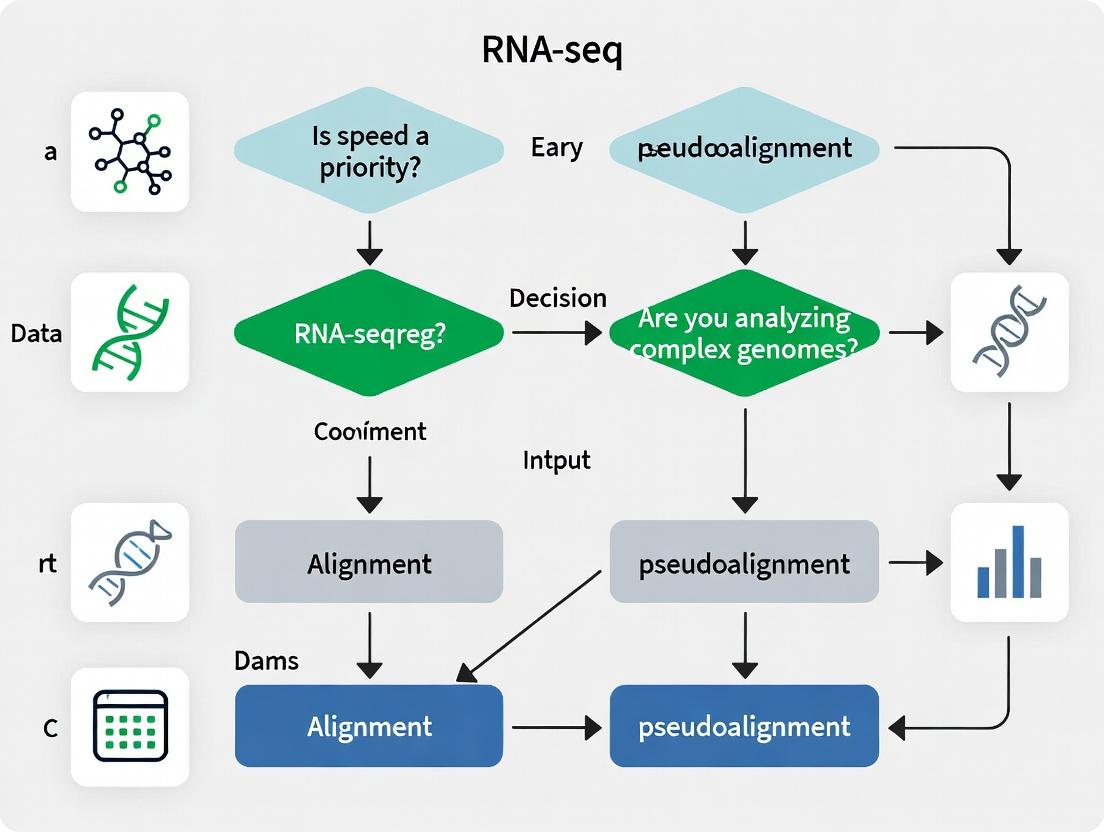
This definitive guide clarifies the critical choice between traditional alignment (e.g., STAR, HISAT2) and pseudoalignment (e.g., kallisto, salmon) for RNA-seq analysis.
RNA-seq Alignment vs. Pseudoalignment: A Strategic Guide for Genomics Researchers
Abstract
This definitive guide clarifies the critical choice between traditional alignment (e.g., STAR, HISAT2) and pseudoalignment (e.g., kallisto, salmon) for RNA-seq analysis. We detail the foundational principles, computational mechanisms, and practical workflows for each method, directly addressing the needs of researchers and drug developers. The article provides a structured framework for troubleshooting, optimizing performance based on experimental design and hardware, and validating results. A comparative analysis of accuracy, speed, and resource requirements offers clear decision-making criteria, empowering scientists to select the optimal tool for gene expression quantification, novel isoform discovery, and biomarker identification in clinical and biomedical research.
Alignment and Pseudoalignment Decoded: Core Concepts for RNA-seq Analysis
What is Traditional Alignment? Mapping Reads to a Reference Genome
Within the critical research decision of How to choose between RNA-seq alignment and pseudoalignment, understanding the foundational technology is paramount. Traditional alignment, often called "spliced aware" alignment for RNA-seq, is the process of determining the precise genomic origin of each sequencing read by mapping it to a reference genome. This computationally intensive method seeks the optimal location for a read, allowing for mismatches, indels, and, crucially for RNA, exon-spanning gaps (spliced junctions). It remains the gold standard for applications requiring high precision and variant detection, but must be weighed against the speed of pseudoalignment for differential expression analysis.
Core Algorithmic Principles
Traditional aligners like HISAT2, STAR, and BWA employ a seed-and-extend paradigm optimized for large genomes and spliced transcripts.
- Indexing: The reference genome is pre-processed into an index (e.g., FM-index, suffix array) for rapid querying.
- Seeding: Substrings ("seeds") from the read are matched to the genome index.
- Extension & Scoring: Candidate seed locations are extended into full alignments. Alignment scores are computed using scoring matrices (match, mismatch, gap penalties).
- Spliced Alignment: For RNA-seq, aligners use databases of known splice junctions or de novo discovery to identify reads spanning introns, a process requiring significant memory and processing power.
Detailed Experimental Protocol: RNA-seq Alignment with STAR
This protocol details a standard workflow for aligning RNA-seq reads using the STAR aligner.
1. Prerequisite: Genome Index Generation
- Input: Reference genome FASTA file and corresponding annotation file (GTF/GFF).
- Command:
- Explanation:
--sjdbOverhangshould be set to (read length - 1). This step is performed once per genome/annotation combination.
2. Alignment of Reads
- Input: FASTQ files (paired-end or single-end).
- Command:
- Output: A sorted BAM file containing genomic coordinates for each read.
3. Post-Alignment Processing (Typical Workflow)
- Sorting & Indexing: Often done directly by STAR as above.
- Duplicate Marking: Using tools like Picard Tools to flag PCR duplicates.
- Junction File Extraction: STAR outputs a file of discovered splice junctions for downstream use.
Quantitative Data Comparison: Key Aligners
Table 1: Performance Metrics of Traditional RNA-seq Aligners
| Aligner | Algorithm Core | Speed (Relative) | Memory Usage | Spliced Alignment | Best For |
|---|---|---|---|---|---|
| STAR | Suffix Array | Moderate-Fast | High (≥30GB for human) | Excellent, de novo | Comprehensive transcriptome studies, novel junction discovery |
| HISAT2 | Hierarchical FM-index | Fast | Moderate (~10GB for human) | Excellent, uses global index | Sensitive alignment, especially for small genomes |
| TopHat2 | Bowtie2 + Segmentation | Slow | Moderate | Good, relies heavily on annotation | Legacy workflows, annotation-dependent analysis |
| BWA-MEM | FM-index | Moderate | Low | Basic (DNA-focused) | DNA-seq, genomic variant calling |
Table 2: Alignment vs. Pseudoalignment in RNA-seq Context
| Feature | Traditional Alignment (e.g., STAR) | Pseudoalignment (e.g., Kallisto, Salmon) |
|---|---|---|
| Primary Output | Genomic coordinates (BAM file) | Transcript abundance estimates |
| Reference Used | Full reference genome | Transcriptome (cDNA) index |
| Splice Junction Handling | Explicitly models and discovers junctions | Implicit via transcript compatibility |
| Speed | Minutes to hours per sample | Seconds to minutes per sample |
| Resource Intensity | High CPU & Memory | Low CPU & Memory |
| Key Applications | Variant calling, novel isoform/discovery, fusion detection | High-throughput differential expression, rapid quantification |
Visualizing the Traditional Alignment Workflow
Title: Traditional Alignment Computational Workflow
The Scientist's Toolkit: Essential Research Reagents & Solutions
Table 3: Key Reagents & Materials for RNA-seq Alignment Experiments
| Item | Function in Workflow | Example/Note |
|---|---|---|
| High-Quality Total RNA | Starting biological material; RIN > 8 is typically required for library prep. | Isolated from tissues/cells using TRIzol or column-based kits. |
| Poly-A Selection Beads | Enriches for mRNA by binding polyadenylated tails, reducing ribosomal RNA background. | Oligo-dT magnetic beads (e.g., NEBNext Poly(A) mRNA Magnetic). |
| RNA-seq Library Prep Kit | Fragments RNA, converts to double-stranded cDNA, and adds sequencing adapters/indexes. | Illumina TruSeq Stranded mRNA, NEBNext Ultra II. |
| Reference Genome FASTA | The canonical genomic sequence for the target organism. | Downloaded from ENSEMBL, UCSC, or NCBI. |
| Annotation File (GTF/GFF) | Provides coordinates of known genes, transcripts, and exon boundaries. | Crucial for spliced alignment and downstream quantification. |
| Alignment Software | Executes the mapping algorithm. | STAR, HISAT2, or TopHat2 installed on HPC or local server. |
| High-Performance Computing (HPC) Resources | Provides the necessary CPU, memory, and storage for alignment and analysis. | Typically a Linux-based cluster with sufficient RAM (>32GB for human). |
What is Pseudoalignment? A K-mer-Based Approach for Transcriptome Quantification
Within the critical research question of How to choose between RNA-seq alignment and pseudoalignment, understanding the core mechanism of pseudoalignment is paramount. Traditional alignment maps each read to a reference transcriptome, base-by-base, a computationally intensive process. Pseudoalignment, pioneered by tools like Kallisto and Salmon, re-frames the problem. It determines not where a read aligns, but which transcripts it is compatible with, using a k-mer-based index. This paradigm shift offers dramatic speed and efficiency gains, making it a compelling choice for large-scale transcript quantification, especially in differential expression studies for drug development. The choice hinges on the trade-off between the exhaustive detail of alignment and the speed and sufficiency of pseudoalignment for count-based expression estimates.
Core Principles of Penoalignment
Pseudoalignment operates on three fundamental principles:
- K-mer Indexing: The reference transcriptome is decomposed into all possible substrings of length k (k-mers). Each k-mer is hashed and mapped to the set of transcripts in which it appears.
- Compatibility via K-mer Matching: An RNA-seq read is also broken into its constituent k-mers. By querying the index, the algorithm retrieves the set of potential transcript origins for each k-mer.
- Set Intersection for Transcript Identification: The transcript of origin for the read is inferred by finding the intersection of the transcript sets for all its k-mers. The read is "pseudoaligned" to the minimal set of transcripts that collectively contain all its k-mers.
This process bypasses the costly steps of gap alignment, spliced alignment, and base-pair resolution, focusing solely on transcript assignment for quantification.
Detailed Methodological Workflow
The experimental protocol for pseudoalignment-based quantification is structured as follows:
Protocol 3.1: Kallisto Pseudoalignment and Quantification
Input: FASTQ files (single-end or paired-end), reference transcriptome (FASTA format). Output: Transcript-level abundance estimates (TPM, estimated counts).
Index Building:
- The
-kparameter specifies the k-mer size (default 31). The algorithm builds a colored de Bruijn graph from the transcriptome, where each k-mer is a node and paths through the graph represent transcripts.
- The
Quantification (Pseudoalignment & Expectation-Maximization):
- Reads are hashed into k-mers and queried against the index to find compatible transcripts.
- An Expectation-Maximization (EM) algorithm resolves reads that map to multiple transcripts (multi-mapping reads) and calculates maximum likelihood abundance estimates.
Protocol 3.2: Salmon Quasi-mapping and Quantification
Input: FASTQ files, reference transcriptome (FASTA format) or decoy-aware genome. Output: Transcript-level abundance estimates.
Index Building:
- Builds a quasi-index over the transcriptome, combining k-mer matches (via a fMD) with suffix array (SA) intervals for rapid mapping.
Quantification:
- Quasi-mapping: For each read, finds a set of candidate locations in the transcriptome using the fMD and SA.
- Inference: Employs a variant of the EM algorithm, often incorporating sample-specific and sequence-specific bias corrections (
--gcBias,--seqBias).
Key Comparative Data
Table 1: Performance Comparison of Pseudoalignment vs. Traditional Alignment (Representative Benchmark Data)
| Metric | Traditional Aligner (STAR+featureCounts) | Pseudoaligner (Kallisto) | Quasi-mapper (Salmon) |
|---|---|---|---|
| Speed (CPU hours) | ~15 hours (for 30M paired-end reads) | ~0.5 hours | ~0.8 hours |
| Memory Usage (GB) | ~30 GB | ~5 GB | ~8 GB |
| Correlation of DE Genes | 1.00 (baseline) | 0.98 - 0.99 | 0.98 - 0.99 |
| Accuracy on Simulated Data | High | Very High | Very High |
| Primary Output | BAM files (alignments) + counts | Direct abundance estimates (TPM/counts) | Direct abundance estimates (TPM/counts) |
| Handles Multi-mapping | Yes, but often discards or weights | Yes, via EM algorithm | Yes, via rich statistical model |
Table 2: Decision Framework for Choosing Alignment vs. Pseudoalignment
| Research Objective | Recommended Approach | Justification |
|---|---|---|
| Differential Expression (Bulk RNA-seq) | Pseudoalignment (Kallisto/Salmon) | Superior speed and efficiency with minimal accuracy trade-off for count-based methods. |
| Variant Calling / SNP Detection | Traditional Alignment (STAR, HISAT2) | Requires base-pair resolution alignment files (BAM/CRAM). |
| Novel Isoform Discovery | Traditional Alignment or StringTie2 | Relies on spliced alignment across the genome to assemble new transcripts. |
| Single-Cell RNA-seq (UMI-based) | Pseudoalignment (e.g., alevin in Salmon suite) | Optimized for high-throughput processing of UMI-based protocols. |
| Fusion Gene Detection | Specialized Alignment (STAR-Fusion, Arriba) | Requires chimeric alignment signals across the genome. |
| Clinical Diagnostics | Validated Alignment Pipeline | Often mandated by regulatory guidelines requiring auditable, base-level alignment evidence. |
Visualization of Workflows
Diagram 1: Comparison of Traditional and Pseudoalignment Workflows (87 chars)
Diagram 2: K-mer Intersection Principle in Pseudoalignment (96 chars)
The Scientist's Toolkit: Essential Research Reagents & Solutions
Table 3: Key Reagents and Tools for Pseudoalignment Experiments
| Item | Function/Description | Example Product/Resource |
|---|---|---|
| High-Quality RNA Extraction Kit | Isolates intact, pure total RNA from cells/tissues, minimizing degradation which creates spurious k-mers. | Qiagen RNeasy Kit, TRIzol Reagent. |
| RNA Integrity Number (RIN) Analyzer | Assesses RNA quality (e.g., Agilent Bioanalyzer). Samples with RIN > 8 are optimal for accurate k-mer representation. | Agilent 2100 Bioanalyzer RNA Nano Kit. |
| Strand-Specific Library Prep Kit | Preserves strand-of-origin information, critical for accurate transcript assignment in complex genomes. | Illumina Stranded mRNA Prep. |
| Reference Transcriptome (FASTA) | Curated set of known transcripts. Quality directly impacts results. | ENSEMBL cDNA files, RefSeq transcripts. |
| Pseudoalignment Software | Core computational tool for k-mer indexing and quantification. | Kallisto, Salmon (with salmon and alevin). |
| Computational Environment | Sufficient RAM (≥8 GB) and multi-core CPUs. Cloud or HPC resources are often used for large studies. | AWS EC2 instance, local server with Conda environment. |
| Downstream Analysis Suite | For statistical analysis of the count matrix produced by pseudoaligners. | R/Bioconductor (DESeq2, edgeR, tximport). |
This technical guide examines the fundamental dichotomy in transcriptome analysis: traditional RNA-seq alignment, which seeks base-pair precision, versus pseudoalignment, which employs probabilistic assignment for transcript quantification. Framed within the critical decision-making process for research, this document provides an in-depth comparison of methodologies, data outputs, and applications, specifically for researchers and drug development professionals choosing between these paradigms.
RNA sequencing has evolved into two dominant computational approaches for transcript quantification. Alignment-based methods (e.g., STAR, HISAT2) map reads to a reference genome or transcriptome with base-pair resolution, enabling the discovery of novel isoforms and precise variant detection. In contrast, pseudoalignment (e.g., Kallisto, Salmon) uses lightweight, probabilistic algorithms to assign reads to transcripts without exact alignment, optimizing for speed and quantification accuracy of known transcripts. The choice between them hinges on the specific research questions, ranging from novel discovery in exploratory research to high-throughput quantification in biomarker validation.
Technical Comparison of Core Algorithms
RNA-Seq Alignment (Base-Pair Precision)
Alignment involves a seed-and-extend strategy. Reads are broken into k-mers, matched to a reference index (often a genome), and then meticulously aligned using dynamic programming (e.g., Smith-Waterman) to resolve gaps and mismatches.
Detailed Protocol for STAR Alignment:
- Index Generation:
STAR --runMode genomeGenerate --genomeDir /path/to/genomeDir --genomeFastaFiles reference.fa --sjdbGTFfile annotation.gtf --sjdbOverhang 99 - Alignment:
STAR --genomeDir /path/to/genomeDir --readFilesIn sample_R1.fastq sample_R2.fastq --runThreadN 12 --outSAMtype BAM SortedByCoordinate --quantMode GeneCounts - Output: A coordinate-sorted BAM file with detailed alignment information for each read, including splice junctions.
Pseudoalignment (Probabilistic Assignment)
Pseudoalignment uses a k-mer-based transcriptome index (de Bruijn graph). Reads are hashed into k-mers, and their presence across transcripts is evaluated. Assignment is probabilistic, calculating the likelihood a read originated from a compatible set of transcripts.
Detailed Protocol for Kallisto:
- Index Generation:
kallisto index -i transcriptome.idx transcriptome.fasta - Quantification:
kallisto quant -i transcriptome.idx -o output_dir -t 12 sample_R1.fastq sample_R2.fastq - Output: Direct estimates of transcript abundances (TPM, counts) without an intermediate alignment file.
Quantitative Performance Comparison
The following tables synthesize data from recent benchmarking studies (2023-2024).
Table 1: Computational Resource Requirements
| Metric | STAR (Alignment) | Kallisto (Pseudoalignment) | Salmon (Selective Alignment) |
|---|---|---|---|
| Indexing Time | ~1 hour (genome) | ~15 minutes (transcriptome) | ~20 minutes (transcriptome) |
| Processing Time | ~30 min per sample | ~5 min per sample | ~10 min per sample |
| Memory (RAM) | 32-64 GB | 8-12 GB | 10-16 GB |
| Disk Space (Output) | Large (BAM: 20-40 GB) | Minimal (TSV: < 100 MB) | Moderate (SF: ~1 GB) |
Table 2: Accuracy & Application Suitability
| Aspect | Base-Pair Alignment | Probabilistic Assignment |
|---|---|---|
| Quantification Accuracy | High, but can be biased by multi-mapping | Very high for known transcripts, handles multi-mapping statistically |
| Novel Isoform Detection | Yes (via spliced alignment) | No (relies on provided transcriptome) |
| Variant Calling (SNPs/Indels) | Yes | No |
| Differential Splicing Analysis | Yes (with appropriate tools) | Limited (requires pre-defined isoforms) |
| Ideal Use Case | Exploratory discovery, cancer genomics, non-model organisms | High-throughput drug screening, expression biomarker validation, large cohort studies |
Decision Framework: Choosing the Right Tool
The choice is dictated by the research goal within the drug development pipeline.
Title: Decision Flowchart for RNA-seq Method Selection
Integrated Analysis Workflow
A modern hybrid approach often uses pseudoalignment for quantification, supplemented by targeted alignment for discovery tasks.
Title: Integrated RNA-seq Analysis Workflow
The Scientist's Toolkit: Essential Research Reagents & Materials
Table 3: Key Reagent Solutions for RNA-seq Experiments
| Reagent/Material | Function & Purpose | Example Product/Kit |
|---|---|---|
| Poly-A Selection Beads | Enriches for mRNA by binding poly-adenylated tails; critical for standard RNA-seq. | NEBNext Poly(A) mRNA Magnetic Isolation Kit |
| Ribo-depletion Kits | Removes abundant ribosomal RNA (rRNA) to increase sequencing depth of non-rRNA. | Illumina Ribo-Zero Plus rRNA Depletion Kit |
| RNA Library Prep Kit | Converts RNA to double-stranded cDNA, adds sequencing adapters and barcodes. | Illumina TruSeq Stranded mRNA Kit |
| Ultra-low Input RNA Kit | Enables library preparation from minimal input (<10 ng), crucial for precious samples. | SMART-Seq v4 Ultra Low Input RNA Kit |
| UMI Adapters | Incorporates Unique Molecular Identifiers (UMIs) to correct for PCR duplication bias. | IDT for Illumina - UMI Adapters |
| Spike-in Control RNAs | Exogenous RNA added to sample for normalization and quality control of quantification. | ERCC RNA Spike-In Mix (Thermo Fisher) |
| High-Fidelity DNA Polymerase | Used in PCR amplification of libraries; minimizes PCR errors and bias. | KAPA HiFi HotStart ReadyMix |
The core difference between base-pair precision and probabilistic assignment is not a matter of superiority but of appropriate application. For comprehensive discovery where novel biology is sought—such as in early-stage oncology research or studying poorly annotated diseases—alignment remains indispensable. For high-throughput, quantitative applications where speed, efficiency, and cost are paramount—such as in pharmacodynamic biomarker assessment or large-scale clinical trial analysis—probabilistic assignment is the unequivocal choice. A strategic, hybrid approach that leverages the strengths of both is increasingly becoming the standard for robust, multi-faceted transcriptomic research in drug development.
Within RNA-seq data analysis, a fundamental methodological choice exists between alignment and pseudoalignment. Traditional aligners like STAR, HISAT2, and Bowtie2 map sequencing reads to a reference genome or transcriptome with base-pair precision. In contrast, lightweight tools like kallisto, salmon, and Sailfish perform pseudoalignment—rapidly assigning reads to transcripts of origin without exact base-level mapping. This guide provides an in-depth technical comparison, framed within the thesis of choosing the appropriate approach for your research goals, experimental design, and resource constraints.
Core Algorithmic Distinctions
The fundamental difference lies in the underlying algorithm and data structures.
Alignment-Based Tools: These tools build an index of the reference genome and perform exhaustive or heuristic search to find the optimal genomic location for each read, often considering splice junctions for RNA-seq.
- STAR: Uses a sequential maximum mappable seed search in two stages.
- HISAT2: Employs a hierarchical indexing scheme based on the Burrows-Wheeler Transform (BWT) and the Ferragina-Manzini (FM) index for efficient spliced alignment.
- Bowtie2: Utilizes the FM-index for rapid, memory-efficient whole-genome alignment, often used with a transcriptome reference or in conjunction with splice-aware tools.
Pseudoalignment-Based Tools: These tools build an index of the transcriptome (k-mers) and use clever hashing or probabilistic data structures to determine the set of transcripts a read is compatible with, without specifying the exact coordinate.
- kallisto: Constructs a colored de Bruijn graph from the transcriptome. Reads are partitioned into k-mers, and their paths through the graph determine transcript compatibility.
- salmon: Uses a quasi-mapping approach coupled with a rich statistical model (via variational Bayesian inference or EM algorithm) to account for sequence- and fragment-level biases during quantification.
- Sailfish (early pioneer): Introduced the concept of counting k-mers in reads and mapping them to a transcriptome index for rapid quantification.
Quantitative Performance Comparison
The choice between these tool classes involves trade-offs in speed, memory, accuracy, and required output.
Table 1: Core Algorithm & Index Characteristics
| Tool | Class | Primary Index Type | Core Algorithm | Handles Spliced Reads? |
|---|---|---|---|---|
| STAR | Aligner | Genome (Suffix Array) | Seed-and-extend, 2-pass mapping | Yes (explicitly) |
| HISAT2 | Aligner | Hierarchical FM-index | Graph FM-index for splicing | Yes (explicitly) |
| Bowtie2 | Aligner | FM-index (Burrows-Wheeler) | BWT backtracking with gaps | Only with spliced reference |
| kallisto | Pseudoaligner | Transcriptome (de Bruijn Graph) | Colored de Bruijn graph traversal | Implicitly via transcriptome |
| salmon | Pseudoaligner | Transcriptome (FMD-index) | Quasi-mapping + rich bias models | Implicitly via transcriptome |
| Sailfish | Pseudoaligner | Transcriptome (Hash-based) | K-mer hashing & counting | Implicitly via transcriptome |
Table 2: Performance Benchmarks (Typical RNA-seq Experiment ~30M paired-end reads)*
| Tool | Approx. Runtime | Peak Memory (GB) | Primary Output | Quantification Accuracy (vs. qPCR) |
|---|---|---|---|---|
| STAR | 1.5 - 2 hours | 28 - 32 | Aligned BAM files (genomic) | High (with careful parameters) |
| HISAT2 | 2 - 3 hours | 8 - 12 | Aligned BAM files (genomic) | High |
| Bowtie2 (to trans.) | ~45 mins | 3 - 5 | Aligned SAM/BAM (transcriptomic) | Moderate |
| kallisto | ~15 mins | ~5 | Read counts & TPM | Very High |
| salmon | ~20 mins | ~4 | Read counts & TPM | Very High (with bias correction) |
| Sailfish | ~20 mins | ~4 | Read counts & TPM | High |
*Benchmarks are approximate, based on typical human transcriptome analysis using a standard server (16-32 cores). Performance varies with data size, organism, and hardware.
Detailed Experimental Protocols
Protocol 1: Standard RNA-seq Alignment Workflow with STAR & Feature Counting
Objective: Generate gene-level expression counts from raw FASTQ files using genomic alignment.
- Genome Indexing:
STAR --runMode genomeGenerate --genomeDir /path/to/GenomeDir --genomeFastaFiles genome.fa --sjdbGTFfile annotation.gtf --runThreadN 20 - Read Alignment:
STAR --genomeDir /path/to/GenomeDir --readFilesIn read1.fq.gz read2.fq.gz --runThreadN 20 --outSAMtype BAM SortedByCoordinate --outFileNamePrefix sample1. - Post-processing: Sort and index BAM files if not done by aligner (
samtools). - Quantification: Use a dedicated counting tool (e.g.,
featureCountsfrom Subread package):featureCounts -p -a annotation.gtf -o counts.txt *.bam
Protocol 2: Transcript-Level Quantification with Salmon (Pseudoalignment)
Objective: Rapidly estimate transcript abundances directly from raw reads.
- Transcriptome Indexing:
salmon index -t transcripts.fa -i salmon_index --gencode - Quantification:
salmon quant -i salmon_index -l A -1 read1.fq.gz -2 read2.fq.gz -p 20 --validateMappings -o sample1_quant - Output: The
quant.sffile in the output directory contains transcript IDs, estimated counts, TPM, and effective length.
Decision Framework & Workflow Diagrams
Title: RNA-seq Tool Selection Decision Tree
Title: Alignment vs. Pseudoalignment Workflow Comparison
The Scientist's Toolkit: Essential Research Reagents & Solutions
Table 3: Key Computational Reagents for RNA-seq Analysis
| Item | Function & Description | Example/Tool |
|---|---|---|
| Reference Genome | The complete DNA sequence of the organism used as a mapping template. Essential for alignment. | Human: GRCh38 (hg38), Mouse: GRCm39 (mm39) from ENSEMBL/NCBI. |
| Annotation File (GTF/GFF) | Contains genomic coordinates of known genes, transcripts, exons, and other features. Critical for assigning reads to features. | ENSEMBL .gtf file corresponding to the reference genome version. |
| Transcriptome Sequence (FASTA) | A file of all known cDNA/transcript sequences. Required for pseudoaligner indexing and quantification. | Derived from reference genome and annotation (e.g., using gffread). |
| High-Quality Sequencing Reads | The raw input data in FASTQ format. Quality (Phred scores) and adapter contamination impact all downstream results. | Output from Illumina, NovaSeq, etc. Tools: FastQC, Trimmomatic. |
| Alignment File (BAM/SAM) | The standardized output of aligners, storing read coordinates and alignment information. Required for visualization and variant calling. | Generated by STAR, HISAT2. Manipulated with samtools. |
| Abundance File | The output of quantification tools, listing estimated counts and normalized expression (TPM, FPKM) per feature. | quant.sf from salmon, abundance.tsv from kallisto. |
| Computational Infrastructure | Adequate CPU, RAM, and storage. Alignment is resource-intensive; pseudoalignment can be run on a modern laptop. | High-performance compute cluster or cloud instance (e.g., AWS, GCP). |
The choice between alignment and pseudoalignment is dictated by the research question. Choose STAR, HISAT2, or Bowtie2 when your analysis requires precise genomic coordinates for discovering novel splice junctions, characterizing genetic variants, or working in poorly annotated genomes. Opt for kallisto, salmon, or Sailfish when the primary goal is fast and accurate transcript-level quantification for differential expression in a well-annotated context, especially under limited computational resources. For the majority of standard differential expression studies, the speed and accuracy of modern pseudoalignment tools like salmon make them the compelling first choice, while traditional aligners remain indispensable for exploratory genomic analyses.
1. Introduction
The choice between RNA-seq alignment and pseudoalignment is not merely a technical preference; it is fundamentally dictated by the biological question driving the research. This guide operationalizes this thesis, providing a framework for decision-making and detailed experimental protocols. The core decision hinges on the requirement for quantification versus discovery.
2. Biological Questions Dictate the Computational Approach
The following table categorizes primary biological questions and recommends the appropriate analytical paradigm.
Table 1: Mapping Biological Questions to Analytical Methods
| Core Biological Question | Sub-Question Example | Recommended Method | Primary Rationale |
|---|---|---|---|
| Differential Gene Expression | Which genes are upregulated in treated vs. control samples? | Pseudoalignment (e.g., Salmon, kallisto) | Speed, accuracy in transcript-level quantification, reduced memory footprint. |
| Transcript Isoform Discovery & Usage | What novel splice variants are present? How do isoform ratios change? | Traditional Alignment (e.g., STAR, HISAT2) → Assembly (StringTie) | Full read alignment is required for de novo transcript assembly and precise junction analysis. |
| Genetic Variant Detection (in RNA) | What somatic or expression quantitative trait loci (eQTLs) are present? | Traditional Alignment (e.g., STAR) → Variant Calling (GATK) | Base-level alignment fidelity is essential for single-nucleotide variant and indel identification. |
| Fusion Gene Detection | Are there oncogenic gene fusions in this cancer sample? | Traditional Alignment (Specialized: STAR-Fusion, Arriba) | Relies on precise mapping of discordant read pairs and split-read alignments across genes. |
| Viral Transcriptome Analysis | How does a virus integrate and express in the host genome? | Traditional Alignment (to hybrid host+virus reference) | Requires complex alignment to both host and pathogen genomes, often needing splice-aware mapping. |
3. Experimental Protocols
Protocol A: Reference-based Transcriptome Quantification via Pseudoalignment (for Differential Expression)
- Input: FASTQ files (raw or adapter-trimmed).
- Indexing: Build a transcriptome index from a reference cDNA FASTA file using
kallisto indexorsalmon index. The k-mer size (typically 31) is a key parameter. - Quantification: Run
kallisto quantorsalmon quant. For paired-end data:-i [index] -o [output] --bias [for GC correction] [reads_1.fastq reads_2.fastq]. - Output: Abundance estimates in Transcripts Per Million (TPM) and estimated counts per transcript/gene.
- Downstream Analysis: Import count matrices into R/Bioconductor (e.g., tximport → DESeq2, edgeR, limma-voom) for differential expression testing.
Protocol B: Splice-Aware Genome Alignment & Novel Isoform Analysis
- Input: FASTQ files.
- Genome Indexing: Generate a genome index with a splice-aware aligner (e.g.,
STAR --runMode genomeGenerateusing a reference genome FASTA and gene annotation GTF). - Alignment: Map reads to the genome:
STAR --genomeDir [index] --readFilesIn [reads.fastq] --outSAMtype BAM SortedByCoordinate --quantMode GeneCounts. - Assembly: Use the aligned BAM file as input to a transcript assembler:
stringtie [aligned.bam] -G [reference.gtf] -o [novel_isoforms.gtf]. - Output: BAM alignment files, gene/transcript count matrices, and an updated GTF file containing novel transcript models.
4. Visualization of Decision Logic & Workflows
Title: RNA-seq Method Selection Logic Flow
Title: Core Workflow Comparison: Quantification vs Discovery
5. The Scientist's Toolkit: Key Research Reagent Solutions
Table 2: Essential Reagents & Materials for RNA-seq Experiments
| Item | Function / Rationale | Example Product / Kit |
|---|---|---|
| High-Quality Total RNA | Starting material integrity (RIN > 8) is critical for accurate representation of the transcriptome. | QIAGEN RNeasy Kit, TRIzol Reagent. |
| Poly(A) Selection or rRNA Depletion Beads | Enriches for mRNA by capturing polyadenylated tails or removing ribosomal RNA. | NEBNext Poly(A) mRNA Magnetic Isolation Kit, Illumina Ribo-Zero Plus. |
| RNA Fragmentation Reagents | Controlled fragmentation (e.g., divalent cations, heat) converts long mRNA into short fragments suitable for library construction. | NEBNext First Strand Synthesis Reaction Buffer. |
| Reverse Transcriptase with High Processivity | Synthesizes stable cDNA from RNA templates, especially through complex secondary structures. | SuperScript IV Reverse Transcriptase, Maxima H Minus. |
| Double-Stranded cDNA Synthesis Kit | Converts first-strand cDNA into double-stranded DNA for subsequent library preparation. | NEBNext Second Strand Synthesis Module. |
| Library Preparation Kit with Unique Dual Indexes (UDIs) | Prepares sequencing-ready libraries with inline barcodes. UDIs prevent index hopping errors. | Illumina Stranded mRNA Prep, IDT for Illumina UDI Kit. |
| SPRIselect Beads | Size selection and purification of cDNA and final libraries. Replaces traditional gel electrophoresis. | Beckman Coulter SPRIselect. |
| Sequencing Platform-specific Flow Cell & Reagents | The consumable and chemistry required for the actual sequencing run. | Illumina NovaSeq 6000 S-Prime Reagent Kit, NextSeq 2000 P3 Reagents. |
Step-by-Step Protocols: Implementing Alignment and Pseudoalignment Workflows
Within the broader thesis on choosing between RNA-seq alignment and pseudoalignment, the initial data preparation stage is a critical, foundational step. The quality and structure of the analysis-ready inputs directly influence the performance, accuracy, and ultimate validity of both alignment-based (e.g., STAR, HISAT2) and pseudoalignment-based (e.g., Kallisto, Salmon) methodologies. This guide provides a detailed technical workflow for transforming raw sequencing reads (FASTQ) into the processed inputs required for downstream quantification and analysis.
Raw Data Assessment: Quality Control (QC)
The first step involves a rigorous assessment of raw sequence quality using tools like FastQC and MultiQC.
Experimental Protocol: Initial Quality Control
- Tool: FastQC (v0.12.0+).
- Command:
fastqc sample_R1.fastq.gz sample_R2.fastq.gz -o ./qc_report/ - Output: Generates an HTML report per file detailing per-base sequence quality, adapter contamination, GC content, etc.
- Aggregation: Use MultiQC to compile all FastQC reports:
multiqc ./qc_report/ -o ./multiqc_summary/
Table 1: Key FastQC Metrics and Acceptable Thresholds
| Metric | Ideal Outcome | Warning Threshold | Action Required If Failed |
|---|---|---|---|
| Per Base Sequence Quality | Phred score > 30 across all bases | Phred score < 28 in any cycle | Trimming required |
| Per Sequence Quality Scores | Mean quality > 30 | Mean quality < 27 | Investigate library prep |
| Adapter Content | < 1% for all adapters | > 5% for any adapter | Adapter trimming mandatory |
| Overrepresented Sequences | < 0.1% of total | > 0.5% of total | Potential contamination |
Preprocessing: Trimming and Filtering
Based on QC, reads require preprocessing to remove low-quality bases, adapters, and artifacts.
Experimental Protocol: Adapter & Quality Trimming
- Tool: fastp or Trimmomatic.
- fastp Command (Typical):
- Post-trimming QC: Re-run FastQC on trimmed files to confirm improvement.
Core Processing Pathways: Alignment vs. Pseudoalignment Preparation
The data preparation workflow diverges based on the chosen downstream quantification method. This decision point is central to the overarching thesis.
Diagram Title: Data Preparation Workflow Divergence for RNA-seq Analysis.
Pathway 1: Preparation for Traditional Spliced Alignment
This path requires a reference genome and often a gene annotation file (GTF/GFF).
Experimental Protocol: STAR Alignment
- Genome Indexing (One-time):
- Read Alignment:
- Output: A sorted BAM file (
sample_aligned.Aligned.sortedByCoord.out.bam) and a raw count file (sample_aligned.ReadsPerGene.out.tab).
Pathway 2: Preparation for Pseudoalignment
This path requires a decoy-aware transcriptome reference for optimal accuracy with tools like Salmon.
Experimental Protocol: Salmon Quantification with Decoys
- Generate Transcriptome and Decoy Index:
- Extract transcript sequences:
gffread -w transcriptome.fa -g genome.fa annotation.gtf - Create decoy list from genome sequences not used as transcripts.
- Concatenate transcriptome and genome decoy sequences.
- Build index:
salmon index -t combined_transcriptome_decoys.fa -d decoys.txt -i salmon_index -p 16
- Extract transcript sequences:
- Quantification:
- Output: A directory (
sample_quant) containingquant.sffile with transcript-level abundances (TPM, NumReads).
Table 2: Comparative Outputs from Alignment vs. Pseudoalignment Preparation
| Feature | Alignment-Based Output (e.g., STAR+featureCounts) | Pseudoalignment-Based Output (e.g., Salmon) |
|---|---|---|
| Primary File | Coordinate-sorted BAM file | quant.sf (text file) |
| Quantification Level | Gene-level (default) | Transcript-level (default) |
| Key Metrics | Raw read counts per gene | Transcripts Per Million (TPM), Estimated counts |
| Data Density | Large file (GBs), contains spatial info | Small file (MBs), contains abundance info |
| Downstream Ready | Requires secondary counting tool | Directly importable into DESeq2/tximport |
The Scientist's Toolkit: Research Reagent Solutions
Table 3: Essential Materials and Tools for RNA-seq Data Preparation
| Item | Function | Example/Note |
|---|---|---|
| Raw FASTQ Data | The primary input containing sequencing reads. | Typically gzip-compressed (.fastq.gz). |
| Reference Genome | A curated assembly of an organism's DNA. | Required for alignment (e.g., GRCh38 from GENCODE/Ensembl). |
| Gene Annotation (GTF/GFF) | File defining genomic coordinates of genes/transcripts. | Crucial for STAR indexing and feature counting. |
| Transcriptome FASTA | File containing sequences of all known transcripts. | Required for pseudoalignment index (derived from genome + GTF). |
| Quality Control Suite | Assesses read quality and identifies issues. | FastQC (visual), MultiQC (aggregation). |
| Trimming Tool | Removes adapters and low-quality bases. | fastp (integrated QC), Trimmomatic. |
| Alignment Software | Maps reads to reference genome, handling splicing. | STAR (spliced), HISAT2. |
| Pseudoalignment Software | Rapidly assigns reads to transcripts without full alignment. | Kallisto, Salmon (needs decoy-aware index). |
| High-Performance Compute (HPC) | Computational resources for intensive steps. | Necessary for genome indexing and alignment. |
1. Introduction
Within the critical decision framework of choosing between RNA-seq alignment and pseudoalignment for a research project, understanding the capabilities and requirements of a full alignment workflow is paramount. This guide details the practice of using the Spliced Transcripts Alignment to a Reference (STAR) aligner, the current industry standard for comprehensive, splice-aware genomic alignment. STAR's ability to precisely map reads across splice junctions and its rich output of diagnostic data make it essential for applications demanding high accuracy, such as novel isoform discovery, variant calling, or integrative analysis in drug development. This whitepaper provides an in-depth technical guide to its three core phases: indexing, mapping, and post-processing.
2. The STAR Alignment Workflow: A Three-Phase Process
Diagram Title: Three-Phase Workflow of STAR RNA-seq Alignment
3. Phase 1: Reference Genome Indexing
Indexing constructs a searchable reference from the genome sequence and annotation, crucial for STAR's speed.
3.1. Protocol: Generating a STAR Genome Index
- Input Preparation: Download reference genome FASTA files and corresponding gene annotation (GTF/GFF) files from a source like ENSEMBL or Gencode.
- Command Execution:
- Parameter Explanation:
--sjdbOverhangspecifies the length of the genomic sequence around annotated junctions. The optimal value is[Read Length] - 1.
3.2. Key Indexing Parameters & Resources
Table 1: Critical Parameters for STAR Genome Indexing
| Parameter | Typical Value | Function |
|---|---|---|
--runThreadN |
4-16 | Number of CPU threads to use. |
--genomeDir |
User path | Directory to store the generated index. |
--genomeFastaFiles |
genome.fa |
Path to reference genome FASTA file(s). |
--sjdbGTFfile |
annotation.gtf |
Path to gene annotation file. |
--sjdbOverhang |
99 (for 100bp reads) | Critical for junction detection accuracy. |
--genomeSAindexNbases |
14 (for human) | Genome index size. Adjusted for small genomes. |
4. Phase 2: Read Mapping
This core phase aligns sequencing reads from FASTQ files to the indexed genome.
4.1. Protocol: Two-Pass Mapping for Novel Junction Discovery
The two-pass mode increases sensitivity for novel splice junctions and is recommended for most analyses.
First Pass:
Second Pass:
4.2. Key Mapping Outputs
Table 2: Essential Output Files from STAR Mapping
| File | Format | Content & Use |
|---|---|---|
Aligned.sortedByCoord.out.bam |
BAM | Coordinate-sorted alignments for downstream analysis. |
ReadsPerGene.out.tab |
Tab-delimited | Raw counts per gene, unstranded/forward/reverse. |
SJ.out.tab |
Tab-delimited | High-confidence splice junctions for novel discovery. |
Log.final.out |
Text | Summary mapping statistics for QC. |
5. Phase 3: Post-Processing
Raw BAM files and counts require further processing for biological interpretation.
5.1. Protocol: Generating a Count Matrix with FeatureCounts
STAR's GeneCounts provides raw counts. For finer control, use dedicated tools like featureCounts.
5.2. Protocol: Marking Duplicates with Picard Tools
PCR duplicates can bias quantification and must be flagged.
6. Comparison: Alignment vs. Pseudoalignment
Table 3: Quantitative & Qualitative Comparison of STAR Alignment vs. Pseudoalignment (e.g., Kallisto/Salmon)
| Aspect | STAR (Alignment) | Pseudoalignment (Kallisto/Salmon) |
|---|---|---|
| Primary Output | Genomic coordinate BAM files. | Estimated transcript abundances. |
| Speed | Slower (hours). | Faster (minutes). |
| Memory | High (>30 GB for human). | Low (~5 GB). |
| Key Strength | Variant detection, novel isoform/junction discovery, visual inspection. | Differential expression speed, efficient quantification. |
| Best For | Exploratory analysis, non-model organisms, clinical diagnostics (variant calling). | High-throughput DE analysis, large cohort studies, rapid hypothesis testing. |
| Typical % Aligned | 85-95% (with well-matched reference). | N/A (direct quantification). |
7. The Scientist's Toolkit: Essential Research Reagents & Solutions
Table 4: Key Reagents and Computational Tools for a STAR Workflow
| Item | Function & Rationale |
|---|---|
| High-Quality Total RNA | Intact RNA (RIN > 8) is critical for accurate library prep and splicing analysis. |
| Stranded mRNA-seq Kit | Preserves strand information, essential for accurate transcript assignment and antisense detection. |
| Illumina Sequencing Reagents | Generate high-quality, paired-end reads (≥75bp) for reliable splice junction spanning. |
| STAR Aligner (v2.7.11a+) | Industry-standard splice-aware aligner. Version control ensures reproducibility. |
| SAMtools/BEDTools | For manipulating, filtering, and analyzing BAM files (e.g., indexing, coverage calculations). |
| Picard Tools | Provides essential QC and processing functions (duplicate marking, insert size metrics). |
| Subread (featureCounts) | Efficient, accurate quantification of gene/feature-level counts from BAM files. |
| High-Performance Computing | Cluster/server with >32 GB RAM and multi-core CPUs is required for human genome indexing. |
Within the broader thesis on choosing between RNA-seq alignment and pseudoalignment, the pseudoalignment approach, as implemented by tools like salmon, offers a compelling alternative for transcript-level quantification. Traditional alignment maps reads to a reference genome or transcriptome, determining their exact origin. Pseudoalignment, in contrast, rapidly determines which transcripts a read is compatible with without calculating the exact base-to-base alignment. This shift in paradigm enables substantial gains in speed and reduced computational resource consumption, making it highly suitable for large-scale studies and iterative analyses in drug development and clinical research.
The core trade-off centers on the research question: alignment (e.g., via STAR) is necessary for detecting novel isoforms, genetic variants, or detailed splice junction analysis, while pseudoalignment is optimal for accurate, fast transcript abundance estimation from a known transcriptome.
Core Methodology: The salmon Pseudoalignment Workflow
Prerequisites and Data Acquisition
The workflow begins with the collection of a reference transcriptome and RNA-seq reads (FASTQ files).
Research Reagent Solutions & Essential Materials:
| Item | Function in Experiment |
|---|---|
| High-Quality Reference Transcriptome (FASTA) | A comprehensive set of known transcript sequences for the organism (e.g., from Ensembl, GENCODE). Serves as the basis for index construction. |
| RNA-seq Reads (FASTQ files) | The raw sequencing data (single-end or paired-end) to be quantified. Quality control (FastQC) and adapter trimming (Trim Galore!) are recommended pre-processing steps. |
| salmon Software | The core tool that performs lightweight alignment and quantification using the quasi-mapping algorithm. |
| Compute Environment | A server or cluster with sufficient RAM (≥16GB recommended for mammalian transcriptomes) and multiple CPU cores for parallel processing. |
| Bioinformatics Pipelines (e.g., nf-core/rnaseq) | Optional but recommended for reproducible, containerized execution of the entire workflow. |
Step 1: Building the Transcriptome Index
The index is a compact data structure (the quasi-index) that allows salmon to efficiently map k-mers from the reads to their potential transcript(s) of origin.
Detailed Protocol:
- Obtain Transcriptome: Download the cDNA fasta file for your organism (e.g.,
Homo_sapiens.GRCh38.cdna.all.fa.gzfrom Ensembl). - Index Command: Execute the
salmon indexcommand.-t: Input transcriptome FASTA file.-i: Directory where the generated index will be stored.-k: Specifies the k-mer size. A larger k (e.g., 31) increases specificity but requires longer reads.
Step 2: Quantification of RNA-seq Samples
With the index built, quantification proceeds sample-by-sample using the salmon quant module.
Detailed Protocol:
- Prepare Reads: Ensure reads are quality-trimmed. For paired-end data, you will have two FASTQ files per sample (
sample_1.fq,sample_2.fq). - Quantification Command:
-l: Library type (e.g.,Afor automatic inference,IUfor stranded).-1/-2: Paths to paired-end read files.--validateMappings: Enables selective alignment, a more accurate but slightly slower mapping strategy.--gcBias: Corrects for biases in fragment abundance due to GC content.-o: Output directory containing thequant.sffile with abundance estimates.
Quantitative Performance Comparison
Table 1: Benchmarking salmon (Pseudoalignment) vs. STAR (Traditional Alignment)
| Metric | salmon (Pseudoalignment) | STAR + RSEM (Alignment-Based) | Notes / Source |
|---|---|---|---|
| Speed (CPU hours) | ~0.5 hours | ~2-4 hours | Time to process a typical 30M read paired-end human sample (20 threads). salmon is 4-8x faster. |
| Memory Usage (GB) | ~8-12 GB | ~28-32 GB | Peak RAM usage during indexing/alignment. salmon requires ~3-4x less memory. |
| Accuracy (vs. qPCR) | High (r > 0.95) | High (r > 0.95) | Both methods show high correlation with ground truth measures for well-annotated transcripts. |
| Detection of Novel Events | No | Yes | Pseudoalignment requires a pre-specified transcriptome; STAR can discover novel junctions/isoforms. |
| Input Flexibility | Transcriptome | Genome / Transcriptome | salmon requires a transcriptome reference; STAR can map to the genome. |
Table 2: Output File (quant.sf) Structure
| Column | Description | Example Value |
|---|---|---|
Name |
Transcript identifier from the FASTA file. | ENST00000641515.2 |
Length |
Effective length of the transcript (adjusted for fragment length distribution). | 1423 |
EffectiveLength |
Computed effective length considering all biases. | 1367.42 |
TPM |
Transcripts Per Million, the normalized abundance estimate. Primary output for most analyses. | 253.42 |
NumReads |
Estimated number of reads originating from this transcript. | 1245.7 |
Workflow Visualization
Salmon Pseudoalignment Workflow from Inputs to Output
Decision Guide: Alignment vs Pseudoalignment
The pseudoalignment workflow with salmon represents a state-of-the-art method for transcript quantification, offering dramatic improvements in speed and resource efficiency with no loss in accuracy for its intended purpose. For researchers and drug development professionals whose primary aim is to quantify expression levels of known transcripts across many samples—such as in biomarker studies, treatment cohort analysis, or large-scale screening—salmon is the unequivocal recommendation.
However, within the thesis framework, the choice remains context-dependent. If the research question hinges on exploring the full complexity of the transcriptome (novel isoforms, fusion genes, or fine-grained splicing analysis), traditional alignment remains indispensable. A pragmatic hybrid approach is also viable: using STAR for genomic alignment and discovery, followed by salmon for quantification using the generated transcriptome BAM file as input, leveraging the strengths of both paradigms.
The choice between traditional alignment and pseudoalignment for RNA-seq analysis fundamentally dictates the nature and format of the primary output data. This decision is central to the broader thesis on optimizing RNA-seq workflows, balancing biological insight, computational resource allocation, and project timelines. Alignment yields Sequence Alignment/Map (SAM) and its binary counterpart (BAM) files, rich in genomic context. Pseudoalignment, in contrast, directly generates gene- or transcript-level quantification matrices, streamlining the path to expression analysis.
Core File Formats: Structure and Content
SAM/BAM Files: The Alignment Archives
SAM is a tab-delimited text format containing alignment information for every read. BAM is its compressed, indexed binary version, essential for efficient storage and access.
Key Fields in a SAM Record:
| Field | Description | Example/Values |
|---|---|---|
| QNAME | Query (read) template name | read_12345 |
| FLAG | Bitwise flag indicating alignment properties | 99 (paired, properly paired, mapped, ...) |
| RNAME | Reference sequence name (chromosome) | chr1 |
| POS | 1-based leftmost mapping position | 100000 |
| MAPQ | Mapping quality (Phred-scaled) | 60 |
| CIGAR | String describing alignment (matches, indels, clipping) | 150M |
| RNEXT | Reference name of the mate/next read | chr1 |
| PNEXT | Position of the mate/next read | 100150 |
| TLEN | Observed template length (insert size) | 150 |
| SEQ | Read sequence | ATCG... |
| QUAL | Read base quality scores (ASCII) | FFF... |
| Optional Tags | Additional information (e.g., gene assignment) | XS:A:- (strand) |
Experimental Protocol: Generating SAM/BAM via Alignment (e.g., STAR)
- Input: FASTQ files (raw reads), reference genome and annotation (GTF/GFF).
- Genome Indexing:
STAR --runMode genomeGenerate --genomeDir /path/to/genomeDir --genomeFastaFiles genome.fa --sjdbGTFfile annotation.gtf - Alignment:
STAR --genomeDir /path/to/genomeDir --readFilesIn sample.fastq --outSAMtype BAM SortedByCoordinate --outFileNamePrefix sample_ - Post-processing: Sort and index BAM files (if not done by aligner) using
samtools sort sample.bam -o sample.sorted.bamandsamtools index sample.sorted.bam.
Quantification Matrices: The Expression Summaries
These are tabular files where rows represent features (genes/transcripts), columns represent samples, and cells contain counts or abundance estimates.
Typical Structure of a Quantification Matrix (CSV/TSV):
| Feature_ID | Sample_A | Sample_B | Sample_C | ... |
|---|---|---|---|---|
| Gene_1 | 150 | 210 | 95 | ... |
| Gene_2 | 0 | 5 | 12 | ... |
| Gene_3 | 3050 | 2870 | 3125 | ... |
Experimental Protocol: Generating Quantification via Pseudoalignment (e.g., Kallisto)
- Input: FASTQ files, reference transcriptome (FASTA of cDNA sequences).
- Transcriptome Indexing:
kallisto index -i transcriptome.idx transcriptome.fasta - Quantification:
kallisto quant -i transcriptome.idx -o output_dir -b 100 sample_1.fastq sample_2.fastq - Output: The
abundance.tsvfile contains estimated counts (est_counts) and TPM (Transcripts Per Million). Aggregating these files across samples creates the final matrix.
| Characteristic | SAM/BAM Files | Quantification Matrices |
|---|---|---|
| Primary Content | Per-read genomic alignments. | Per-feature aggregated counts. |
| Data Density | Very high; raw alignment data. | High; summarized numerical data. |
| Typical Size (per sample) | 20-50 GB (BAM, compressed). | 1-10 MB (text, uncompressed). |
| Direct Usability | Low; requires further processing (e.g., counting). | High; ready for statistical analysis (e.g., DESeq2, edgeR). |
| Biological Resolution | Nucleotide-level; enables variant calling, splicing analysis. | Gene/Transcript-level; focused on abundance. |
| Key Metrics Contained | MAPQ, CIGAR, alignment position, optional tags. | Estimated counts, TPM, possibly within-sample uncertainty. |
| Downstream Applications | Variant detection, novel isoform discovery, visualization (IGV). | Differential expression, clustering, pathway analysis. |
| Computational Demand | High (alignment, storage, I/O). | Low (rapid pseudoalignment, small files). |
Visualizing the Divergent Workflows
Title: RNA-seq Alignment vs. Pseudoalignment Workflow Comparison
The Scientist's Toolkit: Research Reagent Solutions
| Item | Function in RNA-seq Analysis |
|---|---|
| High-Quality Total RNA | Starting material; integrity (RIN > 8) is critical for accurate representation of the transcriptome. |
| Poly-A Selection or rRNA Depletion Kits | Enriches for mRNA or removes abundant ribosomal RNA, defining the scope of transcriptome captured. |
| Reverse Transcriptase & Library Prep Kits | Converts RNA to cDNA and prepares sequencing libraries with adapters and sample barcodes. |
| Reference Genome (FASTA) & Annotation (GTF) | Essential map for alignment-based tools (e.g., STAR). Provides genomic coordinates for features. |
| Reference Transcriptome (FASTA) | Essential index for pseudoaligners (e.g., Kallisto). Contains known cDNA sequences for rapid matching. |
| Alignment Software (e.g., STAR) | Performs splice-aware mapping of reads to the genome, generating SAM/BAM files. |
| Pseudoalignment Software (e.g., Kallisto) | Uses k-mer matching to rapidly assign reads to transcripts, directly outputting counts. |
| Quantification Aggregator (e.g., tximport) | Collates individual sample quantification files into a unified matrix for analysis in R/Bioconductor. |
| BAM Index (.bai) File | Allows random access to specific genomic regions in a BAM file, enabling efficient visualization and analysis. |
Downstream Analysis Pipelines for Differential Expression (DESeq2, edgeR)
Within the broader thesis context of choosing between RNA-seq alignment and pseudoalignment, the selection of a downstream differential expression (DE) analysis pipeline is a critical, consequential decision. Alignment-based workflows (e.g., STAR/HISAT2 → featureCounts) and pseudoalignment/kallisto workflows both produce count matrices that serve as the input for DE tools. The two most established statistical packages for analyzing these count data are DESeq2 and edgeR. This guide provides an in-depth technical comparison and protocol for their use, enabling researchers and drug development professionals to implement robust, reproducible DE analysis.
Core Methodologies: DESeq2 vs. edgeR
Statistical Foundations
Both DESeq2 and edgeR model count data using a negative binomial (NB) distribution to handle over-dispersion common in RNA-seq. However, they differ in their estimation procedures and normalization strategies.
DESeq2 employs a median-of-ratios method for normalization (estimating size factors) and uses shrinkage estimators (empirical Bayes) to stabilize log fold change estimates across low-count genes, reducing false positives.
edgeR typically uses trimmed mean of M-values (TMM) for normalization and can employ either a quantile-adjusted conditional maximum likelihood (qCML) or a generalized linear model (GLM) framework. Its empirical Bayes method shrinks dispersion estimates towards a trended mean.
Experimental Protocol: Standard Differential Expression Workflow
The following protocol is applicable to a count matrix derived from either alignment or pseudoalignment.
- Data Import & Preprocessing: Load the count matrix and sample information table (colData). Filter out genes with very low counts across all samples (e.g., genes with <10 reads across all samples).
- Normalization: Calculate normalization factors (DESeq2:
estimateSizeFactors; edgeR:calcNormFactors). - Dispersion Estimation: Estimate gene-wise dispersion, then shrink towards a fitted trend (DESeq2:
estimateDispersions; edgeR:estimateDispfor GLM orestimateTagwiseDispfor classic). - Statistical Testing:
- DESeq2: Perform Wald test (default) or Likelihood Ratio Test (LRT) using
nbinomWaldTestornbinomLRT. - edgeR (GLM): Fit a GLM per gene using
glmFit, followed by a likelihood ratio test or quasi-likelihood F-test usingglmLRTorglmQLFTest.
- DESeq2: Perform Wald test (default) or Likelihood Ratio Test (LRT) using
- Result Extraction: Generate a results table with log2 fold changes, p-values, and adjusted p-values (FDR). Apply independent filtering and log fold change shrinkage in DESeq2 (
lfcShrink).
Quantitative Data Comparison
Table 1: Core Feature Comparison of DESeq2 and edgeR
| Feature | DESeq2 | edgeR |
|---|---|---|
| Primary Normalization | Median-of-ratios | TMM |
| Dispersion Estimation | Empirical Bayes shrinkage to trend | Empirical Bayes shrinkage to common or trended |
| Statistical Test | Wald test (default) or LRT | Exact test (classic) or GLM LRT/QLF-test |
| Handling of Multifactor Designs | Native via design formula | Native via design matrix in GLM |
| Fold Change Shrinkage | Integrated (apeglm, ashr) |
Available via glmTreat or external packages |
| Optimal for Small N (<5/group) | Robust, but requires careful filtering | Robust, especially with robust=TRUE in dispersion estimation |
| Typical Output | DESeqResults object |
TopTags table |
Table 2: Performance Benchmark Summary (Typical Findings)
| Metric | DESeq2 | edgeR | Notes |
|---|---|---|---|
| Sensitivity | High | Slightly higher in some benchmarks | edgeR may detect more DE genes at same FDR threshold. |
| Specificity | Very High | Very High | Both control FDR effectively at the nominal level. |
| Speed | Moderate | Faster for classic designs | Differences often marginal for modern hardware. |
| Usability | High (integrated workflow) | High (modular functions) | DESeq2 offers a more streamlined single-package experience. |
Key Experimental Protocols
Protocol 1: Basic DE Analysis with DESeq2
Protocol 2: Basic DE Analysis with edgeR (GLM approach)
Visualization of Workflows
RNA-seq to DE Analysis Decision Flow
Choosing Between DE Pipelines Logic Tree
The Scientist's Toolkit: Research Reagent Solutions
Table 3: Essential Computational Tools & Resources
| Item | Function in DE Analysis | Example/Provider |
|---|---|---|
| Count Matrix Generation | Converts aligned reads (BAM) or pseudoalignment abundances into gene-level counts. | featureCounts (Subread), HTSeq, tximport (for kallisto/Salmon output) |
| DE Analysis Software | Performs statistical modeling, normalization, and testing for DE. | DESeq2 (Bioconductor), edgeR (Bioconductor) |
| Functional Analysis Suite | Interprets DE gene lists in biological context (pathways, GO terms). | clusterProfiler, fgsea, Enrichr |
| Interactive Visualization | Enables exploration of results (PCA, heatmaps, volcano plots). | ggplot2, pheatmap, EnhancedVolcano, Glue |
| High-Performance Compute (HPC) | Provides resources for memory/CPU-intensive alignment and analysis steps. | Local compute cluster (SLURM), Cloud (AWS, GCP), BioHPC solutions |
| Reproducibility Framework | Packages and documents code, data, and environment for replicability. | RMarkdown, Jupyter Notebook, Docker/Singularity containers |
| Reference Annotations | Essential for assigning reads to genes/transcripts. | ENSEMBL GTF, RefSeq GFF, GENCODE annotations |
The choice between DESeq2 and edgeR for downstream analysis is nuanced. Both are exceptionally robust for DE analysis from either alignment or pseudoalignment-derived counts. DESeq2's integrated, opinionated workflow offers ease of use and strong stabilization of effect sizes, which is advantageous for visualization and ranking. edgeR's modularity and slight sensitivity edge, particularly in its quasi-likelihood implementation, make it a powerful alternative. This decision should be guided by the specific biological question, experimental design complexity, and the desired balance between sensitivity and stability of fold-change estimates. Ultimately, proper experimental design, adequate replication, and careful quality control are more consequential to success than the choice between these two elite tools.
Optimizing Performance and Solving Common Issues in RNA-seq Mapping
Within the pivotal decision framework of How to choose between RNA-seq alignment and pseudoalignment research, the selection of computational methodology is not merely a technical detail but a fundamental determinant of research feasibility, scalability, and cost. Alignment tools (e.g., STAR, HISAT2) map reads to a reference genome, providing high accuracy and variant detection at high computational cost. Pseudoalignment tools (e.g., Kallisto, Salmon) perform rapid transcriptome quantification by identifying compatible transcripts, trading some genomic context for drastic speed and memory improvements. This whitepaper provides an in-depth technical guide to benchmarking the core computational resources—speed, memory (RAM), and storage—that define this critical choice.
Core Benchmarking Methodology
To ensure reproducibility and fair comparison, the following standardized experimental protocol is proposed for benchmarking RNA-seq quantification tools.
2.1 Experimental Protocol for Resource Benchmarking
- Compute Environment: All benchmarks must be run on identical hardware. A modern Linux server (e.g., Ubuntu 22.04 LTS) with at least 16 CPU cores, 64 GB RAM, and SSD storage is recommended. CPU clock speed and cache architecture should be documented.
- Data Selection:
- Reference: Use a standard reference genome (e.g., GRCh38 for human) and its corresponding transcriptome (GENCODE v44). For alignment tools, generate a genome index. For pseudoaligners, generate a transcriptome index.
- Input Data: Select publicly available RNA-seq datasets from repositories like SRA (Sequence Read Archive). Use datasets of varying sizes (e.g., 10 million, 30 million, 100 million paired-end reads) to assess scaling.
- Tool Execution & Measurement:
- Speed: Use the Unix
timecommand (or/usr/bin/time -vfor detailed metrics) to record wall-clock time and CPU time. Run each tool three times and report the median. - Memory (RAM): Measure peak memory usage via
/usr/bin/time -vor dedicated monitoring tools (e.g.,ps,htop). - Storage: Calculate the size of all input files, generated indices, and output files (e.g., BAM, quant.sf).
- Speed: Use the Unix
- Tool Versions & Commands: Specify exact versions and command-line arguments. Example baselines:
- STAR:
STAR --genomeDir /ref/star_index/ --readFilesIn R1.fastq.gz R2.fastq.gz --runThreadN 16 --outSAMtype BAM SortedByCoordinate --quantMode TranscriptomeSAM - Kallisto:
kallisto quant -i /ref/kallisto_index.idx -o output -t 16 R1.fastq.gz R2.fastq.gz
- STAR:
Quantitative Benchmark Data
The following tables synthesize current benchmark data (as of early 2025) for key representative tools, illustrating the core trade-offs.
Table 1: Indexing Phase Resource Requirements (Human GRCh38/GENCODE v44)
| Tool | Type | Index Size (GB) | Indexing Time (CPU hrs) | Peak Memory (GB) |
|---|---|---|---|---|
| STAR | Genome Aligner | ~31.0 | 2.5 | 32 |
| HISAT2 | Genome Aligner | ~4.5 | 1.0 | 8 |
| Salmon (SA) | Pseudoaligner | ~2.1 | 1.2 | 12 |
| Kallisto | Pseudoaligner | ~1.8 | 0.3 | 5 |
Table 2: Quantification Phase Resources (30 Million Paired-End Reads)
| Tool | Wall-clock Time (min) | CPU Time (hrs) | Peak Memory (GB) | Output Size (GB) |
|---|---|---|---|---|
| STAR | 45 | 10.5 | 28 | ~6.5 (BAM) |
| HISAT2 + StringTie2 | 90 | 22.0 | 5 | ~5.0 (BAM) |
| Salmon (alignment-based) | 25 | 6.2 | 4 | <0.01 (quant) |
| Kallisto | 8 | 2.0 | 3 | <0.01 (quant) |
Visualizing the Decision Workflow
The following diagram maps the logical decision-making process for selecting a quantification method based on research goals and resource constraints.
Decision Workflow for RNA-seq Tool Selection
The Scientist's Toolkit: Research Reagent Solutions
Table 3: Essential Materials & Tools for RNA-seq Computational Analysis
| Item/Reagent | Function & Purpose in Analysis |
|---|---|
| High-Quality Reference Genome/Transcriptome (e.g., from GENCODE, RefSeq) | The foundational sequence against which reads are mapped or quantified. Accuracy is paramount for all downstream results. |
| Tool-Specific Index | Pre-computed data structure (k-mer hash, FM-index, etc.) that enables rapid lookup and alignment/pseudoalignment. Must match the tool and reference version. |
| Adapters & Quality Trimming Tool (e.g., Cutadapt, fastp) | Removes adapter sequences and low-quality bases from raw sequencing reads, reducing noise and improving mapping rates. |
| Format Conversion Utilities (e.g., samtools, gffread) | Converts between file formats (BAM/SAM/FASTQ/GTF), enabling interoperability between alignment and quantification pipelines. |
| Containerized Environment (e.g., Docker/Singularity image) | Ensures software version and dependency consistency, guaranteeing reproducible results across different computing platforms. |
| Cluster/Cloud Job Scheduler (e.g., SLURM, AWS Batch) | Manages parallel execution of jobs on high-performance computing (HPC) clusters or cloud infrastructure, essential for large-scale studies. |
| Quantification Matrix Aggregator (e.g., tximport, BUSpaRse) | Collates output from multiple samples into a single gene/transcript expression matrix for downstream statistical analysis in R/Python. |
The choice between alignment and pseudoalignment is a direct optimization function of the research question against computational constraints. For large-scale drug screening or cohort studies where quantification speed and cost are limiting, pseudoalignment is the unequivocal choice. For discovery-oriented research requiring novel isoform detection or splicing analysis, the resource intensity of traditional alignment remains justified. These benchmarks provide a framework for researchers to make an informed, strategic allocation of computational resources, directly supporting the broader thesis that methodological choice in RNA-seq is a fundamental driver of research design and success.
Within the critical decision framework of RNA-seq analysis—choosing between traditional alignment (e.g., STAR, HISAT2) and pseudoalignment (e.g., kallisto, salmon)—parameter tuning is paramount for accurate transcript quantification. This guide details core strategies for optimizing two persistent challenges: the accurate alignment of spliced reads across exon junctions and the statistically valid resolution of reads mapping to multiple genomic locations (multi-mappers).
The choice of computational method fundamentally shapes downstream biological interpretation. Traditional alignment maps reads to a reference genome, enabling novel junction discovery but requiring meticulous parameterization for splice awareness. Pseudoalignment maps reads to a transcriptome, offering speed and reduced memory footprint but relying on a complete, accurate annotation. This paper's thesis is that informed parameter tuning, tailored to the chosen method's architecture, is essential for deriving biologically accurate results in either paradigm.
Core Challenge I: Accurate Handling of Spliced Reads
Algorithmic Foundations
Spliced aligners use seed-and-extend or FM-index based algorithms to identify reads spanning introns. Key tunable parameters govern sensitivity and specificity.
Critical Parameters & Experimental Tuning
For Genome Aligners (e.g., STAR):
--alignSJoverhangMin: Minimum overhang for unannotated junctions.--alignIntronMin/Max: Minimum and maximum intron sizes.--alignMatesGapMax: Maximum genomic gap between paired-end mates.--scoreGapNoncan: Penalty for non-canonical splice sites.
For Pseudoaligners (e.g., salmon):
--minScoreFraction: Minimum fraction of the optimal score for a mapping to be considered.--consensusSlack: Slack allowed in the consensus mapping during the selective alignment phase.
Experimental Protocol for Validation
Protocol Title: Benchmarking Spliced Read Detection Accuracy.
- Input: Generate a synthetic RNA-seq dataset (using tools like Polyester) with known splice junctions, including novel (unannotated) junctions.
- Alignment: Run the aligner/pseudoaligner with a matrix of parameter values (e.g., varying
--alignIntronMinfrom 10 to 30). - Validation: Compare discovered junctions to the ground truth using BEDTools.
- Metric Calculation: Compute precision (TP/(TP+FP)) and recall (TP/(TP+FN)) for junction discovery.
- Optimization: Select the parameter set that maximizes the F1-score (harmonic mean of precision and recall) for your organism and library prep.
Table 1: Impact of STAR --alignIntronMin on Junction Discovery (Synthetic Data)
| Parameter Value | True Positives (TP) | False Positives (FP) | False Negatives (FN) | Precision | Recall | F1-Score |
|---|---|---|---|---|---|---|
| 10 | 9,850 | 210 | 150 | 0.979 | 0.985 | 0.982 |
| 20 | 9,820 | 95 | 180 | 0.990 | 0.982 | 0.986 |
| 30 | 9,800 | 42 | 200 | 0.996 | 0.980 | 0.988 |
Core Challenge II: Statistically Robust Resolution of Multi-Mappers
The Quantification Problem
Reads originating from paralogous genes or shared exonic regions map to multiple locations, biasing quantification if not handled properly.
Strategic Approaches & Parameters
1. Expectation-Maximization (EM) Algorithm (salmon, kallisto): Probabilistically allocates multi-mapping reads.
- Key Tuning:
--numGibbsSamples(salmon): Number of Gibbs sampling rounds for uncertainty estimation. - Validation: Examine the
numEqClassesreport; a very high number may indicate over-splitting of read mappings.
2. Multi-Mapping Correction (STAR with RSEM): Aligns to the genome, then quantifies using the transcriptome-aware EM model.
- Key Tuning: STAR's
--winAnchorMultimapNmaxand--outFilterMultimapNmaxcontrol initial multi-map reporting. RSEM's--estimate-rspdflag improves fragment length distribution estimation.
Experimental Protocol for Validation
Protocol Title: Evaluating Multi-Mapper Resolution in Quantification.
- Input: Use a simulated dataset from a known transcriptome (e.g., using RSEM sim) where the true transcript abundances are defined.
- Processing: Quantify using the tool with different multi-mapping resolution strategies (e.g., EM with varying Gibbs samples, or simple unique-only mapping).
- Validation: Compare estimated Transcripts Per Million (TPM) to the known true TPM.
- Metric Calculation: Calculate the Spearman correlation coefficient and the mean absolute relative difference (MARD) between true and estimated abundances.
- Optimization: Select parameters that maximize correlation and minimize MARD for highly homologous gene families.
Table 2: Quantification Accuracy for Multi-Mappers Under Different Parameters
| Method & Parameters | Spearman Correlation (vs. Truth) | MARD (High-Homology Set) | Runtime (min) |
|---|---|---|---|
| STAR (unique only) | 0.85 | 0.65 | 45 |
| STAR + RSEM (default) | 0.94 | 0.25 | 70 |
salmon (--numGibbsSamples=20) |
0.96 | 0.18 | 15 |
salmon (--numGibbsSamples=100) |
0.97 | 0.16 | 22 |
Integrated Workflow & Decision Framework
The choice between alignment and pseudoalignment, and the subsequent parameter tuning, must be driven by the biological question, data quality, and reference completeness.
Title: RNA-seq Method Choice & Parameter Tuning Decision Flow
The Scientist's Toolkit: Essential Research Reagents & Solutions
Table 3: Key Computational Research Reagents for RNA-seq Analysis
| Item/Category | Specific Tool/Solution | Primary Function in Context |
|---|---|---|
| Alignment Engine | STAR (v2.7.11a+) | Performs genome-alignment with sensitive splice junction detection. Tunable for multi-mappers. |
| Pseudoaligner | salmon (v1.10.0+) | Enables lightweight, transcriptome-based quantification with built-in bias correction and EM resolution of multi-mappers. |
| Hybrid Quantifier | RSEM (v1.3.3+) | Works with STAR's genome alignments to provide transcript-level quantification using an EM algorithm. |
| Synthetic Data Generator | Polyester (R/Bioconductor), ART, RSEM sim | Creates in-silico RNA-seq reads with known ground truth for benchmarking parameter sets. |
| Benchmarking Suite | BEDTools (v2.30.0), gffcompare | Compares discovered genomic features (junctions) to annotated or simulated truth sets. |
| Metric Calculator | Custom R/Python scripts | Computes precision, recall, F1-score (junctions) and correlation/MARD (quantification). |
| Reference Package | GENCODE human/mouse annotation, Ensembl cDNA | High-quality transcriptome annotations required for pseudoalignment and junction-aware alignment. |
Accuracy in RNA-seq analysis is not inherent to the tool but is achieved through deliberate parameter tuning informed by the underlying algorithmic strategy. For studies prioritizing novel isoform discovery, tuning a genome aligner's splice-aware parameters is critical. For rapid, accurate quantification in well-annotated systems, tuning the probabilistic models in a pseudoaligner is key. In both scenarios, rigorous benchmarking against simulated truth sets provides the empirical evidence necessary for optimal parameter selection, ensuring downstream biological conclusions are built on a robust computational foundation.
This technical guide explores the critical challenge of managing technical noise in RNA-seq data analysis, specifically addressing batch effects and quality control (QC) metrics. This discussion is framed within the broader thesis of choosing between traditional RNA-seq alignment (e.g., using STAR or HISAT2) and pseudoalignment (e.g., using kallisto or Salmon) for differential expression analysis. The choice of workflow directly impacts the sources and magnitude of technical noise, the QC metrics applied, and the strategies required for batch correction. For researchers and drug development professionals, robust handling of these artifacts is essential for generating biologically valid and reproducible conclusions.
Technical noise arises from non-biological variability introduced during sample collection, library preparation, sequencing, and data processing. Batch effects—systematic differences between groups of samples processed in different experimental batches—are a predominant concern. Their impact varies between alignment-based and pseudoalignment workflows due to differences in underlying algorithms and information used.
Quality Control Metrics: A Comparative Framework
QC metrics must be evaluated at multiple stages. The table below summarizes core QC metrics, their targets, and their relevance to alignment versus pseudoalignment.
Table 1: Essential RNA-seq Quality Control Metrics
| QC Metric | Target/Measurement | Alignment-Based Relevance | Pseudoalignment Relevance | Typical Threshold (Post-Filtering) |
|---|---|---|---|---|
| Sequence Quality | Per-base Phred score (Q). | Critical for alignment accuracy and variant calling. | Less critical; robust to moderate quality drops. | Q ≥ 30 for most bases. |
| Adapter Contamination | % reads with adapter sequence. | High levels hinder alignment. | High levels can corrupt k-mer counting. | < 5% for standard libraries. |
| Read Duplication Rate | % PCR duplicates. | Identified via coordinate sorting; can bias variant calls. | Not directly identified; inherent in abundance estimation. | Varies by protocol; expect higher for 3' tagged. |
| Alignment Rate | % reads mapped to reference. | Primary QC; low rates indicate issues. | Not applicable (no explicit alignment). | > 70-80% for standard genomes. |
| Transcriptomic | % reads mapped to exons/rRNA. | High rRNA indicates poor poly-A selection. | Inferred from assigned counts; similar interpretation. | rRNA < 5% for poly-A selections. |
| Genomic | % reads in introns/intergenic. | High levels may indicate genomic DNA contamination. | Not directly measurable. | Intronic < 20-30% for poly-A. |
| Gene/Transcript Detection | # genes with counts > threshold. | Measures library complexity & sensitivity. | Direct output; key metric for both. | Expect 10,000-15,000 for mammalian cells. |
| Count Distribution | Median CV, PCA of QC metrics. | Identifies outlier samples. | Identifies outlier samples. | No single threshold; used for sample exclusion. |
Experimental Protocol for an Integrative QC Workflow
Protocol: Comprehensive QC and Batch Effect Diagnosis for RNA-seq Data
A. Pre-processing and Alignment/Pseudoalignment
- Raw Read QC: Use
FastQCon all raw FASTQ files. Aggregate results withMultiQC. - Adapter Trimming: Use
cutadaptorTrim Galore!with adapter sequences appropriate to your library kit. - Processing Path:
- Alignment Path: Align reads using
STAR(spliced aware) to the reference genome. Generate BAM files. Usesamtoolsto sort and index. - Pseudoalignment Path: Run
kallistoorSalmon(in mapping-based mode for diagnostics) directly on trimmed reads using a pre-built transcriptome index.
- Alignment Path: Align reads using
- Post-Alignment/Map QC: For alignment, use
QualimaporRSeQCto generate mapping statistics. For both paths, useMultiQCto aggregate all QC outputs.
B. Quantification and Count Matrix Generation
- Alignment Path: Generate gene-level counts from BAM files using
featureCounts(from Subread package) with an appropriate GTF annotation file. - Pseudoalignment Path: Use the direct transcript abundance estimates (
abundance.tsvfrom kallisto/Salmon). Aggregate to gene level usingtximportin R/Bioconductor, which correctly handles transcript-length biases and uncertainty.
C. Diagnostic Data Analysis in R
- Load Data: Load count matrices and sample metadata into R.
- Initial Filtering: Filter out lowly expressed genes (e.g., requiring >10 counts in at least n samples, where n is the size of the smallest group).
- Exploratory Analysis:
- Perform Principal Component Analysis (PCA) on variance-stabilized (e.g.,
vstin DESeq2) or log-transformed (e.g.,log2(CPM + 1)) count data. - Color PCA plots by known biological conditions (e.g., disease state) and technical factors (e.g., sequencing batch, date, lane).
- Perform Principal Component Analysis (PCA) on variance-stabilized (e.g.,
- Batch Effect Visualization:
- Create PCA plots as described above.
- Generate a hierarchical clustering dendrogram of samples based on Euclidean distance of the top 500 most variable genes.
- Use the
svapackage'ssvaseq()function to estimate surrogate variables of unsupervised variation. Plot these against technical factors.
Mitigating Batch Effects: Pre- and Post-Processing Strategies
Table 2: Batch Effect Mitigation Strategies
| Stage | Strategy | Method/Tool | Applicability |
|---|---|---|---|
| Experimental Design | Randomization & Balancing | Distribute biological groups across batches/lanes. | Universal best practice. |
| Statistical Modeling | Inclusion in Model | Include batch as a covariate in linear models (e.g., DESeq2, limma-voom). |
Effective when batch is known and orthogonal to condition. |
| Post-Hoc Correction | ComBat/sva | Use ComBat (parametric empirical Bayes) from sva package to adjust counts. |
Powerful for known batches; svaseq for unknown factors. Use with caution. |
| Algorithm Choice | Pseudoalignment | May reduce alignment-induced batch noise related to genome/annotation ambiguities. | Alternative paradigm, not a direct correction. |
Note: Post-hoc correction should be validated. Over-correction can remove biological signal. It is generally not recommended to correct the primary count matrix used for differential expression with tools like DESeq2; instead, correct the normalized matrix used for visualization or include batch in the DESeq2 design formula.
Alignment vs. Pseudoalignment: Implications for Noise Management
The choice between workflows influences the noise profile:
- Alignment-Based Workflows: Susceptible to noise from reference genome quality, annotation accuracy, and mapping parameters. Provide rich diagnostic metrics (e.g., genomic distribution of reads) crucial for identifying contamination. Batch effects can arise from changes in alignment software versions or parameters.
- Pseudoalignment Workflows: More robust to sequencing errors and polymorphisms due to k-mer matching. Faster and less computationally intensive. However, they are dependent on a complete and accurate transcriptome reference and offer fewer traditional alignment-based QC diagnostics. Batch effects related to library preparation and sequencing are still fully captured.
The Scientist's Toolkit: Research Reagent Solutions
Table 3: Essential Reagents and Tools for RNA-seq QC & Batch Management
| Item | Function & Relevance |
|---|---|
| External RNA Controls Consortium (ERCC) Spike-In Mix | Synthetic RNA transcripts at known concentrations added to lysate. Used to diagnose technical sensitivity, dynamic range, and batch-specific amplification biases. Crucial for batch effect studies. |
| UMI (Unique Molecular Identifier) Adapters | Short random nucleotide sequences added to each molecule before PCR. Allow precise counting of original RNA molecules, removing PCR duplication noise. Essential for single-cell and low-input RNA-seq. |
| Poly-A RNA Control (e.g., from other species) | Spike-in controls (e.g., Arabidopsis RNA) to monitor mRNA enrichment efficiency and cross-species contamination. |
| RNA Integrity Number (RIN) Standard | Used with Bioanalyzer/TapeStation to quantitatively assess RNA degradation. Low RIN is a major source of technical bias. |
| Commercial Library Prep Kits (e.g., Illumina TruSeq, NEB Next) | Standardized reagents reduce protocol variability, a major source of batch effects. Using the same kit version across a study is critical. |
| Benchmarking Datasets (e.g., SEQC, GEUVADIS) | Publicly available gold-standard datasets with known truth. Used to validate performance of alignment/pseudoalignment pipelines and batch correction methods. |
Visualizations
Diagram 1: RNA-seq Analysis Workflow with QC & Batch Management
Diagram 2: Batch Effect Source, Diagnosis, and Mitigation Pathway
The core thesis of choosing between read alignment and pseudoalignment hinges on the fundamental trade-off between comprehensiveness and efficiency. Alignment (e.g., with STAR, HISAT2) maps reads to a reference genome, enabling the discovery of novel isoforms, splice variants, and mutations. Pseudoalignment (e.g., with kallisto, Salmon) rapidly quantifies known transcripts by matching k-mers to a pre-built index. For standard bulk RNA-seq of high-quality RNA, this choice is often dictated by the biological question and computational resources. However, for the specialized designs of single-cell, long-read, and low-input RNA-seq, the optimization requirements decisively shift the balance.
This guide details how the constraints and goals of these three advanced designs necessitate bespoke optimization strategies, fundamentally influencing the alignment/pseudoalignment decision and the subsequent analytical pipeline.
Single-Cell RNA-seq (scRNA-seq)
Core Challenge: Processing thousands to millions of cells, each with sparse, biased, and noisy transcriptome data (dropouts, amplification artifacts, UMIs). The priority is efficient handling of massive datasets and accurate cell-level quantification.
Optimization Strategy & Tool Choice: Pseudoalignment is overwhelmingly favored for initial gene-level quantification due to its speed and reduced memory footprint, which is critical for large-scale studies. Alignment is reserved for specific sub-analyses requiring genomic context.
- Primary Quantification: kallisto | bustools or Salmon alevin are optimized for scRNA-seq. They perform rapid pseudoalignment, handle UMIs, and correct for cell/nucleus barcodes and technical biases.
- Alignment for Specialized Applications: For detecting somatic variants, analyzing viral integration, or investigating novel splice events within a specific cell population, alignment (e.g., STARsolo) is used on a subset of cells or data.
Table 1: scRNA-seq Optimization Overview
| Aspect | Recommended Approach | Key Tools | Rationale |
|---|---|---|---|
| Primary Quantification | Pseudoalignment | kallisto/bustools, Salmon alevin | Speed, efficient UMI/cell barcode processing, low memory. |
| Splice-Aware Analysis | (Selective) Alignment | STARsolo, | Necessary for detecting novel isoforms or detailed splice-variant analysis per cell. |
| Variant Calling | Alignment | CellSNP, STARsolo + GATK | Requires genomic alignment to identify single-nucleotide variants. |
| Integrated Analysis | Alignment | Cell Ranger (STAR-based) | Provides a unified but resource-intensive suite for mapping and quantification. |
Key Experimental Protocol: Droplet-based scRNA-seq Library Prep (10x Genomics)
- Cell Suspension Preparation: Viability >90%, concentration optimized for target cell recovery.
- Gel Bead-in-EMulsion (GEM) Generation: Cells, beads with barcoded oligos, and RT reagents are partitioned into nanoliter-scale droplets.
- Reverse Transcription: Within each GEM, RNA is reverse-transcribed, adding a Unique Molecular Identifier (UMI) and cell barcode.
- cDNA Amplification: Breaking droplets, pooling cDNA, and PCR amplification.
- Library Construction: Fragmentation, end-repair, A-tailing, adapter ligation, and sample indexing.
- Sequencing: Typically on Illumina platforms (NovaSeq, NextSeq) with paired-end reads (Read1: transcript; Read2: cell/UMI barcode).
The Scientist's Toolkit: Key Reagents for scRNA-seq
| Reagent/Material | Function |
|---|---|
| Chromium Chip & GEM Beads | Microfluidic device and barcoded gel beads for partitioning single cells. |
| Partitioning Oil & Reagents | Creates stable droplets for isolated RT reactions. |
| Reverse Transcriptase (Maxima H-) | Highly processive enzyme for efficient cDNA synthesis in droplets. |
| SPRIselect Beads | Size-selective magnetic beads for cDNA and library purification. |
| Dual Index Kit (i7/i5) | Adds unique sample indices for multiplexed sequencing. |
| Cell Viability Stain (e.g., DAPI/Propidium Iodide) | Critical for assessing sample quality pre-processing. |
Diagram 1: Single-cell RNA-seq workflow and analysis paths.
Long-Read RNA-seq (Isoform Sequencing)
Core Challenge: Resolving full-length transcript isoforms, complex splice patterns, and epigenetic modifications (via direct RNA-seq). Reads are long (>1kb) but have higher error rates (~10-15% for PacBio HiFi; ~5-15% for ONT).
Optimization Strategy & Tool Choice: Standard alignment is mandatory. Pseudoalignment, which relies on k-mers from a known transcriptome, cannot identify novel isoforms or structural variants from long reads. The focus shifts to specialized aligners that handle gaps (introns), high error rates, and can produce accurate splice-aware mappings.
- Primary Alignment: Minimap2 is the de facto standard, optimized for aligning noisy long reads. Graph aligners (e.g., deSALT, SPLICE) are emerging for complex splice graphs.
- Isoform Identification & Quantification: After alignment, tools like StringTie2 or FLAIR assemble transcripts and estimate their abundances. SQANTI3 is critical for quality control and classifying isoforms against a reference annotation.
Table 2: Long-Read RNA-seq Optimization Overview
| Aspect | Recommended Approach | Key Tools | Rationale |
|---|---|---|---|
| Read Alignment | Spliced Alignment | Minimap2, deSALT | Essential for handling long reads, high error rates, and splice junctions. |
| Isoform Assembly | Reference-guided | StringTie2, FLAIR | Reconstructs full-length transcript sequences from aligned reads. |
| Quantification | Alignment-based | StringTie2, Salmon (with alignment) | Estimates abundance of known and novel isoforms. |
| QC & Classification | Functional Analysis | SQANTI3, gffcompare | Filters artifacts and categorizes isoforms (novel, fusion, etc.). |
Key Experimental Protocol: cDNA PCR Sequencing (Iso-Seq) on PacBio
- Full-Length cDNA Synthesis: Use SMARTer or Template Switching technology to generate full-length, reverse-transcribed cDNA.
- cDNA Size Selection: Use SPRI beads or gel electrophoresis to select cDNA >1kb.
- PCR Amplification: Amplify size-selected cDNA with a limited number of cycles.
- SMRTbell Library Prep: End-repair, A-tailing, and adapter ligation to create circularizable templates.
- Sequencing on Sequel II/Revio: HiFi reads are generated via Circular Consensus Sequencing (CCS), producing highly accurate (>99%) long reads.
The Scientist's Toolkit: Key Reagents for Long-Read RNA-seq
| Reagent/Material | Function |
|---|---|
| Template Switching RT Enzyme | Generates full-length cDNA with common adapter sequence. |
| SMARTer Oligonucleotides | Cap-switching oligos for capturing the 5' cap of mRNA. |
| SPRIselect Beads | For precise size selection of long, fragile cDNA. |
| LongAmp Taq Polymerase | High-fidelity polymerase for amplifying long cDNA fragments. |
| SMRTbell Prep Kit | Prepares cDNA for PacBio circular consensus sequencing. |
| Ligation Sequencing Kit (ONT) | Prepares library for nanopore direct cDNA or direct RNA sequencing. |
Diagram 2: Long-read RNA-seq analysis for isoform resolution.
Low-Input and Degraded RNA-seq
Core Challenge: Limited starting material (pg-ng of total RNA) or degraded samples (e.g., FFPE, liquid biopsy) lead to low library complexity, 3' bias, and high duplication rates. The goal is to maximize information recovery.
Optimization Strategy & Tool Choice: The wet-lab protocol dictates the computational approach. 3'-biased methods (most common in low-input) are perfectly suited for pseudoalignment. Full-length methods require alignment for isoform analysis.
- Tag-Based Protocols (e.g., 10x 3', SMART-seq3): Pseudoalignment (kallisto, Salmon) is optimal, as reads originate primarily from transcript ends. These tools are robust to the resulting positional bias.
- Full-Transcript Protocols (e.g., SMART-seq2): If successful, alignment (STAR) can be used, but benefits are limited by low complexity. Pseudoalignment remains a robust, efficient choice.
- FFPE-Specific Analysis: Tools like STAR with customized parameters (allowing more mismatches/gaps) or RNA-seq mappers for bisulfite-treated samples (if dealing with degradation+modification) are necessary.
Table 3: Low-Input RNA-seq Optimization Overview
| Aspect | Recommended Approach | Key Tools | Rationale |
|---|---|---|---|
| 3'-Tagged Libraries | Pseudoalignment | kallisto, Salmon | Matches the protocol's bias; fastest, most efficient. |
| Full-Length Libraries | Either, leaning Pseudoalignment | STAR or kallisto/Salmon | Alignment possible but complexity low; pseudoalignment suffices for gene-level count. |
| FFPE/Degraded Reads | Tolerant Alignment | STAR (soft-clipping), HISAT2 | Special parameters handle deletions, cross-links, and fragmentation. |
| Duplicate Marking | Mandatory | Picard MarkDuplicates | Critical for accurate quantification in low-complexity libraries. |
Key Experimental Protocol: Ultra-Low Input RNA-seq using SMART-seq2
- Cell Lysis & RNA Capture: Single cells or few cells are lysed in a buffer containing oligo-dT primer.
- Reverse Transcription: Template-switching reverse transcription creates cDNA with universal adapter sequences.
- cDNA Preamplification: Limited-cycle PCR amplifies the full-length cDNA library.
- Tagmentation & Library Prep (Nextera XT): Amplified cDNA is fragmented and indexed via a tagmentation reaction.
- Clean-up & Sequencing: SPRI bead clean-up followed by Illumina sequencing (typically 75bp paired-end).
The Scientist's Toolkit: Key Reagents for Low-Input RNA-seq
| Reagent/Material | Function |
|---|---|
| RNA Extraction Beads (SPRI) | Maximizes RNA recovery from minute samples. |
| SMARTer Oligos & RT Enzyme | For template-switching, capturing full-length transcript info. |
| Reduced-Cycle PCR Master Mix | Minimizes amplification bias during library preamplification. |
| Nextera XT or ThruPLEX Tagmentation Kit | Creates sequencing libraries from picogram cDNA amounts. |
| ERCC RNA Spike-In Mix | Exogenous controls for absolute quantification and QC. |
| RNase H (for rRNA depletion) | Critical for ribosomal RNA removal in ultra-low total RNA inputs. |
Diagram 3: Decision path for analyzing low-input/degraded RNA-seq data.
The optimization demands of specialized RNA-seq designs crystallize the alignment/pseudoalignment decision:
- Single-Cell: Default to pseudoalignment for scalability and efficiency; supplement with alignment for genomic-context questions on cell subsets.
- Long-Read: Require spliced alignment as a non-negotiable step for de novo isoform discovery and accurate mapping of complex transcripts.
- Low-Input: Let the library protocol dictate: pseudoalignment for 3'-biased workflows, with specialized alignment reserved for severely degraded samples needing sensitive splice junction detection.
The overarching thesis is confirmed: the choice is not universal but contingent on the experimental design's specific constraints and biological objectives. Optimizing for these advanced designs requires a deliberate, informed selection of the computational strategy that extracts maximal biological insight from inherently challenging data.
The choice between cloud and local compute infrastructure is a pivotal strategic decision in modern genomics, directly impacting the feasibility, cost, and timeline of scaling research projects. This analysis is framed within the critical context of choosing between RNA-seq alignment (e.g., using STAR, HISAT2) and pseudoalignment (e.g., using kallisto, Salmon) methodologies. While alignment provides comprehensive genomic context, pseudoalignment offers speed and efficiency for transcript-level quantification. The scalability of these workflows—from a few samples to thousands—is fundamentally governed by the computational paradigm employed.
Core Technical & Cost Considerations
Performance & Scalability Metrics
The following table summarizes key performance differentials between cloud and local HPC (High-Performance Computing) clusters for scaling RNA-seq analyses.
Table 1: Performance & Scalability Comparison
| Metric | Local HPC/Cluster | Public Cloud (e.g., AWS, GCP) |
|---|---|---|
| Time to Scale | Months for procurement/expansion | Minutes to hours for new instances |
| Max Theoretical Scale | Fixed by capital budget & physical space | Effectively limitless, on-demand |
| Compute Flexibility | Low (fixed hardware types) | Very High (diverse instance types) |
| Data Egress Cost | None within local network | High cost for large result downloads |
| Team Access | Restricted to on-premise/VPN | Globally accessible with credentials |
| Best-fit Workflow | Stable, high-throughput, recurring batch jobs | Bursty, variable, or exploratory workloads |
Total Cost of Ownership (TCO) Analysis
A nuanced cost model must include capital expenditure (CapEx), operational expenditure (OpEx), and personnel time.
Table 2: Cost-Benefit Analysis Model (For 10,000 RNA-seq samples)
| Cost Category | Local Compute (CapEx-heavy) | Public Cloud (OpEx-heavy) |
|---|---|---|
| Initial Hardware | High ($200k - $500k+) | None (Pay-as-you-go) |
| Infrastructure & Power | High annual cost (~15-20% of hardware) | Billed within compute/storage |
| IT/Admin Personnel | Required for maintenance | Partially offset to cloud provider |
| Compute Cost | Near-zero marginal cost after purchase | Variable; can be optimized with spot/committed use |
| Storage Cost | Moderate (local NAS/SAN) | Recurring (S3, EBS, Persistent Disk) |
| Cost Predictability | High (after initial investment) | Variable (requires careful management) |
| Depreciation Risk | Hardware obsolescence in 3-5 years | No risk; always access to latest hardware |
Application to RNA-seq Alignment vs. Pseudoalignment
Computational Profiles of Key Methods
The choice of analytical method drastically alters the computational economics of scaling.
Table 3: Computational Demand of RNA-seq Analysis Methods
| Method | Example Tool | Primary Resource Need | Memory Intensity | I/O Intensity | Best-suited Infrastructure |
|---|---|---|---|---|---|
| Spliced Alignment | STAR, HISAT2 | High CPU cores, RAM | Very High (≥32 GB RAM) | High (reads vs. genome) | Local HPC (high, consistent load) or Cloud VMs |
| Pseudoalignment | kallisto, Salmon | Moderate CPU cores | Low (≈8 GB RAM) | Low (transcriptome index) | Cloud (easy scaling), or modest local servers |
| Quantification | featureCounts | Moderate CPU | Low | Moderate | Either; often batch processed |
Experimental Protocol for Scalability Testing
To inform the infrastructure decision, researchers should conduct a controlled pilot.
Protocol: Pilot Scalability and Cost Assessment
- Sample Selection: Choose a representative subset of RNA-seq samples (e.g., n=50).
- Workflow Containerization: Package both alignment (STAR + featureCounts) and pseudoalignment (kallisto) pipelines using Docker/Singularity for portability.
- Local Benchmark: Run pipelines on local cluster. Record:
- Wall-clock time per sample.
- Peak memory and CPU core utilization.
- Storage I/O metrics.
- Cloud Benchmark: Launch equivalent compute instances (e.g., AWS c5.4xlarge, m5.4xlarge). Use spot instances for cost-saving. Repeat runs, recording identical metrics plus detailed cost tracking via the cloud platform's cost manager.
- Data Analysis: Extrapolate costs and times to full project scale (e.g., 10,000 samples). Model both a "burst" timeline (all samples parallelized) and a "trickle" timeline (using a fixed-size cluster).
Strategic Decision Framework
Title: Decision Framework for Compute Infrastructure
The Scientist's Toolkit: Key Research Reagent Solutions
Table 4: Essential Computational Reagents for Scaling RNA-seq Analysis
| Item / Solution | Function / Purpose | Example/Note |
|---|---|---|
| Workflow Manager | Orchestrates multi-step pipelines across compute nodes. Enables reproducibility & scaling. | Nextflow, Snakemake, CWL. Critical for portability between local and cloud. |
| Containerization | Packages software, dependencies, and environment into a single portable unit. | Docker (development), Singularity/Apptainer (HPC & production). Ensures consistent results. |
| Reference Genome Index | Pre-built, optimized search structure for alignment/pseudoalignment tools. | Must be rebuilt for each tool (STAR, HISAT2, kallisto). Storage location impacts cloud I/O costs. |
| Genomic Data Format | Efficient, compressed formats for large-scale data storage and processing. | CRAM/BAM (alignments), HDF5 (quant matrices). Reduces storage and egress costs. |
| Metadata Manager | Tracks samples, experimental conditions, and file locations in a scalable database. | SQLite (small), PostgreSQL (large). Essential for managing thousands of samples. |
| Cloud Cost Monitor | Tracks and allocates spending in real-time across projects and users. | AWS Cost Explorer, GCP Cost Management. Mandatory to avoid budget overruns. |
The decision between cloud and local compute is not universally prescriptive but must be derived from the specific computational profile of the chosen RNA-seq method (alignment vs. pseudoalignment), the scale and pattern of the project, and the financial and personnel constraints of the organization. A hybrid model often emerges as the most pragmatic, leveraging cloud elasticity for peak demands and exploratory analysis while maintaining local infrastructure for core, predictable workloads and sensitive data storage. A rigorous pilot study, following the outlined protocol, is indispensable for making a data-driven strategic choice.
Head-to-Head Comparison: Validating Results and Choosing Your Champion Tool
1. Introduction Within the critical decision framework of how to choose between RNA-seq alignment and pseudoalignment for transcript-level quantification, the assessment of tool accuracy is paramount. This review synthesizes evidence from two cornerstone experimental approaches: in silico simulation and physical spike-in controls. Each methodology provides distinct insights into the systematic biases and accuracy limits of alignment (e.g., STAR, HISAT2) and pseudoalignment/pseudo-mapping (e.g., Kallisto, Salmon, Sailfish) tools. Understanding the provenance, strengths, and limitations of data from these benchmarking studies is essential for informed tool selection in research and drug development pipelines.
2. Simulation-Based Benchmarking: Methodology and Protocols Simulation offers complete ground truth by generating synthetic RNA-seq reads from a defined transcriptome, allowing precise error rate calculation.
2.1. Core Simulation Protocol:
- Reference Selection: A reference genome (e.g., GRCh38) and transcriptome (e.g., GENCODE annotations) are selected.
- Expression Matrix Generation: A vector of abundances for each transcript is defined. This can follow empirical distributions (e.g., from real RNA-seq data) or specific models (e.g., uniform, log-normal).
- Read Simulation: Tools like
ART,Polyester, orrsem-simulate-readsare employed.- Parameters: Read length (e.g., 75bp, 150bp), sequencing depth (e.g., 10M, 50M pairs), and error profiles (machine-specific, e.g., Illumina HiSeq) are set.
- Process: Reads are computationally "sampled" from transcripts according to the abundance matrix, with optional introduction of base-call errors, insertions/deletions, and position-specific bias.
- Quantification: Simulated FASTQ files are processed by target alignment and pseudoalignment tools using standard pipelines.
- Accuracy Assessment: Estimated abundances (TPM or counts) are compared to ground truth abundances using accuracy metrics.
2.2. Key Accuracy Metrics for Simulation Data:
| Metric | Formula/Description | Interpretation | ||
|---|---|---|---|---|
| Pearson Correlation (r) | ( r = \frac{\sum{i}(xi-\bar{x})(yi-\bar{y})}{\sqrt{\sum{i}(xi-\bar{x})^2\sum{i}(y_i-\bar{y})^2}} ) | Measures linear relationship between estimated and true abundances. | ||
| Spearman Correlation (ρ) | Rank-based correlation coefficient. | Measures monotonic relationship; robust to outliers. | ||
| Mean Absolute Error (MAE) | ( MAE = \frac{1}{n}\sum_{i=1}^{n} | xi - yi | ) | Average absolute deviation from truth. |
| Root Mean Squared Error (RMSE) | ( RMSE = \sqrt{\frac{1}{n}\sum{i=1}^{n}(xi - y_i)^2} ) | Average deviation, penalizing larger errors more heavily. | ||
| Recall/Sensitivity | ( \frac{TP}{TP+FN} ) (for detection of low-abundance transcripts) | Proportion of truly expressed transcripts detected. |
3. Spike-In-Based Benchmarking: Methodology and Protocols Spike-in experiments use known quantities of exogenous RNA sequences (not present in the host genome) added to a biological sample prior to library preparation. They control for technical variability from extraction through sequencing.
3.1. Core Spike-In Protocol (e.g., using ERCC or SIRV controls):
- Spike-in Selection: A set of spike-in RNAs (e.g., ERCC ExFold RNA Spike-In Mixes) with known, predetermined molar concentrations across a wide dynamic range (e.g., 6 logs) is chosen.
- Sample Preparation: A dilution series of the spike-in mix is added to the total RNA sample before cDNA synthesis and library construction. The ratio of spike-in to total RNA is carefully recorded.
- Library Prep & Sequencing: Standard RNA-seq library preparation and sequencing is performed.
- Quantification & Analysis: Sequenced reads are processed. Reads aligning to the spike-in reference sequences are counted. The relationship between observed read counts and expected input molarity is modeled.
- Accuracy Assessment: Tools are evaluated on linearity, limit of detection, and precision across the abundance range.
3.2. Key Accuracy Metrics for Spike-In Data:
| Metric | Description | Interpretation |
|---|---|---|
| Linear Regression Slope & R² | Fit of log2(observed counts) vs. log2(expected concentration). | Slope: Deviation from 1 indicates systematic bias (over/under-estimation). R²: Proportion of variance explained; measures technical noise. |
| Limit of Detection (LoD) | The lowest input concentration reliably distinguished from zero. | Sensitivity for very low-abundance transcripts. |
| Coefficient of Variation (CV) | ( CV = \frac{standard\ deviation}{mean} ) across replicates. | Measurement precision at a given abundance level. |
| Dynamic Range | The range of concentrations between LoD and saturation. | Effective operational range of the quantification. |
4. Comparative Summary of Benchmarking Data Synthesized findings from recent studies (2022-2024) comparing representative aligners (STAR) and pseudoaligners (Kallisto, Salmon) are summarized below.
Table 1: Benchmarking Results Summary (Simulation vs. Spike-In)
| Benchmark Aspect | Simulation Data Findings | Spike-In Data Findings |
|---|---|---|
| Speed & Resource Use | Pseudoaligners (Kallisto, Salmon) are consistently 5-20x faster with 10x lower memory usage than full aligners. | Consistent with simulation; pseudoalignment enables rapid re-quantification. |
| Accuracy (High Abundance) | Both alignment and pseudoalignment show high correlation (r > 0.95) with ground truth for moderate/highly expressed transcripts. | Linear performance (slope ~0.9-1.1) for mid-to-high abundance spike-ins. Salmon (with GC bias correction) often shows superior linearity. |
| Accuracy (Low Abundance) | Pseudoaligners can show slightly higher false-positive rates for very low-expression transcripts in complex genomes due to multi-mapping uncertainty. | Pseudoaligners and aligners have comparable LoD. Alignment-based counting can be more susceptible to genomic DNA contamination bias. |
| Mapping-Specific Bias | Can simulate positional, sequencing, and fragmentation biases. Pseudoaligners (Salmon's --seqBias, --gcBias) effectively correct for these when enabled. |
Directly measures technical bias. Confirms that bias-aware modeling in Salmon and Kallisto significantly improves accuracy over naive counting. |
| Differential Expression (DE) Results | Simulation shows both paradigms yield similar DE results for major changes. Pseudoalignment may show marginally higher false discovery rates for low-fold-change, low-abundance DE. | Spike-in controlled DE analyses validate that tools with bias correction provide the most accurate fold-change estimates. |
5. Visual Guide: Benchmarking Workflow & Decision Logic
Title: Accuracy Benchmarking Workflow for RNA-seq Tools
Title: Logic for Choosing Alignment vs Pseudoalignment
6. The Scientist's Toolkit: Essential Research Reagents & Materials Table 2: Key Reagents and Resources for Benchmarking Experiments
| Item | Function in Benchmarking | Example Product/Resource |
|---|---|---|
| Synthetic RNA Spike-In Mixes | Provide known-abundance external standards for accuracy and linearity assessment. | ERCC ExFold RNA Spike-In Mixes (Thermo Fisher), SIRV Spike-In Control Kit (Lexogen). |
| Reference RNA Sample | Provides consistent biological background for spike-in experiments. | Universal Human Reference RNA (Agilent), Brain RNA (Ambion). |
| RNA-Seq Library Prep Kit | Prepares sequencing libraries from RNA samples containing spike-ins. | Illumina TruSeq Stranded mRNA, NEBNext Ultra II Directional RNA. |
| In Silico Read Simulator | Generates synthetic FASTQ reads with defined expression and error profiles. | ART (Illumina simulator), Polyester (R/Bioconductor), rsem-simulate-reads. |
| High-Quality Reference Annotations | Essential for both simulation (ground truth) and tool quantification. | GENCODE human/mouse annotations, Ensembl GTF files. |
| Alignment Software | Represents the alignment-based quantification paradigm for comparison. | STAR, HISAT2. |
| Pseudoalignment/Pseudo-mapping Software | Represents the lightweight, k-mer-based quantification paradigm. | Kallisto, Salmon (with salmon quant), Sailfish. |
| Benchmarking Pipeline Framework | Automates tool runs, metric calculation, and visualization. | nf-core/rnaseq, snakemake/nextflow custom workflows, rna-seqc. |
Within the central thesis of choosing between RNA-seq alignment and pseudoalignment, the nature of the desired biological output is a critical deciding factor. This guide examines the quantitative and qualitative outputs generated by these approaches at three distinct levels of resolution: gene-level, transcript-level, and novel isoform discovery. The choice of method profoundly impacts the type, accuracy, and interpretability of the results.
Core Concepts: Alignment vs. Pseudoalignment
- Alignment (e.g., STAR, HISAT2): Maps sequencing reads to a reference genome, often using spliced alignment algorithms. It provides genomic coordinates, supports the discovery of novel junctions and isoforms, and is essential for variant calling.
- Pseudoalignment (e.g., Salmon, Kallisto): Rapidly determines the compatibility of reads with a pre-defined set of transcripts (a transcriptome). It is optimized for quantification of known transcripts but cannot identify novel genomic features.
Quantitative and Qualitative Outputs by Analysis Level
Table 1: Comparison of Outputs by Method and Resolution
| Analysis Level | Primary Output | Alignment-Based Approach (Quantitative/Qualitative) | Pseudoalignment Approach (Quantitative/Qualitative) | Best For |
|---|---|---|---|---|
| Gene-Level | Gene expression counts | Quantitative: Read counts per gene via tools like featureCounts. Qualitative: Visual inspection of read coverage in IGV. | Quantitative: Direct, fast estimation of gene-level counts/TPM from transcript-level estimates. Qualitative: Limited; no genomic visualization. | Differential gene expression studies where speed and accuracy are priorities. |
| Transcript-Level | Isoform expression estimates | Quantitative: Often less accurate for isoforms without dedicated probabilistic models. Qualitative: Strong; can validate isoforms via splice junction evidence and genome browser viewing. | Quantitative: Highly accurate and fast abundance estimates (TPM) using EM algorithms. Qualitative: Very limited; reliant on provided transcriptome. | High-resolution differential transcript usage (DTU) analysis on known transcriptomes. |
| Novel Isoform Discovery | Identification of unannotated transcripts | Quantitative: N/A (discovery phase). Qualitative: Core strength. Tools like StringTie2 assemble transcripts de novo from spliced alignments, predicting novel isoforms and splicing events. | Quantitative: N/A. Qualitative: Cannot perform. Requires a pre-existing transcript catalog. | Exploratory analysis in non-model organisms or complex tissues to expand transcriptome annotations. |
Detailed Experimental Protocols
Protocol 1: Alignment-Based Workflow for Gene/Transcript Quantification & Novel Discovery
Objective: Generate both quantitative expression matrices and a catalog of novel isoforms from raw FASTQ files. Reagents: High-quality total RNA, Strand-specific library prep kit, Sequencing platform. Software: FASTQC, Trimmomatic/Trim Galore!, STAR, StringTie2, featureCounts.
- Quality Control & Trimming: Assess raw reads with FASTQC. Remove adapters and low-quality bases using Trimmomatic (
ILLUMINACLIP:adapters.fa:2:30:10 LEADING:3 TRAILING:3 SLIDINGWINDOW:4:15 MINLEN:36). - Genome Alignment: Generate a genome index with STAR (
--runMode genomeGenerate). Align trimmed reads using spliced alignment (--outSAMtype BAM SortedByCoordinate --outFilterMultimapNmax 20 --quantMode TranscriptomeSAM). - Novel Isoform Assembly: Provide the coordinate-sorted BAM file to StringTie2 in reference-guided mode (
-G annotated.gtf -o output.gtf -l novel). Merge assemblies from all samples (--merge) to create a unified transcriptome. - Quantification: Run StringTie2 in quantification mode against the merged transcriptome to produce transcript-level counts. Alternatively, use featureCounts on the BAM file with a GTF for gene-level counts (
-t exon -g gene_id -s 2).
Protocol 2: Pseudoalignment Workflow for Rapid Transcript Quantification
Objective: Achieve fast and accurate transcript-level expression estimates from raw FASTQ files. Reagents: High-quality total RNA, cDNA synthesis kit. Software: FASTQC, Salmon/Kallisto.
- Quality Control: Assess raw reads with FASTQC. Light trimming may be performed, but many pseudoaligners are robust to adapter contamination.
- Index Building: Download or prepare a transcriptome FASTA file. Build an index: For Salmon, use
salmon index -t transcripts.fa -i salmon_index. - Quantification: Quantify reads directly against the index. For Salmon in mapping-based mode:
salmon quant -i index -l A -1 read1.fq -2 read2.fq --validateMappings -o quants. Kallisto uses:kallisto quant -i index -o output read1.fastq read2.fastq. - Gene-Level Summarization: Use the
tximportR/Bioconductor package to summarize transcript-level abundances (TPM, estimated counts) to the gene level, correcting for potential length bias.
Visualization of Workflows and Logical Decision Framework
Title: Decision Framework: RNA-seq Alignment vs. Pseudoalignment
Title: Comparative Workflows for RNA-seq Analysis
The Scientist's Toolkit: Research Reagent & Software Solutions
Table 2: Essential Reagents and Software for Featured Experiments
| Item Name | Type | Function/Benefit | Typical Use Case |
|---|---|---|---|
| Poly(A) Selection Kit | Wet-lab Reagent | Enriches for mRNA by capturing the polyadenylated tail, reducing ribosomal RNA contamination. | Standard RNA-seq for eukaryotic mRNA expression. |
| Ribo-Depletion Kit | Wet-lab Reagent | Removes ribosomal RNAs, enabling analysis of non-polyadenylated transcripts (e.g., lncRNAs, bacterial RNA). | Total RNA-seq, prokaryotic RNA-seq, lncRNA studies. |
| Strand-Specific Library Prep Kit | Wet-lab Reagent | Preserves the original orientation of the transcript, allowing determination of which strand was transcribed. | Accurate transcript annotation and discovery of antisense transcription. |
| STAR (Spliced Transcripts Alignment to a Reference) | Software | Ultra-fast spliced aligner that maps reads to a genome, accurately handling junctions. | Primary tool in alignment-based workflows. |
| Salmon | Software | Fast transcript-level quantifier that uses dual-phase mapping and EM algorithm. Offers high accuracy in estimating isoform abundance. | Primary tool in pseudoalignment workflows for quantification. |
| StringTie2 | Software | Fast and efficient assembler of RNA-seq alignments into potential transcripts. Essential for novel isoform discovery. | Used after STAR in alignment workflows to generate/refine transcript models. |
| tximport | R/Bioconductor Package | Converts transcript-level abundances from pseudoaligners into gene-level count matrices suitable for DESeq2/edgeR. | Bridge between Salmon/Kallisto output and downstream differential gene expression analysis. |
| Integrative Genomics Viewer (IGV) | Software | High-performance desktop visualization tool for interactive exploration of large genomic datasets (BAM/GTF files). | Qualitative validation of alignments, splice junctions, and novel isoforms. |
The choice between RNA-seq alignment (e.g., using STAR, HISAT2) and pseudoalignment (e.g., using kallisto, Salmon) is foundational to experimental design. This guide details when and why traditional alignment is essential for discovery-driven research and variant calling, framing the discussion within the broader thesis of selecting an RNA-seq analysis strategy.
Core Technical Distinction and Thesis
The broader thesis posits that pseudoalignment, which rapidly quantifies transcript abundance using k-mer matching, is optimal for well-annotated, differential expression studies. Conversely, traditional alignment, which maps individual reads to a reference genome/transcriptome, is mandatory for research requiring nucleotide-level resolution and novel discovery. This includes identifying:
- Novel splicing events and isoforms.
- Fusion genes.
- Sequence variants (SNPs, indels).
- RNA editing events.
Alignment preserves the full genomic context of reads, enabling these discoveries at the cost of greater computational resources.
Quantitative Comparison of Methods
Table 1: Performance and Application Comparison
| Feature | Traditional Alignment (STAR) | Pseudoalignment (kallisto) | Implication for Choice |
|---|---|---|---|
| Primary Speed | ~30-45 minutes per sample | ~3-5 minutes per sample | Pseudoalignment offers rapid turnaround. |
| Memory Usage | High (~32 GB RAM for human) | Low (~8 GB RAM) | Alignment requires substantial compute infrastructure. |
| Output | Genomic-coordinate BAM files | Transcript abundance estimates | Alignment provides positional data for visualization and variant calling. |
| Novel Isoform Detection | Yes, via de novo assembly or junction discovery | No | Alignment is required for discovery. |
| Variant Calling Feasibility | Yes, from BAM files | No | Alignment is required for SNP/indel detection. |
| Ideal Use Case | Discovery, cancer genomics, complex genetics | Differential expression in annotated genomes | Choice is question-driven. |
Experimental Protocols for Alignment-Centric Research
Protocol 1: Spliced Alignment for Novel Junction Discovery
- Library Prep & Sequencing: Generate stranded, paired-end RNA-seq libraries (e.g., Illumina). Aim for >30 million read pairs per sample.
- Alignment: Execute STAR with two-pass mode to sensitively discover novel junctions.
- Junction Analysis: Use
regtoolsor custom scripts to extract and compare splice junctions (SJ.out.tabfiles) against annotated databases. - Validation: Prioritize novel junctions with high read counts and perform PCR validation.
Protocol 2: Variant Calling from RNA-seq BAM Files
- Alignment & Processing: Generate coordinate-sorted BAM files using STAR as above. Process with GATK best practices for RNA-seq:
- Variant Calling: Run a variant caller tuned for RNA-seq.
- Filtering: Filter VCF for variant quality, depth, and strand bias. Annotate using
SnpEff/SnpSiftto predict functional impact.
Diagram 1: Alignment-Driven RNA-seq Analysis Workflow (Max Width: 760px)
Diagram 2: Decision Logic for RNA-seq Method Selection (Max Width: 760px)
The Scientist's Toolkit: Research Reagent Solutions
Table 2: Essential Materials for Alignment-Based RNA-seq Experiments
| Item | Function & Relevance |
|---|---|
| Stranded mRNA Library Prep Kit(e.g., Illumina Stranded mRNA, NEBNext Ultra II) | Preserves strand information, critical for accurate transcriptome annotation and fusion detection. |
| High-Quality Reference Genome & Annotation(e.g., GENCODE, RefSeq) | Essential for spliced alignment and as a baseline for novel discovery. Must match organism and strain. |
| RNase Inhibitors(e.g., Recombinant RNasin) | Maintains RNA integrity during library preparation, especially for degraded or clinical samples. |
| DNA/RNA Cleanup Beads(e.g., SPRIselect Beads) | For size selection and purification of libraries, affecting insert size distribution. |
| Unique Dual Indexes (UDIs) | Enables multiplexing of many samples without index hopping ambiguity, crucial for cohort studies. |
| PCR Validation Reagents(e.g., specific primers, reverse transcriptase, polymerase) | Required for orthogonal validation of novel splice junctions or fusion genes discovered in silico. |
The choice between traditional read alignment and pseudoalignment is a pivotal decision in modern RNA-seq experimental design, directly impacting computational efficiency, cost, and analytical accuracy. This guide situates itself within the broader thesis that the optimal selection hinges on the specific research goal: alignment is required for discovery-oriented applications (e.g., variant calling, novel isoform detection), while pseudoalignment is optimal for quantification-oriented applications in high-throughput or resource-constrained environments.
Core Technical Principles: Alignment vs. Pseudoalignment
Traditional Alignment (e.g., STAR, HISAT2) maps each sequencing read to a reference genome or transcriptome, identifying its exact origin and splice junctions. This process is computationally intensive, requiring significant memory and time.
Pseudoalignment (e.g., Kallisto, Salmon, Sailfish) determines whether a read could originate from a set of transcripts without performing exact base-to-base alignment. It uses efficient data structures (like colored de Bruijn graphs) to match k-mers, drastically reducing computational overhead.
Quantitative Comparison: Performance and Accuracy
Recent benchmarks (2023-2024) consistently demonstrate the trade-offs. The following table summarizes key performance metrics from studies comparing STAR (alignment-based) with Kallisto and Salmon (pseudoalignment-based).
Table 1: Computational Resource and Performance Benchmark
| Metric | STAR (Alignment) | Kallisto (Pseudoalignment) | Salmon (Selective Alignment) | Notes |
|---|---|---|---|---|
| CPU Hours (per 10M reads) | 15-20 | 0.2-0.5 | 1-2 (in mapping mode) | Hardware: 16-core CPU, 64GB RAM |
| Peak Memory (GB) | 30-35 | 5-10 | 8-15 | |
| Accuracy (vs. qPCR) | High | High | High | Correlation typically >0.95 for well-annotated species |
| Novel Isoform Detection | Yes | No | Limited | Salmon can perform lightweight alignment |
| Spliced Read Handling | Genome-based, full | Transcriptome-based, inferred | Transcriptome-based, lightweight | |
| Ideal Use Case | Discovery, Lowly-expressed genes, Poorly-annotated genomes | High-throughput bulk quantification, Diagnostics | Quantification with better splice handling |
Table 2: Suitability Assessment for Common Research Scenarios
| Research Scenario | Recommended Method | Primary Rationale |
|---|---|---|
| Large-scale cohort studies (1000+ samples) | Pseudoalignment | Speed and cost reduction are critical; goal is differential expression. |
| Single-cell RNA-seq (10,000+ cells) | Pseudoalignment | Scalability for processing millions of cells; quantification of known transcripts. |
| Cancer transcriptomics with fusion gene detection | Alignment | Requires detection of novel junctions and structural variants. |
| Infectious disease pathogen transcriptomics (novel strain) | Alignment | Requires mapping to a genome, possibly with de novo assembly components. |
| Clinical diagnostic pipeline with rapid turnaround | Pseudoalignment | Fast, reproducible quantification for a defined panel of transcripts. |
| Resource-limited setting (e.g., laptop analysis) | Pseudoalignment | Low memory footprint enables analysis on consumer hardware. |
Experimental Protocols for Benchmarking
To empirically determine the best method for a specific lab context, the following benchmarking protocol is recommended.
Protocol 1: In-house Method Comparison for RNA-seq Quantification
- Sample Selection: Select a representative RNA-seq dataset (or subset) with available qPCR validation data for key targets. Ideally, use a publicly available dataset (e.g., from SEQC/MAQC consortium) with ground truth.
- Data Processing:
- Alignment Pipeline: Trim reads with Trimmomatic. Align to reference genome using STAR (v2.7.11a) with two-pass mode for splice junction discovery. Generate count matrix using featureCounts.
- Pseudoalignment Pipeline: Run Kallisto (v0.50.0) directly on raw reads, providing an indexed transcriptome. Run Salmon (v1.10.0) in both pure quasi-mapping and selective alignment modes.
- Quantification Normalization: Process all count outputs through a common normalization pipeline (e.g., DESeq2 for counts, tximport for Kallisto/Salmon TPMs).
- Validation Metrics: Calculate the correlation of log2 fold-changes (for differentially expressed genes) with qPCR validation data. Measure computational resources (wall-clock time, memory) using
/usr/bin/time -v. - Decision Point: If accuracy correlations are comparable (delta < 0.05 in correlation coefficient) and the project is high-throughput, pseudoalignment is justified.
Visualizing the Decision Workflow
Diagram 1: RNA-seq Method Selection Workflow (100 chars)
Diagram 2: Alignment vs Pseudoalignment Workflow Comparison (99 chars)
The Scientist's Toolkit: Essential Research Reagent Solutions
Table 3: Key Software and Database Resources
| Item | Function | Example/Version |
|---|---|---|
| Transcriptome Index | Pre-built k-mer index of known transcripts; essential for pseudoalignment speed. | Ensembl cDNA, GENCODE |
| Reference Genome + Annotation | Genome sequence and GTF/GFF file; required for alignment and transcriptome index creation. | GRCh38.p13, GRCm39 |
| Pseudoalignment Software | Performs rapid quantification by k-mer matching. | Kallisto (0.50.0+), Salmon (1.10.0+) |
| Alignment Software | Performs splice-aware genomic mapping. | STAR (2.7.11a+), HISAT2 (2.2.1+) |
| Quantification Import Tool | Bridges pseudoalignment output to statistical analysis tools. | tximport R package |
| Containerization Platform | Ensures reproducibility of computational environment and dependencies. | Docker, Singularity/Apptainer |
| High-Performance Compute (HPC) Scheduler | Manages batch job submission for large-scale analyses. | Slurm, SGE |
| Validation Dataset | Benchmark dataset with orthogonal validation (qPCR) to assess accuracy. | SEQC/MAQC Consortium data |
The evolution of transcriptomic analysis has been shaped by the dichotomy between traditional alignment-based methods and modern pseudoalignment algorithms. This guide explores hybrid and emerging computational approaches that leverage the strengths of both paradigms, offering researchers in genomics and drug development a nuanced framework for method selection. By integrating quantitative accuracy with computational efficiency, these integrative strategies are redefining best practices in RNA-seq data analysis.
RNA-seq analysis traditionally involves aligning sequencing reads to a reference genome or transcriptome using splice-aware aligners like STAR or HISAT2. This process is accurate but computationally intensive. The advent of pseudoalignment tools, such as Kallisto and Salmon, introduced a paradigm shift by rapidly mapping reads to a transcriptome through k-mer matching without determining base-pair coordinates, offering substantial speed gains at a potential cost in granularity. The core thesis for the modern researcher is no longer a binary choice, but a strategic decision on how to integrate these approaches to meet specific experimental goals in biomarker discovery, therapeutic target validation, and clinical genomics.
Technical Comparison of Core Methodologies
Table 1: Quantitative Performance Comparison of Prominent Tools
| Tool | Type | Speed (CPU hrs) | Memory (GB) | Accuracy (vs. Simulated Data) | Primary Use Case |
|---|---|---|---|---|---|
| STAR | Full Alignment | 15-20 | 30-35 | >99% Alignment Rate | Variant calling, novel isoform detection |
| Salmon | Pseudoalignment | 0.2-0.5 | 8-12 | ~98% Quantification Accuracy | High-throughput expression profiling |
| Kallisto | Pseudoalignment | 0.1-0.3 | 5-8 | ~97.5% Quantification Accuracy | Rapid differential expression screening |
| RSEM | Alignment-based | 5-10 | 10-15 | >98.5% Quantification Accuracy | Isoform-level quantification with EM |
| Hybrid (e.g., Salmon + STAR) | Integrated | 15.5-20.5 | 35-40 | >99% Alignment, ~98% Quantification | Comprehensive analysis for drug development |
Detailed Experimental Protocol: A Hybrid Validation Workflow
Objective: To validate transcript abundance estimates from a pseudoalignment tool using alignment-derived evidence. Protocol:
- Sample Preparation & Sequencing: Extract total RNA (≥ 100 ng, RIN > 8) using a silica-membrane kit. Prepare libraries with a poly-A selection protocol and sequence on an Illumina platform to obtain ≥ 30 million 150bp paired-end reads per sample.
- Parallel Processing:
- Path A (Pseudoalignment): Run
salmon quantusing the--validateMappingsflag and a decoy-aware transcriptome index built from GENCODE v44. - Path B (Alignment): Run
STAR --genomeDiron the GRCh38 primary assembly with two-pass mode for novel junction discovery. Convert BAM to transcript-level counts usingRSEM-calculate-expression.
- Path A (Pseudoalignment): Run
- Integration & Validation:
- Compute Pearson/Spearman correlation between TPM values from Path A and Path B.
- Use
tximportin R to create a consensus count matrix, optionally weighting alignment-derived counts for low-abundance transcripts.
- Downstream Analysis: Perform differential expression with
DESeq2(using consensus counts) andsleuth(using bootstrap counts from Salmon). Intersect significant gene lists (FDR < 0.05).
Diagram 1: Hybrid RNA-seq Validation Workflow (95 chars)
Emerging Hybrid Architectures and Tools
Next-generation tools are natively incorporating hybrid logic. pizzly and kallisto | bustools for single-cell analysis fuse lightweight mapping with rigorous downstream validation. Sailfish with its selective alignment mode and Salmon with the --skipQuant option for alignment output demonstrate the convergence. The most significant trend is the use of pseudoalignment for rapid discovery and hypothesis generation, followed by targeted, deep alignment-based analysis on candidate genes or isoforms of interest—a stratified approach that maximizes resource efficiency.
The Scientist's Toolkit: Research Reagent & Software Solutions
Table 2: Essential Toolkit for Hybrid RNA-seq Research
| Item / Reagent | Function / Purpose | Example Vendor / Tool |
|---|---|---|
| High-Quality Total RNA Kit | Ensures input integrity; critical for accurate isoform detection. | Qiagen RNeasy, Zymo Research |
| Stranded mRNA Library Prep Kit | Maintains transcript orientation, essential for both alignment and pseudoalignment. | Illumina TruSeq, NEB Next Ultra |
| Spliced Alignment Index | Genome + transcriptome + junction database for comprehensive alignment. | STAR genomeGenerate, HISAT2-build |
| Transcriptome Deoxy Index | Decoy-augmented transcriptome for accurate read assignment in pseudoalignment. | Salmon index with decoys |
| Consensus Analysis Pipeline | Software to integrate quantifications from multiple methods. | tximport R/Bioconductor package |
| Validation Spike-in RNA | External RNA controls to benchmark quantification accuracy across methods. | ERCC RNA Spike-In Mix (Thermo) |
| Cloud/High-Performance Compute Allocation | Essential for running alignment components of hybrid workflows. | AWS, Google Cloud, Slurm Cluster |
Diagram 2: Method Selection Decision Tree (87 chars)
The choice between RNA-seq alignment and pseudoalignment is superseded by a strategic integration of both. For pivotal studies in drug development—where both discovery speed and regulatory-grade accuracy are paramount—a hybrid approach is optimal. We recommend a tiered protocol: use pseudoalignment for rapid, genome-wide expression profiling across all samples, followed by focused, full-alignment analysis on a subset of samples and candidate genes identified in the initial screen. This leverages the "best of both worlds," ensuring robust, efficient, and interpretable results that accelerate the translational research pipeline.
Conclusion
The choice between RNA-seq alignment and pseudoalignment is not a question of which method is universally superior, but which is optimal for your specific research goals and constraints. Alignment remains indispensable for discovery-oriented tasks requiring base-level resolution, such as novel transcript assembly, fusion detection, or variant analysis. Pseudoalignment offers unparalleled speed and efficiency for high-throughput quantification studies, a critical advantage in drug development and large-scale clinical cohorts. The future points towards intelligent, context-aware pipelines that may strategically combine both approaches. As single-cell and spatial transcriptomics mature, and as long-read sequencing becomes more accessible, this foundational decision will continue to shape the precision and efficiency of biomarker discovery, therapeutic target identification, and ultimately, the translation of genomic insights into clinical impact.